How to Improve Pronunciation?
Complete pronunciation guide • Step-by-step exercises
Pronunciation Fundamentals:
Show Pronunciation SimulatorPronunciation is the way words are spoken, involving the correct production of sounds, stress, rhythm, and intonation. Good pronunciation helps ensure clear communication and reduces misunderstandings.
Effective pronunciation improvement requires understanding of phonemes (distinct sounds), articulation (how sounds are produced), and prosody (stress, rhythm, and intonation).
Key pronunciation elements:
- Phonetic Awareness: Recognizing and distinguishing sounds
- Articulation: Correct placement of tongue, lips, and jaw
- Stress Patterns: Emphasizing correct syllables
- Intonation: Pitch variations for meaning and emphasis
- Practice Techniques: Repetition, listening, and feedback
Mastering pronunciation involves developing muscle memory for sound production and consistent practice with feedback mechanisms.
Pronunciation Parameters
Practice Options
Practice Results
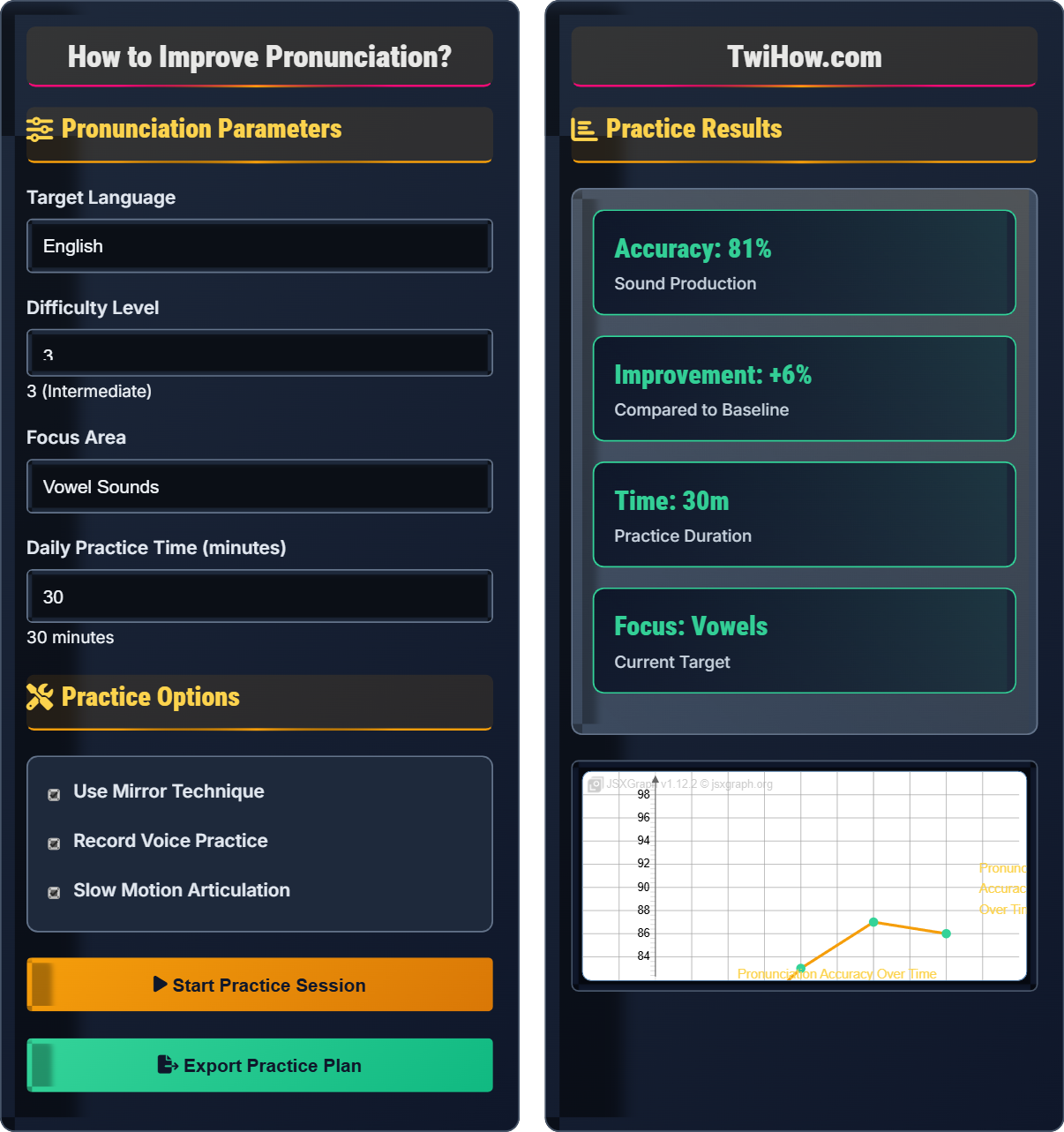
| Day | Accuracy | Focus | Duration |
|---|---|---|---|
| 1 | 65% | Vowels | 20m |
| 2 | 70% | Vowels | 25m |
| 3 | 72% | Vowels | 30m |
| 4 | 75% | Vowels | 30m |
| 5 | 78% | Vowels | 30m |
How Pronunciation Works Explained
Pronunciation is the way words are spoken, involving the correct production of sounds, stress, rhythm, and intonation. It encompasses the physical mechanics of sound production through the coordination of breathing, vocal cord vibration, and articulation using the tongue, lips, teeth, and palate.
Speech sounds are produced through coordinated movements of the vocal apparatus:
Where:
- Breath: Provides airflow for sound production
- Vocal Cords: Vibrate to create voiced sounds
- Articulation: Tongue, lips, teeth shape sounds
Effective pronunciation improvement targets specific areas:
- Individual Sounds: Consonants and vowels that don't exist in your native language
- Word Stress: Correct emphasis on syllables within words
- Sentence Stress: Emphasis patterns in longer phrases
- Rhythm: Timing and flow of speech
- Intonation: Pitch patterns that convey meaning and emotion
- Connected Speech: Linking sounds between words
- Mirror Technique: Watch mouth movements while practicing
- Minimal Pairs: Practice words that differ by one sound
- Shadowing: Repeat along with native speakers
- Slow Motion: Exaggerate movements to build muscle memory
- Recording: Listen to yourself to identify issues
- Visual Feedback: Use spectrograms or pitch visualizers
Pronunciation Fundamentals
Phonemes, articulation, stress patterns, intonation, rhythm, connected speech.
Sound = Breath × Vocal Cord Vibration × Articulation
Where Sound = speech output, Breath = airflow, Vibration = vocal cord action, Articulation = tongue/lip positioning.
- Consistent daily practice is more effective than occasional intensive sessions
- Focus on one sound or pattern at a time
- Get feedback from native speakers or teachers
Articulation Techniques
Front, central, back positions for vowel sounds; various positions for consonants.
- High vowels: Tongue positioned high in mouth
- Low vowels: Tongue positioned low in mouth
- Front vowels: Tongue positioned toward front
- Back vowels: Tongue positioned toward back
- Individual anatomy affects sound production
- Age affects ability to acquire new sounds
- Native language influences pronunciation patterns
- Confidence impacts speaking fluency
Tongue Placement Guide
/iː/ as in "see"
Tongue high and front, lips spread
/uː/ as in "too"
Tongue high and back, lips rounded
/æ/ as in "cat"
Tongue low and front, mouth open
/ɑː/ as in "father"
Tongue low and back, mouth open
Practice Exercises
Stand in front of a mirror while practicing difficult sounds. Observe your lip, tongue, and jaw movements. Compare your mouth position to that of native speakers in videos or audio recordings.
Practice words that differ by one sound, such as "ship" vs "sheep", "bat" vs "pat", or "rock" vs "lock". This helps distinguish between similar sounds.
Listen to a native speaker and repeat immediately after, trying to match their pronunciation, rhythm, and intonation exactly. This builds muscle memory for correct sound production.
Pronunciation Learning Quiz
Which part of the mouth is primarily responsible for producing the English "th" sound (/θ/ and /ð/)?
The English "th" sounds (/θ/ as in "think" and /ð/ as in "this") are produced by placing the tongue tip against or between the upper teeth and allowing air to pass through. This creates the characteristic friction sound. The tongue tip and teeth work together to create this unique sound that doesn't exist in many other languages.
The answer is B) Tongue tip and teeth.
Understanding articulation points is crucial for pronunciation improvement. Each sound has a specific place and manner of production. The "th" sounds are dental fricatives, meaning they're produced at the teeth (dental) with friction of air (fricative). This knowledge helps learners understand exactly what movements are needed to produce accurate sounds.
Articulation Point: Location in the mouth where sounds are produced
Dental Sound: Sound produced using teeth as point of contact
Fricative: Sound produced with friction of air through a narrow opening
• Tongue position is critical for accurate sounds
• Airflow control affects sound quality
• Mouth shape influences sound production
• Practice tongue position slowly before speeding up
• Use mirror to observe mouth movements
• Feel air movement to verify correct production
• Substituting "t" or "d" for "th" sounds
• Not placing tongue tip between teeth
• Incorrect air pressure
Explain the difference between word stress and sentence stress in English. Why are both important for effective communication?
Word Stress: The emphasis placed on specific syllables within individual words. In multi-syllabic words, one syllable is typically pronounced louder, longer, and higher in pitch. For example, "PHO-to-graph" (primary stress on first syllable).
Sentence Stress: The emphasis placed on content words (nouns, verbs, adjectives, adverbs) in sentences, while function words (articles, prepositions, pronouns) are often reduced. For example, "I WENT to the STORE to BUY some BOOKS."
Both are crucial because incorrect stress patterns can change meaning, cause confusion, or make speech difficult to understand. English is a stress-timed language, so stress patterns are integral to rhythm and comprehension.
Stress patterns are fundamental to English rhythm and meaning. Word stress helps distinguish between different words ("CONtract" vs "conTRACT") and parts of speech. Sentence stress helps listeners identify important information and follow the flow of conversation. Mastering stress patterns significantly improves comprehensibility and naturalness of speech.
Word Stress: Emphasis on syllables within words
Sentence Stress: Emphasis on important words in sentences
Stress-Timed: Language where stressed syllables occur at regular intervals
• English is stress-timed, not syllable-timed
• Content words receive sentence stress
• Word stress often distinguishes meaning
• Practice with schwa reductions in unstressed syllables
• Mark stress patterns when learning new vocabulary
• Listen to native speakers for stress patterns
• Applying native language stress patterns to English
• Not reducing unstressed syllables
• Misplacing word stress in multi-syllabic words
A Mandarin speaker learning English struggles with the distinction between /r/ and /l/ sounds, often pronouncing "rice" as "lice" and "light" as "right". Describe the articulation differences between these sounds and suggest a practice routine to address this challenge.
Articulation Differences: The /r/ sound is a retroflex approximant where the tongue tip curls back toward the roof of the mouth without touching it. The /l/ sound is a lateral approximant where the tongue tip touches the alveolar ridge while air flows around the sides of the tongue.
Practice Routine:
1. Isolation Practice: Produce /r/ and /l/ sounds separately in front of a mirror
2. Minimal Pairs: Practice "rice/lice", "right/light", "red/led" repeatedly
3. Slow Motion: Exaggerate tongue movements to build muscle memory
4. Shadowing: Listen to native speakers and repeat with correct sounds
5. Recording: Record yourself and compare to native pronunciation
This challenge is common among speakers whose native languages don't distinguish between /r/ and /l/ sounds. The key is developing awareness of the articulatory differences and building new motor patterns through systematic practice. Visual feedback and tactile awareness (feeling tongue position) are particularly helpful for this type of sound distinction.
Retroflex: Tongue tip curled back toward roof of mouth
Lateral: Air flows around the sides of the tongue
Alveolar Ridge: Bony ridge behind upper teeth
• Articulatory awareness precedes production
• Consistent practice builds muscle memory
• Feedback accelerates improvement
• Use tactile feedback by placing finger under chin
• Practice with exaggerated mouth movements initially
• Focus on one sound pair at a time
• Trying to learn too many sounds simultaneously
• Not getting adequate feedback
• Inconsistent practice schedule
Explain how rising and falling intonation patterns affect meaning in English questions. Provide examples showing how the same question can have different meanings depending on intonation.
Rising Intonation: Used in yes/no questions, indicating expectation of a response. Example: "Are you coming?" (rising at the end)
Falling Intonation: Used in wh-questions and statements, showing completion. Example: "Where are you going?" (falling at the end)
Contrast Example: "You're leaving?" (rising - seeking confirmation) vs "You're leaving." (falling - statement of fact)
Impact on Meaning: Rising intonation suggests uncertainty, inquiry, or continuation of conversation. Falling intonation indicates certainty, completion, or finality.
Intonation is crucial for conveying attitude, emotion, and grammatical function in English. Rising and falling patterns not only indicate question types but also express politeness, sarcasm, surprise, or certainty. Mastering intonation patterns significantly improves communicative effectiveness and naturalness of speech.
Intonation: Pitch variation patterns in speech
Rising Tone: Pitch increases at the end of utterance
Falling Tone: Pitch decreases at the end of utterance
• Yes/No questions typically rise
• Wh-questions typically fall
• Intonation conveys emotional subtext
• Listen to native speakers for intonation patterns
• Practice with exaggerated pitch changes
• Record and analyze your own intonation
• Applying native language intonation patterns
• Flat intonation lacking variation
• Misinterpreting others' intonation cues
Which of the following best describes the phenomenon of linking sounds between words in natural English speech?
Liaison is the term that describes the linking of sounds between words in connected speech. This includes phenomena like linking "r" sounds between words (e.g., "car alarm" sounding like "caralarm"), consonant-vowel linking, and other transitional sounds that make speech flow naturally. This is different from elision (omitting sounds), assimilation (sounds becoming more similar), or epenthesis (adding sounds).
The answer is B) Liaison.
Connected speech processes are essential for natural-sounding pronunciation. Learners often focus on individual word pronunciation but struggle with how sounds connect and change in natural speech flow. Understanding liaison helps bridge the gap between careful, isolated pronunciation and fluent, connected speech that native speakers use in everyday conversation.
Liaison: Linking sounds between words in connected speech
Elision: Omission of sounds in connected speech
Assimilation: Sounds becoming more similar to adjacent sounds
• Natural speech differs from dictionary pronunciation
• Connected speech rules vary by dialect
• Fluency requires mastering these patterns
• Listen to connected speech patterns in media
• Practice linking words together smoothly
• Notice how spelling differs from pronunciation
• Speaking each word in isolation
• Not adapting to natural speech patterns
• Over-articulating in casual conversation
FAQ
Q: How long does it take to significantly improve pronunciation?
A: Pronunciation improvement varies greatly depending on factors like age, native language, starting level, and practice consistency. Generally:
• Initial improvements: 2-4 weeks with daily practice
• Noticeable changes: 1-3 months of focused work
• Significant improvement: 6-12 months of consistent practice
• Native-like pronunciation: Years for adults, much faster for children
The key is consistent daily practice focusing on specific sounds rather than hoping for gradual improvement over time. Adults may find it harder to achieve perfect pronunciation of sounds that don't exist in their native language.
Q: What's the difference between accent modification and pronunciation improvement?
A: These terms represent different approaches to speech modification:
Pronunciation Improvement: Focuses on making speech more comprehensible and accurate. The goal is clear communication, not necessarily eliminating all traces of native accent. This approach emphasizes intelligibility over accent elimination.
Accent Modification: Specifically aims to reduce or eliminate foreign accent markers. This involves changing established speech patterns to more closely match native-like pronunciation.
Modern language teaching tends to favor pronunciation improvement for clarity over accent elimination, as accents don't necessarily impede communication and are part of linguistic identity.