How to Learn a Language Quickly?
Complete language learning guide • Step-by-step explanations
Language Learning Fundamentals:
Show Language Learning ToolsLearning a new language quickly requires strategic approaches that leverage scientific research on language acquisition. Modern language learning combines immersive techniques, spaced repetition, active practice, and targeted vocabulary building. The key is to maximize input while maintaining high engagement and retention rates.
Key language learning techniques:
- Immersion: Surrounding yourself with the target language
- Spaced Repetition: Reviewing vocabulary at optimal intervals
- Active Speaking: Practicing pronunciation and conversation
- Frequency-Based Learning: Focusing on most common words first
- Shadowing: Mimicking native speakers' pronunciation
Modern approaches combine cognitive science with practical techniques to create personalized systems that accelerate language acquisition.
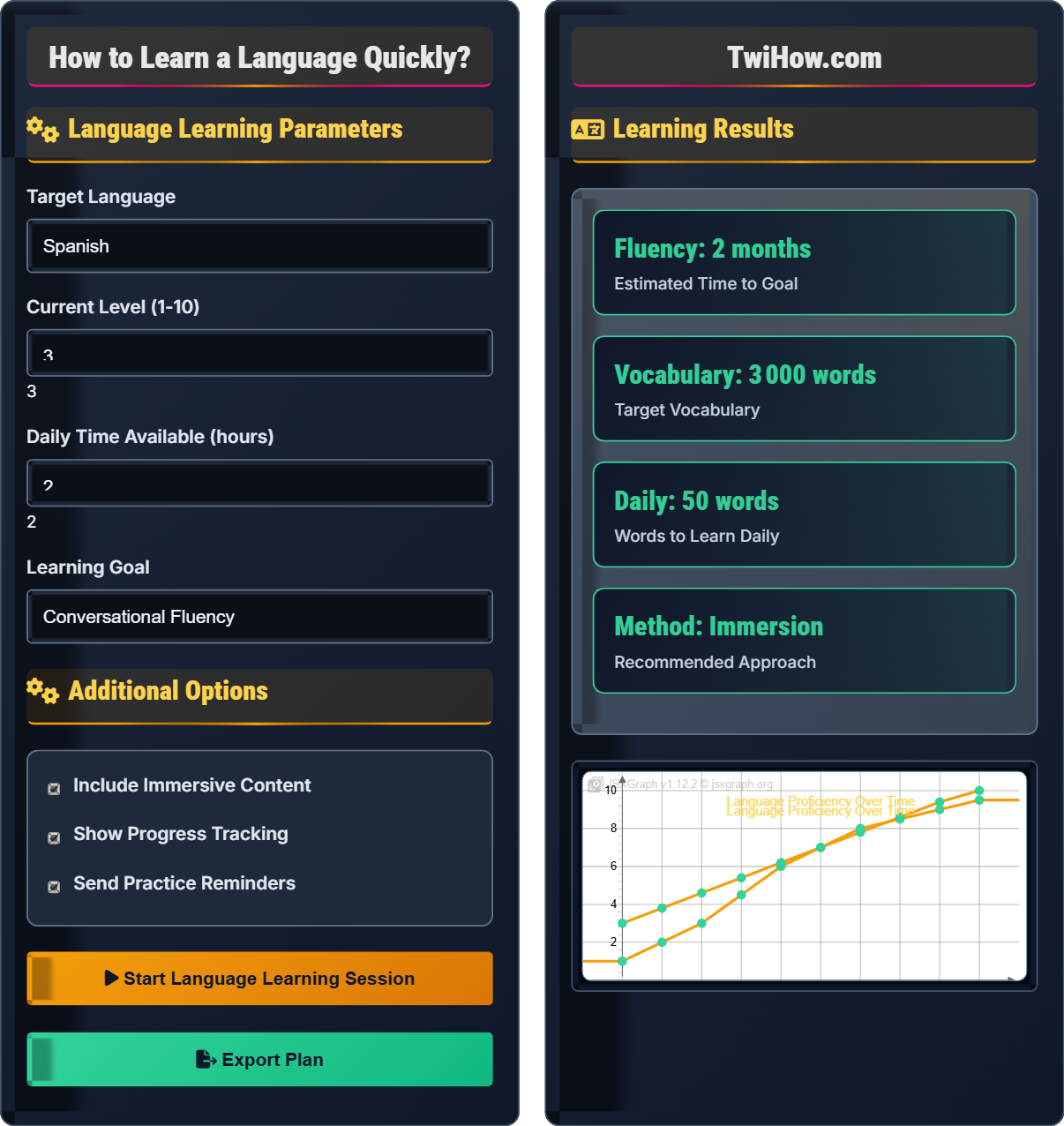
Language Learning Parameters
Additional Options
Learning Results
| Week | Focus Area | Goal | Progress |
|---|---|---|---|
| 1 | Basics | 50 words | 25% |
| 2 | Greetings | 100 words | 50% |
| 3 | Essentials | 200 words | 75% |
| 4 | Conversations | 300 words | 90% |
| 5 | Fluency | 500 words | 95% |
How to Learn a Language Quickly Explained
Language learning is a complex cognitive process that involves multiple brain systems. The most effective approaches combine input (listening/reading) with output (speaking/writing) while maintaining high engagement and frequency of exposure. Research shows that immersion and active practice significantly accelerate the learning process compared to traditional classroom methods.
Modern language learning emphasizes the importance of communicative competence over grammatical accuracy, allowing learners to communicate effectively even with imperfect grammar.
Successful language learning follows the principle of optimized exposure and practice:
Where:
- Input Frequency: Amount of exposure to the target language
- Active Practice: Speaking, writing, and producing language
- Forgetting Factor: Natural decay of memory over time
- Contextual Relevance: Meaningful and practical language use
Proven techniques for accelerating language learning:
- Spaced Repetition: Reviewing vocabulary at increasing intervals
- Shadowing: Mimicking native speakers' pronunciation
- Frequency-Based Learning: Focusing on most common words first
- Immersion: Surrounding yourself with the target language
- Active Speaking: Practicing pronunciation and conversation
- Contextual Learning: Learning words in real-life situations
- Cognitive Enhancement: Improved memory and multitasking abilities
- Career Advancement: Increased job opportunities and pay
- Cultural Connection: Deeper understanding of other cultures
- Travel Experience: Enhanced travel and communication
- Brain Health: Delayed onset of dementia
- Personal Growth: Increased confidence and perspective
Language Learning Fundamentals
Input, output, immersion, frequency-based learning, spaced repetition, shadowing, contextual learning.
Focus on the 20% of vocabulary that covers 80% of daily conversations. Typically, 1,000-3,000 words cover 85-95% of everyday language use.
This approach allows you to communicate effectively in the shortest time possible by prioritizing the most frequently used words and phrases.
- Focus on communication over perfection
- Immerse yourself daily
- Practice speaking from day one
Practical Applications
Business communication, travel, academic study, cultural exchange, entertainment, professional development.
- Goal assessment and timeline
- Resource selection and combination
- Practice schedule and consistency
- Progress tracking and adjustment
- Start with essential vocabulary
- Engage with native content
- Find conversation partners
- Track your progress
Language Learning Quiz
According to research on language acquisition, which approach is most effective for achieving conversational fluency quickly?
Research consistently shows that communicative approaches emphasizing active speaking and real conversation are most effective for achieving conversational fluency. While grammar and vocabulary are important, communicative competence develops fastest through actual communication practice. The interaction hypothesis suggests that negotiation of meaning during conversation accelerates acquisition.
The answer is B) Communicative approach with active speaking practice.
Language learning research indicates that comprehensible input combined with output practice is crucial for acquisition. The communicative approach emphasizes meaning over form, allowing learners to focus on message delivery rather than grammatical accuracy. This creates more natural learning conditions similar to how children acquire their first language.
Communicative Competence: Ability to communicate effectively in context
Comprehensible Input: Language slightly above current level
Interaction Hypothesis: Negotiation of meaning facilitates learning
• Focus on communication over accuracy
• Engage in meaningful conversations
• Accept imperfection in early stages
• Start speaking from day one
• Find conversation partners online
• Use language exchange apps
• Waiting until "ready" to speak
• Focusing only on grammar
• Not engaging with native speakers
Explain the spaced repetition technique and why it's particularly effective for language learning. Include the psychological mechanisms behind its effectiveness and describe how to implement it for vocabulary acquisition.
Spaced Repetition: Reviewing vocabulary at increasing intervals (e.g., 1 day, 3 days, 1 week, 2 weeks, 1 month) just as you're about to forget it.
Psychological Mechanisms: This technique exploits the "spacing effect" - memories are strengthened when retrieval is difficult. Each time you retrieve a word after a gap, the memory becomes more durable. The "desirable difficulty" of spaced retrieval strengthens neural pathways more than easy retrieval.
Implementation: For vocabulary, use tools like Anki or Memrise that automatically schedule reviews. Focus on words you're about to forget. Review new words after 1 day, then 3 days, then 1 week, then 2 weeks, then monthly.
Spaced repetition is particularly effective for language learning because vocabulary consists of discrete items that need to be retrieved quickly. The technique combats the forgetting curve by timing reviews just before you would naturally forget, maximizing the strengthening effect. This is especially important for language learners who need to rapidly expand their vocabulary to reach communicative competence.
Spaced Repetition: Reviewing material at increasing intervals
Spacing Effect: Superior retention with distributed practice
Forgetting Curve: Rate at which memories fade over time
• Review just before you'd forget
• Focus on difficult items
• Maintain consistent schedule
• Use spaced repetition apps
• Create meaningful associations
• Practice in context
• Reviewing too frequently
• Not adjusting for difficulty
• Stopping after initial mastery
María needs to learn Spanish for her job relocation to Mexico in 6 months. She currently speaks English and French but has never studied Spanish. She can dedicate 1.5 hours daily and wants to reach conversational fluency. Design a comprehensive language learning plan for María that incorporates multiple evidence-based techniques. Include specific milestones, recommended tools, and strategies for maintaining motivation. Explain how each component of your plan addresses the challenges of learning a new language with limited time.
Plan Structure: 6-month plan with daily 1.5-hour sessions using spaced repetition and active practice. Month 1-2: Foundation (basic vocabulary and pronunciation). Months 3-4: Intermediate (conversations and grammar). Months 5-6: Advanced (idioms and cultural nuances).
Techniques: Use Anki for spaced repetition, practice with native speakers via HelloTalk, and consume Spanish media (news, podcasts, TV shows).
Motivation: Set weekly goals, track progress visually, connect with Mexican culture, and practice with real communication needs.
Addressing Challenges: Leverage existing language learning skills from French, use cognates with English, and maintain consistent daily practice to build momentum.
María's plan leverages her existing linguistic knowledge (English/French) which will accelerate Spanish learning through transfer of skills and knowledge. The 6-month timeline requires intensive daily practice but is achievable with the right methods. The combination of systematic vocabulary building (spaced repetition) with communicative practice (conversations) addresses both lexical and pragmatic aspects of fluency.
Transfer: Application of knowledge from one language to another
Cognates: Words with similar spelling and meaning across languages
Pragmatic Fluency: Cultural and contextual language use
• Maintain daily consistency
• Focus on high-frequency vocabulary
• Practice speaking from early stages
• Use Spanish subtitles initially
• Think in Spanish daily
• Connect with native speakers regularly
• Over-focusing on grammar
• Not practicing speaking enough
• Expecting perfection too quickly
David is learning Mandarin Chinese but struggles with tones and pronunciation. He can understand the language reasonably well but feels embarrassed to speak because of his accent. Design a pronunciation-focused learning strategy that helps David improve his speaking skills and build confidence. Include specific techniques for tone mastery and explain how each addresses his particular challenges.
Strategy Components: Shadowing technique, tone drills, recording practice, and pronunciation apps. Focus on tone pairs and minimal pairs.
Implementation: Use apps like Speechling or Forvo for tone practice. Record yourself daily and compare to native speakers. Practice tone pairs (mā/má/mǎ/mà) in isolation and in context.
Building Confidence: Start with simple sentences, find patient conversation partners, and accept that accent is normal in language learning.
Addressing Challenges: Shadowing improves intonation, tone drills build muscle memory, and recording practice allows self-assessment and correction.
Pronunciation in tonal languages like Mandarin requires developing new phonetic categories and motor patterns. The key is intensive practice with immediate feedback. Shadowing helps develop prosodic features (tone, rhythm, stress) while tone drills build accuracy. Accepting that accents are normal and focusing on intelligibility over perfection helps maintain motivation.
Shadowing: Mimicking native speakers' pronunciation
Tonal Language: Language where pitch changes word meaning
Prosody: Rhythm, stress, and intonation patterns
• Focus on tones from the beginning
• Practice with immediate feedback
• Embrace making mistakes
• Sing along to Chinese songs
• Practice with tongue twisters
• Use visual tone markers
• Ignoring tones initially
• Not practicing enough
• Being overly self-conscious
Which of the following language pairings would likely result in the fastest learning progression for an English speaker?
English and German share significant similarities in vocabulary (due to shared Germanic roots), grammar structures, and sentence patterns. This linguistic proximity means English speakers can leverage existing knowledge, recognize cognates, and understand grammatical concepts more easily. Research shows that language similarity significantly impacts learning speed, with closer languages requiring less time to achieve proficiency.
The answer is B) English and German.
Linguistic distance affects learning difficulty and time. Languages within the same family (Germanic, Romance, Slavic) share vocabulary, grammar, and syntax patterns that facilitate learning. English and German share about 60% lexical similarity, making German one of the easier languages for English speakers to learn compared to languages from different families.
Linguistic Distance: Degree of difference between languages
Cognates: Words with similar spelling and meaning
Language Family: Group of related languages
• Leverage language similarities
• Expect greater difficulty with distant languages
• Adjust expectations accordingly
• Identify shared vocabulary
• Compare grammar patterns
• Use your native language as a reference
• Underestimating difficulty of distant languages
• Not leveraging language similarities
• Comparing learning speeds unfairly
FAQ
Q: I'm worried about making mistakes when speaking. Should I wait until I feel more confident?
A: Making mistakes is not only normal but essential for language learning! Research shows that fear of making errors actually hinders acquisition. Native speakers expect and appreciate effort from language learners. The sooner you start speaking, the faster you'll learn. Every mistake is an opportunity to receive corrective feedback and refine your understanding. Start with simple phrases and gradually build complexity.
Q: How many words do I need to know to be conversational in a new language?
A: Research indicates that 1,000-3,000 words cover 85-95% of daily conversation. The most common 1,000 words in any language allow for basic communication, while 3,000 words enable comfortable conversation on most topics. Focus on high-frequency words first (pronouns, verbs, question words) as they provide the biggest return on investment. Quality of practice matters more than quantity of vocabulary.
Q: Can I learn a language effectively through apps alone, or do I need additional resources?
A: Apps are excellent for vocabulary building and basic grammar but insufficient for comprehensive fluency. They excel at spaced repetition and gamified learning but lack contextual communication practice. Effective learning requires input from native speakers, cultural context, and real conversation. Use apps as a foundation but supplement with media consumption, conversation practice, and cultural immersion for complete proficiency.