Adapting Learning Styles to Different Content Types
Complete guide • Flexible learning
Learning style adaptation involves adjusting your approach to learning based on the type of content you're encountering. Rather than rigidly adhering to a single learning style, successful learners flexibly adapt their methods to match the demands of different content types. This approach maximizes learning effectiveness and retention across diverse subjects and formats.
Key learning styles:
- Visual: Learning through seeing and visualizing information
- Auditory: Learning through hearing and sound
- Reading/Writing: Learning through text-based materials
- Kinesthetic: Learning through hands-on experience
- Multimodal: Combining multiple learning styles
Research shows that adapting learning styles to content type can improve comprehension by up to 40% compared to using a fixed approach.
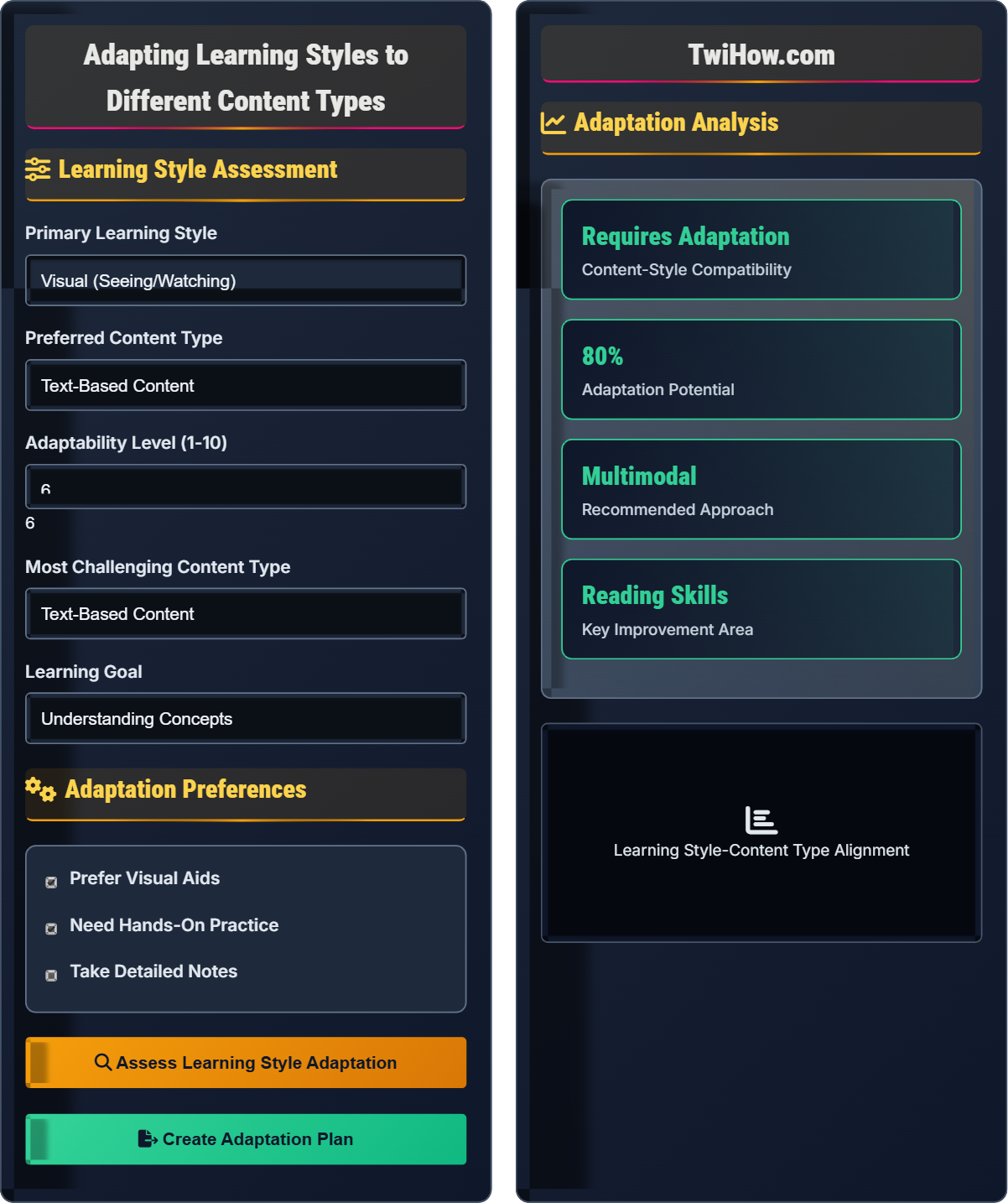
Learning Style Assessment
Adaptation Preferences
Adaptation Analysis
Learning Style-Content Type Alignment
| Content Type | Recommended Style | Technique | Effectiveness |
|---|---|---|---|
| Text-Based | Reading/Writing | Active note-taking | High |
| Video | Visual + Auditory | Visual note-taking | Medium-High |
| Audio | Auditory + Kinesthetic | Verbal repetition | Medium |
| Hands-On | Kinesthetic | Practice and repetition | High |
Adaptation Strategies
Visual to Text: Create diagrams and mind maps from text
Auditory to Video: Narrate visual elements aloud
Reading to Audio: Summarize audio content in writing
Kinesthetic to Theory: Create physical models of concepts
Learning Style Adaptation Guide
Based on the VARK model (Visual, Auditory, Reading/Writing, Kinesthetic), learning styles reflect how individuals prefer to receive and process information. However, effective learning requires adapting these preferences to match content demands.
Content-Style matching principles:
- Visual Content: Use visual learning techniques (diagrams, charts, colors)
- Auditory Content: Employ listening strategies (note-taking, summarizing)
- Text Content: Apply reading/writing methods (annotations, outlines)
- Interactive Content: Engage kinesthetically (practice, manipulation)
The relationship between learning style and content adaptation:
Where:
- Style Flexibility: Ability to switch between learning approaches
- Content Match: Alignment between content type and learning method
- Strategy Application: Effective use of learning techniques
Optimal pairings for different content types:
- Textbooks/Articles: Reading/Writing (annotate, summarize, outline)
- Videos/Presentations: Visual + Auditory (visual notes, audio summaries)
- Lectures/Discussions: Auditory + Kinesthetic (note-taking, gesturing)
- Simulations/Experiments: Kinesthetic + Visual (hands-on practice)
- Diagrams/Charts: Visual + Reading (labeling, description)
- Problem Sets: Multimodal (read, visualize, solve, verify)
Advantages of flexible learning style adaptation:
- Improved Comprehension: Better understanding across different content types
- Enhanced Retention: Stronger memory formation through varied approaches
- Increased Flexibility: Ability to learn in any environment
- Reduced Learning Fatigue: Prevents monotony through variety
- Better Performance: Optimal learning outcomes in all contexts
- Transfer Skills: Ability to apply learning to new situations
Learning Style Strategies
Visual aids, active note-taking, hands-on practice, multimodal approaches, spaced repetition.
Content analysis, style assessment, strategy selection, practice implementation, reflection.
- Match approach to content demands
- Remain flexible and adaptive
- Combine multiple strategies
- Practice different approaches regularly
Content-Style Mapping
Text-based, visual, auditory, interactive, hands-on, theoretical, practical.
- Identify content characteristics
- Assess personal learning preferences
- Identify potential mismatches
- Select appropriate adaptation strategies
- Implement and practice strategies
- Reflect and refine approach
- Self-awareness of learning preferences
- Willingness to experiment with new approaches
- Regular practice of different techniques
- Monitoring and adjustment of strategies
Learning Style Adaptation Quiz
Which learning style combination is most effective for learning complex mathematical concepts presented through video lectures?
For mathematical concepts presented in video format, the most effective approach combines visual and auditory learning. The visual component captures diagrams, equations, and spatial relationships, while the auditory component processes the instructor's explanations and reasoning. This multimodal approach addresses both the visual nature of mathematical notation and the sequential nature of problem-solving.
The answer is B) Visual + Auditory.
Mathematics is inherently visual (equations, graphs, geometric relationships) but also sequential (step-by-step reasoning). Video lectures combine both modalities, so learners need to engage both visual and auditory processing systems to maximize comprehension. This demonstrates the importance of matching learning approach to content characteristics.
Multimodal Learning: Using multiple sensory channels simultaneously
Sequential Processing: Following ordered steps in logical sequence
Spatial Relationships: Geometric and positional connections
• Match learning approach to content type
• Use multiple modalities for complex content
• Engage appropriate senses for the material
• Take visual notes during video lectures
• Pause and work through problems yourself
• Verbalize your thought process
• Using only one learning modality
• Passive consumption without active processing
Explain why learning style flexibility is more important than having a single dominant learning style, and provide specific examples of when flexibility is beneficial.
Importance of Flexibility: Learning style flexibility is more valuable than a single dominant style because:
• Educational and professional environments present diverse content types
• Different subjects require different approaches for optimal learning
• Rigid adherence to one style limits learning opportunities
• Flexibility prevents learning bottlenecks when preferred style isn't available
Examples of Beneficial Flexibility:
• A visual learner attending an auditory-only lecture (taking notes, visualizing concepts)
• A kinesthetic learner studying theoretical concepts (creating models, role-playing)
• A reading learner participating in hands-on workshops (documenting processes, writing reflections)
• An auditory learner reading dense technical documents (reading aloud, discussing with others)
Flexibility allows learners to extract maximum value from any learning situation regardless of format.
Learning style flexibility represents metacognitive awareness - the ability to adapt learning strategies based on context. This executive function of learning allows individuals to optimize their approach to different situations rather than being constrained by a single method. Research shows that flexible learners outperform rigid learners in diverse educational environments.
Learning Style Flexibility: Ability to adapt learning approach to content demands
Metacognitive Awareness: Knowledge of one's own learning processes
Learning Bottleneck: Situation where learning is hindered by style mismatch
• Adapt to content, not vice versa
• Practice different approaches regularly
• Remain open to new techniques
• Experiment with different learning modalities
• Practice learning in suboptimal conditions
• Develop backup strategies for different content types
• Refusing to learn in non-preferred styles
• Not practicing alternative approaches
• Assuming one style fits all situations
You're primarily a visual learner, but you're enrolled in a music appreciation course that relies heavily on audio content. The instructor plays recordings without visual aids, and the textbook contains mostly text. How would you adapt your learning approach to succeed in this course?
Adaptation Strategy: Transform the auditory content into visual formats:
During Audio Sessions: Create visual representations of what you hear - mood maps, timeline charts, structural diagrams, or color-coded emotional responses to different musical sections.
Note-Taking: Develop a visual note system using symbols, diagrams, and spatial organization rather than just text. Create charts comparing different composers, instruments, or musical periods.
Supplementary Materials: Find visual resources like sheet music, concert videos, or infographics about musical concepts to support the audio content.
Active Engagement: Draw while listening to help maintain focus and create visual associations with the audio content.
Text Transformation: Convert textual information into visual formats like mind maps, flowcharts, and concept diagrams.
Practice: Create your own visual aids for musical concepts and share them with classmates.
This approach leverages your visual strengths while engaging with the required audio content.
This scenario demonstrates the power of transformation strategies - converting content from one modality to another that matches your preferences. Rather than fighting the course format, you're creating bridges between the required content and your preferred learning approach. This maintains engagement while ensuring comprehension.
Transformation Strategy: Converting content from one format to another
Visual Representation: Creating images or diagrams to represent concepts
Bridge Building: Creating connections between content and learning style
• Transform content to match your strengths
• Maintain engagement with required format
• Create visual anchors for auditory content
• Use drawing to maintain focus during audio
• Create visual timelines of musical pieces
• Find video performances to accompany audio
• Avoiding the course due to style mismatch
• Passive listening without active engagement
• Not seeking supplementary visual resources
You're a kinesthetic learner attending a theoretical training workshop on organizational behavior. The content is highly conceptual with minimal hands-on activities. How would you adapt your learning approach to maximize retention and understanding of the theoretical concepts?
Physical Engagement: Use fidget tools, take notes by hand, and use gestures to represent concepts. Create physical models or role-play scenarios based on the theories discussed.
Active Participation: Ask questions, volunteer for discussions, and physically move around during breaks to maintain engagement.
Conceptual Physicalization: Create tangible metaphors - build towers with objects to represent organizational hierarchies, use string to show reporting relationships, or act out workplace scenarios.
Application Exercises: Develop case studies or hypothetical situations where you can apply the theories. Practice explaining concepts to imaginary colleagues or write scenario-based examples.
Memory Techniques: Use physical memory palaces or associate concepts with physical locations and movements.
Post-Session Practice: Immediately apply concepts by analyzing your workplace or creating action plans that implement the theories.
These strategies convert abstract concepts into concrete, manipulable elements that engage your kinesthetic learning preferences.
This scenario highlights the importance of creating hands-on experiences from theoretical content. Kinesthetic learners need to manipulate information physically to process it effectively. By creating tangible representations of abstract concepts, you're able to engage your natural learning strengths while mastering theoretical material.
Kinesthetic Learning: Learning through physical activity and touch
Physicalization: Converting abstract concepts into physical forms
Tangible Metaphors: Physical representations of abstract ideas
• Create physical interactions with abstract content
• Use movement to maintain engagement
• Apply concepts through practical exercises
• Use sticky notes to create visual-physical representations
• Walk around while reviewing notes
• Create physical models of organizational structures
• Remaining passive during theoretical sessions
• Not creating hands-on experiences
• Assuming theory can't be practiced
When encountering text-heavy content as an auditory learner, which adaptation strategy is most effective?
For an auditory learner encountering text-heavy content, the most effective strategy is to convert the visual text into auditory format. Reading aloud or using text-to-speech transforms the written words into the auditory input that matches the learner's preferences. This maintains the content integrity while engaging the preferred learning channel.
The answer is B) Read aloud or listen to text-to-speech.
This strategy represents content transformation - changing the modality of information delivery to match learning preferences. Rather than trying to force a visual approach on an auditory learner, the content is converted to the preferred format. This maintains engagement and comprehension while respecting the learner's natural processing tendencies.
Content Transformation: Changing modality of information delivery
Auditory Processing: Receiving information through hearing
Modality Conversion: Changing format to match preferences
• Transform content to preferred modality
• Maintain content integrity during conversion
• Engage preferred sensory channel
• Use text-to-speech tools for lengthy texts
• Read important passages aloud
• Discuss text content with others
• Forcing visual processing for auditory learner
• Not utilizing available technology
• Avoiding text-heavy content entirely
FAQ
Q: I've always learned best through one style. Is it really necessary to adapt to others?
A: While you may have a dominant learning style, adapting to different approaches is crucial because:
• Educational and professional environments don't always match your preferences
• Different content types require different processing approaches
• Using multiple modalities strengthens memory and understanding
• Flexibility prevents learning bottlenecks
• It's not about abandoning your preferred style, but expanding your toolkit
Think of it as being multilingual in learning - you can still favor one language but speak others when needed.
Q: How can I help my students develop learning style flexibility?
A: Encourage flexibility by:
1. Explicit Teaching: Explain the benefits of multimodal learning
2. Variety: Present content in multiple formats
3. Strategy Instruction: Teach specific adaptation techniques
4. Reflection: Have students evaluate what works in different situations
5. Practice: Provide opportunities to use different approaches
6. Modeling: Demonstrate how you adapt your learning
Focus on building students' metacognitive awareness of their own learning processes.