How to Avoid Information Overload While Learning
Complete guide • Focus strategies
Information overload occurs when the amount of information we encounter exceeds our cognitive processing capacity, leading to decreased comprehension, poor decision-making, and mental fatigue. In today's digital age, learners are constantly bombarded with information, making it essential to develop strategies to manage cognitive load effectively.
Key factors contributing to information overload:
- Volume: Too much information at once
- Velocity: Information arriving too quickly
- Variety: Multiple formats and sources
- Veracity: Uncertainty about information quality
Research shows that the average person processes approximately 74 gigabytes of information daily, which can overwhelm our working memory capacity and impede effective learning.
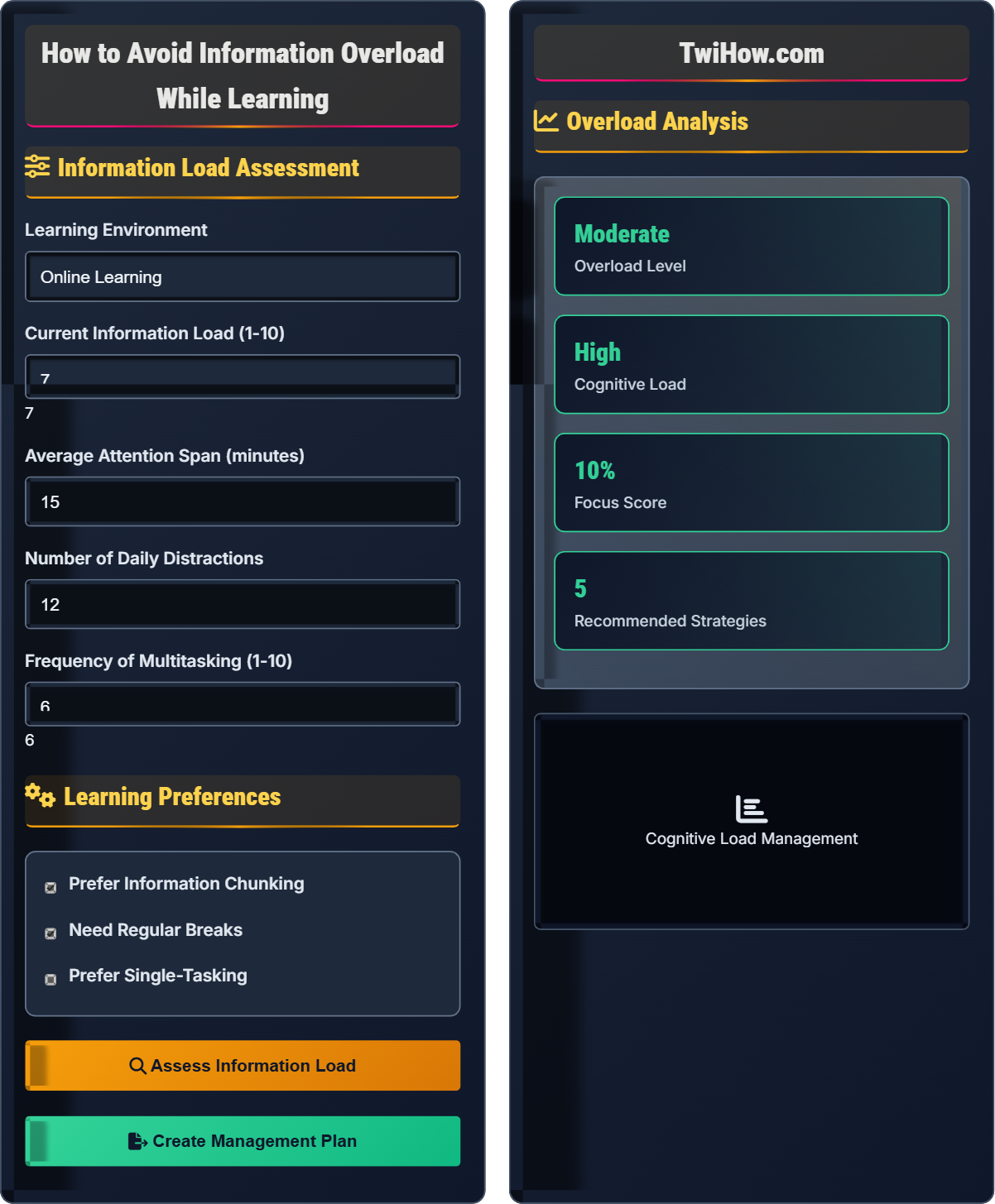
Information Load Assessment
Learning Preferences
Overload Analysis
Cognitive Load Management
| Factor | Score | Impact | Recommendation |
|---|---|---|---|
| Information Volume | High | High | Reduce information intake |
| Attention Span | Short | Medium | Implement focused breaks |
| Multitasking | High | High | Focus on single-tasking |
| Distractions | High | High | Minimize environmental distractions |
Recommended Strategies
1. Information Chunking: Break content into smaller segments
2. Focused Sessions: 25-minute concentrated learning periods
3. Distraction Elimination: Create focused learning environment
4. Single-Tasking: Focus on one task at a time
5. Regular Breaks: Implement Pomodoro technique
Information Overload Management Guide
Cognitive Load Theory explains how our working memory has limited capacity for processing information. When information exceeds this capacity, learning becomes inefficient. There are three types of cognitive load:
- Intrinsic Load: Complexity inherent to the material
- Extraneous Load: Irrelevant information that hinders learning
- Germane Load: Effort devoted to schema construction
The relationship between information processing and cognitive load:
Where:
- Available Cognitive Resources: Mental capacity for processing
- Information Load: Amount of information to process
Proven methods to manage information overload:
- Chunking: Breaking information into smaller, manageable units
- Spaced Repetition: Distributing learning over time
- Elaborative Interrogation: Asking "why" questions
- Concrete Examples: Using specific instances to illustrate concepts
- Dual Coding: Combining verbal and visual information
- Self-Testing: Retrieving information from memory
Signs of effective information management:
- Improved Comprehension: Better understanding of material
- Enhanced Retention: Longer-lasting memory formation
- Increased Focus: Better concentration during learning
- Reduced Stress: Less anxiety about information intake
- Efficient Processing: Faster information absorption
- Better Decision Making: Improved judgment with information
Information Management Strategies
Information chunking, spaced repetition, focused attention, distraction elimination, single-tasking.
Time blocking, environment optimization, digital tools, note-taking systems, regular breaks.
- Limit information sources
- Focus on one task at a time
- Take regular breaks
- Organize information systematically
Cognitive Load Reduction
Eliminate distractions, simplify complex information, use visual aids, provide worked examples.
- Remove unnecessary elements
- Organize information hierarchically
- Use multiple modalities
- Provide scaffolding
- Encourage elaboration
- Facilitate knowledge integration
- Consistent practice and application
- Gradual implementation of techniques
- Regular assessment of effectiveness
- Adjustment based on individual needs
Information Overload Quiz
According to Cognitive Load Theory, which type of load is directly related to the complexity of the material being learned?
Intrinsic cognitive load refers to the inherent difficulty of the material being learned. This type of load is determined by the complexity of the information and the learner's prior knowledge. It cannot be eliminated but can be managed through instructional design that takes into account the learner's cognitive capacity.
The answer is B) Intrinsic Load.
Understanding the different types of cognitive load is crucial for managing information overload. Intrinsic load is the unavoidable complexity of the subject matter itself. While we cannot reduce this load, we can help learners manage it by breaking complex information into smaller chunks and providing appropriate support structures.
Cognitive Load: Mental effort required to process information
Intrinsic Load: Complexity inherent to the learning material
Working Memory: Cognitive system for temporary information storage
• Distinguish between different types of cognitive load
• Manage rather than eliminate intrinsic load
• Reduce extraneous load when possible
• Break complex topics into smaller chunks
• Build on existing knowledge gradually
• Use visual aids to reduce cognitive load
• Confusing intrinsic with extraneous load
• Not considering prior knowledge levels
Explain the concept of information chunking and why it's effective for managing cognitive load during learning.
Information Chunking: The process of grouping individual pieces of information into larger, more meaningful units. This technique helps manage cognitive load by reducing the number of items that need to be held in working memory.
Effectiveness: Working memory can typically hold only 7±2 items at once. By chunking information, we can hold more complex information within this limited capacity. For example, instead of remembering 12 individual digits (012345678901), we chunk them into a phone number format (012-345-678901), making it easier to process.
Applications: Phone numbers, Social Security numbers, credit card numbers, and complex concepts broken into smaller, related components all utilize chunking principles.
Benefits: Reduces cognitive load, improves comprehension, enhances retention, and makes complex information more manageable.
Chunking works because it creates meaningful connections between pieces of information, making them easier to retrieve from memory. The brain naturally organizes information into schemas, and chunking leverages this natural process to improve learning efficiency. It's particularly effective when chunks are created based on logical relationships or patterns.
Information Chunking: Grouping related information into larger units
Working Memory: Limited capacity system for temporary information storage
Schemas: Mental frameworks that organize knowledge
• Create meaningful chunks based on relationships
• Limit chunks to 3-5 items for optimal processing
• Build chunks gradually as knowledge increases
• Use acronyms to create memorable chunks
• Organize information hierarchically
• Connect new information to existing knowledge
• Creating chunks that are too large
• Not connecting chunks meaningfully
• Overloading individual chunks with information
You're studying for finals and feel overwhelmed by the volume of material across multiple subjects. Using information overload management principles, design a study plan that prevents cognitive overload while maximizing learning effectiveness.
Assessment: Evaluate the total volume of material and your available study time. Identify subjects that require more attention based on difficulty and weight.
Chunking Strategy: Break each subject into smaller, manageable topics. For example, divide a 500-page textbook into 25-page chunks over 20 study sessions.
Time Management: Use the Pomodoro Technique (25 minutes focused study + 5-minute break). Limit study sessions to 2-3 hours per day to prevent mental fatigue.
Single-Tasking: Focus on one subject per study session. Avoid switching between multiple subjects simultaneously.
Environmental Control: Create a distraction-free study space. Turn off notifications and use website blockers if studying online.
Active Learning: Use techniques like self-testing, summarization, and elaborative interrogation rather than passive reading.
Rest and Recovery: Include regular breaks and ensure adequate sleep. Schedule study sessions during your peak energy times.
This approach manages cognitive load while maintaining focus and retention.
Effective study planning involves managing cognitive resources by matching study intensity to available capacity. The key is to maintain a balance between challenge and capacity, ensuring that information processing remains within optimal limits. This prevents overload while promoting effective learning.
Pomodoro Technique: Time management method using focused intervals
Cognitive Resources: Mental capacity available for information processingActive Learning: Engaging with material through practice and reflection
• Match study intensity to cognitive capacity
• Focus on one subject at a time
• Include regular breaks and rest
• Create a visual study schedule
• Use active recall techniques
• Prioritize difficult subjects during peak energy times
• Trying to study too many subjects simultaneously
• Not taking adequate breaks
• Relying on passive reading alone
You're taking an online course with multiple video lectures, readings, quizzes, and discussion forums. How would you structure your learning approach to avoid information overload while engaging with all components effectively?
Content Organization: Create a structured schedule that allocates specific times for different content types. For example, watch videos in the morning, read materials in the afternoon, and participate in discussions in the evening.
Information Filtering: Identify the most critical content based on learning objectives. Focus on core concepts rather than trying to absorb every detail.
Chunking Approach: Break long video lectures into smaller segments (15-20 minutes). Take notes during each segment and summarize key points.
Active Engagement: Rather than passively consuming all content, actively process information through note-taking, summarization, and self-questioning.
Discussion Integration: Use discussion forums to clarify doubts and reinforce learning, but limit time spent to avoid information overload.
Regular Reviews: Schedule weekly reviews to consolidate learning and identify areas that need more attention.
Break Implementation: Take short breaks between different content types to prevent cognitive fatigue.
This systematic approach ensures comprehensive engagement while managing cognitive load.
Digital learning environments often present multiple streams of information simultaneously, which can overwhelm cognitive resources. The key is to create structure and rhythm that allows for focused attention on each component while maintaining overall coherence. This approach leverages the benefits of digital resources while mitigating their potential for overload.
Digital Learning Environment: Online platform with various content types
Active Engagement: Direct interaction with learning materials
Content Filtering: Selecting most relevant information
• Create structure for unstructured digital content
• Focus on quality over quantity of information
• Maintain consistent study rhythms
• Use browser extensions to block distracting websites
• Take handwritten notes to improve retention
• Create mind maps to visualize connections
• Consuming all content without prioritization
• Multitasking across different content types
• Not taking breaks between different media
Which of the following is the most effective strategy for maintaining attention during intensive learning sessions?
Regular scheduled breaks are the most effective strategy because they align with our natural attention rhythms. Research shows that attention naturally fluctuates in cycles of approximately 20-25 minutes, followed by a brief decline. Scheduled breaks reset attention and prevent cognitive fatigue, ultimately improving learning efficiency and retention.
The answer is B) Take regular scheduled breaks.
Attention management is crucial for preventing information overload. Our brains have natural rhythms that make sustained attention difficult beyond certain timeframes. Working with these rhythms rather than against them leads to more effective learning outcomes. Scheduled breaks actually improve focus by allowing the brain to reset and process information.
Attention Rhythms: Natural fluctuations in focus and concentration
Cognitive Fatigue: Mental exhaustion from sustained cognitive effort
Attention Reset: Brief period allowing focus restoration
• Work with natural attention rhythms
• Schedule breaks proactively
• Maintain consistent break intervals
• Use the Pomodoro Technique (25+5 minute cycles)
• Take physical breaks during mental work
• Practice mindfulness during breaks
• Pushing through attention fatigue
• Taking breaks only when exhausted
• Not maintaining consistent schedules
FAQ
Q: How do I know if I'm experiencing information overload?
A: Signs of information overload include:
• Difficulty concentrating or maintaining focus
• Feeling overwhelmed or anxious about information
• Poor retention of recently learned material
• Procrastination or avoidance of learning tasks
• Mental fatigue or headaches after learning sessions
• Inability to make decisions due to too many options
• Decreased comprehension and understanding
If you experience multiple signs consistently, it's time to implement information management strategies.
Q: How can I help my students avoid information overload?
A: Help students by:
1. Breaking content into smaller chunks - Present information in digestible segments
2. Providing clear learning objectives - Help students focus on what's most important
3. Using multiple modalities - Combine visual, auditory, and kinesthetic approaches
4. Building in processing time - Allow pauses for reflection and practice
5. Teaching self-regulation strategies - Help students monitor their own cognitive load
6. Offering choices - Allow students to select from curated options rather than presenting all possibilities
Remember that individual students have different cognitive capacities and may require different approaches.