Developing a Consistent Learning Routine
Complete guide • Habit formation strategies
Building a lifelong learning habit involves developing consistent practices that support continuous growth and knowledge acquisition throughout your life. This habit encompasses both formal education and informal learning experiences, creating a framework for personal and professional development. Research shows that individuals with strong learning habits experience greater career satisfaction, adaptability, and resilience in changing environments.
Key components of lifelong learning habits:
- Curiosity: Maintaining interest in new knowledge and experiences
- Self-Directed Learning: Taking responsibility for your own education
- Reflection: Regularly evaluating and adjusting your learning approach
- Goal Setting: Establishing clear learning objectives
- Continuous Adaptation: Evolving learning strategies based on needs
Studies indicate that individuals who maintain consistent learning habits are 40% more likely to achieve career advancement and report higher levels of job satisfaction.
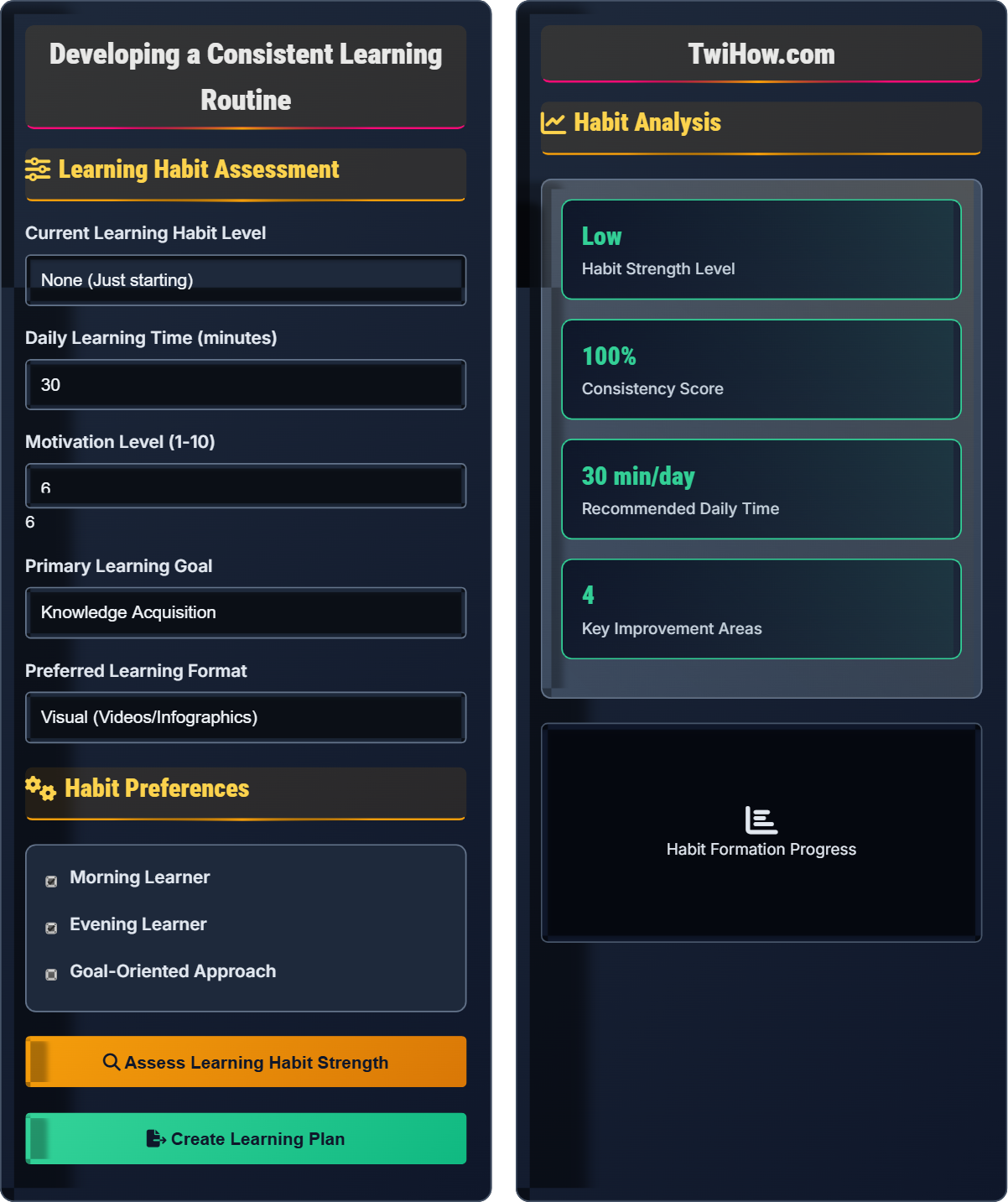
Learning Habit Assessment
Habit Preferences
Habit Analysis
Habit Formation Progress
| Habit Component | Current Status | Priority | Recommendation |
|---|---|---|---|
| Daily Consistency | Medium | High | Set fixed learning time |
| Goal Setting | Low | High | Create SMART learning goals |
| Progress Tracking | Low | Medium | Use habit tracking tools |
| Environment Optimization | Medium | Medium | Create dedicated learning space |
Personalized Strategies
Beginner: Start with 10-minute daily learning sessions
Intermediate: Build on existing habits with new techniques
Advanced: Implement sophisticated tracking and optimization
Ongoing: Regular evaluation and adjustment of approaches
Lifelong Learning Habit Guide
Learning habits form through the psychological process of habit stacking, where new behaviors are attached to existing routines. According to research by Charles Duhigg, habits follow a cue-routine-reward loop that becomes automatic over time. For learning habits, the cue might be a specific time or location, the routine is the learning activity itself, and the reward is the satisfaction of acquiring new knowledge or skills.
Key components:
- Cue: Trigger that initiates the learning behavior
- Routine: The learning activity itself
- Reward: Satisfaction or benefit from learning
- Craving: Desire that drives the habit cycle
The relationship between learning consistency and habit strength:
Where:
- Consistency: Regularity of practice
- Repetition: Number of times performed
- Reward Value: Satisfaction derived from activity
- Environmental Support: Surroundings that facilitate habit
Effective approaches to develop consistent learning habits:
- Micro-Learning: Short, focused learning sessions
- Spaced Repetition: Review material at increasing intervals
- Learning Partners: Accountability and social support
- Progressive Difficulty: Gradually increase complexity
- Varied Formats: Use different learning modalities
- Regular Reflection: Assess and adjust learning approach
Signs of effective learning habit development:
- Automaticity: Learning behavior becomes effortless
- Consistency: Regular practice without conscious effort
- Enjoyment: Intrinsic motivation to learn
- Progress: Continuous skill and knowledge growth
- Resilience: Ability to resume after interruptions
- Expansion: Natural extension to new topics
Habit Formation Strategies
Habit stacking, environment design, trigger identification, reward systems, accountability partnerships.
Micro-learning, spaced repetition, peer accountability, progress tracking, environmental optimization.
- Start with tiny, achievable changes
- Link new habits to existing routines
- Focus on consistency over intensity
- Create supportive learning environments
Environmental Optimization
Physical space, digital tools, social networks, learning materials, time allocation.
- Assess current learning environment
- Identify barriers and distractions
- Design supportive learning spaces
- Implement digital tools and resources
- Establish learning-friendly routines
- Regular environment evaluation
- Consistent practice and application
- Gradual habit building
- Supportive environment creation
- Regular progress assessment
Learning Habit Quiz
According to research, how long does it typically take to form a new learning habit?
Research published in the European Journal of Social Psychology found that it takes an average of 66 days to form a new habit, though this can vary significantly depending on the complexity of the behavior and individual factors. The 21-day myth originates from plastic surgery recovery observations and doesn't apply to behavioral habit formation. More complex habits like learning require longer periods to become automatic.
The answer is C) 66 days on average.
Understanding the actual timeframe for habit formation helps set realistic expectations. Many people abandon learning habits too early because they expect rapid results. Knowing that 66 days is the average helps maintain commitment during the challenging early phases when the habit still requires conscious effort.
Habit Formation: Process of making behaviors automatic through repetition
Automaticity: Behavior performed without conscious thought
Behavioral Consistency: Regular performance of an action
• Set realistic timelines for habit development
• Focus on consistency over perfection
• Expect challenges during the initial phase
• Start with very small, achievable goals
• Track your progress daily
• Be patient with yourself during the process
• Expecting instant results
• Abandoning after missing a day or two
Explain how to design a physical and digital environment that supports consistent learning habits, including specific recommendations for both spaces.
Physical Environment: Create a dedicated learning space with minimal distractions. Ensure good lighting, comfortable seating, and easy access to learning materials. Keep the space organized and reserved primarily for learning activities.
Digital Environment: Use website blockers during learning time, organize digital resources in accessible folders, and utilize learning management tools. Configure devices to minimize notifications during learning sessions.
Specific Recommendations:
• Physical: Designate a specific learning area, keep materials organized, use good lighting
• Digital: Use apps like Forest or Freedom to block distractions, organize bookmarks by subject
• Social: Inform family/housemates of learning times, join learning communities
• Temporal: Establish consistent learning times, minimize interruptions
• Motivational: Display learning goals, use progress trackers, celebrate milestones
Environment design leverages the principle that our surroundings significantly influence our behavior. By creating spaces that support learning and minimize friction, we make it easier to engage in learning activities consistently. The environment should reduce decision fatigue and make learning the path of least resistance.
Environmental Design: Arranging physical and digital spaces to support behavior
Decision Fatigue: Reduced decision-making ability after prolonged choices
Friction Reduction: Minimizing barriers to desired behavior
• Make learning spaces easily accessible
• Minimize potential distractions
• Create visual reminders of goals
• Prepare materials the night before
• Use consistent locations for learning
• Create visual progress indicators
• Trying to learn in high-distraction environments
• Not preparing materials in advance
• Failing to establish clear boundaries
You've successfully established a daily learning habit but recently experienced a disruption (vacation, illness, busy schedule). How would you approach getting back into your routine without losing momentum?
Immediate Action: Don't try to catch up on missed sessions. Instead, restart with your original commitment level to avoid overwhelming yourself.
Forgive Yourself: Understand that disruptions are normal and don't define your commitment to learning.
Re-establish Cues: Reinforce the environmental or temporal cues that trigger your learning habit.
Lower the Barrier: Start with an easier version of your habit if needed (e.g., 10 minutes instead of 30).
Focus on Identity: Emphasize your identity as a learner rather than just the behavior.
Track Progress: Resume logging your learning activities to rebuild momentum.
Seek Support: Connect with learning partners or communities for accountability.
Remember that one missed day doesn't mean failure - it's about getting back on track as soon as possible.
Resuming a disrupted habit is different from forming one initially. The key is to maintain your identity as a learner while rebuilding the behavior. Research shows that people who can quickly resume habits after disruptions are more likely to maintain them long-term. The focus should be on progress, not perfection.
Habit Resumption: Restarting a behavior after interruption
Identity-Based Habits: Habits tied to self-concept
Behavioral Momentum: Tendency to continue consistent actions
• Don't try to catch up immediately
• Focus on resuming rather than perfecting
• Maintain your learning identity
• Use the "two-miss rule" (don't miss twice in a row)
• Lower the bar temporarily if needed
• Focus on small, achievable sessions
• Trying to make up for all missed sessions at once
• Abandoning the habit completely after disruption
• Being overly critical of yourself
You want to use technology to support your learning habit but are concerned about digital distractions. How would you design a technology-enabled learning system that enhances rather than hinders your learning consistency?
Distraction Management: Use website blockers, app timers, and notification controls to minimize interruptions during learning time.
Productive Tools: Utilize spaced repetition apps, digital flashcards, learning management systems, and progress trackers.
Specific Recommendations:
• Anki for spaced repetition flashcards
• Forest or Cold Turkey for focus sessions
• Notion or Obsidian for knowledge management
• Habitica for gamified habit tracking
• YouTube Premium to eliminate ads during learning videos
Environment Configuration: Set up devices with learning-focused profiles or restricted mode during study times.
Social Integration: Join online learning communities or accountability groups while avoiding distracting social media.
This approach harnesses technology's benefits while minimizing its potential for distraction.
Technology can be both a tool and a distraction for learning. The key is intentional design of your digital environment to support learning goals. Rather than avoiding technology entirely, we can leverage it strategically while implementing safeguards against its distracting potential.
Digital Distraction: Interruptions from electronic devices during focused work
Technology Integration: Purposeful use of digital tools for learning
Focus Mode: Configurations that minimize distractions
• Use technology intentionally, not reactively
• Implement safeguards against distraction
• Regularly audit digital tools for effectiveness
• Use grayscale mode on devices during learning
• Create separate user profiles for learning
• Schedule digital detox periods
• Leaving social media accessible during learning
• Not configuring notification settings properly
• Using too many tools at once
Which strategy is most effective for maintaining motivation when learning becomes challenging or progress seems slow?
Connecting learning to deeper values and identity creates intrinsic motivation that sustains effort during difficult periods. When learning is tied to your core values and sense of self, you're more likely to persist through challenges. Outcome-focused motivation is often insufficient for long-term habit maintenance because it relies on external rewards rather than internal satisfaction.
The answer is B) Connect learning to deeper values and identity.
Intrinsic motivation, which comes from internal satisfaction and alignment with personal values, is more sustainable than extrinsic motivation, which depends on external rewards. When learners connect their education to their identity and core values, they develop a sense of purpose that helps them persist through difficulties.
Intrinsic Motivation: Drive from internal satisfaction
Extrinsic Motivation: Drive from external rewards
Identity-Based Habits: Habits tied to self-concept
• Focus on identity rather than just outcomes
• Connect to personal values regularly
• Maintain long-term perspective
• Write a personal learning manifesto
• Create vision boards for learning goals
• Regularly reflect on why learning matters
• Relying only on external rewards
• Not connecting learning to personal values
• Focusing only on immediate results
FAQ
Q: How do I maintain a learning habit when I have a very busy schedule?
A: Maintain learning consistency by:
• Using micro-learning sessions (5-10 minutes throughout the day)
• Integrating learning into existing routines (commute, lunch, breaks)
• Preparing materials in advance for easy access
• Using audio learning during physical activities
• Setting up automated reminders and triggers
• Prioritizing learning like any other important appointment
• Using weekends for longer, deeper learning sessions
Focus on frequency over duration - consistent small sessions are more effective than sporadic long ones.
Q: What's the best way to choose what to learn when there's so much information available?
A: Select learning topics by:
1. Aligning with goals: Choose subjects that support your objectives
2. Assessing relevance: Focus on skills applicable to your field
3. Considering ROI: Evaluate potential impact of knowledge
4. Checking prerequisites: Ensure you have foundational knowledge
5. Validating sources: Select credible learning materials
6. Starting small: Focus on one topic at a time
Remember that depth in fewer areas often provides more value than breadth across many.