ROI of Investing in Education
Complete guide • Financial analysis
Evaluating the Return on Investment (ROI) of education involves analyzing the costs of educational programs against the financial benefits gained over time. This includes increased earning potential, career advancement opportunities, and long-term financial stability. Education ROI calculations consider both direct costs (tuition, fees, materials) and opportunity costs (income lost during study periods).
Key components:
- Direct Costs: Tuition, fees, books, supplies, living expenses
- Opportunity Costs: Lost income during study periods
- Financial Benefits: Higher salaries, promotions, career changes
- Non-Financial Benefits: Job satisfaction, personal fulfillment, expanded networks
Studies show that higher education typically yields positive ROI over a lifetime, though the rate varies significantly by field of study and institution.
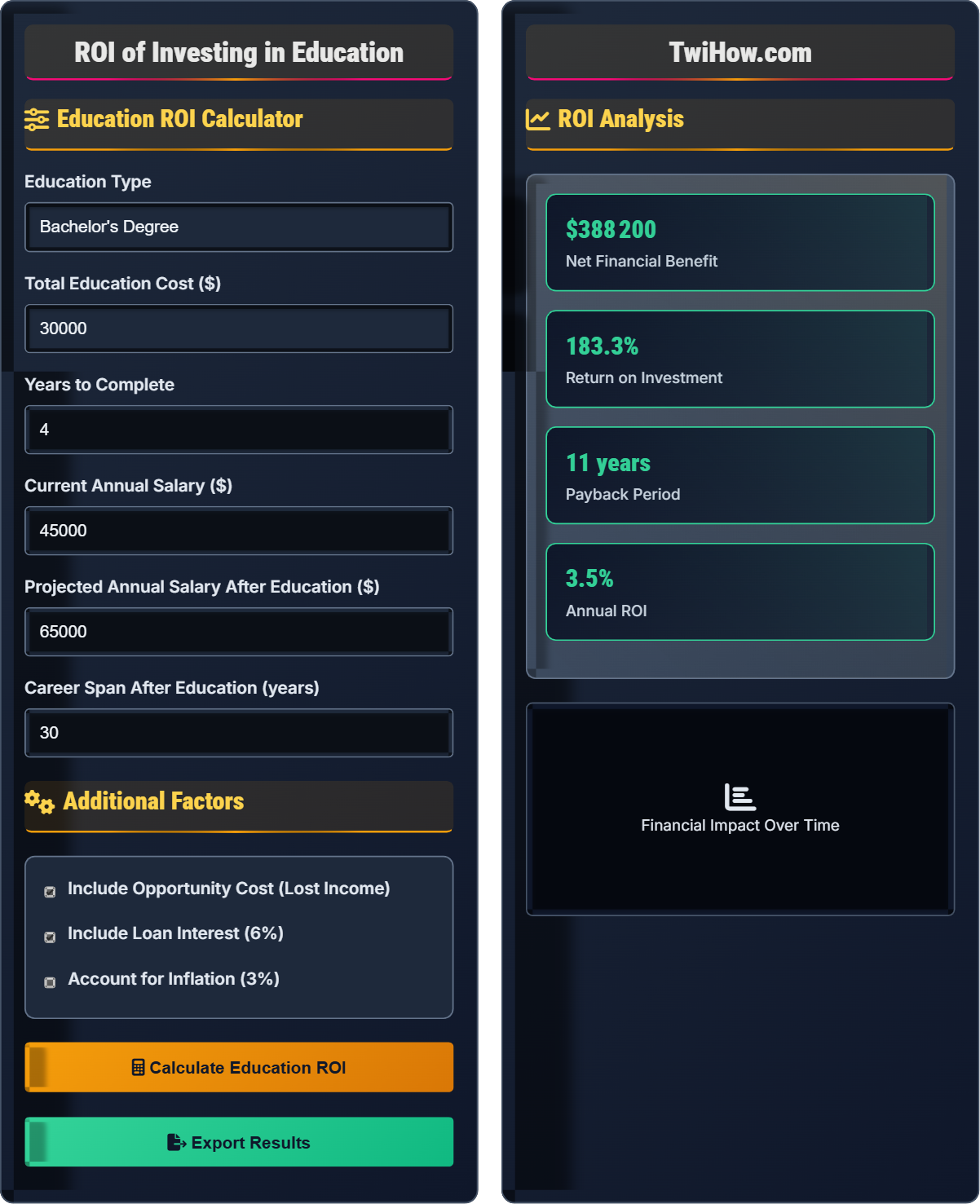
Education ROI Calculator
Additional Factors
ROI Analysis
Financial Impact Over Time
| Component | Amount | Notes |
|---|---|---|
| Education Cost | -$30,000 | Includes tuition, fees, books |
| Opportunity Cost | -$180,000 | Lost income during study period |
| Total Investment | -$210,000 | Initial cost basis |
| Total Earnings Difference | $690,000 | Higher salary over career span |
| Net Benefit | $480,000 | Final ROI calculation |
Financial Timeline
Year 0-4: Initial investment phase (-$210,000)
Year 5-10: Payback period (recovering investment)
Year 11-40: Positive returns phase (net benefit)
Education ROI Guide
The basic formula for calculating Education ROI:
Where Net Financial Benefit = Total Earnings Difference - Total Investment
Total Earnings Difference = (Projected Salary - Current Salary) × Career Years
Total Investment = Education Costs + Opportunity Costs + Interest
Comprehensive cost analysis includes:
- Direct Costs: Tuition, fees, textbooks, supplies, equipment
- Living Expenses: Room, board, transportation during study
- Opportunity Costs: Income foregone during study period
- Loan Interest: Accumulated interest on educational loans
- Time Investment: Hours spent in study and preparation
Typical ROI ranges by education type:
- Bachelor's Degree: 15-20 year payback, 10-15% annual ROI
- Master's Degree: 8-12 year payback, 8-12% annual ROI
- Professional Certifications: 2-5 year payback, 15-25% annual ROI
- Bootcamps: 1-3 year payback, 20-30% annual ROI
- Trade Schools: 1-4 year payback, 12-20% annual ROI
Factors that improve educational ROI:
- Field of Study: STEM and business degrees typically offer higher returns
- Institution Quality: Prestigious schools often yield better networking opportunities
- Career Alignment: Matching education to career goals increases relevance
- Timing: Pursuing education during career transition periods
- Employer Support: Companies that sponsor education reduce personal costs
ROI Calculation Components
Direct costs, opportunity costs, loan interest, living expenses during study.
Salary projections, career advancement, job security, networking opportunities.
- Consider both financial and non-financial benefits
- Account for time value of money
- Factor in career longevity
- Adjust for economic conditions
Education Investment Strategies
Part-time vs. full-time, employer sponsorship, online vs. traditional, timing optimization.
- Assess current financial situation
- Research education costs and benefits
- Calculate expected ROI for different options
- Consider financing alternatives
- Plan for implementation
- Monitor and adjust as needed
- Thorough research and planning
- Realistic salary projections
- Consideration of opportunity costs
- Alignment with career goals
Education ROI Quiz
If an education program costs $40,000 and increases your annual salary by $15,000 over 25 years, what is the net financial benefit?
Net Financial Benefit = Total Earnings Difference - Total Investment
Total Earnings Difference = $15,000 × 25 years = $375,000
Net Financial Benefit = $375,000 - $40,000 = $335,000
The answer is A) $335,000.
Calculating education ROI requires identifying all costs associated with the program and comparing them to the total financial benefits over time. The benefit calculation must account for the entire career period where the salary increase applies, not just the first year.
Net Financial Benefit: Total earnings difference minus investment costs
Annual Salary Increase: Additional income earned due to education
Payback Period: Time required to recoup initial investment
• Include all costs in the calculation
• Consider the full career impact
• Account for inflation and time value of money
• Use conservative salary estimates
• Factor in career interruptions
• Consider geographic variations in salaries
• Only calculating first-year benefits
• Overestimating salary increases
Explain how opportunity cost affects the ROI calculation of pursuing a two-year full-time master's degree program, and calculate the opportunity cost for someone currently earning $60,000 annually.
Opportunity Cost Definition: The income foregone by not working during the study period. For a two-year full-time program, this represents the salary that would have been earned if the person had continued working.
Calculation: Opportunity Cost = Annual Salary × Number of Years Studying
Opportunity Cost = $60,000 × 2 = $120,000
Impact on ROI: This cost must be added to the direct education costs to calculate the total investment. The total investment now includes both the program cost and the lost income, which significantly affects the ROI calculation.
Many people focus only on tuition and fees when calculating education ROI, but opportunity cost is often the largest component of the investment. Full-time students miss out on years of income, benefits, and career advancement opportunities. This cost is particularly significant for older students with established careers.
Opportunity Cost: Value of the next best alternative forgone
Full-Time Study: Dedication of all working hours to education
Income Foregone: Money not earned due to educational pursuit
• Always include opportunity cost in calculations
• Consider career progression lost during study
• Factor in benefits and retirement contributions
• Consider part-time options to reduce opportunity cost
• Negotiate sabbaticals with employers
• Look for programs with internships or co-ops
• Ignoring lost income during study
• Underestimating career advancement lost
• Not accounting for benefits and retirement contributions
You're a marketing manager earning $70,000 annually considering a coding bootcamp that costs $15,000 and takes 6 months to complete. The bootcamp promises entry-level developer positions at $65,000 annually. Calculate the payback period assuming a 30-year career in tech and explain whether this investment makes financial sense.
Costs: Bootcamp cost: $15,000; Opportunity cost (lost salary for 6 months): $35,000; Total investment: $50,000
Benefits: New salary: $65,000; Previous salary: $70,000; Annual difference: -$5,000 initially
This scenario shows a negative initial ROI because the new salary is lower than the current salary. However, if we assume developer salaries grow faster than marketing salaries, we need to project future earnings. Assuming developers reach $80,000 after 3 years, the annual benefit becomes $10,000.
Payback Period: With $10,000 annual benefit after 3 years, payback occurs in 8 years from start of bootcamp.
Conclusion: The investment may make sense if long-term career growth in tech exceeds marketing, but the initial salary decrease is a significant risk.
Education ROI calculations for career changes are more complex because they involve salary comparisons and growth projections. The analysis must consider not just immediate salary differences but also long-term career trajectories. Career changers often accept temporary salary reductions for greater long-term potential.
Career Change: Transition from one professional field to another
Payback Period: Time required to recover investment costsSalary Trajectory: Expected progression of compensation over time
• Compare long-term career paths, not just initial salaries
• Research industry growth rates
• Consider job security and satisfaction
• Validate salary assumptions with industry research
• Consider part-time career transitions
• Factor in job satisfaction and work-life balance
• Assuming immediate salary increases
• Ignoring time to reach expected salaries
• Overestimating career growth potential
You're comparing an online certificate program ($8,000, 1 year) with a traditional university program ($25,000, 2 years) for the same specialization. Both promise a $12,000 annual salary increase. Calculate the ROI for each and recommend which option offers better value, considering opportunity costs.
Online Program: Investment = $8,000; Opportunity cost = $0 (part-time); Total investment = $8,000
Traditional Program: Investment = $25,000; Opportunity cost = $60,000 (full-time for 2 years); Total investment = $85,000
Benefits (over 25 years): Both programs provide $300,000 in additional earnings ($12,000 × 25 years)
Net Benefits: Online: $300,000 - $8,000 = $292,000; Traditional: $300,000 - $85,000 = $215,000
ROI: Online: 3,650%; Traditional: 253%
The online program offers significantly better ROI due to lower total investment, despite identical benefits.
Delivery format significantly impacts education ROI through opportunity costs. Part-time online programs allow students to maintain employment, dramatically reducing the total investment. While traditional programs may offer networking advantages, these must be weighed against the substantial opportunity cost differential.
Delivery Format: Method of course delivery (online, traditional, hybrid)
Opportunity Cost Differential: Difference in foregone income between options
Networking Advantages: Professional connections made during education
• Compare total costs including opportunity costs
• Consider format-specific advantages
• Factor in quality and accreditation
• Research program quality regardless of format
• Consider hybrid options for best of both worlds
• Factor in learning style preferences
• Focusing only on upfront costs
• Ignoring opportunity cost differences
• Assuming format correlates with quality
Which of the following is the most important risk factor to consider when calculating education ROI?
While all factors are important, economic conditions affecting employment is the most critical risk factor because it directly impacts the ability to secure the projected higher-paying position after completing education. Even the best education investment fails if there are no jobs available in the field. Economic downturns can significantly delay or prevent the realization of expected benefits.
The answer is C) Economic conditions affecting employment.
Education ROI calculations rely heavily on assumptions about future employment and salaries. Economic conditions can fundamentally alter these assumptions, making the projected benefits unrealizable. Other risks, while important, don't completely eliminate the possibility of realizing benefits like economic conditions can.
Market Volatility: Fluctuations in industry demand and compensation
Economic Conditions: Broader economic factors affecting employment
Risk Assessment: Evaluation of potential negative outcomes
• Diversify career options to reduce risk
• Research employment trends in target field
• Consider recession-resilient industries
• Choose fields with consistent demand
• Build transferable skills
• Maintain emergency funds during study
• Ignoring economic cycles in projections
• Assuming job availability in all conditions
• Not having backup plans
FAQ
Q: How do I account for non-financial benefits like job satisfaction and personal fulfillment in ROI calculations?
A: Non-financial benefits are important but difficult to quantify. You can estimate their value by:
• Calculating how much more you'd pay for a job with better satisfaction
• Estimating reduced stress-related healthcare costs
• Valuing improved work-life balance (e.g., equivalent to additional vacation time)
• Considering longer career sustainability due to job satisfaction
While these benefits don't appear in financial ROI calculations, they should be factored into your overall decision-making process alongside the monetary returns.
Q: Is it worth going into debt for a college degree given the rising costs?
A: The decision depends on several factors:
1. Field of study: STEM and business degrees typically offer higher returns
2. Quality of education: Choose institutions with strong outcomes
3. Debt-to-income ratio: Don't borrow more than expected first-year salary
4. Alternative paths: Consider community colleges, trade schools, or work-first options
5. Loan terms: Federal loans offer better protections than private loans
Generally, if managed responsibly with reasonable debt levels, a college degree still provides positive ROI for most people.