Learning from Failures and Setbacks
Complete guide • Resilience strategies
Learning from failures and setbacks is a crucial skill for personal and professional growth. Failure is not the opposite of success—it's a stepping stone toward it. By developing resilience, adopting a growth mindset, and implementing systematic approaches to learning from setbacks, you can transform obstacles into opportunities for growth.
Key concepts:
- Growth Mindset: Believing abilities can be developed
- Resilience: Bouncing back from adversity
- Reflection: Analyzing experiences for learning
- Recovery: Implementing strategies to move forward
Research shows that people who learn effectively from failures are more likely to achieve long-term success than those who avoid failure altogether.
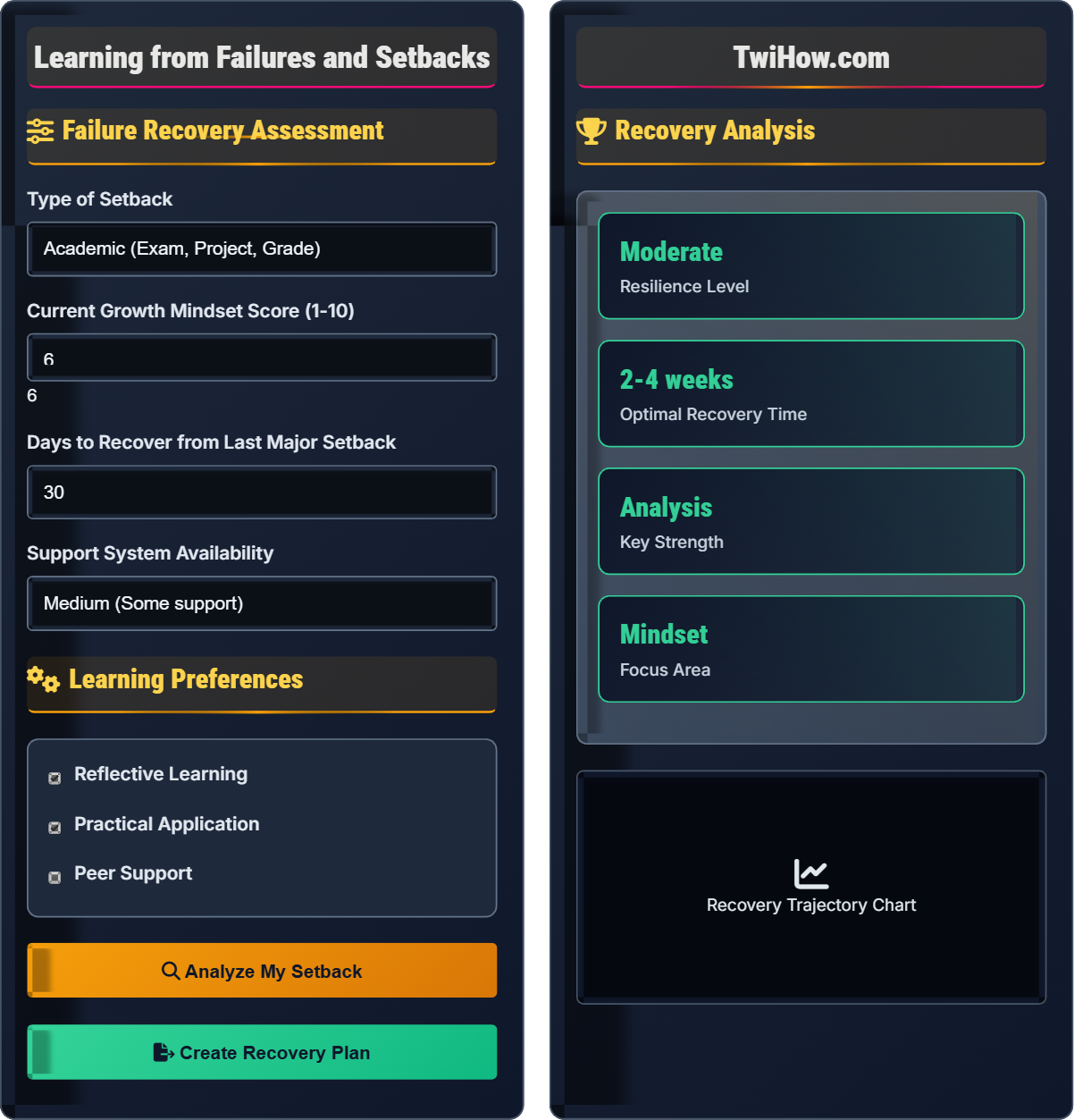
Failure Recovery Assessment
Learning Preferences
Recovery Analysis
Recovery Trajectory Chart
| Factor | Level | Impact | Recommendation |
|---|---|---|---|
| Growth Mindset | Medium | High | Focus on learning from setbacks |
| Resilience | Moderate | Medium | Build coping strategies |
| Support System | Medium | High | Strengthen network |
| Reflection Skills | Low | High | Develop analysis techniques |
Recommended Recovery Strategies
Week 1-2: Acceptance and emotional processing
Week 3-4: Analysis and learning extraction
Week 5-6: Implementation of new approaches
Ongoing: Building resilience for future setbacks
Learning from Failures Guide
A growth mindset, coined by psychologist Carol Dweck, is the belief that abilities and intelligence can be developed through dedication and hard work. This contrasts with a fixed mindset, which assumes talents are innate and unchangeable.
Key components include:
- Embrace Challenges: View difficulties as opportunities to grow
- Learn from Criticism: Use feedback constructively
- Find Lessons in Failure: Extract value from setbacks
- Persist Through Obstacles: Maintain effort despite difficulties
Resilience is the ability to bounce back from adversity. The formula for building resilience:
Where:
- Acceptance: Acknowledging the setback without denial
- Analysis: Understanding what went wrong and why
- Action: Implementing corrective measures
- Adaptation: Adjusting approach for future situations
Effective failure analysis follows systematic approaches:
- Root Cause Analysis: Identify underlying factors
- SWOT Analysis: Examine strengths, weaknesses, opportunities, threats
- 5 Whys Technique: Ask "why" repeatedly to find root causes
- After-Action Review: Systematic examination of what happened
- Failure Mode Analysis: Categorize different types of failures
Having a strong support system accelerates recovery from setbacks:
- Mentors: Experienced individuals who provide guidance
- Peers: Others facing similar challenges
- Professionals: Therapists, coaches, or counselors
- Communities: Groups with shared interests or goals
- Family/Friends: Personal relationships for emotional support
Failure Recovery Strategies
Reframing, reflection, resourcing, resilience building, and systematic analysis.
Journaling, peer discussions, mentorship, structured analysis, and gradual exposure.
- Separate identity from performance
- Focus on process, not just outcomes
- Document lessons learned
- Build in recovery time
Growth Mindset Development
From "I can't do this" to "I can't do this yet", from "failure means I'm not good enough" to "failure is information".
- Recognize fixed mindset triggers
- Challenge limiting beliefs
- Reframe setbacks as learning opportunities
- Focus on effort and strategy
- Embrace the learning process
- Build resilience through practice
- Consistent practice
- Patience with progress
- Supportive environment
- Focus on growth, not perfection
Learning from Failures Quiz
Which statement best exemplifies a growth mindset when facing a learning setback?
A growth mindset involves believing that abilities can be developed through effort and learning. The key phrase is "not yet," which indicates potential for future mastery. Statement C demonstrates this belief by acknowledging current difficulty while expressing confidence in future improvement through strategy changes.
The answer is C) "I haven't mastered this yet, but I can improve with different strategies."
Growth mindset research shows that students who believe intelligence is malleable perform better over time than those who believe it's fixed. The word "yet" is particularly powerful because it implies a timeline for improvement and acknowledges that learning is a process rather than a destination.
Growth Mindset: Belief that abilities can be developed through dedication and hard work
Fixed Mindset: Belief that abilities are innate and unchangeable
Yet: Powerful word indicating potential for future achievement
• Focus on effort, not talent
• Embrace challenges as learning opportunities
• Learn from criticism constructively
• Replace "can't" with "can't yet"
• Focus on the learning process
• Celebrate effort and improvement
• Equating failure with lack of ability
• Giving up after initial difficulty
Explain the five-step process for recovering from a significant learning setback and how each step contributes to long-term growth.
Step 1: Process Emotions: Allow yourself to feel disappointment, frustration, or sadness. Suppressing emotions prolongs the recovery process. This step prevents emotional buildup that could interfere with clear thinking.
Step 2: Analyze Objectively: Examine what happened without self-blame. Look at factors within and outside your control. This prevents repeating the same mistakes.
Step 3: Extract Lessons: Identify specific insights and learning opportunities. This transforms the setback into valuable information for future success.
Step 4: Create Action Plan: Develop concrete steps to address identified issues. This provides direction and reduces anxiety about the future.
Step 5: Implement Safely: Take measured steps to apply new knowledge. This rebuilds confidence gradually and prevents overwhelming yourself.
Each step in the recovery process serves a specific purpose in rebuilding both emotional and intellectual capacity. Skipping steps often leads to incomplete recovery and increased vulnerability to future setbacks. The process should be viewed as cyclical since each setback provides new learning opportunities.
Objective Analysis: Examining events without emotional bias
Lessons Extraction: Identifying actionable insights from experiences
Safe Implementation: Gradual application of new strategies
• Don't rush through emotional processing
• Focus on controllable factors
• Document the learning process
• Keep a setback journal
• Seek feedback from trusted sources
• Set small, achievable goals during recovery
• Suppressing emotions instead of processing them
• Blaming external factors exclusively
• Jumping straight to action without analysis
You've failed an important exam in a subject you need for your degree. Your confidence is shaken, and you're considering dropping the course. Using failure recovery principles, describe how you would approach this setback to turn it into a learning opportunity.
Immediate Response: First, acknowledge the disappointment and allow yourself to feel upset. This is normal and healthy. Then, schedule a meeting with the professor to understand specific areas of weakness.
Analysis Phase: Identify contributing factors: inadequate preparation time, misunderstanding of concepts, test anxiety, or ineffective study methods. Use the 5 Whys technique to get to root causes.
Action Plan: Based on analysis, implement changes: join a study group, seek tutoring, adjust study schedule, or practice relaxation techniques for test anxiety.
Long-term Strategy: View this as valuable information about your learning process. The setback reveals areas for improvement that will benefit you in future courses.
Academic setbacks often reveal mismatched learning strategies rather than lack of ability. The key is to view the failure as diagnostic information rather than a judgment of worth. This perspective shift transforms a negative experience into valuable data for optimizing future learning.
Diagnostic Information: Data that reveals areas for improvement
Learning Strategy: Method used to acquire and retain information
Test Anxiety: Psychological response that interferes with exam performance
• Don't make major decisions when emotionally overwhelmed
• Seek objective feedback on performance
• Focus on what can be controlled
• Review the exam with your professor
• Form or join a study group
• Try different study techniques
• Dropping the course without exploring alternatives
• Continuing the same ineffective approach
• Isolating yourself during recovery
You were passed over for a promotion you felt ready for. The feedback was that you need to improve your leadership and communication skills. How would you apply failure learning principles to develop these skills?
Acceptance: Acknowledge the feedback without defensiveness. Recognize this as specific, actionable information about skill gaps.
Analysis: Reflect on specific situations where leadership or communication might have been lacking. Seek additional feedback from colleagues and mentors.
Learning Plan: Enroll in leadership and communication courses, find a mentor, volunteer for projects requiring these skills, and practice with low-stakes opportunities.
Implementation: Apply new skills in current role, document improvements, and track progress toward the next promotion opportunity.
Professional setbacks often provide the clearest feedback on skill gaps. The specific nature of the feedback in this scenario offers a roadmap for targeted improvement. Viewing the setback as a skill-building opportunity reframes it from a rejection to a development plan.
Leadership Skills: Ability to guide and inspire others toward goals
Communication Skills: Effectively conveying information and ideas
Targeted Improvement: Focused development in specific areas
• View feedback as gifts, not criticism
• Focus on skill development, not just the next promotion
• Document progress for future opportunities
• Seek leadership opportunities in current role
• Join professional development groups
• Practice skills in low-risk situations
• Dismissing feedback as unfair
• Becoming discouraged and giving up
• Not taking concrete action steps
Which of the following is the most effective long-term strategy for building resilience to learning setbacks?
Resilience is built through practice and systematic approaches to handling difficulties. Developing a consistent method for learning from setbacks creates a skill that can be applied repeatedly. This approach builds confidence and competence over time, unlike avoidance strategies which limit growth opportunities.
The answer is B) Developing a systematic approach to learning from setbacks.
Like physical exercise strengthens muscles, mental challenges strengthen resilience. The key is having effective tools and approaches for processing setbacks constructively. This creates a positive feedback loop where each setback becomes easier to handle and provides more learning opportunities.
Resilience: Ability to recover from or adjust to misfortune
Systematic Approach: Consistent method for handling challenges
Positive Feedback Loop: Process that reinforces itself
• Embrace challenges as growth opportunities
• Build consistent recovery processes
• Focus on learning, not just outcomes
• Create a personal setback recovery toolkit
• Practice recovery strategies on small setbacks
• Build a support network proactively
• Avoiding challenges to prevent discomfort
• Not developing consistent approaches
• Focusing only on avoiding future failures
FAQ
Q: How do I distinguish between a temporary setback and a sign that I should change direction?
A: Temporary setbacks typically involve:
• External factors beyond your control
• Specific skill gaps that can be addressed
• Maintained intrinsic motivation for the goal
• Patterns of progress interrupted by challenges
Direction changes are indicated by:
• Consistent misalignment with values or interests
• Persistent lack of progress despite varied approaches
• Significant negative impact on wellbeing
• Discovery of more compelling alternatives
The key is evaluating whether challenges are surmountable obstacles or fundamental mismatches.
Q: How can I help my students develop resilience to academic setbacks?
A: Help students by:
1. Normalizing setbacks: Share examples of successful people who faced failures
2. Teaching analysis skills: Guide them through systematic review of what worked and didn't
3. Focusing on process: Praise effort, strategy, and improvement over grades
4. Providing tools: Teach specific techniques like the 5 Whys or SWOT analysis
5. Creating safe spaces: Encourage risk-taking without fear of judgment
6. Modeling behavior: Demonstrate how you handle your own setbacks
Remember that resilience is built through experiencing and overcoming challenges, not avoiding them.