Maintaining Curiosity and Growth Mindset
Complete guide • Lifelong learning
Curiosity and growth mindset are fundamental attitudes that drive lifelong learning, resilience, and personal development. Curiosity fuels the desire to explore, question, and discover new knowledge, while a growth mindset embraces challenges and views failures as learning opportunities. Together, they create a powerful combination that enables continuous growth and adaptation in our rapidly changing world.
Key components:
- Curiosity: The drive to explore, question, and discover new knowledge
- Growth Mindset: Believing abilities can be developed through dedication and hard work
- Resilience: Bouncing back from setbacks and challenges
- Learning Orientation: Focusing on the process of learning rather than just outcomes
Research shows that individuals with high curiosity and growth mindset achieve greater success, happiness, and adaptability in both personal and professional contexts.
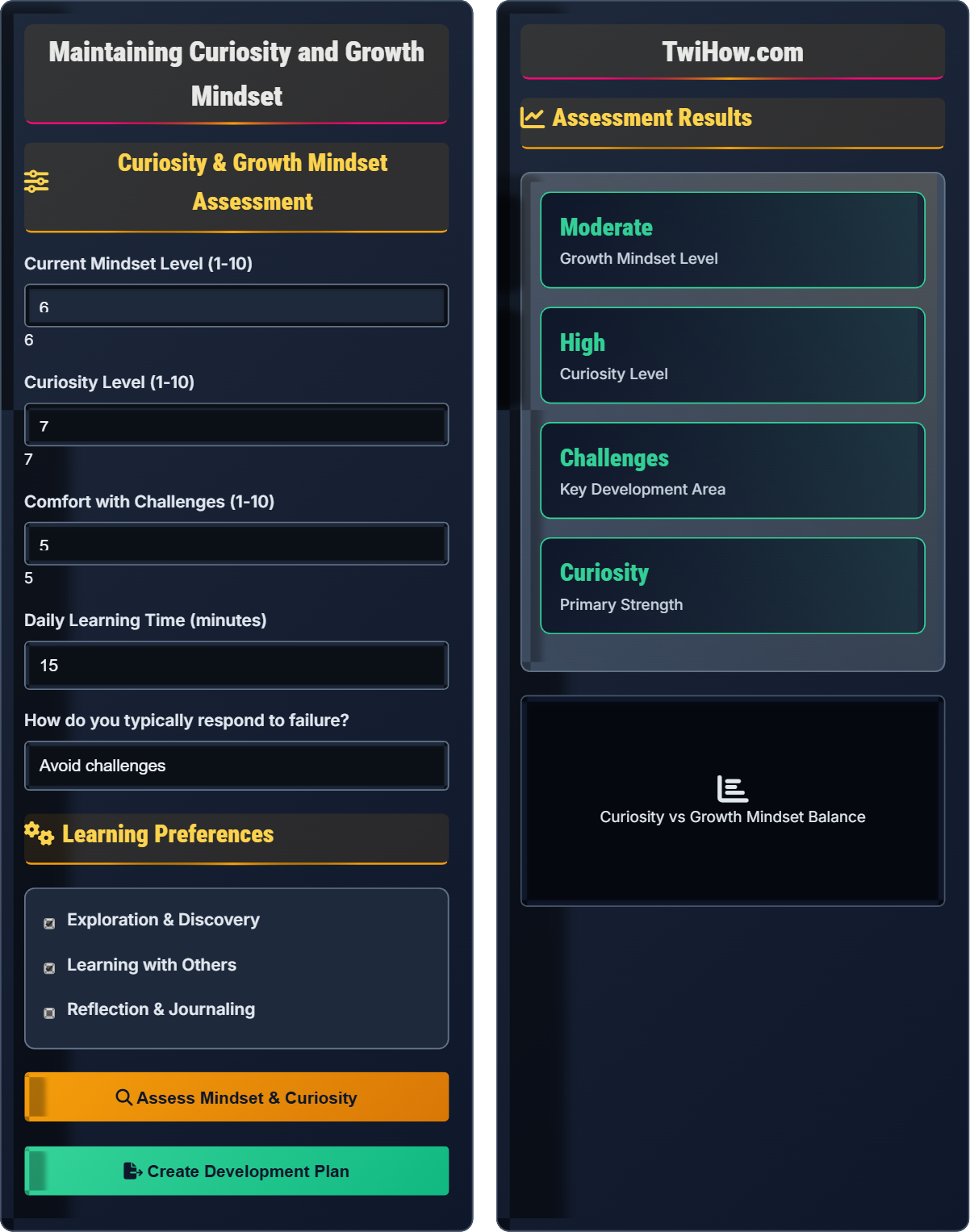
Curiosity & Growth Mindset Assessment
Learning Preferences
Assessment Results
Curiosity vs Growth Mindset Balance
| Dimension | Score | Status | Recommendation |
|---|---|---|---|
| Growth Mindset | 6/10 | Moderate | Focus on embracing challenges |
| Curiosity | 7/10 | High | Channel curiosity into learning |
| Resilience | 5/10 | Low-Moderate | Develop failure response skills |
| Learning Orientation | 6/10 | Moderate | Focus on process over outcomes |
Recommended Strategies
Week 1-2: Practice embracing challenges with positive self-talk
Week 3-4: Reframe failures as learning opportunities
Week 5-6: Develop questioning techniques and curiosity practices
Ongoing: Build learning routines and reflection practices
Curiosity and Growth Mindset Guide
Based on research by psychologist Carol Dweck, a growth mindset is the belief that abilities and intelligence can be developed through dedication and hard work. This contrasts with a fixed mindset, which assumes talents are innate and unchangeable.
Key characteristics include:
- Embrace Challenges: View difficulties as opportunities to grow
- Learn from Criticism: Use feedback constructively
- Find Lessons in Failure: Extract value from setbacks
- Persist Through Obstacles: Maintain effort despite difficulties
Curiosity drives learning and growth through inquiry and exploration:
Where:
- Questioning: Asking "what if" and "why" questions
- Exploration: Actively seeking new experiences
- Openness: Being receptive to new ideas
- Persistence: Following through on inquiries
Methods to maintain curiosity and growth mindset:
- Daily Questioning: Ask "why" and "how" about everyday experiences
- Failure Analysis: Conduct post-mortems on setbacks to extract lessons
- Learning Rituals: Establish consistent time for exploration and learning
- Curiosity Journals: Record interesting discoveries and questions
- Growth Language: Use "not yet" instead of "can't" to indicate potential
- Challenge Seeking: Actively look for difficult problems to solve
Advantages of maintaining curiosity and growth mindset:
- Enhanced Learning: Faster acquisition of new skills and knowledge
- Greater Resilience: Better ability to bounce back from setbacks
- Increased Innovation: More creative problem-solving approaches
- Improved Relationships: Better collaboration and communication
- Career Advancement: Greater adaptability and leadership potential
- Personal Fulfillment: Increased sense of purpose and achievement
Growth Mindset Development
Belief in ability development, embrace challenges, learn from criticism, persist through obstacles.
Self-reflection, goal setting, feedback seeking, challenge acceptance, and continuous learning.
- Focus on effort and process, not just results
- View failures as learning opportunities
- Seek feedback actively
- Embrace challenges as growth opportunities
Curiosity Maintenance
Asking questions, exploring new topics, seeking diverse perspectives, and staying open to learning.
- Ask open-ended questions daily
- Explore unfamiliar topics regularly
- Engage with diverse viewpoints
- Practice active listening
- Keep a curiosity journal
- Seek out challenging experiences
- Consistent practice and application
- Patience with progress
- Supportive environment
- Focus on growth, not perfection
Curiosity and Growth Mindset Quiz
Which statement best exemplifies a growth mindset?
A growth mindset involves believing that abilities can be developed through effort and learning. The key phrase is "not yet," which indicates potential for future mastery. Statement C demonstrates this belief by acknowledging current difficulty while expressing confidence in future improvement through practice.
The answer is C) "I haven't mastered this yet, but I can improve with practice."
Growth mindset research shows that students who believe intelligence is malleable perform better over time than those who believe it's fixed. The word "yet" is particularly powerful because it implies a timeline for improvement and acknowledges that learning is a process rather than a destination.
Growth Mindset: Belief that abilities can be developed through dedication and hard work
Fixed Mindset: Belief that abilities are innate and unchangeable
"Not Yet": Powerful phrase indicating potential for future achievement
• Focus on effort, not talent
• Embrace challenges as learning opportunities
• Learn from criticism constructively
• Replace "can't" with "can't yet"
• Focus on the learning process
• Celebrate effort and improvement
• Equating failure with lack of ability
• Giving up after initial difficulty
Explain how to maintain curiosity in a field where you already have significant expertise, and why this is important for continued growth.
Maintaining Curiosity: Even with expertise, curiosity can be maintained by:
• Seeking out adjacent fields that connect to your expertise
• Teaching others to gain fresh perspectives on familiar topics
• Asking "what if" questions about established practices
• Attending conferences and workshops to stay updated
• Mentoring others to learn from their questions and approaches
• Experimenting with new applications of your knowledge
Importance: Maintaining curiosity prevents stagnation, keeps you adaptable to changes, fosters innovation, and helps you continue contributing meaningfully to your field. Experts who maintain curiosity often become thought leaders who drive their fields forward.
Expertise can sometimes lead to complacency, where individuals stop questioning or exploring. Maintaining curiosity requires conscious effort to resist the comfort of "knowing" and instead remain open to new possibilities. This is crucial for continued growth and innovation.
Adjacent Fields: Related disciplines that connect to your main area of expertise
Thought Leader: Individual recognized for innovative ideas in their field
Expertise Stagnation: Decline in learning and growth despite experience
• Never assume you know everything
• Remain humble and open to learning
• Seek diverse perspectives regularly
• Ask beginners' questions about advanced topics
• Read outside your field regularly
• Attend talks by experts in different domains
• Becoming overconfident in expertise
• Stopping exploration of new ideas
• Avoiding challenges that expose gaps
You've been working on a project for months but recently received harsh criticism that made you question your abilities. Using growth mindset principles, describe how you would respond to maintain both curiosity and motivation for continued learning.
Immediate Response: First, acknowledge the disappointment without judgment. Remind yourself that feedback is information, not a reflection of your worth.
Analysis Phase: Separate the feedback from the delivery method. Look for specific, actionable elements in the criticism that could help improve your work.
Growth Mindset Application: View this as valuable information about areas for improvement rather than evidence of inability. Ask yourself, "What can I learn from this?"
Curiosity Response: Channel your natural curiosity to understand why the criticism was given. Ask clarifying questions if possible to gain deeper insights.
Action Plan: Identify specific skills or approaches to improve based on the feedback. Create a plan to address the areas of concern.
Maintaining Motivation: Remember that challenges and setbacks are part of the learning process. Focus on the progress made so far and the potential for growth.
Criticism and setbacks are inevitable in any learning journey. The key is to develop resilience by viewing these experiences as opportunities for growth rather than evidence of inadequacy. This perspective shift requires practice but becomes more natural over time.
Constructive Criticism: Feedback intended to help improve performance
Resilience: Ability to recover from setbacks and continue progress
Learning Orientation: Focus on growth rather than proving ability
• Separate feedback from personal worth
• Look for actionable elements in criticism
• Focus on growth opportunities
• Keep a learning journal to track progress
• Seek feedback from multiple sources
• Practice gratitude for learning opportunities
• Taking criticism personally
• Avoiding similar challenges in the future
• Focusing on defending rather than learning
Your company has announced a major change that will require learning new technologies you've never encountered. Some colleagues are resistant and claiming the change is unnecessary. How would you apply curiosity and growth mindset principles to approach this situation?
Growth Mindset Response: View the change as an opportunity to develop new skills and stay relevant in your field. Remind yourself that abilities can be developed with effort and practice.
Curiosity Application: Ask questions about the new technologies and their potential benefits. Explore how these changes might improve processes or outcomes.
Learning Strategy: Begin researching the new technologies independently. Look for online courses, tutorials, and documentation to start building knowledge.
Positive Influence: Share your excitement about learning opportunities with colleagues. Demonstrate how approaching the change with curiosity can lead to better outcomes.
Resilience Building: Prepare for the learning curve by setting realistic expectations and celebrating small wins along the way.
Future Focus: Consider how these new skills will enhance your career prospects and adaptability in a changing environment.
Workplace changes often trigger resistance because they represent uncertainty and additional work. However, maintaining curiosity and growth mindset allows you to see change as an opportunity rather than a burden. This perspective not only improves your own experience but can also influence others positively.
Adaptability: Ability to adjust to new conditions and requirements
Learning Agility: Speed at which one can learn and apply new knowledge
Future-Orientation: Focus on long-term benefits rather than short-term discomfort
• View change as opportunity, not threat
• Maintain focus on long-term benefits
• Use curiosity to understand new concepts
• Start learning before formal training begins
• Form study groups with interested colleagues
• Look for mentors familiar with new technologies
• Resisting change due to comfort with current methods
• Assuming new technologies are unnecessary
• Waiting for others to learn first
Which of the following is the most significant long-term benefit of maintaining curiosity and growth mindset?
Resilience and adaptability are the most significant long-term benefits because they enable continued success in an ever-changing world. These qualities allow individuals to bounce back from setbacks, adjust to new circumstances, and continue learning throughout their lives. While quick success and avoiding challenges might seem appealing, they don't lead to sustainable growth.
The answer is C) Developing resilience and adaptability.
Curiosity and growth mindset create a foundation for lifelong learning and adaptation. In a rapidly changing world, the ability to learn new things and bounce back from setbacks is more valuable than any specific skill or piece of knowledge. These meta-skills enable continuous growth and success across different contexts.
Resilience: Ability to recover from or adjust to misfortune
Adaptability: Capacity to adjust to new conditions
Meta-skills: Abilities that support other skills
• Focus on long-term development over short-term wins
• Embrace challenges as growth opportunities
• Develop learning agility
• Cultivate a learning habit
• Build a growth-oriented network
• Practice self-reflection regularly
• Focusing only on immediate results
• Avoiding challenges to maintain comfort
• Neglecting long-term skill development
FAQ
Q: How do I maintain curiosity when studying topics that seem boring or irrelevant to my interests?
A: To maintain curiosity in seemingly boring subjects:
• Connect the material to your personal interests or goals
• Find the "why" behind the content - how does it fit into larger picture?
• Ask questions about the material, even if it seems dull
• Look for interesting examples or applications
• Set small challenges or puzzles related to the content
• Find a study partner to discuss and debate the material
Remember that even "boring" subjects often contain fascinating elements once you dig deeper.
Q: How can I help my students develop curiosity and growth mindset?
A: Help students by:
1. Normalizing struggles: Share examples of famous failures and persistence
2. Teaching analysis skills: Guide them through systematic review of what worked and didn't
3. Focusing on process: Praise effort, strategy, and improvement over grades
4. Providing tools: Teach specific techniques like questioning strategies
5. Creating safe spaces: Encourage risk-taking without fear of judgment
6. Modeling behavior: Demonstrate how you handle your own challenges
Remember that curiosity and growth mindset are learned behaviors that develop over time.