Emerging Fields to Learn About
Complete guide • Future skills
Emerging fields represent rapidly growing areas of knowledge and employment that are expected to shape the future economy. These fields are driven by technological advances, societal changes, and evolving global challenges. Learning about these areas now provides a competitive advantage and prepares individuals for careers that will be in high demand in the coming decades.
Key emerging fields include:
- Artificial Intelligence & Machine Learning: Developing intelligent systems and algorithms
- Quantum Computing: Next-generation computational technologies
- Biotechnology & Genetic Engineering: Manipulating biological systems for medical and industrial applications
- Renewable Energy & Sustainability: Clean energy technologies and environmental solutions
- Cybersecurity: Protecting digital infrastructure and data
- Space Technology: Commercial space exploration and satellite technologies
These fields offer significant career opportunities and the chance to contribute to solving humanity's greatest challenges.
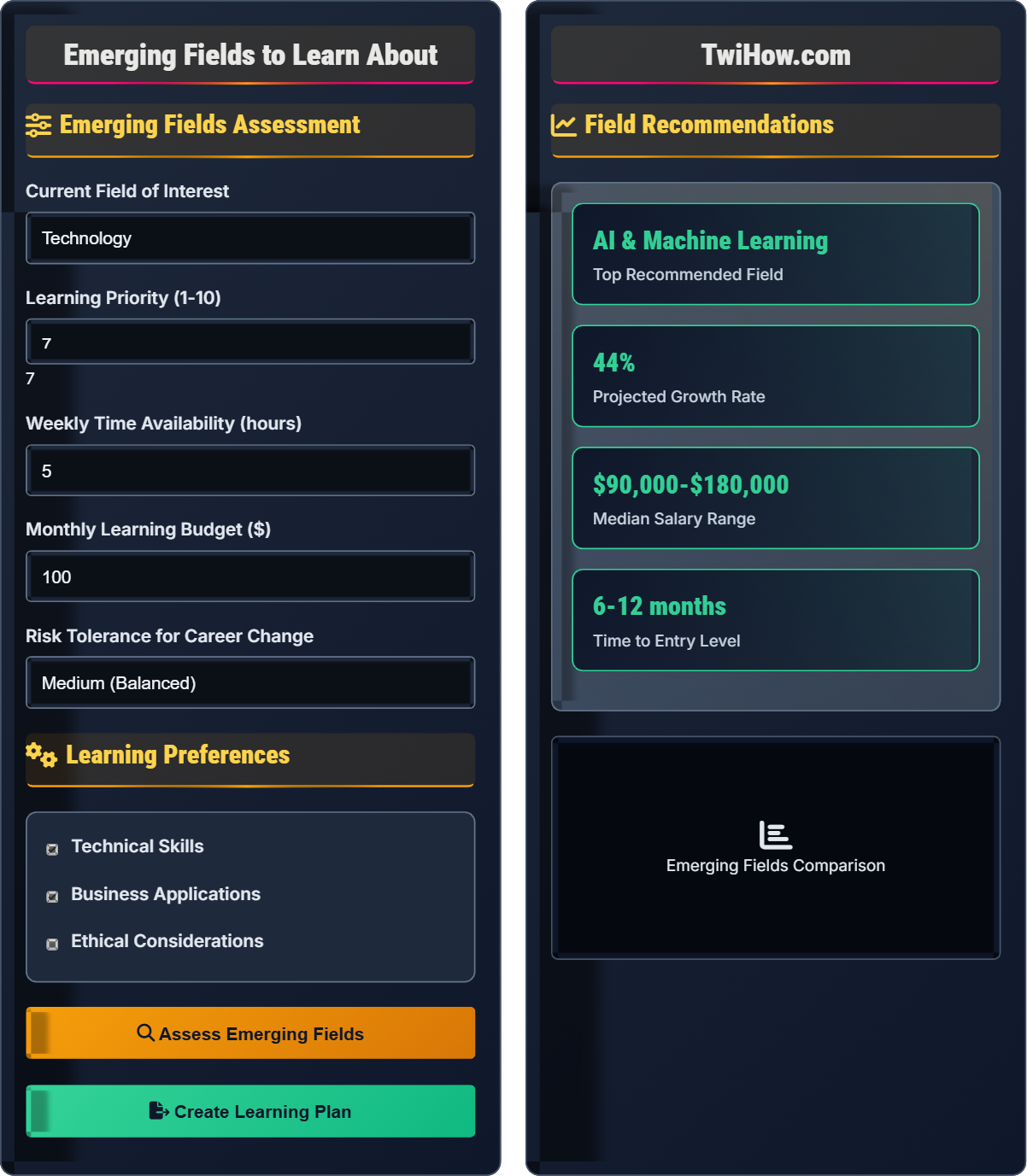
Emerging Fields Assessment
Learning Preferences
Field Recommendations
Emerging Fields Comparison
| Field | Growth Rate | Salary Range | Entry Level |
|---|---|---|---|
| AI & Machine Learning | 35% | $90k-$180k | 6-12 months |
| Quantum Computing | 25% | $120k-$220k | 2-4 years |
| Biotechnology | 20% | $70k-$150k | 1-3 years |
| Renewable Energy | 30% | $60k-$120k | 6-18 months |
| Cybersecurity | 31% | $80k-$160k | 6-12 months |
Required Skills for Top Field
Technical: Python, TensorFlow, Statistics, Linear Algebra
Soft Skills: Problem-solving, Critical thinking, Communication
Domain Knowledge: Data structures, Algorithms, Applied mathematics
Emerging Fields Guide
AI and ML are transforming every industry by enabling computers to learn from data and make intelligent decisions. This field encompasses neural networks, deep learning, natural language processing, and computer vision.
Key applications include:
- Automated Decision Making: Predictive analytics and recommendation systems
- Pattern Recognition: Image and speech recognition technologies
- Process Automation: Robotic process automation and intelligent systems
- Data Insights: Extracting valuable information from large datasets
Quantum computing leverages quantum mechanical phenomena for computation:
Where:
- \(\left|\psi\right\rangle\): Quantum state of qubit
- \(\alpha, \beta\): Probability amplitudes
- \(\left|0\right\rangle, \left|1\right\rangle\): Quantum basis states
Leading emerging fields with high growth potential:
- AI & Machine Learning: Developing intelligent systems and algorithms
- Quantum Computing: Next-generation computational technologies
- Biotechnology: Genetic engineering and personalized medicine
- Renewable Energy: Solar, wind, and battery technologies
- Cybersecurity: Protecting digital infrastructure
- Space Technology: Satellite systems and commercial space
- Blockchain & Web3: Decentralized technologies
- Environmental Tech: Climate solutions and sustainability
Factors that determine success in emerging fields:
- Early Adoption: Being among the first to learn new technologies
- Continuous Learning: Adapting to rapid changes in the field
- Practical Application: Building real-world solutions
- Networking: Connecting with industry leaders and innovators
- Interdisciplinary Skills: Combining technical with business knowledge
Top Emerging Fields
Developing algorithms that enable computers to learn from data and make intelligent decisions.
Mathematical foundations, programming skills, hands-on projects, and continuous experimentation.
- Master mathematical foundations
- Focus on practical applications
- Stay updated with research
- Build a portfolio of projects
Learning Strategies
Online courses, hands-on projects, community engagement, mentorship, and continuous practice.
- Assess current skills and knowledge gaps
- Research field requirements and trends
- Choose appropriate learning resources
- Create a structured learning plan
- Practice with real-world projects
- Join communities and seek mentorship
- Consistent practice and application
- Building a strong foundation
- Staying current with developments
- Developing practical skills
Emerging Fields Quiz
Which of the following is NOT a current application of artificial intelligence?
Time travel technology is not a current application of AI. While AI is used extensively in customer service, medical diagnosis, and financial markets, time travel remains in the realm of science fiction and theoretical physics. This question highlights the importance of distinguishing between current AI capabilities and speculative future possibilities.
The answer is D) Time travel technology.
It's important to distinguish between current AI capabilities and speculative future applications. While AI continues to advance rapidly, it's grounded in solving real-world problems today. Understanding the current state of AI helps set realistic expectations and focus learning on practical applications.
Artificial Intelligence: Simulation of human intelligence processes by machines
Machine Learning: Subset of AI that enables systems to learn and improve
Current Applications: Technologies that exist and are in use today
• Focus on current, practical applications
• Distinguish between hype and reality
• Understand limitations of current technology
• Verify claims about AI capabilities
• Focus on proven applications
• Stay informed about real developments
• Overestimating current AI capabilities
• Focusing on unrealistic applications
Explain the fundamental difference between classical computing and quantum computing, and describe the potential applications of quantum computing.
Classical Computing: Uses bits that exist in definite states of 0 or 1. Operations are deterministic and follow Boolean logic. Problems are solved sequentially through algorithmic steps.
Quantum Computing: Uses quantum bits (qubits) that can exist in superposition (both 0 and 1 simultaneously). Operations leverage quantum phenomena like entanglement and interference. Problems can be solved in parallel through quantum algorithms.
Potential Applications: Cryptography (breaking encryption codes), drug discovery (molecular simulation), optimization (complex logistics), financial modeling, and artificial intelligence acceleration.
Quantum computing represents a paradigm shift from classical computing. Instead of simply being faster versions of classical computers, quantum computers solve problems using fundamentally different principles. This makes them potentially revolutionary for specific types of problems, particularly those involving massive parallelism and complex optimization.
Qubit: Quantum bit that can exist in superposition
Superposition: Quantum state where a particle exists in multiple states simultaneously
Entanglement: Quantum phenomenon linking particles regardless of distance
• Quantum computers won't replace classical ones
• They excel at specific problem types
• Current technology is still in early stages
• Focus on quantum algorithms and applications
• Understand the mathematical foundations
• Follow leading research institutions
• Assuming quantum computers will replace classical ones
• Overestimating current capabilities
• Ignoring mathematical prerequisites
You're interested in biotechnology but come from a non-scientific background. Describe a learning pathway to enter this field, including the necessary foundational knowledge, skills to develop, and potential career opportunities.
Foundational Knowledge: Start with biology fundamentals, chemistry basics, and molecular biology concepts. Focus on genetics, biochemistry, and cell biology.
Technical Skills: Learn laboratory techniques, data analysis, and computational biology tools. Develop programming skills (Python/R) for bioinformatics.
Learning Path: Begin with online courses (Coursera, edX), pursue relevant certifications, engage in virtual lab experiences, and consider formal education if feasible.
Career Opportunities: Research technician, laboratory analyst, biotechnology sales, regulatory affairs specialist, or bioinformatics analyst.
Timeline: 1-2 years to gain foundational skills, 3-5 years for advanced positions.
Transitioning into biotechnology from a non-scientific background requires building a strong foundation in life sciences. The field offers diverse career paths that accommodate various backgrounds, from laboratory work to business applications. The key is identifying which aspect of biotechnology aligns with your interests and strengths.
Biotechnology: Use of biological systems to develop products and technologies
Bioinformatics: Application of computational tools to biological dataMolecular Biology: Study of biological molecules and their interactions
• Build a strong foundational knowledge base
• Focus on practical laboratory skills
• Stay updated with regulatory changes
• Engage in virtual lab experiences
• Join biotech professional organizations
• Consider interdisciplinary specializations
• Skipping foundational science courses
• Underestimating laboratory skill requirements
• Ignoring regulatory and ethical considerations
Your city is planning to transition to 100% renewable energy within 20 years. As someone interested in this emerging field, what skills and knowledge areas should you develop to contribute to this initiative, and what career opportunities might emerge?
Technical Skills: Solar panel installation, wind turbine maintenance, energy storage systems, grid management, power electronics, and renewable energy systems design.
Soft Skills: Project management, policy understanding, environmental impact assessment, and stakeholder communication.
Knowledge Areas: Energy economics, environmental regulations, grid integration, energy storage technologies, and sustainable development.
Career Opportunities: Renewable energy engineer, sustainability consultant, grid operator, policy analyst, project manager, or energy storage specialist.
Learning Path: Technical certification programs, engineering degrees, policy courses, and hands-on experience with renewable energy installations.
The renewable energy transition requires expertise across multiple disciplines. The field combines technical engineering skills with policy understanding and project management. Success in this area requires both specialized technical knowledge and broader understanding of energy systems and their integration into society.
Grid Integration: Connecting renewable energy sources to electrical grids
Energy Storage: Technologies that store energy for later use
Grid Operator: Manages electricity transmission and distribution
• Combine technical and policy knowledge
• Understand energy storage as critical component
• Focus on grid stability and reliability
• Gain experience with specific technologies
• Understand local energy policies
• Develop project management skills
• Focusing only on generation technologies
• Ignoring storage and grid integration
• Underestimating policy and regulatory complexity
Which factor is most critical when transitioning into an emerging field?
Developing a strong foundation in core concepts is most critical when transitioning into an emerging field. While having a related degree, equipment, or prestigious employer can be helpful, a deep understanding of fundamental principles enables adaptation as the field evolves. Emerging fields change rapidly, so foundational knowledge provides the flexibility to learn new developments and technologies.
The answer is B) Developing a strong foundation in core concepts.
Emerging fields are characterized by rapid change and evolution. Rather than relying on static knowledge, success comes from understanding core principles that remain stable while specific technologies and applications evolve. A strong foundation provides the conceptual framework needed to understand new developments as they emerge.
Emerging Field: Rapidly developing area with evolving applications
Core Concepts: Fundamental principles that underlie the field
Foundational Knowledge: Essential understanding required for advanced learning
• Prioritize foundational knowledge over trendy tools
• Develop adaptability and continuous learning skills
• Focus on principles that remain stable
• Master mathematical and scientific foundations
• Build problem-solving skills
• Develop ability to learn independently
• Focusing on specific tools rather than concepts
• Assuming prior experience transfers directly
• Neglecting fundamental knowledge
FAQ
Q: Should I specialize in one emerging field or learn multiple related areas?
A: Start with one field and develop deep expertise, then expand to related areas. Specialization gives you credibility and allows you to become truly skilled in a particular domain. Once you have a solid foundation, you can branch out to complementary fields.
For example, if you start with AI, you might later add expertise in data science or robotics. This creates a "T-shaped" skill profile: deep expertise in one area with broader knowledge in related fields.
The key is to ensure that any additional areas you learn complement and reinforce your primary specialization.
Q: How do I balance learning emerging fields with my current job responsibilities?
A: Implement these strategies:
1. Micro-learning: Dedicate 15-30 minutes daily to focused learning
2. Leverage commute time: Listen to podcasts or audiobooks
3. Weekend immersion: Spend focused time on projects and courses
4. Apply at work: Look for ways to implement new knowledge in current role
5. Join communities: Participate in online forums and meetups
6. Set boundaries: Protect your learning time and avoid burnout
Remember, consistency matters more than intensity. Small, regular efforts compound over time.