Benefits of Teaching Others to Reinforce Learning
Complete guide • Knowledge consolidation
Teaching others to reinforce learning is a powerful educational principle based on the "protégé effect" and "active recall." When you teach, you engage in deeper processing of information, which strengthens neural pathways and improves retention. This approach transforms you from a passive learner to an active knowledge consolidator, accelerating your own understanding while helping others learn.
Key benefits:
- Knowledge Consolidation: Organizing and explaining concepts strengthens understanding
- Enhanced Retention: Active recall and explanation improve long-term memory
- Communication Skills: Improves ability to articulate complex ideas
- Confidence Building: Mastery demonstrated through teaching builds self-efficacy
Research consistently shows that students who teach others retain 90% of the material compared to 50% for those who only study.
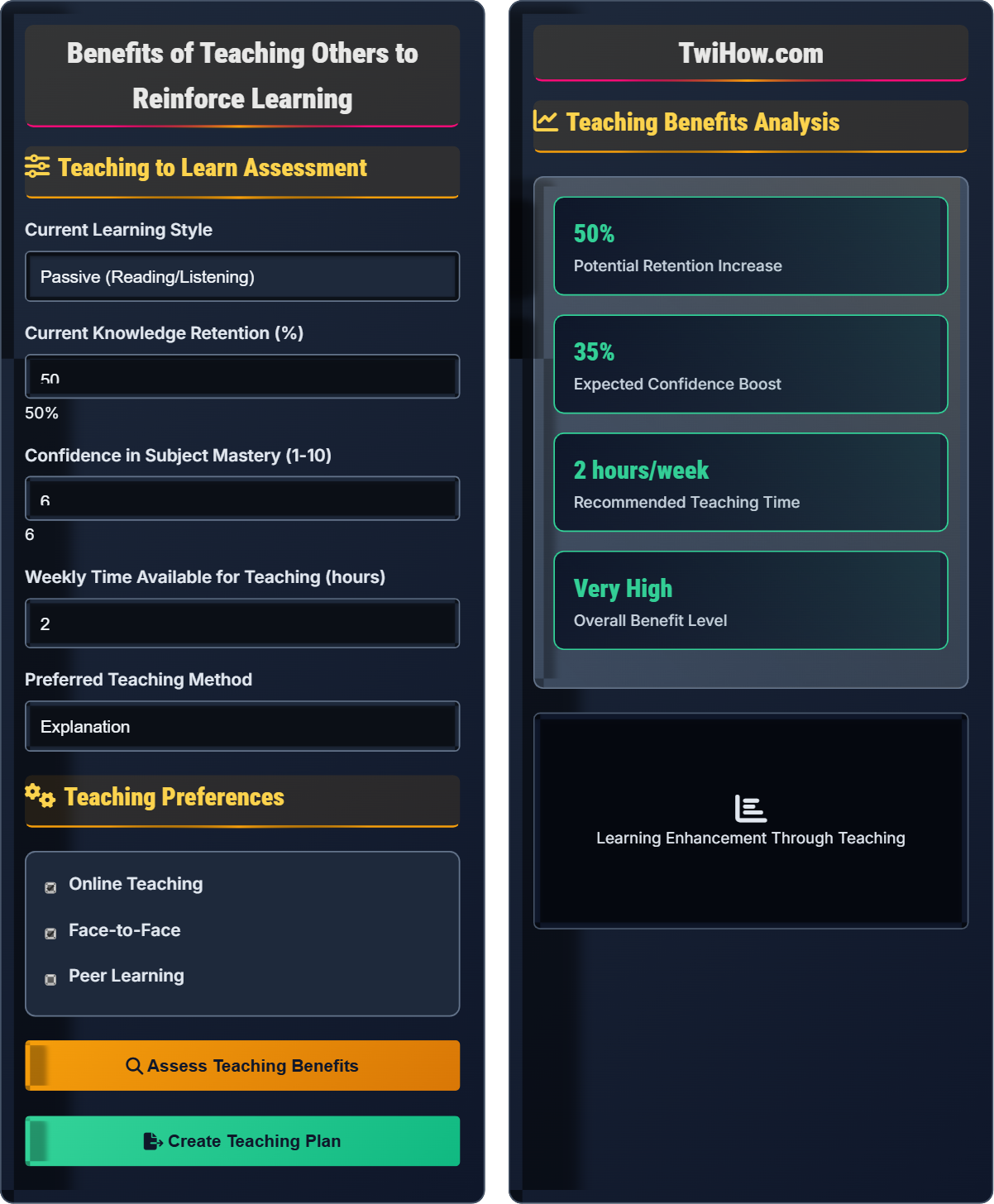
Teaching to Learn Assessment
Teaching Preferences
Teaching Benefits Analysis
Learning Enhancement Through Teaching
| Benefit | Impact | Timeline | Recommendation |
|---|---|---|---|
| Knowledge Retention | High | 2-4 weeks | Explain concepts aloud |
| Confidence | High | 1-3 weeks | Teach to peers |
| Communication | Medium | 4-6 weeks | Present findings |
| Understanding | High | 1-2 weeks | Answer questions |
Recommended Teaching Methods
Study Buddy: Explain concepts to a peer weekly
Mini-Lectures: Create short presentations on topics
Question Sessions: Answer questions about studied material
Video Creation: Make teaching videos for others
Writing: Create summaries and explainers
Teaching to Learn Guide
Research shows that students who teach others retain 90% of the material compared to 50% for those who only study. This phenomenon, known as the "protégé effect," occurs because teaching forces deeper processing of information.
Key mechanisms include:
- Active Recall: Retrieving information to explain it
- Elaborative Processing: Connecting concepts and creating analogies
- Metacognitive Awareness: Monitoring understanding and gaps
- Knowledge Organization: Structuring information logically
The relationship between teaching and learning enhancement:
Where:
- Active Recall: Retrieving information from memory
- Explanation: Articulating concepts clearly
- Feedback: Responses from learners
- Practice: Repeated teaching opportunities
Effective approaches to teaching for learning:
- Peer Teaching: Explain concepts to classmates or study partners
- Mini-Lectures: Create short presentations on studied topics
- Question Answering: Respond to others' questions about material
- Tutoring: Provide structured support to learners
- Writing Explanations: Create summaries and teaching materials
- Video Creation: Develop instructional content for others
Quantifiable benefits of teaching to learn:
- Retention Increase: Up to 90% retention when teaching vs 50% studying alone
- Understanding Depth: Better grasp of complex concepts and relationships
- Communication Skills: Improved articulation of ideas and concepts
- Confidence Building: Increased self-efficacy and subject mastery
- Problem Identification: Better recognition of knowledge gaps
- Critical Thinking: Enhanced analysis and synthesis abilities
Teaching Methods
Peer teaching, mini-lectures, question answering, tutoring, writing explanations, video creation.
Study groups, online forums, presentation practice, peer review, explanation exercises.
- Explain concepts in your own words
- Use analogies and examples
- Encourage questions
- Reflect on teaching effectiveness
Benefits and Outcomes
Enhanced retention, improved communication, increased confidence, deeper understanding, better metacognition.
- Identify knowledge gaps through teaching
- Organize information for clear explanation
- Practice articulating concepts
- Receive feedback on understanding
- Iterate and improve explanations
- Build confidence through mastery demonstration
- Regular practice and application
- Seeking feedback from learners
- Reflecting on teaching effectiveness
- Maintaining patience and clarity
Teaching to Learn Quiz
According to the protégé effect, what percentage of material do students retain when they teach others compared to when they only study?
Research consistently shows that students who teach others retain 90% of the material, compared to 50% for those who only study. This dramatic difference demonstrates the power of the protégé effect, where the act of preparing to teach and actually teaching forces deeper processing of information.
The answer is B) 90% vs 50%.
When you prepare to teach, you must organize information logically, identify key concepts, and anticipate questions. This process requires deeper cognitive processing than passive studying. Teaching forces you to retrieve information from memory and explain it in different ways, strengthening neural pathways and improving long-term retention.
Protégé Effect: Phenomenon where teaching others improves the teacher's learning
Active Recall: Retrieving information from memory rather than reviewing
Elaborative Processing: Connecting new information to existing knowledge
• Teaching requires deeper processing than studying
• Preparation and explanation enhance retention
• Anticipating questions improves understanding
• Explain concepts to yourself aloud
• Teach to study partners regularly
• Create teaching materials for others
• Assuming studying alone is sufficient
• Not preparing adequately for teaching
• Avoiding opportunities to explain concepts
Explain how teaching others enhances cognitive processes like memory consolidation, metacognition, and problem-solving abilities.
Memory Consolidation: Teaching requires retrieving information from memory and organizing it systematically. This retrieval practice strengthens neural pathways and moves information from short-term to long-term memory. The act of explaining concepts in different ways creates multiple retrieval routes.
Metacognition: When teaching, you become aware of what you know and don't know. You must monitor your understanding, identify gaps, and adjust explanations accordingly. This self-monitoring enhances metacognitive awareness.
Problem-Solving: Teaching involves anticipating questions and challenges, which requires analyzing concepts from multiple angles. Answering diverse questions develops flexible thinking and creative problem-solving approaches.
Organization: Preparing to teach requires structuring information logically, which improves understanding of relationships between concepts.
Teaching creates a feedback loop where explaining concepts to others reveals gaps in understanding. This process forces deeper cognitive processing than passive learning, enhancing all aspects of memory and thinking. The need to anticipate questions and adjust explanations develops critical thinking skills.
Memory Consolidation: Process of stabilizing memories after initial acquisition
Metacognition: Awareness and understanding of one's own thought processes
Retrieval Practice: Act of recalling information from memory
• Teaching requires active mental engagement
• Explanation reveals knowledge gaps
• Multiple perspectives enhance understanding
• Practice explaining concepts without notes
• Teach to different audiences for varied perspectives
• Use analogies to deepen understanding
• Teaching without deep understanding
• Not anticipating learner questions
• Avoiding challenging concepts
You're struggling to understand a complex topic in your course. How would you apply the teaching-to-learn principle to master this subject, and what specific steps would you take?
Initial Assessment: Identify the specific aspects of the topic that are challenging. Write down exactly what you don't understand.
Preparation Phase: Research and gather resources to clarify the confusing parts. Organize the information into logical segments.
Teaching Setup: Find a study partner, join a study group, or set up a "teaching session" with yourself using a mirror or voice recorder.
Explanation Process: Attempt to explain each concept as if teaching someone else. Use analogies, examples, and visual aids.
Question Anticipation: Think of potential questions a learner might ask and prepare answers.
Reflection and Adjustment: Note areas where you struggled to explain. Research these gaps and repeat the process.
Practice Iteration: Repeat the teaching process multiple times until explanations become fluent and confident.
When you attempt to teach a concept you're struggling with, the gaps in your understanding become immediately apparent. This self-revelation is a powerful learning tool. The process of preparing to teach forces you to fill in missing pieces and create coherent explanations, leading to deeper mastery.
Knowledge Gap: Missing or incomplete understanding in a subject area
Fluent Explanation: Ability to articulate concepts smoothly and clearly
Self-Revelation: Discovering your own understanding through teaching
• Struggle reveals areas needing attention
• Preparation enhances understanding
• Iteration builds fluency
• Start with the most basic concepts
• Use multiple explanation methods
• Practice with different audiences
• Trying to teach without adequate preparation
• Skipping difficult concepts
• Not iterating the process
You're learning a new professional skill that you need to master quickly. How would you use the teaching-to-learn approach to accelerate your learning, and what methods would be most effective in a workplace context?
Documentation Method: Create detailed notes and explanations of the new skill. Writing forces you to organize thoughts and identify knowledge gaps.
Peer Sharing: Present your learning to colleagues during team meetings or informal sessions. This provides immediate feedback and questions.
Mentorship Opportunity: Offer to assist others who are newer to the skill, which requires you to explain concepts clearly.
Training Session: Volunteer to create a brief training session for the team on what you've learned.
Reflection Practice: Regularly explain the skill to yourself, identifying areas for improvement.
Question Preparation: Anticipate common questions about the skill and prepare thorough answers.
Iteration Cycle: Continuously refine explanations based on feedback and new understanding.
In professional contexts, teaching-to-learn demonstrates expertise while accelerating mastery. The need to explain skills to colleagues or document them for others forces deeper processing and clearer understanding. Workplace teaching also provides immediate, relevant feedback.
Professional Skill: Competency required for workplace effectiveness
Documentation: Recording and organizing information systematically
Workplace Learning: Acquiring skills in professional context
• Demonstrate expertise through teaching
• Seek feedback from colleagues
• Document learning process
• Create internal training materials
• Share insights in team meetings
• Mentor junior colleagues
• Keeping learning to oneself
• Not documenting the learning process
• Avoiding opportunities to share knowledge
Which of the following is the primary metacognitive benefit of teaching others?
The primary metacognitive benefit of teaching others is better awareness of knowledge gaps. When you attempt to explain concepts, you immediately become aware of what you don't understand or can't articulate clearly. This self-awareness is the essence of metacognition - knowing about your own knowledge and learning processes.
The answer is B) Better awareness of knowledge gaps.
Metacognition involves thinking about thinking - being aware of your own cognitive processes. When teaching, you must monitor your understanding in real-time, identifying areas where you struggle to explain concepts. This creates heightened awareness of knowledge gaps that wouldn't be apparent through passive studying.
Metacognition: Awareness of one's own thought processes
Knowledge Gaps: Missing or incomplete understanding
Self-Awareness: Recognition of one's own knowledge limitations
• Teaching reveals knowledge gaps
• Awareness precedes improvement
• Self-monitoring enhances learning
• Note areas where you struggle to explain
• Reflect on your understanding regularly
• Seek feedback on explanations
• Not recognizing knowledge gaps
• Assuming understanding without testing
• Avoiding challenging explanations
FAQ
Q: What if I don't feel confident enough to teach others? Won't that hurt my learning?
A: Teaching others is actually the best way to build confidence! Start with:
• Teaching to yourself in a mirror
• Recording explanations and reviewing them
• Starting with basic concepts you know well
• Finding peers at similar learning levels
• Beginning with written explanations before verbal ones
The act of organizing and explaining concepts will increase your confidence as you see how much you actually know. Teaching reveals your knowledge more than it exposes your gaps!
Q: How can I encourage my students to teach each other?
A: Create opportunities for peer teaching by:
1. Pair Programming: Students explain concepts to each other
2. Teaching Circles: Small groups rotate explaining different topics
3. Student Presentations: Have students teach portions of material
4. Peer Tutoring: Pair stronger and developing students
5. Study Groups: Encourage collaborative learning
6. Reflection Assignments: Have students explain concepts in writing
Provide structure and guidance, but let students take ownership of their learning through teaching.