Best Resources for Learning Soft Skills
Complete guide • Step-by-step learning paths
Soft skills are personal attributes that enable you to interact effectively with others. These include communication, leadership, teamwork, problem-solving, and emotional intelligence. Unlike hard skills, soft skills are harder to teach but crucial for career success and personal relationships.
Key soft skills categories:
- Communication: Verbal, written, and non-verbal expression
- Leadership: Inspiring and guiding others toward goals
- Teamwork: Collaborating effectively with others
- Emotional Intelligence: Understanding and managing emotions
- Problem-Solving: Analyzing challenges and finding solutions
Developing soft skills enhances your ability to navigate complex social situations, build stronger relationships, and adapt to changing environments.
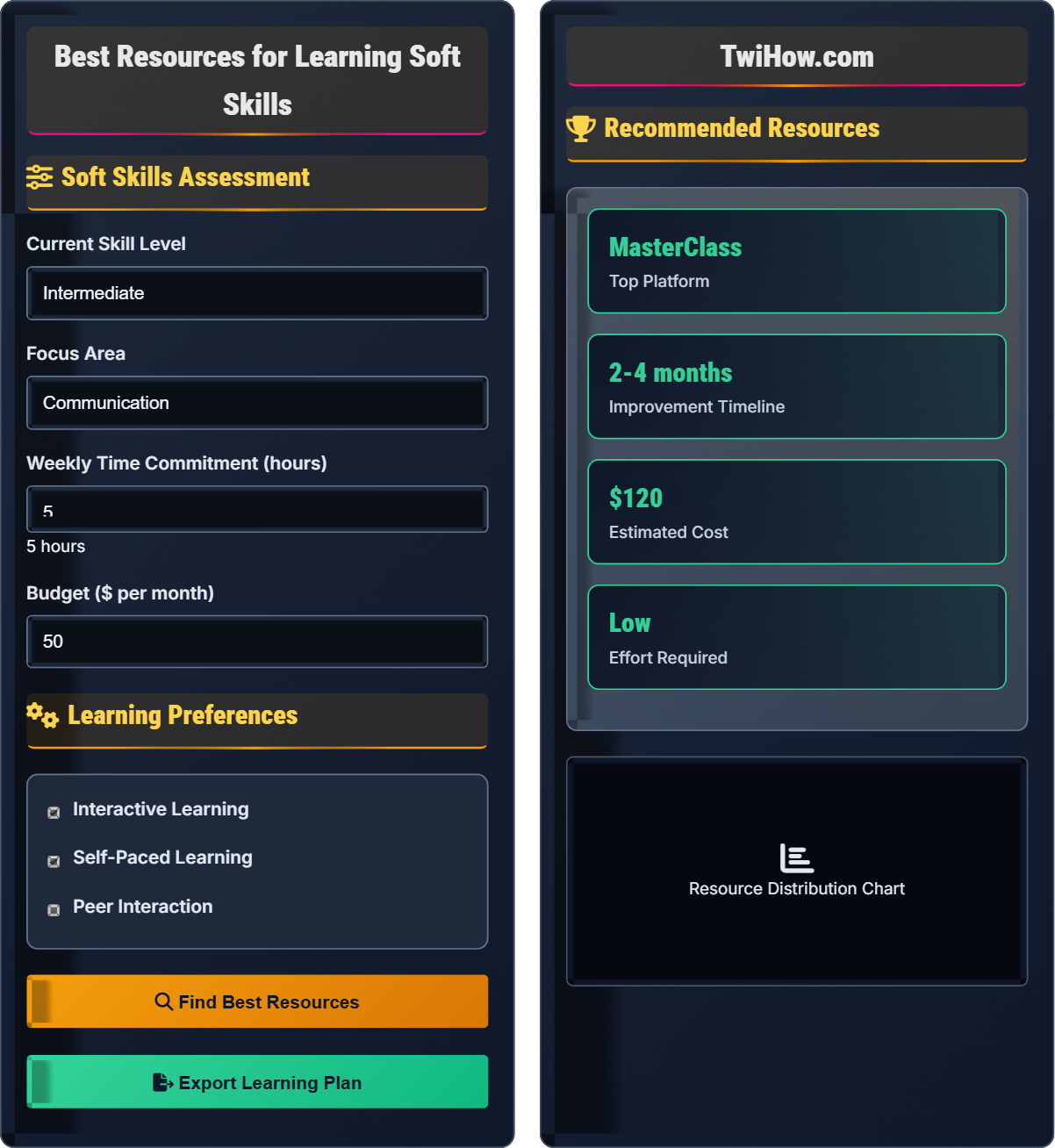
Soft Skills Assessment
Learning Preferences
Recommended Resources
Resource Distribution Chart
| Resource | Type | Duration | Cost |
|---|---|---|---|
| Coursera: Communication Skills | Course | 4 weeks | $49 |
| LinkedIn Learning: Leadership | Course | 3 weeks | $29.99 |
| Toastmasters | Practice Group | Ongoing | $50/month |
| Dale Carnegie Course | Workshop | 12 weeks | $495 |
Weekly Learning Schedule
Monday: Online course (1 hour)
Tuesday: Practice session (1 hour)
Wednesday: Reading (30 minutes)
Thursday: Peer interaction (1 hour)
Friday: Reflection & journaling (30 minutes)
Soft Skills Development Guide
Effective communication is the foundation of all soft skills. It involves both verbal and non-verbal elements, active listening, and the ability to convey ideas clearly.
Key components include:
- Active Listening: Fully concentrating on the speaker
- Clarity: Expressing ideas in a clear, concise manner
- Empathy: Understanding others' perspectives
- Feedback: Providing constructive input
Leadership involves inspiring and guiding others toward shared goals. It encompasses decision-making, motivation, and the ability to influence positively.
Leadership formula:
Where:
- Vision: Clear direction and goals
- Communication: Conveying vision effectively
- Emotional Intelligence: Understanding team dynamics
- Decision-Making: Making informed choices
Emotional intelligence (EQ) is the ability to understand, use, and manage emotions in positive ways to communicate effectively, empathize with others, overcome challenges, and defuse conflict.
The four key skills:
- Self-Awareness: Recognizing your own emotions
- Self-Management: Controlling your emotions
- Social Awareness: Understanding others' emotions
- Relationship Management: Managing relationships
Effective problem-solving follows a systematic approach:
- Identify: Define the problem clearly
- Analyze: Examine root causes
- Generate: Brainstorm possible solutions
- Evaluate: Assess solution effectiveness
- Implement: Execute chosen solution
- Review: Evaluate results and learn
Top Soft Skills Resources
Coursera, LinkedIn Learning, Udemy, Skillshare, MasterClass, Khan Academy.
Self-paced courses, live workshops, peer practice, mentoring, role-playing.
- Consistency is more important than intensity
- Practice regularly in real situations
- Seek feedback from others
- Combine theory with practical application
Development Strategies
Role-playing, shadowing, mentorship, group discussions, case studies.
- Assess current skill level
- Set specific improvement goals
- Select appropriate resources
- Create consistent practice schedule
- Measure progress regularly
- Adjust approach as needed
- Motivation and commitment
- Realistic timeline expectations
- Supportive environment
- Continuous learning mindset
Soft Skills Learning Quiz
Which of the following is the most effective way to demonstrate active listening?
Active listening involves fully concentrating on the speaker, understanding their message, responding appropriately, and remembering what was said. Paraphrasing demonstrates understanding and asking clarifying questions shows engagement and helps ensure accurate comprehension.
The answer is C) Paraphrasing what the speaker said and asking clarifying questions.
Active listening is a foundational soft skill that requires more than just hearing words. It involves paying attention to both verbal and non-verbal cues, showing empathy, and providing feedback that confirms understanding. Effective listeners focus entirely on the speaker rather than planning their response.
Active Listening: Fully concentrating on, understanding, and responding to what someone is saying
Paraphrasing: Restating someone else's message in your own words
Clarifying Questions: Questions that seek to understand the speaker's meaning more precisely
• Avoid interrupting the speaker
• Focus on understanding, not responding
• Confirm your understanding before responding
• Maintain eye contact
• Use verbal affirmations like "I see" or "Go on"
• Summarize key points periodically
• Planning your response while listening
• Interrupting with related stories
• Assuming you know what the speaker means
Explain the four components of emotional intelligence and provide a workplace example for each component.
Self-Awareness: Recognizing your own emotions as they occur. Example: A manager notices they're feeling frustrated during a meeting and recognizes it's affecting their judgment.
Self-Management: Controlling disruptive emotions and impulses. Example: The same manager takes a moment to breathe and composes themselves before addressing the team.
Social Awareness: Understanding others' emotions and feelings. Example: The manager notices tension among team members and identifies the underlying concerns.
Relationship Management: Managing relationships to move people in desired directions. Example: The manager facilitates a discussion to resolve conflicts and rebuild team harmony.
Emotional intelligence builds from internal awareness to external relationship management. Self-awareness is the foundation that enables self-management, which then allows for better social awareness and ultimately more effective relationship management. Each component builds upon the previous one.
Emotional Intelligence (EQ): The ability to understand, use, and manage emotions effectively
Self-Awareness: Conscious knowledge of one's own character, feelings, motives, and desires
Social Awareness: The ability to understand and empathize with others
• EQ can be developed through practice
• It's as important as IQ for success
• Requires ongoing self-reflection
• Keep an emotion journal
• Practice mindfulness meditation
• Seek feedback on your emotional responses
• Suppressing emotions instead of managing them
• Ignoring emotional signals
• Overlooking the emotional climate of groups
You're part of a project team where two colleagues have conflicting ideas about the approach. One prefers a methodical, detail-oriented approach while the other favors rapid prototyping. The conflict is affecting team morale and productivity. How would you address this situation using soft skills?
Approach: Facilitate a structured discussion to understand both perspectives. Use active listening to ensure each person feels heard. Acknowledge the validity of both approaches and suggest combining elements of each method.
Steps: 1) Arrange a private meeting with both colleagues, 2) Listen to each perspective without judgment, 3) Identify the underlying concerns for each approach, 4) Propose a hybrid solution that incorporates both methods, 5) Establish clear milestones to evaluate effectiveness.
Outcome: This approach leverages communication skills, conflict resolution, and collaboration to turn a negative situation into a creative solution.
Conflict in teams often stems from different work styles or priorities rather than personal animosity. Effective team members address the root cause of disagreements rather than just the symptoms. The goal is to find solutions that leverage the strengths of different perspectives.
Conflict Resolution: Process of resolving disputes between parties
Hybrid Approach: Combining different methods to create a more effective solution
Stakeholder Management: Understanding and addressing the needs of all involved parties
• Address conflicts early before escalation
• Focus on interests, not positions
• Seek win-win solutions
• Create a safe space for open dialogue
• Use neutral language
• Focus on project goals rather than personal preferences
• Taking sides in the conflict
• Ignoring the issue hoping it resolves itself
• Focusing on personalities rather than approaches
Your team has just learned that a major project deadline has been moved up by two weeks due to client demands. Team morale is low, and there's resistance to working overtime. As a team leader, how would you apply leadership soft skills to navigate this situation?
Communication Strategy: Hold a team meeting to acknowledge the challenge openly. Share the client's perspective and the importance of the project. Listen to team concerns without dismissing them.
Action Plan: 1) Reassess project scope for possible adjustments, 2) Explore alternative solutions (process improvements, additional resources), 3) Offer incentives for extra effort, 4) Ensure fair distribution of workload.
Follow-up: Regular check-ins to monitor stress levels and adjust approach as needed. Recognize team efforts publicly.
Effective leadership during crises requires balancing task accomplishment with team welfare. Leaders must be transparent about challenges while maintaining hope and direction. The best leaders involve their teams in problem-solving rather than imposing solutions.
Situational Leadership: Adapting leadership style to match the situation and followers' needs
Emotional Support: Providing psychological safety and encouragement
Change Management: Guiding individuals and teams through transitions
• Lead by example during difficult times
• Communicate frequently and transparently
• Balance results with team wellbeing
• Break large tasks into smaller milestones
• Celebrate small wins along the way
• Offer flexibility where possible
• Hiding the reality of the situation
• Forcing overtime without considering consequences
• Failing to acknowledge team stress
Which step in the problem-solving process is most critical for ensuring long-term success?
While all steps are important, the review and learning phase is critical for long-term success because it creates organizational memory. This step ensures that lessons learned from solving the current problem inform future problem-solving efforts, preventing recurrence and improving efficiency.
The answer is C) Reviewing and learning from results.
Many people think problem-solving ends when the immediate issue is resolved, but the learning phase is what transforms a single solution into organizational capability. Without reflection and documentation, the same problems tend to recur. The review phase also validates whether the implemented solution truly addressed the root cause.
Root Cause Analysis: Identifying the fundamental reason for a problem
Organizational Learning: Systematic capture and application of knowledge gained from experienceContinuous Improvement: Ongoing effort to enhance processes and outcomes
• Document the problem-solving process
• Share lessons learned with others
• Update procedures based on insights
• Schedule review sessions after implementing solutions
• Create templates for capturing lessons learned
• Make reflection part of your routine
• Moving immediately to the next problem without reflection
• Failing to document the problem-solving process
• Not sharing insights with others
FAQ
Q: How long does it take to see improvement in soft skills?
A: Soft skill improvement typically follows this timeline:
• Week 1-2: Awareness of current behaviors and areas for improvement
• Week 3-8: Conscious effort to apply new behaviors (can feel awkward)
• Week 9-20: Behaviors become more natural and integrated
• After 20 weeks: New behaviors become habits
Consistent daily practice for 10-15 minutes is more effective than occasional intensive sessions. The key is regular application in real situations rather than just studying concepts.
Q: Which soft skills should I prioritize as a recent graduate entering the workforce?
A: For new graduates, focus on these priority soft skills:
1. Communication: Both written and verbal skills are essential for all roles
2. Adaptability: Ability to learn quickly and adjust to new environments
3. Collaboration: Working effectively with diverse teams
4. Time Management: Prioritizing tasks and meeting deadlines
5. Problem-Solving: Demonstrating initiative and analytical thinking
These skills are universally valued across industries and will support your technical growth. Start by seeking opportunities to practice these skills in volunteer work, internships, or student organizations.