Strategies for Long-Term Knowledge Retention
Complete guide • Memory techniques
Long-term knowledge retention refers to the ability to maintain and recall information over extended periods. This process involves encoding information into long-term memory, consolidating it through various techniques, and retrieving it when needed. Effective retention strategies leverage our understanding of how memory works to maximize the durability and accessibility of learned information.
Key principles:
- Encoding: Converting information into memory traces
- Consolidation: Strengthening and stabilizing memories
- Storage: Maintaining information over time
- Retrieval: Accessing stored information when needed
Research shows that without intervention, we forget approximately 50% of new information within an hour and 70% within 24 hours. However, strategic techniques can increase retention rates to over 80% for extended periods.
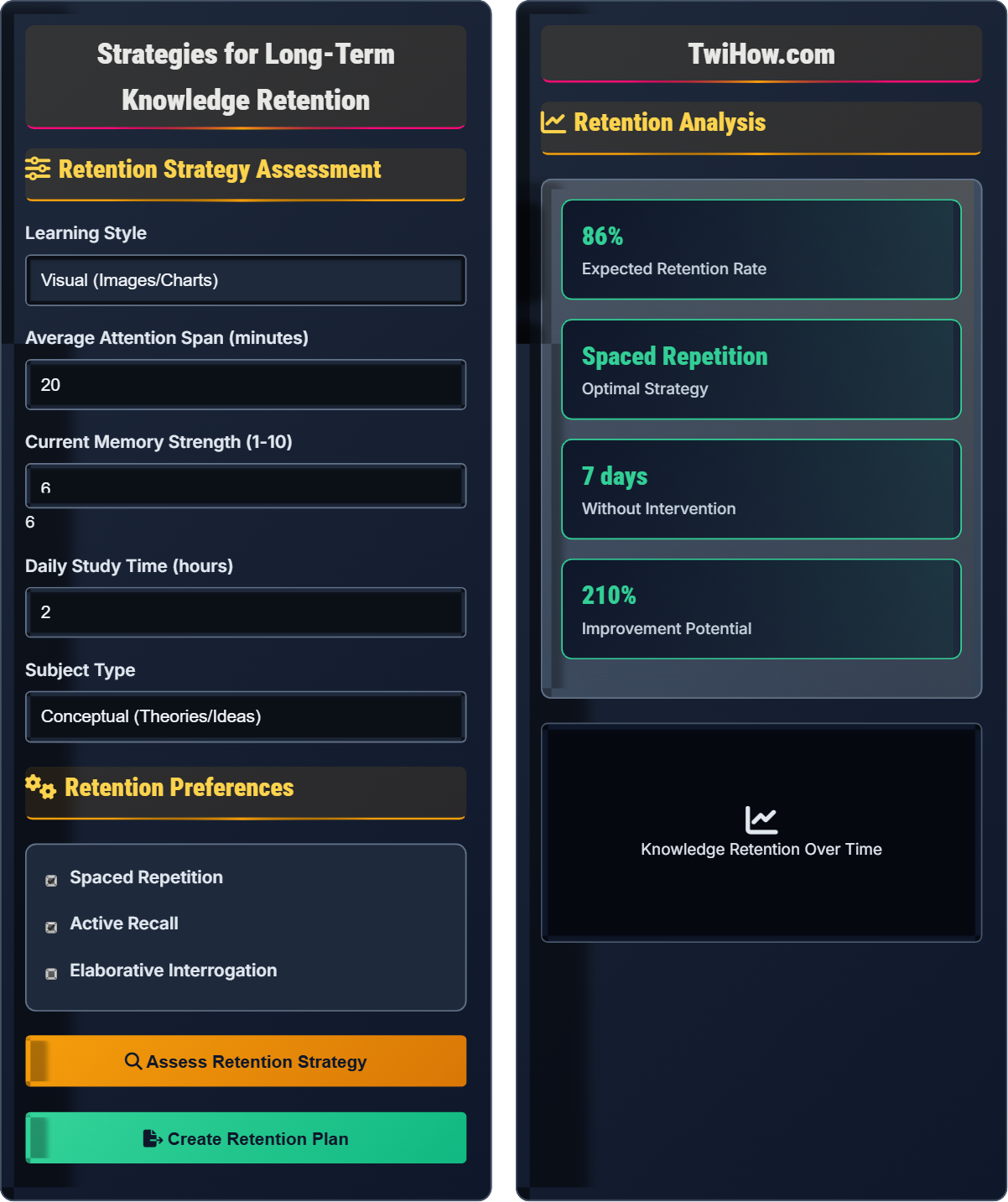
Retention Strategy Assessment
Retention Preferences
Retention Analysis
Knowledge Retention Over Time
| Strategy | Effectiveness | Difficulty | Recommendation |
|---|---|---|---|
| Spaced Repetition | 90% | Medium | Highly Recommended |
| Active Recall | 85% | Easy | Essential |
| Elaborative Interrogation | 75% | Medium | Recommended |
| Interleaving | 70% | Hard | Advanced |
Optimal Review Schedule
Day 1: Initial learning
Day 2: First review (24-hour interval)
Day 7: Second review (5-day interval)
Day 14: Third review (7-day interval)
Day 30: Fourth review (16-day interval)
Day 90: Final review (60-day interval)
Knowledge Retention Guide
Memory formation involves three critical stages:
- Encoding: Converting sensory information into memory traces
- Consolidation: Stabilizing and strengthening memories
- Retrieval: Accessing stored information when needed
Effective retention strategies work by optimizing each stage of this process.
Knowledge retention follows the forgetting curve principle:
Where:
- R: Retention rate
- t: Time since learning
- S: Strength of memory trace
Proven methods to improve retention:
- Spaced Repetition: Review at increasing intervals
- Active Recall: Test yourself instead of re-reading
- Interleaving: Mix different topics during practice
- Elaborative Interrogation: Ask "why" and "how" questions
- Concrete Examples: Use specific instances to illustrate concepts
- Dual Coding: Combine verbal and visual information
Signs of effective retention:
- Easy Retrieval: Information comes to mind readily
- Longevity: Knowledge persists over time
- Flexibility: Ability to apply knowledge in new situations
- Resistance to Forgetting: Minimal decay over time
Evidence-Based Retention Strategies
Spaced repetition, active recall, interleaving, elaborative interrogation, dual coding, concrete examples.
Flashcard systems, self-testing, varied practice, questioning techniques, visualization, real-world application.
- Test yourself instead of re-reading
- Space out practice sessions
- Interleave different topics
- Connect new information to existing knowledge
Application Framework
Context variation, problem-solving practice, teaching others, real-world connections, creative expression.
- Assess current retention level
- Select appropriate strategies
- Create implementation schedule
- Track progress regularly
- Adjust approach based on results
- Maintain consistent practice
- Consistent practice and application
- Regular assessment of progress
- Adjustment based on effectiveness
- Integration with existing study habits
Knowledge Retention Quiz
According to Ebbinghaus's forgetting curve, when should you review new information to maximize retention?
Spaced repetition involves reviewing information at increasing intervals to counteract the forgetting curve. This approach optimizes memory consolidation by timing reviews just as you're about to forget, which strengthens the memory trace more effectively than massed practice.
The answer is B) At increasing intervals (1 day, 3 days, 1 week, 2 weeks, etc.).
Spaced repetition leverages the psychological spacing effect, which shows that information is better retained when study sessions are distributed over time rather than massed together. The optimal intervals vary by individual and material, but the principle remains consistent.
Spaced Repetition: Reviewing information at increasing intervals
Forgetting Curve: Graph showing how quickly we forget information
Memory Consolidation: Process of stabilizing memories
• Review before you forget
• Increase intervals gradually
• Focus on difficult material more frequently
• Use flashcard apps with spaced repetition algorithms
• Create personalized review schedules
• Prioritize challenging concepts
• Cramming before exams
• Not adjusting intervals based on difficulty
Explain the concept of active recall and why it's more effective than passive review for long-term retention.
Active Recall: The process of retrieving information from memory without looking at notes or materials. This requires your brain to reconstruct the information, which strengthens the memory trace.
Why It's More Effective: Active recall creates stronger neural pathways than passive review. When you retrieve information, you're practicing the exact skill needed for later recall. Passive review (like re-reading) creates an illusion of familiarity without strengthening retrieval pathways.
Implementation: Close your book and try to write down or verbally explain what you've learned. Use flashcards, practice tests, or teach the material to someone else.
Benefits: Improved long-term retention, better understanding of knowledge gaps, enhanced ability to apply knowledge in new contexts.
Active recall works because it forces your brain to work harder to retrieve information, which strengthens the neural connections associated with that memory. This "desirable difficulty" enhances learning more than easy recognition tasks.
Active Recall: Retrieving information from memory without cues
Passive Review: Re-reading or looking at information
Desirable Difficulty: Challenges that enhance learning
• Test yourself regularly
• Don't peek at answers
• Focus on difficult concepts
• Use the Feynman Technique (explain simply)
• Create concept maps from memory
• Practice with closed-book exercises
• Highlighting without understanding
• Re-reading instead of testing
• Not challenging yourself enough
You're preparing for a major exam in 6 months. Using retention science principles, design a study schedule that maximizes long-term retention while managing your time efficiently.
Phase 1 (Months 1-2): Focus on initial learning with daily active recall sessions. Spend 2-3 hours per day, breaking content into manageable chunks.
Phase 2 (Months 3-4): Implement spaced repetition with reviews at 3-day, 1-week, and 2-week intervals. Continue learning new material while reviewing old content.
Phase 3 (Months 5-6): Focus on comprehensive reviews and practice tests. Use 1-month and 2-month intervals for final reviews.
Daily Structure: 70% active recall, 20% interleaved practice, 10% initial learning of new material.
Weekly Structure: 4 days focused on specific topics, 1 day for comprehensive review, 2 days for rest.
Techniques: Use flashcards with spaced repetition algorithms, practice tests, teaching concepts to others, and varied problem-solving approaches.
This approach balances initial learning with retention maintenance while preventing cognitive overload.
Long-term preparation allows for optimal spacing of reviews while maintaining focus on both learning and retention. The schedule incorporates multiple evidence-based strategies while considering the natural limitations of attention and memory.
Comprehensive Review: Examining all learned material systematically
Cognitive Load: Amount of mental effort required
Interleaved Practice: Mixing different types of problems
• Balance learning with retention
• Schedule rest periods
• Adapt to individual needs
• Use spaced repetition software
• Track your retention rates
• Adjust schedule based on performance
• Cramming near exam date
• Not scheduling regular reviews
• Ignoring individual learning pace
You're learning a new programming language for your job. How would you apply retention strategies to ensure you remember the syntax and concepts long-term while continuing to work?
Daily Practice: Code for 30-45 minutes each day using active recall - try to write code without looking at examples first.
Spaced Review: Review syntax and concepts at 1-day, 3-day, 1-week, and 2-week intervals using flashcards or practice problems.
Interleaving: Mix different programming concepts (functions, loops, conditionals) rather than focusing on one topic at a time.
Real-World Application: Apply new concepts to actual work projects or personal coding projects.
Elaborative Interrogation: Ask yourself "why" questions about why certain syntax is used and how concepts relate to each other.
Teaching: Explain concepts to colleagues or write blog posts about what you're learning.
Retrieval Practice: Before looking at documentation, try to recall syntax and methods from memory.
This approach ensures that learning transfers to actual job performance while maintaining long-term retention.
Professional skill learning requires immediate application to be effective. The strategies must be adapted to fit into work schedules while still leveraging the principles of memory consolidation. Contextual learning (applying in real situations) enhances retention significantly.
Contextual Learning: Learning in relevant situations
Transfer: Applying knowledge to new situations
Procedural Memory: Memory for skills and processes
• Practice in realistic contexts
• Apply immediately after learning
• Use multiple modalities
• Create personal coding projects
• Use spaced repetition for syntax
• Join programming communities
• Only reading documentation without practice
• Not applying new concepts
• Memorizing without understanding
Which type of memory system is most relevant for long-term retention of educational content?
Long-term memory is the system responsible for storing information over extended periods, from hours to decades. This is the target system for educational content retention. While working memory is important for processing new information, long-term memory is where learning must be consolidated for lasting retention.
The answer is D) Long-term memory.
Understanding memory systems helps explain why certain strategies work better than others. Information must be transferred from working memory to long-term memory through consolidation processes. This transfer is enhanced by strategies like spaced repetition and active recall.
Long-Term Memory: System for permanent information storage
Working Memory: Temporary information processing system
Memory Consolidation: Process of transferring to long-term storage
• Focus on transfer to long-term memory
• Use strategies that promote consolidation
• Recognize memory system limitations
• Create strong encoding experiences
• Use elaborative techniques
• Practice retrieval regularly
• Confusing different memory systems
• Not understanding transfer mechanisms
• Focusing only on short-term retention
FAQ
Q: How do I know if I'm actually retaining information or just recognizing it?
A: True retention involves active recall, not recognition:
• Recognition: "Yes, I've seen this before" (weak indicator)
• Recall: Actually retrieving information from memory (strong indicator)
• Test yourself: Close books and try to explain concepts without cues
• Use different contexts: Apply knowledge in new situations
• Explain to others: Teaching requires true understanding
• Wait before reviewing: Try to recall after some time has passed
Recognition creates an illusion of knowing that can be misleading about actual retention.
Q: How can I help my students develop better retention skills?
A: Help students by:
1. Teaching the science of memory: Explain how retention works
2. Modeling effective strategies: Demonstrate active recall and spaced practice
3. Building in practice: Regular retrieval exercises during class
4. Providing varied contexts: Apply concepts in different scenarios
5. Encouraging self-testing: Have students create their own practice tests
6. Spacing review: Return to concepts at intervals throughout the course
Focus on teaching students how to learn effectively, not just what to learn.