Role of Gamification in Education
Complete guide • Engagement strategies
Gamification in education involves applying game design elements and principles in educational contexts to increase student engagement, motivation, and learning outcomes. Rather than turning education into a game, it integrates elements like points, badges, leaderboards, challenges, and narratives to make learning more interactive and enjoyable.
Key components:
- Game Mechanics: Points, badges, levels, challenges
- Engagement Drivers: Competition, collaboration, achievement
- Learning Outcomes: Improved retention, participation, motivation
- Design Principles: Progressive difficulty, immediate feedback, autonomy
Research shows that well-designed gamification can increase student engagement by up to 60% and improve learning retention rates significantly.
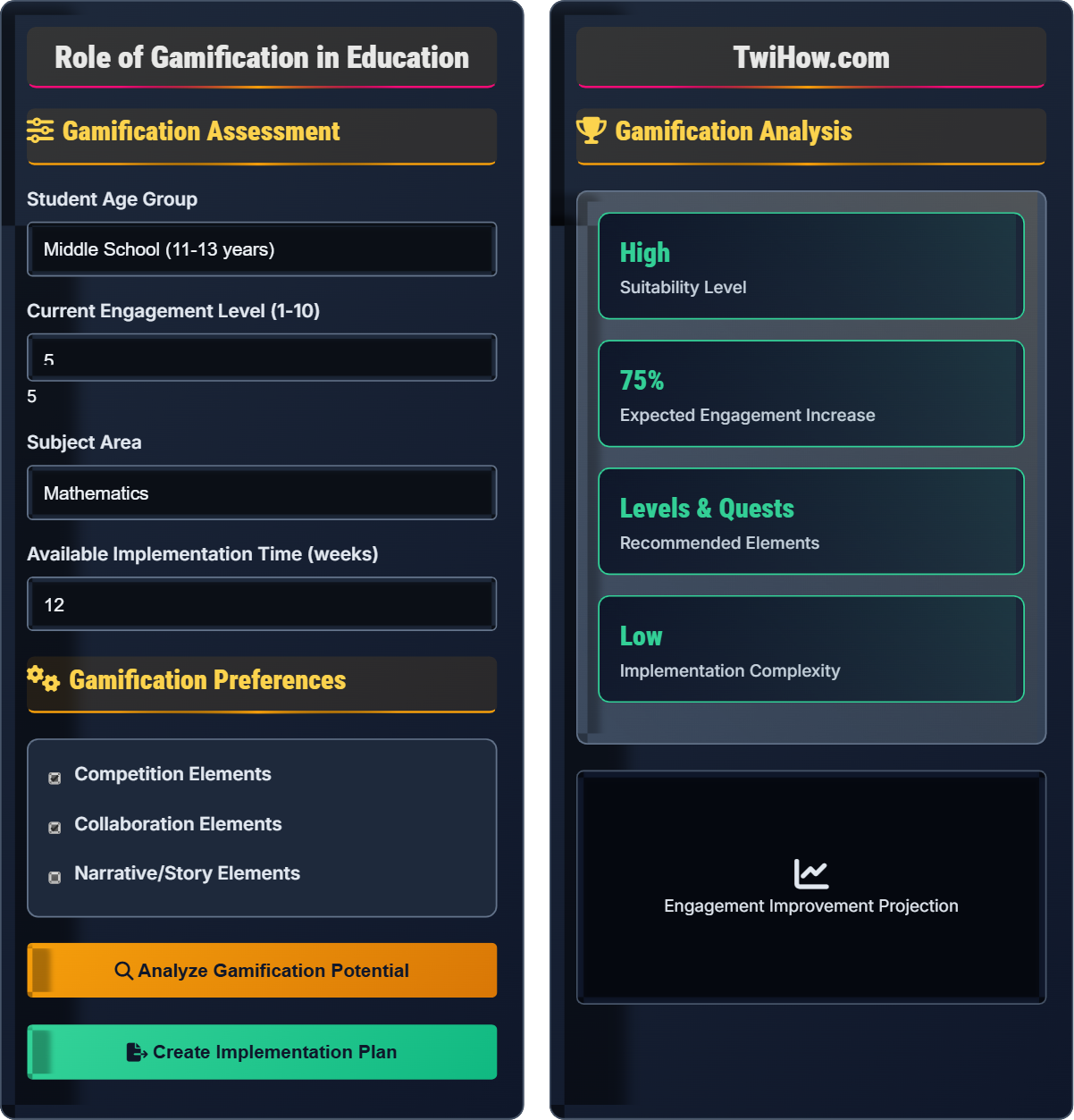
Gamification Assessment
Gamification Preferences
Gamification Analysis
Engagement Improvement Projection
| Factor | Level | Impact | Recommendation |
|---|---|---|---|
| Student Age Suitability | High | High | Use age-appropriate mechanics |
| Subject Engagement Potential | Medium | Medium | Focus on narrative elements |
| Implementation Feasibility | High | High | Start with simple elements |
| Expected ROI | High | High | Invest in comprehensive approach |
Recommended Game Elements
Points System: Reward for completing assignments
Badges: Recognition for achievements
Levels: Progression through content mastery
Challenges: Timed activities to increase engagement
Leaderboard: Friendly competition among peers
Gamification in Education Guide
Game mechanics are the fundamental building blocks of gamification that drive engagement and motivation:
- Points: Immediate feedback for accomplishments
- Badges: Recognition for achievements and milestones
- Leaderboards: Social comparison and competition
- Levels: Progression through increasing difficulty
- Quests/Challenges: Structured tasks with clear goals
- Avatars: Personal identity and customization
Gamification effectiveness follows Self-Determination Theory principles:
Where:
- Autonomy: Learner control over pace and path
- Competence: Feeling of mastery and progression
- Relatedness: Connection with peers and instructors
- Game Elements: Mechanics that enhance motivation
Proven implementations in education:
- Khan Academy: Points, energy points, badges, progress tracking
- Duolingo: Streaks, hearts, levels, timed challenges
- Classcraft: Role-playing game for classroom management
- Prodigy: Math learning through adventure game
- Quizizz: Competitive quiz format with avatars
- Breakout EDU: Escape room style learning challenges
Key metrics to track gamification effectiveness:
- Engagement Metrics: Time spent, participation rates, completion rates
- Learning Outcomes: Test scores, retention rates, skill acquisition
- Behavioral Changes: Attendance, homework completion, collaboration
- Satisfaction Measures: Student feedback, motivation surveys
Game Elements in Education
Points, badges, leaderboards, levels, quests, avatars, challenges, feedback systems.
Curriculum mapping, tool selection, gradual implementation, teacher training, student orientation.
- Game elements should support learning, not distract from it
- Balance competition with collaboration
- Provide meaningful rewards for genuine achievement
- Ensure accessibility for all learners
Benefits and Considerations
Increased engagement, improved retention, enhanced motivation, better collaboration, personalized learning paths.
- Align game elements with learning objectives
- Choose appropriate mechanics for your audience
- Design balanced reward systems
- Plan for sustainable implementation
- Establish clear guidelines and expectations
- Monitor and iterate based on results
- Teacher buy-in and training
- Student choice and autonomy
- Meaningful feedback systems
- Progressive difficulty curves
Gamification in Education Quiz
Which game mechanic is most effective for encouraging long-term learning retention?
Levels and progression systems are most effective for long-term retention because they create a sense of mastery and accomplishment tied directly to learning outcomes. Unlike extrinsic rewards like points or badges, levels encourage students to persist through challenges and master content before advancing, promoting deeper understanding and retention.
The answer is C) Levels and progression through content mastery.
According to Self-Determination Theory, progression systems satisfy the need for competence by allowing learners to experience growth and mastery. When students advance through levels by demonstrating knowledge, they develop intrinsic motivation to continue learning. This contrasts with purely extrinsic rewards that may lose effectiveness over time.
Game Mechanics: Structural elements that define player actions
Learning Retention: Ability to store and recall information over time
Progression Systems: Mechanisms that unlock content based on achievement
• Align mechanics with learning objectives
• Focus on intrinsic motivation
• Ensure progressive difficulty
• Create meaningful progression paths
• Link levels to actual skill mastery
• Provide clear feedback on advancement
• Using gamification as a substitute for good teaching
• Over-relying on competition elements
• Creating meaningless rewards
Explain how to design a gamification system for a high school mathematics class that balances competition and collaboration while supporting learning objectives.
Competition Elements: Individual progress tracking through levels, achievement badges for math milestones, friendly weekly challenges to solve problems faster or more accurately.
Collaboration Elements: Group quests where teams must solve multi-step problems together, peer mentoring systems where advanced students help others, collaborative leaderboards showing class-wide progress toward collective goals.
Learning Alignment: Points awarded for demonstrating problem-solving processes, not just correct answers. Badges for mastering specific mathematical concepts. Levels tied to curriculum standards and skill progression.
Balance Strategy: Alternate between individual and group challenges, provide multiple pathways to earn recognition, ensure all students can participate meaningfully regardless of starting level.
Effective gamification in mathematics requires balancing individual accountability with collaborative learning. Competition can motivate students to practice more, while collaboration helps develop problem-solving skills and mathematical discourse. The key is ensuring that game elements reinforce mathematical practices rather than replacing them.
Individual Accountability: Students responsible for their own learning progress
Mathematical Discourse: Communication about mathematical concepts and reasoning
Problem-Solving Processes: Steps taken to solve mathematical problems
• Ensure all students can succeed
• Focus on mathematical reasoning
• Balance individual and group elements
• Award points for showing work
• Create math-themed storylines
• Use real-world applications in challenges
• Focusing only on getting correct answers
• Creating too much competition
• Neglecting different learning styles
You're teaching a middle school science class where student engagement is low. You want to implement gamification to increase participation and learning. Design a comprehensive approach that addresses the unique challenges of science education and middle school learners.
Science-Specific Elements: Laboratory quest system where experiments are missions, scientific method badges for hypothesis formation, discovery points for observations and conclusions, scientist avatar customization based on completed investigations.
Age-Appropriate Mechanics: Short-term goals to match attention spans, visual progress tracking, peer collaboration on experiments, achievement trees showing skill development.
Engagement Strategy: Weekly science challenges, virtual field trips as rewards, mystery science scenarios, collaborative data collection projects.
Learning Integration: Points tied to scientific reasoning, badges for following safety protocols, levels based on scientific literacy and experimental design skills.
Middle school students are naturally curious about the world around them, making science an ideal subject for gamification. The key is channeling their curiosity into structured learning experiences that emphasize the investigative nature of science. Game elements should support scientific thinking rather than distract from it.
Scientific Method: Systematic approach to investigating phenomena
Scientific Literacy: Understanding of scientific concepts and processesExperimental Design: Planning and conducting scientific investigations
• Emphasize the process of science
• Connect to real-world applications
• Ensure safety in all activities
• Use scientific phenomena as quest hooks
• Reward careful observation
• Celebrate failed experiments as learning
• Focusing on memorization over understanding
• Ignoring safety considerations
• Making games too complex for the subject
Your school has introduced tablets for every student. How would you design a gamified language learning program that leverages technology while maintaining focus on communication skills and cultural understanding?
Technology Integration: Virtual conversation partners, augmented reality cultural experiences, multimedia storytelling projects, peer video exchanges, real-time pronunciation feedback.
Game Elements: Journey maps where students travel through countries, cultural competency badges, conversation streaks, vocabulary leveling systems, collaborative translation projects.
Communication Focus: Speaking challenges with voice recording, peer review systems, video diary entries in target language, collaborative story creation.
Implementation: Blended approach combining digital and face-to-face interactions, gradual introduction of technology tools, regular tech support for students and teachers.
Technology-enhanced language learning can provide immersive experiences and immediate feedback that traditional methods cannot. However, the focus must remain on authentic communication rather than just technological novelty. Gamification should enhance the linguistic and cultural learning experience.
Augmented Reality: Technology that overlays digital information on real world
Authentic Communication: Meaningful language use in real contexts
Blended Learning: Combination of online and face-to-face instruction
• Technology should enhance, not replace, communication
• Maintain focus on cultural understanding
• Provide balance between digital and human interaction
• Use technology for authentic cultural experiences
• Encourage peer-to-peer interaction
• Integrate with real-world applications
• Over-relying on technology
• Losing focus on communication skills
• Ignoring cultural context
How should gamification elements be integrated with traditional assessment in educational settings?
The most effective approach is to have gamification supplement traditional assessments while maintaining the integrity of formal evaluation. Gamification can enhance practice, engagement, and formative assessment, but traditional assessments provide standardized measurement of learning outcomes. The integration should enhance both systems rather than replacing either.
The answer is B) Gamification should supplement but not replace traditional assessments.
Effective educational gamification maintains the rigor of traditional assessment while enhancing engagement and practice opportunities. Gamification excels at providing frequent, low-stakes feedback that supports learning, while traditional assessments serve important functions for measuring achievement and making educational decisions.
Formative Assessment: Ongoing evaluation during learning process
Summative Assessment: Evaluation at end of learning period
Standardized Measurement: Consistent evaluation across contexts
• Maintain assessment integrity
• Use gamification for practice and engagement
• Balance innovation with tradition
• Use gamification for practice tests
• Provide progress tracking
• Celebrate improvement over time
• Replacing valid assessment methods
• Sacrificing rigor for engagement
• Not aligning with learning objectives
FAQ
Q: How do I ensure gamification doesn't become more important than actual learning in my classroom?
A: To maintain focus on learning:
• Align game elements directly with learning objectives
• Award points for demonstrating understanding, not just participation
• Use badges to recognize skill mastery rather than completion
• Regularly connect game progress to actual learning gains
• Balance extrinsic rewards with intrinsic motivation
• Monitor to ensure students understand the connection between game elements and learning goals
The key is designing game elements that naturally support the learning process rather than competing with it.
Q: I've seen gamified learning tools that felt fake or childish. How can educators make gamification feel authentic?
A: Authentic gamification involves:
1. Meaningful challenges: Tasks that genuinely require skill and thinking
2. Real-world connections: Applications that mirror actual practice
3. Student agency: Choices in how to approach challenges
4. Progressive complexity: Difficulty that increases appropriately
5. Clear purpose: Game elements that serve educational goals
6. Student input: Involving learners in design decisions
Authentic gamification respects students' intelligence and connects to their interests and future goals.