How Do I Balance Structure and Flexibility in Parenting?
Complete parenting guide • Step-by-step explanations
Structure-Flexibility Balance:
Show Balance SimulatorBalancing structure and flexibility in parenting is crucial for healthy child development. Structure provides children with security, predictability, and clear boundaries, while flexibility allows for adaptation to individual needs, growth, and changing circumstances. The key is finding the right combination that meets your child's needs while maintaining family values and expectations.
Key aspects of balanced parenting:
- Consistent Boundaries: Clear expectations with reasonable flexibility
- Adaptive Responses: Adjusting to individual child needs and circumstances
- Developmental Appropriateness: Evolving structure with child's growth
- Family Values: Maintaining core principles while allowing growth
- Emotional Security: Providing stability while encouraging independence
Children thrive when they have both predictable structure and the flexibility to explore, grow, and develop their individual personalities. This balance helps build confidence, responsibility, and adaptability.
Balance Assessment Parameters
Balance Areas
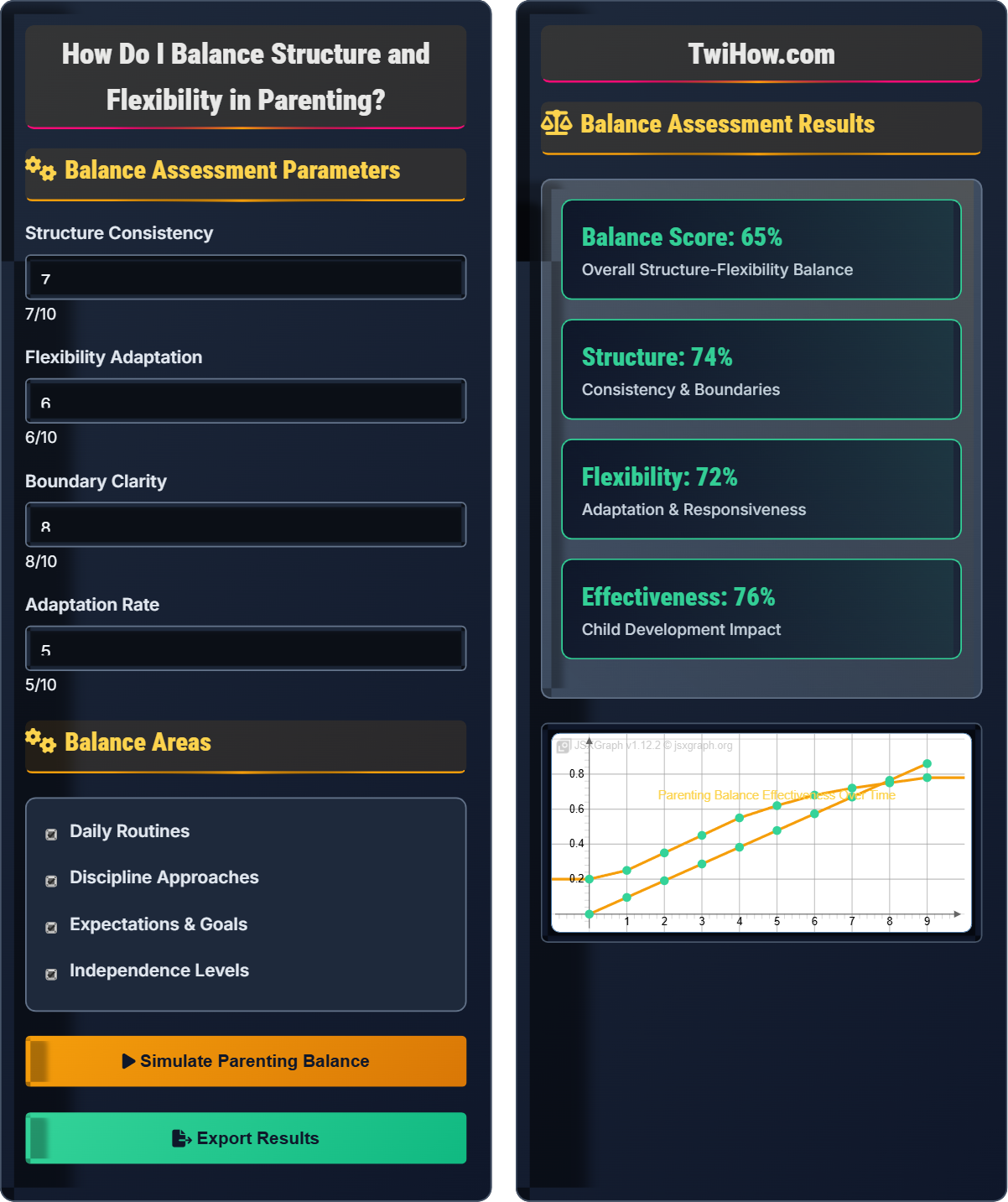
Balance Assessment Results
| Balance Element | Score | Impact Level | Recommendation |
|---|---|---|---|
| Structure Consistency | 7/10 | High | Good balance |
| Flexibility Adaptation | 6/10 | Medium | Increase adaptability |
| Boundary Clarity | 8/10 | High | Excellent |
| Adaptation Rate | 5/10 | Medium | Improve responsiveness |
| Child Response | 7/10 | High | Positive feedback |
Balancing Structure and Flexibility in Parenting
Balanced parenting combines consistent structure with adaptive flexibility. It provides children with secure boundaries and predictable routines while allowing for individual growth and responsiveness to changing needs. This approach creates an environment where children feel safe and supported while developing independence and problem-solving skills.
Where:
- Structure: Consistent boundaries, routines, and expectations
- Flexibility: Adaptive responses and situational adjustments
- Developmental Appropriateness: Matching approach to child's age and maturity
Areas where each approach is emphasized:
- Structure Emphasis: Safety rules, basic manners, sleep routines, academic expectations
- Flexibility Emphasis: Social activities, creative pursuits, learning styles, personal preferences
- Balanced Approach: Discipline methods, independence levels, family responsibilities, social boundaries
- Context Dependent: Weather-dependent activities, special circumstances, developmental stages
- Child-Driven: Individual strengths, interests, temperament, learning preferences
- Clear Communication: Explain the reasoning behind both structure and flexibility
- Gradual Transitions: Ease into new routines or expectations over time
- Consistent Core Rules: Maintain essential boundaries while allowing flexibility in others
- Child Input: Involve children in age-appropriate decision-making
- Regular Reviews: Assess and adjust approaches based on outcomes
- Family Meetings: Discuss and negotiate family expectations together
Parenting Balance Fundamentals
Structure, flexibility, boundaries, consistency, adaptability, child development, parenting style, family dynamics.
Balance = (Structure × Flexibility) ÷ (Child's Age + Circumstances)
Where Balance = optimal parenting approach, Structure = consistent boundaries.
- Non-negotiables provide security
- Flexibility allows growth and adaptation
- Balance evolves with child's development
Practical Applications
Daily routines, discipline situations, social activities, academic expectations, family responsibilities, special circumstances.
- Identify core family values and non-negotiables
- Establish flexible routines and expectations
- Monitor child's responses and development
- Adjust approach based on individual needs
- Communicate changes clearly and consistently
- Individual child temperament
- Family values and beliefs
- Developmental stage
- External circumstances
Parenting Balance Quiz
What is the most important principle for balancing structure and flexibility in parenting?
The most important principle is maintaining core values while allowing flexibility in methods. This approach provides children with security through consistent values and boundaries while allowing for adaptation to individual needs and circumstances. It creates predictability where needed while allowing growth and independence.
The answer is B) Maintain core values while allowing flexibility in methods.
Children need both security and growth opportunities. Core values provide the foundation for decision-making and behavior, while flexible methods allow for individual differences and changing circumstances. This approach teaches children that principles are important while showing that understanding and adaptation are also valuable.
Core Values: Fundamental family principles and beliefs
Flexible Methods: Various approaches to achieve goals
Security: Feeling safe and predictable
• Values provide the foundation
• Methods can adapt to circumstances
• Consistency builds trust
• Identify 3-5 non-negotiable family values
• Explain the reasoning behind rules
• Be willing to adjust methods while maintaining values
• Confusing values with methods
• Being inflexible about everything
• Not explaining the reasoning behind rules
Explain how to maintain structure while being flexible in response to special circumstances. Include specific examples and strategies.
Strategies: Maintain core values while adjusting specific rules, communicate clearly about temporary changes, explain the reasoning, and return to normal routines when possible.
Examples: Extending bedtime during illness, modifying chores during exam week, adjusting screen time during travel, relaxing some rules during family crises while maintaining safety rules.
Communication: "We're making this exception because of [specific reason], but our core rules about safety and respect still apply."
Children benefit from understanding that flexibility exists within a framework of core values. This approach teaches them that rules have purposes and that exceptions are made thoughtfully. It helps them develop judgment skills and shows that responsible adults can adapt while maintaining important principles.
Situational Flexibility: Adjusting rules based on circumstances
Core Values: Unchanging family principlesTemporary Changes: Short-term modifications to rules
• Core safety rules rarely change
• Explain reasons for exceptions
• Return to routines when possible
• Set time limits for exceptions
• Involve children in decision-making when appropriate
• Model flexible thinking
• Not explaining the reasoning for changes
• Making exceptions too frequently
• Changing too many rules at once
Your 10-year-old daughter has a structured homework routine but is struggling with a particular subject. She wants to adjust her routine to spend more time on this subject, but it conflicts with family dinner time. How do you balance maintaining structure with accommodating her academic needs?
Approach: Acknowledge her initiative to improve, maintain family dinner time as a core value, and create a flexible homework schedule that accommodates her needs.
Strategies: Adjust homework timing on certain days, allow extra study time before dinner on weekdays, maintain weekend study schedule, and ensure she gets adequate support for the challenging subject.
Communication: "We value family time and your academic success equally. Let's find a way to support both." This teaches her that important values can coexist with individual needs.
This scenario demonstrates how to honor both structure and flexibility simultaneously. The family dinner time represents a core value that provides structure, while adjusting homework timing shows flexibility in methods. This approach teaches children that important values don't have to be sacrificed for individual needs, and that creative solutions can honor multiple priorities.
Core Value: Fundamental family principle
Flexible Method: Adaptable approach to achieving goals
Creative Solution: Innovative approach to meeting multiple needs
• Identify non-negotiable core values
• Be flexible about methods
• Involve children in problem-solving
• Brainstorm solutions together
• Try temporary adjustments
• Evaluate effectiveness regularly
• Changing core values too easily
• Not involving children in solutions
• Making permanent changes for temporary needs
Your 14-year-old son wants more independence and flexibility, but you're concerned about safety and responsibility. How do you gradually increase flexibility while maintaining necessary structure and boundaries?
Approach: Gradually increase independence based on demonstrated responsibility, maintain core safety boundaries, and create clear expectations for earned freedoms.
Strategies: Implement trial periods for new freedoms, establish clear consequences for misuse of privileges, and gradually expand independence as responsibility increases.
Framework: "Responsibility earns privileges. As you demonstrate responsibility in [specific area], you'll earn [specific privilege]." This teaches cause-and-effect relationships.
Adolescents need increasing independence to develop into responsible adults, but they still need structure and safety. The key is linking privileges to demonstrated responsibility. This approach teaches accountability while gradually expanding freedom. It also helps teenagers understand that rights come with responsibilities.
Gradual Independence: Increasing freedom based on responsibility
Responsibility: Accountability for actions and outcomes
Privilege: Earned freedom based on demonstrated behavior
• Link privileges to responsibility
• Maintain safety boundaries
• Gradual increases in freedom
• Start with small freedoms
• Establish clear expectations
• Monitor and adjust as needed
• Giving too much freedom too quickly
• Not monitoring the results
• Not linking privileges to responsibility
How should you communicate changes in structure and flexibility to your children?
Explaining the reasoning and involving children in decisions when appropriate is the best approach. This builds trust, helps children understand the purpose behind rules, and teaches them to think critically about structure and flexibility. Age-appropriate involvement also helps children develop decision-making skills.
The answer is B) Explain the reasoning and involve them in decisions when appropriate.
Communication is crucial for maintaining the structure-flexibility balance. When children understand the reasoning behind rules and changes, they're more likely to cooperate and develop their own judgment skills. Involving them in age-appropriate decisions teaches them to balance their needs with family values and helps them internalize principles rather than just following rules.
Transparent Communication: Clear explanation of reasoning
Age-Appropriate Involvement: Decision-making matching maturity level
Internalization: Adopting principles as personal values
• Explain the reasoning behind changes
• Involve children appropriately
• Maintain open communication
• Use family meetings for major changes
• Explain both structure and flexibility reasoning
• Listen to children's perspectives
• Not explaining reasoning for changes
• Involving children in inappropriate decisions
• Not maintaining open communication channels
FAQ
Q: How do I know if I'm being too rigid or too flexible?
A: Signs of being too rigid include constant power struggles, children feeling fearful or rebellious, and lack of growth in independence. Signs of being too flexible include inconsistent behavior, lack of security, and difficulty with boundaries. The key is observing your child's responses and outcomes. Children should feel secure but not stifled, and they should be developing responsibility and independence.
Q: What if my spouse has a completely different approach to structure and flexibility?
A: Present a united front by discussing and agreeing on core values and non-negotiables together. Allow for some differences in methods as long as core principles are maintained. Have private discussions to align your approaches and present consistent expectations to children. If you disagree on an issue, tell children you'll discuss it privately and get back to them with a decision. Consistency between parents is crucial for children's security.