How Do I Build a Strong Parent-Child Attachment?
Complete parent's guide • Bonding & emotional connection
Building Parent-Child Attachment:
Attachment BuilderBuilding a strong parent-child attachment is fundamental to healthy child development. Secure attachment provides emotional stability, self-regulation skills, and a foundation for healthy relationships throughout life. The key elements include responsive caregiving, emotional availability, consistency, and unconditional love.
Core components include:
- Responsive Caregiving: Meeting physical and emotional needs promptly
- Emotional Availability: Being present and attuned to your child's emotions
- Consistency: Providing predictable responses and routines
- Quality Time: Engaging in meaningful interactions daily
- Secure Base: Being a source of safety and comfort
Attachment develops through everyday interactions and grows stronger with consistent, loving care over time.
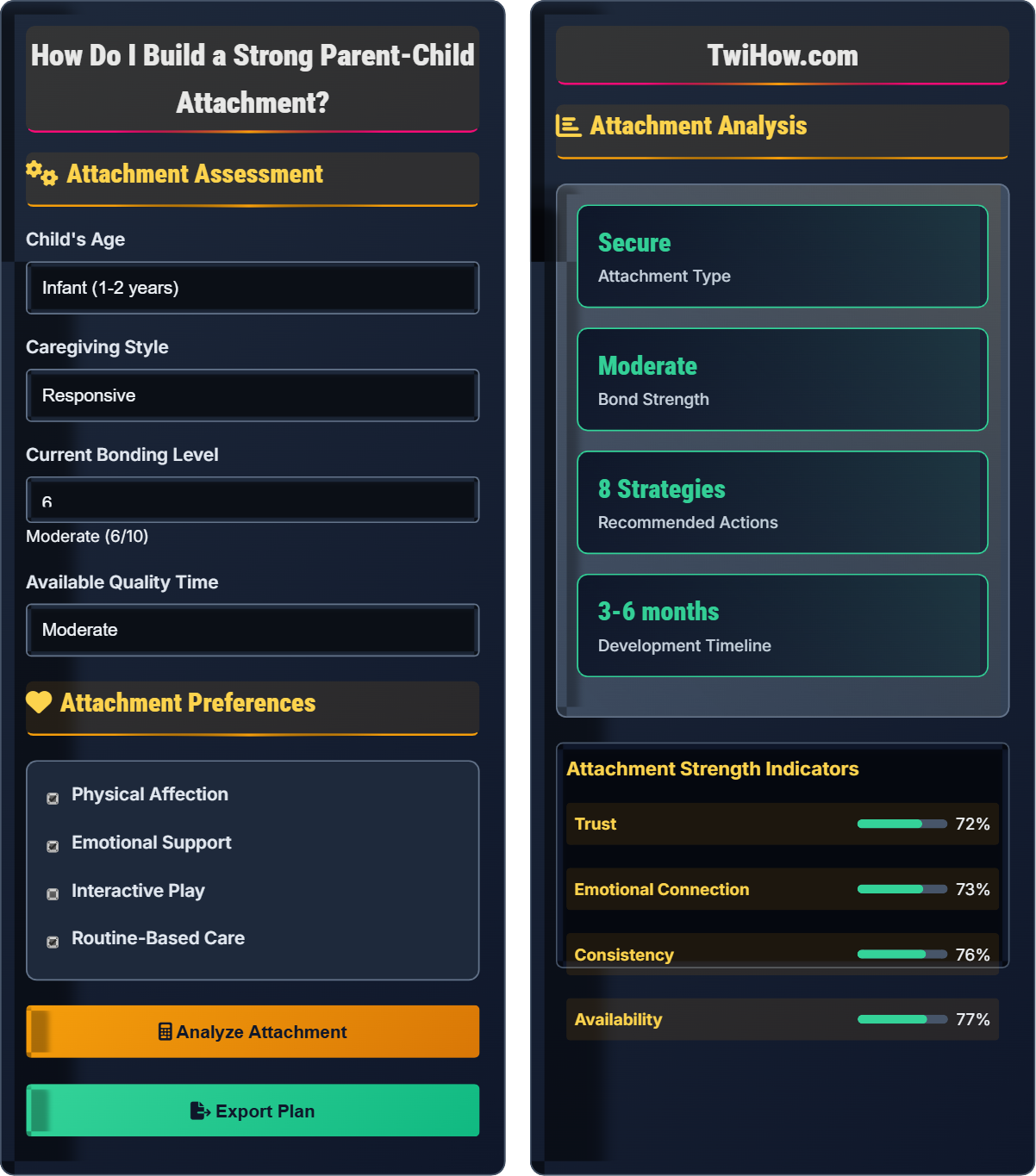
Attachment Assessment
Attachment Preferences
Attachment Analysis
Attachment Strength Indicators
Recommended Strategies
- Responsive Caregiving: Respond promptly to your child's needs and signals.
- Emotional Attunement: Tune into your child's emotional state and validate feelings.
- Consistent Routines: Establish predictable daily routines for security.
- Quality Time: Spend dedicated one-on-one time daily.
Attachment Behaviors
Building Secure Parent-Child Attachment
Attachment theory describes the emotional bond between parent and child:
Secure attachment forms when children trust that their needs will be met consistently and lovingly.
- Secure Attachment: Child feels safe to explore and returns to parent for comfort
- Anxious-Ambivalent: Child shows inconsistent behavior, overly clingy or rejecting
- Avoidant Attachment: Child appears independent but struggles with intimacy
- Disorganized: Child shows confused or contradictory behaviors
- Secure Base: Parent serves as safety point for child's exploration
Strategies that work best for different developmental stages:
Essential behaviors that build secure attachment:
- Responsive Caregiving: Meeting physical and emotional needs promptly and consistently
- Emotional Attunement: Reading and responding to child's emotional cues
- Consistency: Providing predictable responses and maintaining stable routines
- Physical Affection: Appropriate touch, hugging, and physical comfort
- Emotional Availability: Being mentally and emotionally present during interactions
- Quality Time: Dedicated one-on-one time and focused attention
- Security Provision: Being a safe haven during distress
Outcomes of successful parent-child attachment:
- Emotional Regulation: Better ability to manage emotions and stress
- Self-Esteem: Confident sense of self-worth and identity
- Social Skills: Improved ability to form healthy relationships
- Cognitive Development: Better learning and problem-solving abilities
- Resilience: Ability to bounce back from challenges
- Independence: Confident exploration and autonomy
- Empathy: Understanding and consideration of others' feelings
Strategies when attachment has been disrupted:
- Patience: Allow time for trust to rebuild
- Consistency: Maintain predictable responses
- Reassurance: Provide extra emotional security
- Professional Help: Consider family therapy when needed
- Small Steps: Focus on incremental improvements
- Self-Care: Address parent's own emotional needs
Implementation Strategies
Responsive caregiving, emotional attunement, consistency, security, availability, validation.
Security = (Responsive Care × Consistency × Emotional Availability) ÷ Inconsistency
Where Responsive Care = Meeting needs promptly, Consistency = Predictable responses.
- Respond to needs promptly
- Maintain consistency
- Be emotionally available
Avoiding Pitfalls
Ignoring emotional needs, inconsistent responses, overprotection, neglect, emotional unavailability.
- Recognize your child's cues
- Maintain emotional regulation
- Provide consistent responses
- Balance independence with security
- Individual differences in temperament
- Family circumstances and stress
- Previous attachment experiences
- Child's developmental stage
Attachment Building Learning Quiz
Which behavior best demonstrates secure attachment in a parent-child relationship?
Responding consistently to child's needs demonstrates secure attachment because it provides predictability and trust. The child learns that their needs will be met reliably, which builds security and confidence. Consistent responses help the child develop trust in the relationship and feel safe to explore their environment.
The answer is B) Responding consistently to child's needs.
Consistency in caregiving is fundamental to secure attachment formation. When children experience predictable responses to their needs, they develop a sense of trust and security. This allows them to feel safe exploring their environment while knowing they can return to their caregiver for comfort and support.
Secure Attachment: Trusting relationship where child feels safe to explore
Consistency: Predictable responses that build trust over time
Secure Base: Caregiver as source of safety for child's exploration
• Respond promptly to needs
• Maintain predictable responses
• Be emotionally available
• Observe your child's cues
• Respond with warmth and understanding
• Maintain consistent routines
• Ignoring emotional needs
• Inconsistent responses
• Emotional unavailability
Explain the concept of responsive caregiving and why it's crucial for attachment formation.
Responsive Caregiving:
Definition: Prompt, sensitive, and appropriate responses to a child's physical and emotional needs, cues, and signals.
Components: Reading non-verbal cues, responding to emotional expressions, meeting physical needs, providing comfort during distress.
Why Crucial: Builds trust, establishes predictability, creates sense of security, promotes emotional regulation.
Implementation: Attune to child's signals, respond with warmth, provide consistent comfort, validate emotions.
Long-term Impact: Develops self-regulation skills, builds confidence, promotes healthy relationships.
Age-Appropriate Responses: Adapt responses to developmental stage while maintaining sensitivity.
Responsive caregiving is the foundation of secure attachment. When children experience consistent, sensitive responses to their needs, they learn to trust that their world is predictable and safe. This trust becomes the basis for healthy emotional and social development.
Responsive Caregiving: Sensitive and timely responses to child's needs
Emotional Attunement: Ability to read and respond to emotional cues
Secure Base: Caregiver as source of safety for exploration• Read child's cues sensitively
• Respond promptly and appropriately
• Maintain emotional availability
• Practice emotional regulation
• Observe non-verbal signals
• Respond with warmth and understanding
• Not responding to cues
• Inconsistent responses
• Emotional unavailability
Your 18-month-old toddler becomes extremely upset when you leave the room, crying and clinging to you. They also seem anxious around new people and have trouble playing independently. How would you apply attachment principles to help your child feel more secure?
Understand the Behavior: These reactions may indicate insecure attachment or anxiety. The child needs reassurance and predictable responses.
Consistent Departures: Create predictable goodbye routines with clear, honest communication ("I'm going to work, but I'll be back at dinnertime").
Secure Base Establishment: Be consistently available when child needs comfort, providing reassurance that you're there.
Gradual Separation: Start with brief separations and gradually increase time apart, always returning as promised.
Emotional Validation: Acknowledge their feelings ("You're sad that Mommy is leaving") and provide comfort.
Positive Reunion Rituals: Make reunions warm and enthusiastic to reinforce your availability.
Consistency: Maintain the same responses and routines to build predictability and trust.
At 18 months, children are developing their attachment patterns. The separation anxiety and clinginess suggest the child may not yet feel secure in your availability. Consistent, predictable responses will help build trust over time. The key is maintaining the child's sense of security while gradually building confidence in independence.
Secure Base: Parent as source of safety for exploration
Separation Anxiety: Normal response when attachment figure leaves
Trust Building: Gradual development of confidence in caregiver's return
• Maintain predictable routines
• Always return as promised
• Validate emotional responses
• Create consistent goodbye rituals
• Gradually increase separation time
• Maintain warm reunions
• Sneaking away to avoid crying
• Not returning as promised
• Punishing emotional expressions
Your 8-year-old child, who recently joined your family through adoption, shows signs of attachment difficulties including emotional distance, testing boundaries, and inconsistent behavior. How would you approach building attachment with them?
Recognize Trauma Impact: Understand that previous experiences may affect attachment patterns and require patience.
Consistent Presence: Maintain predictable routines and responses to build trust over time.
Emotional Safety: Create an environment where child feels safe to express emotions without punishment.
Small Steps: Focus on building small moments of connection rather than expecting immediate bonding.
Boundaries with Love: Set consistent limits while providing emotional support and understanding.
Professional Support: Consider attachment-focused therapy to address trauma and support healing.
Self-Care: Maintain your own emotional well-being to be available for your child.
Patience: Allow time for attachment to develop gradually as trust builds.
Children with disrupted attachment histories need time and consistent, nurturing responses to build trust. The key is providing a secure base while respecting their emotional pace. Healing from attachment disruption is possible with patience, consistency, and appropriate support.
Attachment Repair: Process of building secure bonds after disruption
Trauma-Informed Care: Understanding impact of past experiences
Consistent Caregiving: Predictable responses to build trust
• Be patient with healing process
• Maintain consistent responses
• Provide emotional safety
• Focus on small connection moments
• Maintain predictable routines
• Seek professional support when needed
• Expecting immediate bonding
• Not addressing trauma history
• Inconsistent responses
How does secure attachment support a child's emotional regulation?
Secure attachment provides a secure base where children can safely explore and learn about emotions. When children know they can return to a trusted caregiver for comfort, they feel safe to experience and process emotions. The caregiver serves as a co-regulator, helping the child learn to manage their emotional responses.
The answer is B) By providing a secure base for emotional learning.
Secure attachment enables emotional regulation by providing a safe environment for emotional exploration. Children learn to regulate their emotions by experiencing them in the presence of a responsive caregiver who helps them understand and manage their feelings.
Emotional Regulation: Ability to manage and respond to emotions appropriately
Secure Base: Caregiver as source of safety for emotional exploration
Co-regulation: Caregiver helping child manage emotional responses
• Validate emotional expressions
• Provide comfort during distress
• Model emotional regulation
• Name emotions with your child
• Help identify triggers
• Teach calming strategies
• Suppressing emotions
• Not validating feelings
• Punishing emotional expressions
FAQ
Q: How long does it take to build a secure attachment with my child?
A: Attachment develops gradually over time:
Newborn-1 Year: Initial bonding and secure attachment formation through consistent caregiving.
1-2 Years: Strengthening of attachment through responsive interactions and emotional validation.
2-5 Years: Refinement of attachment through emotional coaching and boundary-setting.
5+ Years: Continued development through respectful communication and autonomy support.
Repair Timeline: For disrupted attachments, it may take 6 months to 2+ years of consistent effort.
Factors Influencing Speed: Child's age, previous experiences, consistency of care, and individual temperament.
Attachment is a continuous process that strengthens with ongoing responsive caregiving throughout childhood.
Q: What are the long-term benefits of secure parent-child attachment?
A: Children with secure attachment develop numerous long-term benefits:
Emotional Regulation: Better ability to manage stress and emotional responses throughout life.
Social Skills: Improved ability to form healthy relationships with peers and romantic partners.
Academic Success: Better focus, persistence, and problem-solving abilities.
Self-Esteem: Confident sense of self-worth and identity.
Resilience: Ability to bounce back from challenges and setbacks.
Independence: Confident exploration and autonomy while maintaining connection.
Empathy: Better understanding and consideration of others' feelings.
Research shows these benefits extend into adulthood and influence parenting styles.
Q: Can attachment be repaired if it was disrupted early in life?
A: Yes, attachment can be repaired with appropriate interventions:
Consistency: Providing predictable, responsive caregiving over time.
Safety: Creating emotionally safe environments for healing.
Patience: Allowing time for trust to develop gradually.
Professional Support: Working with attachment-focused therapists.
Self-Regulation: Helping child develop emotional regulation skills.
Validation: Acknowledging past hurts while building new positive experiences.
Family Therapy: Addressing systemic issues that may affect attachment.
Support Systems: Building community support for healing.
While early experiences matter, the brain remains plastic throughout life, allowing for healing and growth.
Resources
American Academy of Pediatrics: www.aap.org
Attachment & Trauma Network: www.attachmenttraumanetwork.org
Circle of Security International: www.circleofsecurity.net
Zero to Three: www.zerotothree.org