How Do I Encourage Curiosity and Critical Thinking in Kids?
Complete parenting guide • Step-by-step explanations
Curiosity & Critical Thinking:
Show Thinking SimulatorEncouraging curiosity and critical thinking in children is fundamental to their intellectual development and lifelong learning. Curious children ask questions, explore possibilities, and develop a love for learning. Critical thinkers analyze information, evaluate evidence, and form reasoned opinions. Together, these skills prepare children to navigate an increasingly complex world and make informed decisions.
Key aspects of fostering curiosity and critical thinking:
- Questioning: Encouraging children to ask "why" and "how" questions
- Exploration: Providing opportunities to investigate and discover
- Analysis: Teaching children to examine information and evidence
- Reasoning: Helping children draw logical conclusions
- Problem-Solving: Developing skills to address challenges creatively
Children who develop strong curiosity and critical thinking skills show improved academic performance, better decision-making abilities, and greater resilience when facing challenges. These skills become foundational for success in all areas of life.
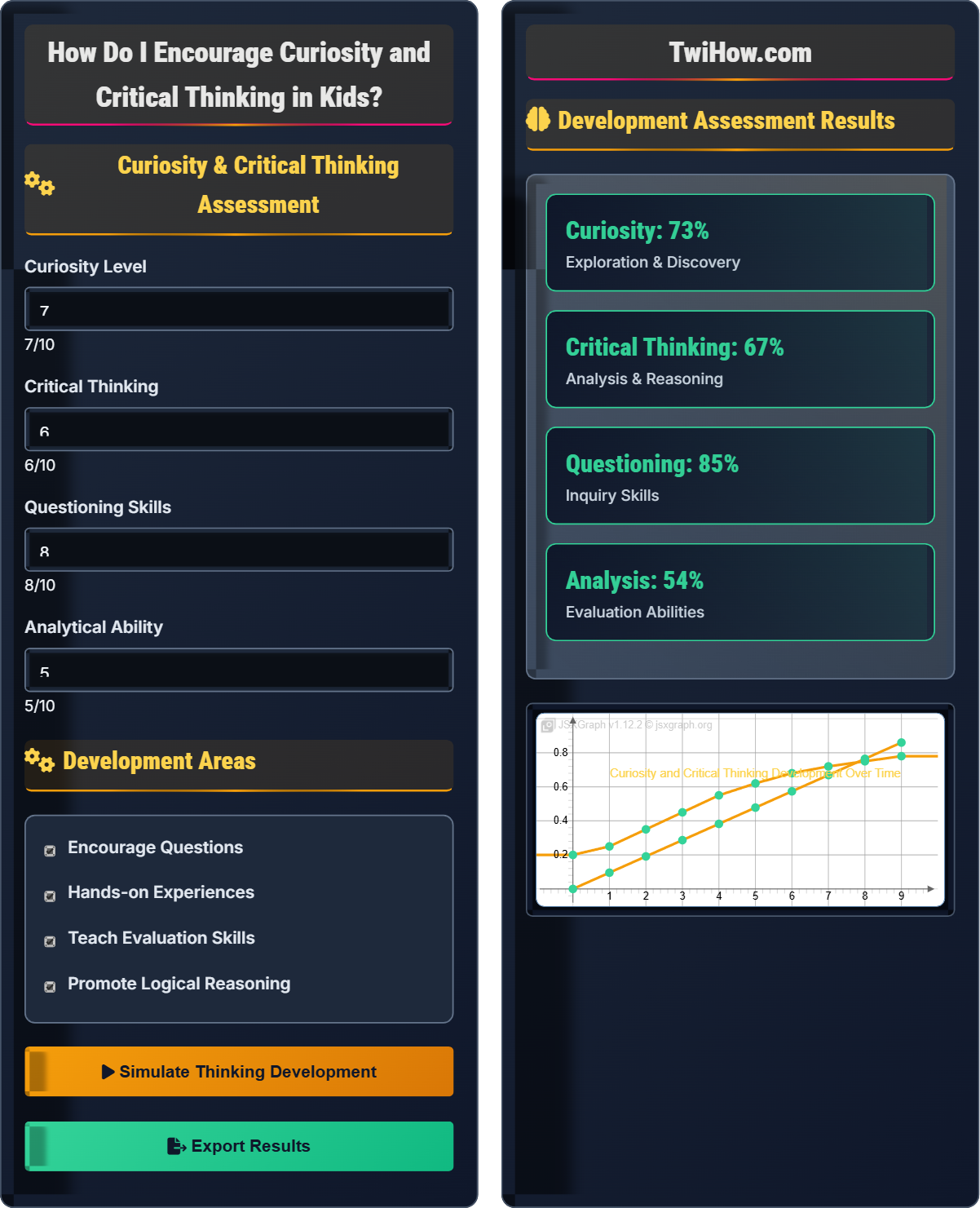
Curiosity & Critical Thinking Assessment
Development Areas
Development Assessment Results
| Thinking Area | Current Level | Impact Level | Improvement Focus |
|---|---|---|---|
| Curiosity | 7/10 | High | Encourage exploration |
| Critical Thinking | 6/10 | Medium | Strengthen analysis |
| Questioning | 8/10 | High | Excellent |
| Analysis | 5/10 | Low | Improve evaluation |
| Problem-Solving | 6/10 | Medium | Develop strategies |
Encouraging Curiosity and Critical Thinking in Children
Curiosity is the natural desire to learn and explore new things, characterized by asking questions and seeking answers. Critical thinking is the ability to analyze information objectively and make reasoned judgments. Together, they form the foundation of intellectual development and lifelong learning. These skills enable children to navigate complex information, solve problems creatively, and make informed decisions.
Where:
- Curiosity: Natural drive to explore and question
- Critical Thinking: Ability to analyze and evaluate
- Experience: Hands-on opportunities and exposure
- Guidance: Supportive adult direction and modeling
Core components of critical thinking:
- Analysis: Breaking down information into parts
- Evaluation: Assessing the credibility and relevance of information
- Inference: Drawing logical conclusions from evidence
- Explanation: Clearly articulating reasoning and evidence
- Self-Regulation: Monitoring and correcting one's own thinking
- Problem-Solving: Identifying and implementing solutions
- Wonder Walks: Explore nature or neighborhoods with questions
- Experiment Days: Conduct simple science experiments
- News Discussions: Analyze current events together
- Debate Practice: Argue both sides of issues
- Research Projects: Investigate topics of interest
- Logic Games: Play puzzles and reasoning games
Thinking Skills Fundamentals
Curiosity, critical thinking, inquiry, analysis, reasoning, evaluation, questioning, problem-solving.
Thinking Development = (Questions × Exploration) + (Analysis × Reasoning)
Where Thinking Development = intellectual growth, Questions = curiosity level.
- Never dismiss a child's questions
- Encourage "what if" scenarios
- Model thinking processes
Practical Applications
Science projects, problem-solving challenges, debate activities, research assignments, everyday decision-making.
- Identify child's interests and curiosities
- Provide relevant resources and materials
- Ask open-ended questions to guide exploration
- Encourage hypothesis formation
- Support experimentation and testing
- Age-appropriate complexity
- Individual learning styles
- Available resources
- Family values alignment
Thinking Skills Quiz
Which type of question best promotes critical thinking in children?
Open-ended questions that require children to explain their reasoning promote critical thinking by encouraging analysis, evaluation, and synthesis of information. These questions cannot be answered with simple yes/no responses and require children to think through their answers, consider alternatives, and justify their conclusions.
The answer is B) Open-ended questions that require explanation.
Critical thinking requires children to process information beyond surface level. Open-ended questions encourage deeper analysis and reasoning. They help children learn to support their ideas with evidence and consider multiple perspectives. This type of questioning develops higher-order thinking skills that transfer to academic and real-world situations.
Open-ended Questions: Questions allowing multiple responses
Critical Thinking: Analytical and evaluative reasoning
Higher-order Thinking: Complex cognitive processes
• Encourage multiple perspectives
• Require justification of answers
• Promote evidence-based reasoning
• Use "What do you think would happen if...?"
• Ask "How did you arrive at that conclusion?"
• Encourage "What if" scenarios
• Only asking closed-ended questions
• Not allowing time for thought
• Providing answers too quickly
Explain how to create an environment that fosters curiosity in children. Include specific strategies and examples.
Strategies: Provide diverse materials, encourage exploration, ask follow-up questions, create safe spaces for experimentation, and model curiosity yourself.
Examples: Set up a discovery corner with magnifying glasses, create a question jar, take nature walks with observation journals, conduct kitchen science experiments, visit museums regularly.
Environment: Make materials accessible, allow time for exploration, celebrate questions, and connect learning to real-world applications.
Curiosity flourishes in environments that provide opportunities for exploration and discovery. Children need access to diverse materials, time to investigate, and encouragement to pursue their interests. When adults model curiosity by asking questions and exploring, children learn that inquiry is valuable and enjoyable. The key is to create spaces and routines that support natural learning instincts.
Exploration: Investigating and discovering new things
Discovery: Finding information through investigation
Safe Space: Environment where children feel secure to explore
• Make exploration accessible
• Allow for mess and mistakes
• Celebrate questions and discoveries
• Create a "wonder wall" for questions
• Have materials readily available
• Follow the child's lead
• Discouraging "messy" exploration
• Not providing adequate materials
• Focusing only on outcomes
Your child comes home excited about a new product they saw advertised on TV that claims to help with school performance. How do you teach them to critically evaluate this claim?
Approach: Ask questions about the evidence, research the product, examine the source, consider alternative explanations, and discuss marketing techniques.
Questions: "What proof do they have?", "Who conducted the studies?", "Are there independent reviews?", "Is this too good to be true?"
Process: Look up the product, check reputable sources, examine claims for evidence, and discuss how advertisements work.
This scenario teaches children to evaluate information critically by examining evidence, source credibility, and potential bias. It demonstrates how to approach claims with skepticism and seek verification. This skill is essential in our information-rich world where children encounter many claims that require evaluation.
Evidence: Facts supporting a claim
Credibility: Trustworthiness of source
Skepticism: Questioning claims until proven
• Examine evidence before accepting claims
• Consider source credibility
• Look for independent verification
• Use fact-checking websites together
• Examine who benefits from the claim
• Look for peer-reviewed research
• Accepting claims without evidence
• Not questioning source credibility
• Focusing only on appealing outcomes
Your child is struggling with a math problem and wants you to give them the answer immediately. How do you encourage critical thinking and problem-solving skills instead of just providing the solution?
Approach: Ask guiding questions, encourage them to explain their thinking, suggest strategies, and support their efforts without giving the answer.
Questions: "What do you already know?", "What have you tried?", "Can you draw a picture?", "Does this remind you of something else?"
Support: Acknowledge their effort, suggest different approaches, and encourage persistence.
This approach teaches children to think through problems systematically rather than relying on others for answers. It builds confidence in their own abilities and develops problem-solving strategies. By guiding rather than providing answers, parents help children develop the skills they need for independent thinking and learning.
Problem-Solving: Finding solutions to challenges
Guided Discovery: Leading to answers through questioningIndependent Thinking: Forming conclusions without guidance
• Guide rather than provide answers
• Encourage multiple approaches
• Acknowledge effort and process
• Ask "What do you notice?"
• Suggest drawing or visualizing
• Encourage trying different strategies
• Giving answers too quickly
• Not allowing struggle time
• Focusing only on correct answers
Which approach is most effective for stimulating curiosity in children?
Encouraging questions and exploration is the most effective approach for stimulating curiosity. This approach validates children's natural inquisitiveness, provides opportunities for discovery, and teaches them that learning is an active process. When children feel safe to ask questions and explore, their curiosity naturally expands.
The answer is B) Encouraging questions and exploration.
Curiosity thrives when children feel their questions are valued and their explorations are supported. This approach builds confidence in their learning abilities and creates positive associations with discovery. When curiosity is encouraged, children develop a lifelong love of learning and become more engaged learners in all areas.
Curiosity: Natural desire to learn and explore
Exploration: Investigating through experience
Discovery Learning: Learning through investigation
• Value all questions
• Support exploration safely
• Encourage independent discovery
• Create exploration time
• Follow their interests
• Celebrate discoveries
• Dismissing questions as irrelevant
• Not providing exploration opportunities
• Focusing only on correct answers
FAQ
Q: What if my child asks questions I don't know the answers to?
A: This is an excellent opportunity to model curiosity and research skills! Tell your child, "That's a great question! Let's find out together." Research the answer using reliable sources, discuss what you learn, and show them how to evaluate information. This teaches them that not knowing is normal and that learning is a lifelong process. It also demonstrates how to find reliable information and think critically about sources.
Q: How do I encourage critical thinking without making my child overly skeptical?
A: Critical thinking is different from cynicism. Teach children to evaluate evidence while maintaining trust in reliable sources and people. Emphasize that questioning doesn't mean rejecting everything, but rather making informed decisions. Focus on evaluating claims rather than people, and teach them to distinguish between reliable and unreliable sources. Balance skepticism with appreciation for expertise and trustworthy information.