How Do I Encourage Independence While Ensuring Safety?
Complete parent's guide • Balancing growth and security
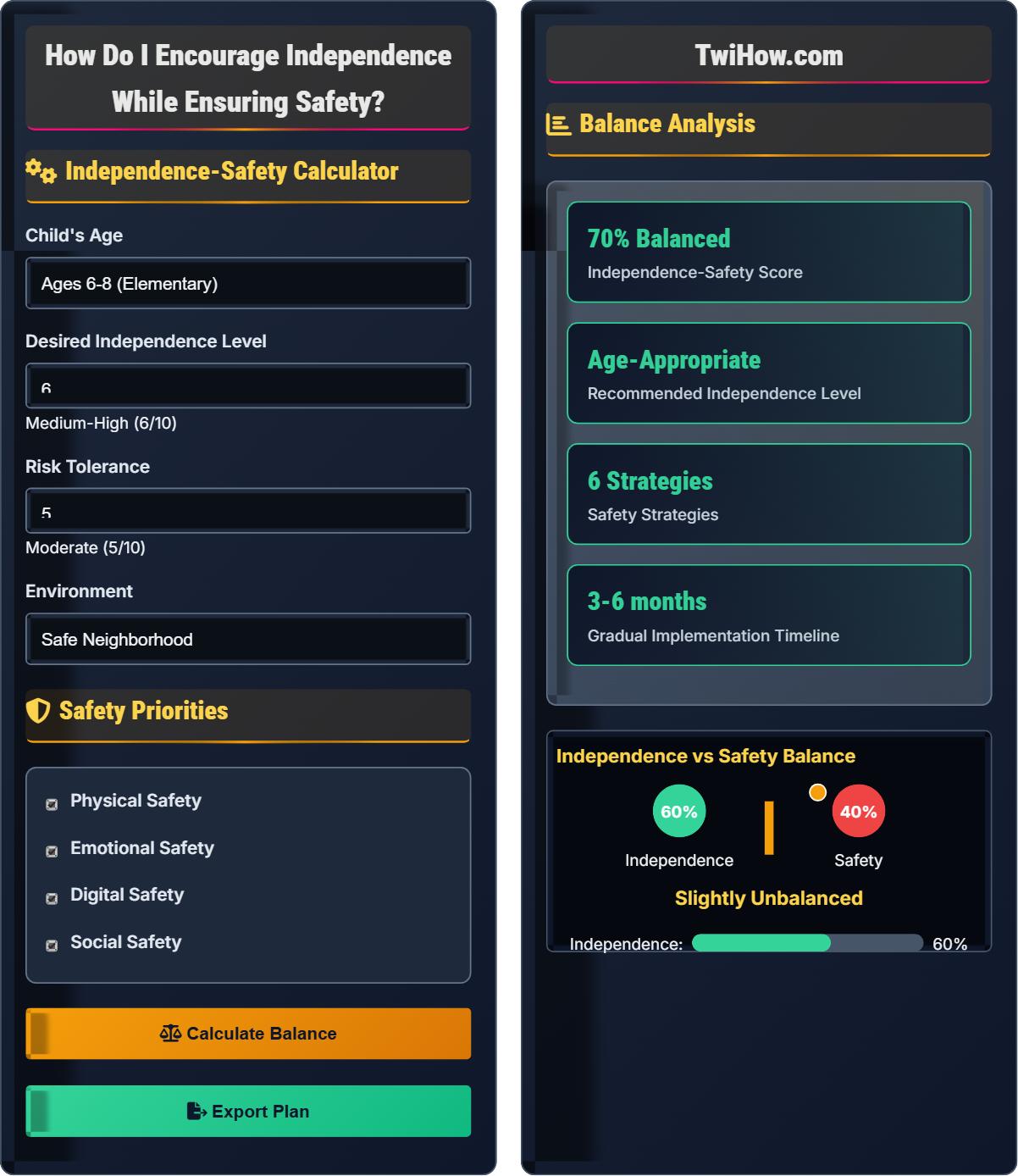
Independence & Safety Balance:
Calculate BalanceFinding the right balance between encouraging independence and ensuring safety is one of the most challenging aspects of parenting. This delicate balance evolves as children grow, requiring different approaches for different ages and situations. The key is to gradually increase freedom while teaching children to assess and manage risks themselves.
Essential components include:
- Age-Appropriate Freedom: Gradually increasing responsibilities and privileges
- Risk Assessment: Teaching children to evaluate potential dangers
- Safe Boundaries: Establishing clear limits and expectations
- Communication: Open dialogue about safety concerns and decisions
- Trust Building: Allowing independence based on demonstrated responsibility
Successful balance promotes healthy development while minimizing risks through preparation, education, and gradual exposure to new challenges.
Independence-Safety Calculator
Safety Priorities
Balance Analysis
Independence vs Safety Balance
Age-Appropriate Independence
For your child's age group, focus on gradually increasing responsibilities while maintaining clear safety boundaries. Start with small freedoms and expand as competence is demonstrated.
Safety Preparation
Before granting new freedoms, ensure your child understands safety rules and can demonstrate responsible behavior. Practice scenarios together.
Communication Plan
Establish regular check-ins and clear expectations for communication about activities and concerns.
| Strategy | Priority | Timeline | Impact |
|---|---|---|---|
| Gradual Increase | High | Immediate | 95% |
| Safety Training | High | 1-2 weeks | 90% |
| Check-in System | High | 2-4 weeks | 85% |
| Responsibility Assessment | Medium | 1-3 months | 80% |
| Environmental Safety | Medium | Immediate | 75% |
Balancing Independence and Safety
Finding the right balance between independence and safety follows a dynamic equation:
As children develop, their capacity for independence grows, but safety considerations must evolve accordingly. The key is matching the level of freedom to the child's demonstrated readiness while maintaining appropriate safeguards.
Key factors include:
- Developmental Readiness: Cognitive and emotional maturity
- Previous Experience: Success with smaller challenges
- Environmental Safety: Physical and social environment
- Communication Skills: Ability to seek help and communicate needs
Different age groups can handle varying levels of independence:
Effective strategies for maintaining safety while promoting independence:
- Clear Boundaries: Define acceptable behaviors and consequences
- Communication Protocols: Establish check-in systems and emergency contacts
- Environmental Safety: Assess and prepare physical environments
- Skills Training: Teach practical safety skills before granting freedoms
- Gradual Implementation: Increase independence in small, manageable steps
- Regular Assessment: Continuously evaluate and adjust the balance
Monitor for these signs that the balance needs adjustment:
- Child seems overwhelmed by new responsibilities
- Increased anxiety or resistance to independence
- Safety incidents or near-misses
- Regression to previous behaviors
- Difficulty managing responsibilities
- Conflict about boundaries or expectations
Balance Fundamentals
Gradual independence, risk assessment, developmental readiness, safety protocols, communication skills.
Freedom = (Readiness × Safety Preparation) ÷ Risk Level
Where Readiness = Child's developmental capacity, Safety Preparation = Skills and knowledge.
- Match freedom to demonstrated capability
- Prepare before granting new freedoms
- Maintain flexibility to adjust as needed
Implementation Strategies
Gradual steps, skill building, boundary setting, communication, assessment, adjustment.
- Assess current readiness level
- Identify next appropriate step
- Provide necessary training
- Implement with supervision
- Individual differences in maturity
- Environmental safety factors
- Family values and circumstances
- Child's comfort level
Independence-Safety Balance Learning Quiz
Which activity is most appropriate for a 9-year-old child to do independently?
For a 9-year-old, staying home alone for 2 hours after school is the most appropriate activity among the options. At this age, children can typically handle short periods of unsupervised time if they are mature enough and the environment is safe. They can follow basic safety rules, know how to contact parents, and handle minor emergencies.
The answer is B) Stay home alone for 2 hours after school.
Child development research shows that around age 9-10, children typically develop the cognitive abilities to handle short periods of unsupervised time. They can follow multi-step instructions, understand cause-and-effect relationships, and have improved emotional regulation. However, the decision should always be based on the individual child's maturity, the safety of the environment, and local laws and regulations.
Developmental Readiness: Child's cognitive, emotional, and physical capacity for independent tasks
Supervision Levels: Different degrees of adult oversight based on child's needs
Age-Appropriate Tasks: Responsibilities matching child's developmental stage
• Individual maturity varies significantly
• Environment safety is crucial
• Gradual progression is essential
• Test readiness with shorter periods first
• Establish clear rules and emergency plans
• Assess the child's comfort level
• Assuming all children are ready at same age
• Not preparing adequately
• Ignoring environmental factors
Describe the process for assessing whether a child is ready for a new level of independence. Include specific evaluation criteria and the steps involved.
Assessment Process:
1. Evaluate Maturity Level: Assess the child's ability to follow instructions, make good decisions, and handle responsibility. Consider their emotional regulation and problem-solving skills.
2. Assess Safety Knowledge: Determine if the child understands basic safety rules, knows how to contact parents, and can identify potential dangers.
3. Environmental Evaluation: Consider the safety of the environment, including neighborhood safety, traffic, weather, and accessibility.
4. Communication Skills: Evaluate the child's ability to communicate needs, concerns, and emergencies effectively.
5. Previous Experience: Review how the child has handled smaller responsibilities and whether they've demonstrated responsible behavior.
6. Trial Period: Implement the new freedom with supervision initially, gradually reducing oversight as competence is demonstrated.
7. Ongoing Assessment: Continuously monitor the child's performance and adjust the level of independence as needed.
Effective risk assessment for children's independence involves multiple dimensions of evaluation. Rather than relying on age alone, parents should consider cognitive, emotional, and social factors alongside environmental conditions. The assessment should be dynamic, with regular check-ins to ensure the child continues to handle the responsibility appropriately.
Risk Assessment: Systematic evaluation of potential dangers and the child's ability to manage them
Developmental Readiness: Child's cognitive, emotional, and physical preparedness for a task
Environmental Safety: Assessment of physical surroundings and potential hazards
• Don't rely solely on age
• Consider individual differences
• Prepare before granting freedom
• Role-play potential scenarios
• Start with shorter durations
• Establish clear communication protocols
• Granting independence without preparation
• Ignoring environmental factors
• Not monitoring after implementation
Your 12-year-old wants permission to ride their bike to the local park (0.5 miles away) without supervision. They've never done this independently before. How would you evaluate readiness and create a safe path for this new freedom?
Readiness Assessment: Evaluate if your child understands traffic rules, can navigate safely, and knows how to handle unexpected situations. Check their ability to follow directions and make good decisions.
Route Planning: Scout the route together, identifying safe paths, crossing points, and potential hazards. Choose the safest route even if it's not the shortest.
Safety Training: Review bike safety rules, traffic signals, and what to do if lost or in trouble. Ensure they have proper equipment (helmet, lights).
Communication Plan: Establish check-in times and methods. Decide on a specific time limit for the visit.
Gradual Implementation: Accompany them on the first few trips, then follow at a distance. Gradually allow more independence.
Emergency Preparation: Ensure they know how to contact you and have emergency information. Consider what to do in bad weather.
Success Criteria: Define what successful independent trips look like before granting permission.
Twelve-year-olds are typically ready for greater independence, but new activities require careful preparation. The key is to match the level of freedom to the child's demonstrated readiness while maintaining appropriate safety measures. This scenario requires evaluating multiple factors including the child's cycling skills, route safety, and communication abilities.
Route Assessment: Evaluation of the safest path considering traffic, terrain, and visibility
Gradual Implementation: Progressive increase in independence with supervision
Safety Protocols: Established procedures for handling emergencies or problems
• Safety equipment is mandatory
• Clear boundaries must be established
• Communication protocols are essential
• Practice the route together first
• Start with daylight hours
• Establish a return time
• Not reviewing safety rules thoroughly
• Ignoring weather conditions
• Not establishing clear boundaries
Your 14-year-old wants access to social media without parental restrictions. How do you balance their desire for digital independence with safety concerns about online predators, cyberbullying, and inappropriate content?
Education First: Teach digital literacy skills including privacy settings, recognizing inappropriate content, and understanding the permanence of online actions.
Gradual Access: Start with one platform and gradually expand as responsible use is demonstrated.
Privacy Training: Explain what information should never be shared and how to adjust privacy settings properly.
Monitoring Setup: Use parental controls initially, gradually reducing them as trust is earned.
Communication Agreement: Establish that your teen can come to you with any online concerns without immediate punishment.
Reporting Skills: Teach how to report inappropriate content or users to platforms and parents.
Regular Check-ins: Schedule periodic discussions about online experiences and concerns.
Consequence Plan: Clearly define what happens if safety rules are broken.
Digital independence requires special considerations as online risks can be more complex and harder to monitor than physical activities. Fourteen-year-olds need to develop digital citizenship skills while learning to navigate social media responsibly. The approach should emphasize education and communication rather than just restrictions.
Digital Literacy: Skills needed to navigate, evaluate, and create information using digital technologies
Digital Citizenship: Responsible and ethical use of technology and online interactions
Privacy Settings: Controls that determine who can see personal information and posts
• Education precedes access
• Trust is earned through demonstrated responsibility
• Communication is key to safety
• Review platforms together first
• Set up accounts jointly
• Monitor initially, then gradually reduce oversight
• Providing access without education
• Being too restrictive without explanation
• Not teaching reporting mechanisms
Which sign indicates that you should decrease independence and increase safety measures?
Safety incidents or near-misses are clear indicators that the current level of independence may be too high for the child's current capabilities or the environment. These events suggest that either the child needs more preparation, the safety measures need to be strengthened, or the level of independence should be temporarily reduced until the child demonstrates improved skills or the environment is made safer.
The answer is C) Child experiences safety incidents or near-misses.
Safety incidents serve as important feedback in the independence-development process. They indicate that the current balance between freedom and safety is not appropriate and needs adjustment. Rather than abandoning independence goals, parents should use these incidents as learning opportunities to strengthen safety skills and gradually rebuild independence.
Safety Incident: Any event where the child's safety was compromised or nearly compromised
Near-Miss: Situation that could have resulted in harm but did not
Feedback Loop: Using experience to adjust future decisions
• Use incidents as learning opportunities
• Adjust based on evidence
• Maintain balance over time
• Discuss incidents without shaming
• Identify contributing factors
• Develop strategies to prevent recurrence
• Ignoring warning signs
• Overreacting by removing all independence
• Not addressing root causes
FAQ
Q: How do I know when my child is ready for more independence?
A: Readiness for independence involves several key indicators:
Responsibility: Does your child complete assigned tasks without reminders? Do they take care of their belongings?
Decision Making: Can they make good choices in low-stakes situations? Do they consider consequences?
Emotional Regulation: Can they handle frustration and setbacks appropriately?
Problem Solving: Do they attempt to solve problems independently before seeking help?
Communication: Can they clearly express needs, concerns, and ask for help when needed?
Safety Awareness: Do they understand and follow safety rules?
Look for these signs across multiple situations and gradually increase responsibilities to test readiness. Remember that readiness can vary by activity and situation.
Q: What are the long-term benefits of finding the right independence-safety balance?
A: Children who experience appropriate levels of independence with adequate safety support develop numerous long-term benefits:
Self-Confidence: Successfully navigating challenges builds self-efficacy and belief in their abilities.
Problem-Solving Skills: Independent decision-making strengthens critical thinking and analytical abilities.
Resilience: Learning to handle setbacks and recover builds emotional resilience.
Risk Assessment: Gradual exposure to managed risks develops good judgment skills.
Responsibility: Trust and autonomy encourage accountability and ownership.
Autonomy: Healthy independence prepares them for adult life and relationships.
Trust: The balance demonstrates that parents trust their judgment while providing security.
These skills form the foundation for healthy development into confident, capable adults.
Q: How do I handle my own anxiety when giving my child more independence?
A: Parental anxiety about independence is completely normal and common:
Normalize Your Feelings: Recognize that anxiety doesn't mean you're doing anything wrong - it's a natural protective instinct.
Gradual Approach: Implement changes slowly so both you and your child can adjust comfortably.
Preparation: The more prepared your child is, the more confident you'll feel about their independence.
Clear Communication: Establish reliable check-in systems so you stay connected even when apart.
Trust Building: Start with small freedoms and gradually expand as both you and your child demonstrate reliability.
Self-Care: Manage your own stress through exercise, support systems, or relaxation techniques.
Reality Check: Remind yourself that appropriate independence is beneficial for your child's development.
Remember that some anxiety is expected, but it shouldn't prevent healthy development.
Resources
American Academy of Pediatrics: www.aap.org
Child Development Institute: www.childdevelopmentinfo.com
Safe Kids Worldwide: www.safekids.org
Center for Parent Information and Resources: www.parentcenterhub.org