How Do I Foster Resilience and Coping Skills in Children?
Complete parenting guide • Step-by-step explanations
Resilience Building:
Show Resilience BuilderFostering resilience and coping skills in children is one of the most important gifts parents can give. Resilience is the ability to bounce back from adversity, adapt to challenges, and maintain emotional stability under stress. Coping skills are the strategies children use to manage difficult situations and emotions. These skills form the foundation for mental health, academic success, and healthy relationships throughout life.
Key aspects of resilience and coping skill development:
- Emotional Regulation: Teaching children to identify, understand, and manage their emotions
- Problem-Solving: Developing critical thinking and decision-making abilities
- Stress Management: Learning techniques to cope with pressure and anxiety
- Self-Efficacy: Building confidence in their ability to handle challenges
- Social Support: Creating strong relationships and communication skills
Children who develop strong resilience and coping skills are better equipped to handle academic challenges, social difficulties, family changes, and life transitions. They demonstrate greater emotional stability, academic achievement, and overall well-being.
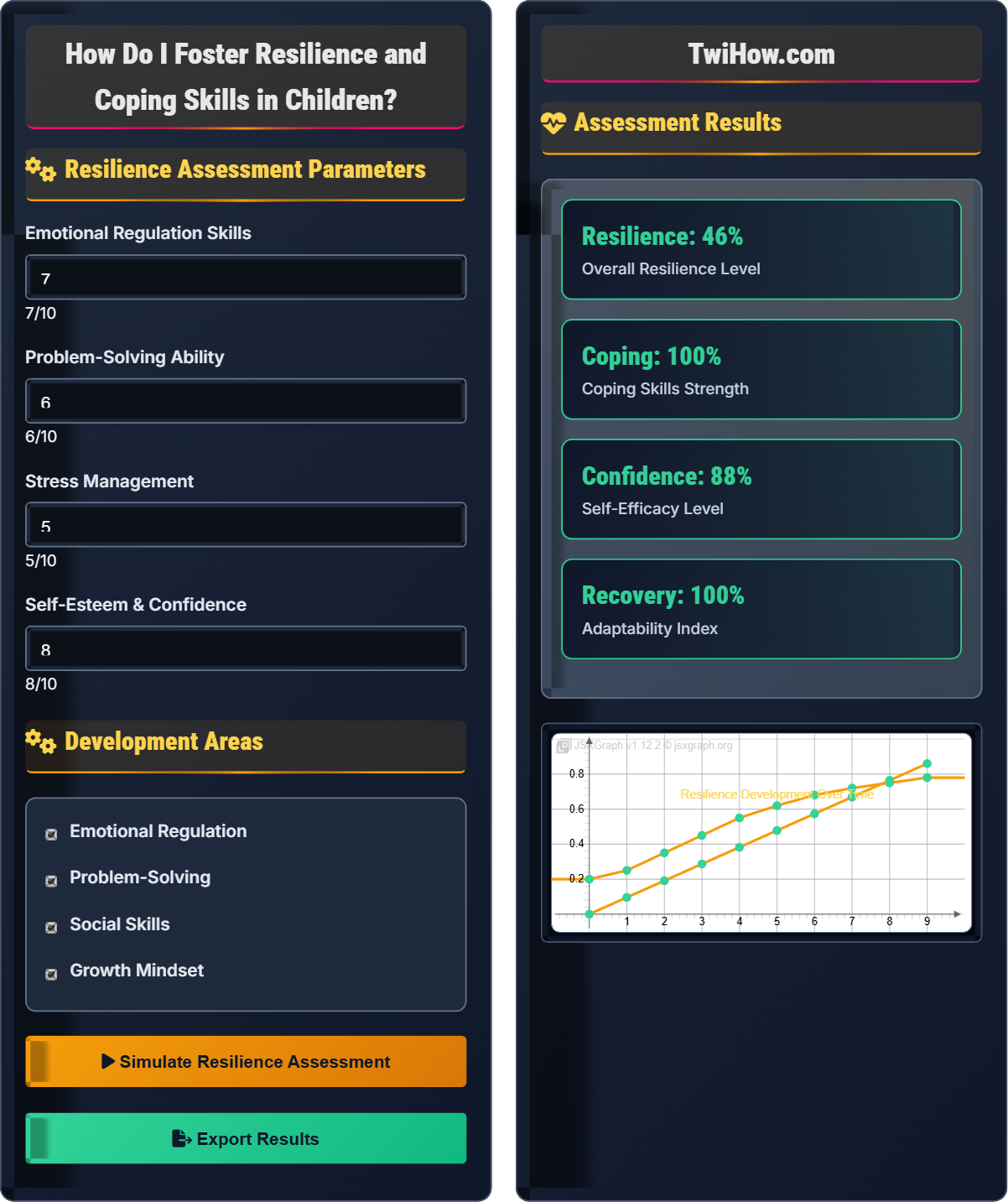
Resilience Assessment Parameters
Development Areas
Assessment Results
| Skill Area | Current Level | Development Need | Priority |
|---|---|---|---|
| Emotional Regulation | 7/10 | Medium | High |
| Problem-Solving | 6/10 | High | High |
| Stress Management | 5/10 | High | Medium |
| Self-Esteem | 8/10 | Low | Low |
| Adaptability | 6/10 | Medium | High |
Feelings
Solve
Strategies
Learn
Fostering Resilience and Coping Skills
Resilience is the ability to adapt well in the face of adversity, trauma, tragedy, threats, or significant sources of stress. Coping skills are the strategies children use to manage difficult situations and emotions. Together, they enable children to bounce back from setbacks, learn from challenges, and maintain emotional stability during difficult times.
Where:
- Personal Strengths: Self-efficacy, optimism, emotional regulation
- Social Support: Family, friends, mentors, community
- Coping Skills: Problem-solving, stress management, flexibility
- Meaningful Experiences: Purpose, values, positive experiences
Effective coping strategies for children:
- Emotion-Focused: Deep breathing, mindfulness, journaling, art therapy
- Problem-Focused: Planning, seeking help, brainstorming solutions
- Social Support: Talking to trusted adults, spending time with friends
- Distraction: Engaging in hobbies, reading, physical activity
- Reframing: Looking for positives, changing perspective
- Acceptance: Acknowledging difficult situations while focusing on controllable aspects
- Model Behavior: Demonstrate healthy coping strategies in your own life
- Practice Opportunities: Create safe spaces for children to try new skills
- Consistent Support: Provide predictable emotional support
- Gradual Challenges: Introduce age-appropriate challenges incrementally
- Reflection Time: Help children process experiences and learn from them
- Positive Reinforcement: Acknowledge efforts and improvements
Resilience Building Fundamentals
Resilience, coping skills, emotional regulation, problem-solving, stress management, self-efficacy, growth mindset.
Resilience = (Practice × Support × Reflection) ÷ Challenges
Where Resilience = ability to bounce back, Practice = skill-building activities.
- Consistency builds trust and security
- Age-appropriate challenges promote growth
- Emotional safety enables learning
Coping Skill Development
Academic stress, social conflicts, family changes, peer pressure, performance anxiety, transitions.
- Identify specific stressors and triggers
- Teach emotion recognition and naming
- Introduce coping strategies gradually
- Practice skills in safe environments
- Apply skills in real situations with support
- Individual differences in development
- Family and cultural values
- Previous experiences and trauma
- Available support systems
Resilience and Coping Skills Quiz
What is the most accurate definition of resilience?
Resilience is the ability to adapt well in the face of adversity, trauma, tragedy, threats, or significant sources of stress. It involves bouncing back from difficult experiences and learning from challenges. Resilience doesn't mean never experiencing difficulties, but rather developing the capacity to recover from them.
The answer is B) Ability to bounce back from adversity.
Understanding the true definition of resilience is crucial for proper development. Many people mistakenly believe resilient individuals never face difficulties, but resilience actually involves successfully navigating through challenges. This understanding helps parents set appropriate expectations and focus on building adaptive skills rather than trying to shield children from all difficulties.
Resilience: Ability to recover from adversity
Adversity: Difficult or challenging circumstances
Adaptation: Adjusting to new conditions
• Resilience involves facing and overcoming challenges
• It's a learned skill, not an innate trait
• Everyone can develop resilience
• View challenges as opportunities for growth
• Focus on what children can control
• Celebrate small victories along the way
• Believing resilient people never face problems
• Trying to eliminate all challenges
• Focusing only on outcomes, not process
Explain how to teach children emotional regulation skills and why these skills are important for resilience.
Teaching Emotional Regulation: Start by helping children identify and name emotions, practice calming techniques like deep breathing, create emotional vocabulary, model emotional regulation, provide safe spaces to express feelings, and teach problem-solving skills.
Importance for Resilience: Emotional regulation is foundational for resilience because it allows children to manage stress responses, think clearly during challenges, maintain relationships, and persist through difficulties. Without emotional regulation skills, children may become overwhelmed by stress and unable to access other coping strategies.
Emotional regulation serves as the foundation for all other resilience skills. When children can manage their emotions, they're better able to think clearly, make good decisions, and maintain relationships during difficult times. Teaching emotional regulation involves both recognizing emotions and having strategies to manage them appropriately. This skill develops gradually and requires consistent practice and modeling.
Emotional Regulation: Managing emotions in healthy ways
Calming Techniques: Methods to reduce stress and anxiety
Emotional Vocabulary: Words to describe feelings accurately
• All emotions are valid and acceptable
• Expression of emotions needs guidance
• Regulation skills take time to develop
• Use emotion wheels to expand vocabulary
• Practice breathing exercises together
• Validate feelings while guiding behavior
• Suppressing emotions instead of regulating them
• Dismissing children's feelings as unimportant
• Expecting immediate mastery of skills
Your child is struggling with math homework and becoming frustrated, saying "I'm bad at math and will never understand it." How would you help them develop problem-solving and resilience skills in this situation? Describe your approach and the expected outcomes.
Approach: Acknowledge their frustration, help them identify the specific problem ("What part of this is confusing?"), break the problem into smaller steps, suggest different strategies, remind them of past successes, encourage persistence, and praise effort over outcome.
Expected Outcomes: Improved problem-solving skills, increased confidence in tackling challenges, better emotional regulation during difficulties, and development of a growth mindset.
Long-term Benefits: Children learn that challenges can be overcome with effort and strategy, building resilience for future obstacles.
This scenario demonstrates how to turn a frustrating situation into a resilience-building opportunity. By guiding children through the problem-solving process rather than solving it for them, parents help develop critical thinking skills. The focus on process rather than outcome encourages persistence and builds confidence in their ability to tackle challenges independently.
Problem-Solving: Identifying and implementing solutions
Growth Mindset: Belief that abilities can improve with effort
Process Focus: Emphasizing effort over results
• Break large problems into smaller parts
• Ask guiding questions instead of giving answers
• Celebrate small progress along the way
• Connect current challenges to past successes
• Solving problems for children instead of guiding them
• Focusing only on correct answers
• Dismissing frustration as unimportant
Your child has an upcoming presentation at school and is showing signs of anxiety. How do you help them develop stress management and coping skills while supporting them through this challenge? Explain your strategy and the skills they'll learn.
Strategy: Acknowledge their anxiety as normal, practice relaxation techniques together, rehearse the presentation in a safe environment, create a preparation plan, teach breathing exercises, focus on preparation rather than perfection, and provide emotional support.
Skills Learned: Stress recognition, relaxation techniques, preparation strategies, self-advocacy, and emotional regulation.
Long-term Impact: Children learn that they can manage anxiety and successfully navigate stressful situations with preparation and coping strategies.
Managing stress during specific challenges teaches children valuable skills they can apply to future situations. The key is to provide support while allowing children to face the challenge themselves. Teaching practical techniques like breathing exercises gives them concrete tools for managing anxiety. This approach builds both confidence and competence.
Stress Management: Techniques to handle pressure and anxiety
Relaxation Techniques: Methods to reduce tension and anxiety
Preparation: Getting ready for challenges in advance
• Anxiety is a normal response to challenges
• Preparation reduces anxiety
• Practice builds confidence
• Practice relaxation techniques regularly
• Create step-by-step preparation plans
• Focus on what they can control
• Minimizing children's anxiety
• Doing tasks for them instead of supporting
• Focusing only on the outcome
Which approach best fosters a growth mindset in children?
Praising effort, strategy, and persistence fosters a growth mindset by emphasizing that abilities can be developed through dedication and hard work. This approach encourages children to embrace challenges, persist through difficulties, and view mistakes as learning opportunities rather than evidence of inability.
The answer is B) Praising effort, strategy, and persistence.
Growth mindset is crucial for resilience because it frames challenges as opportunities for development rather than threats to self-worth. When children believe their abilities can improve through effort, they're more likely to persist through difficulties. Praising process-oriented aspects rather than fixed traits encourages this mindset and builds long-term motivation and resilience.
Growth Mindset: Belief that abilities can be developed
Fixed Mindset: Belief that abilities are unchangeable
Process Praise: Acknowledging effort and strategy
• Focus on effort over innate ability
• Emphasize learning from mistakes
• Value persistence and strategy
• Use phrases like "I noticed you tried..."
• Highlight strategy and effort in praise
• Connect effort to improvement
• Praising intelligence instead of effort
• Avoiding challenges to prevent failure
• Focusing only on results
FAQ
Q: How do I balance supporting my child while letting them develop resilience on their own?
A: Provide scaffolding rather than doing things for them. Be available to support and guide, but let children attempt challenges independently first. Offer help when needed, but gradually reduce support as they develop competence. The key is to stay close enough to catch them if they fall, but far enough to let them try flying. This builds both skills and confidence.
Q: What if my child seems to have low resilience despite my efforts?
A: Resilience develops gradually and varies by individual. Some children need more time and practice. Consider underlying factors like temperament, previous experiences, or potential anxiety disorders. Continue providing consistent support and small challenges. If concerns persist, consult with a child psychologist. Remember that building resilience is a long-term process, not a quick fix.