How Do I Handle Picky Eating Without Power Struggles?
Complete parent's guide • Evidence-based strategies
Picky Eating Management:
Meal PlannerHandling picky eating without power struggles requires understanding the developmental reasons behind food preferences and implementing gentle, consistent strategies. Most children go through phases of selective eating, which is often temporary. The key is to create positive mealtime experiences while respecting the child's autonomy and hunger cues.
Effective strategies include:
- Division of Responsibility: Parents decide what, when, and where to serve food; children decide whether and how much to eat
- Exposure Without Pressure: Offering new foods repeatedly without forcing consumption
- Positive Mealtime Environment: Creating stress-free, enjoyable dining experiences
- Food Variety: Presenting familiar and new foods together
- Patience and Persistence: Understanding that food acceptance takes time
Successful approaches focus on building healthy relationships with food rather than winning battles over individual meals.
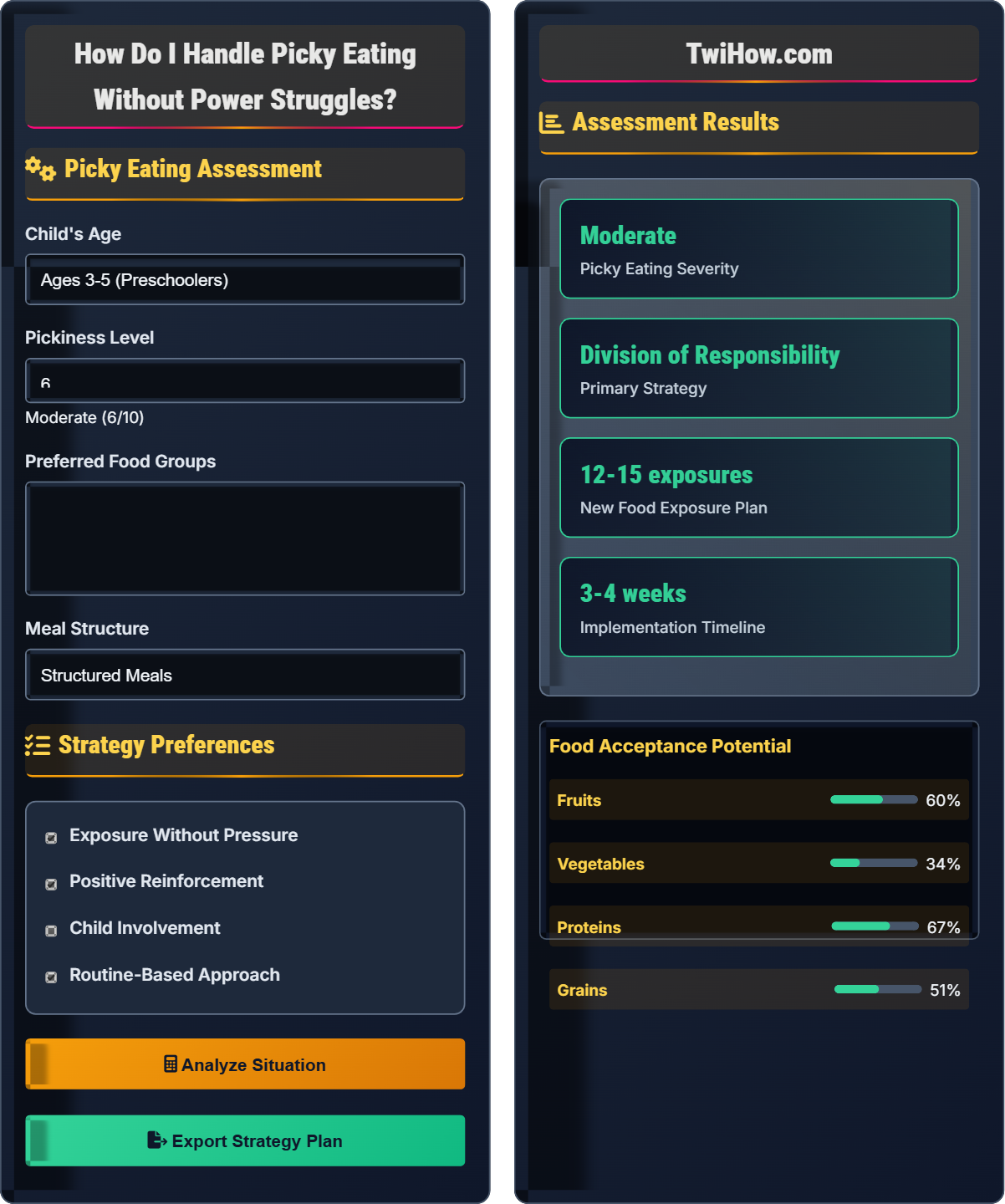
Picky Eating Assessment
Strategy Preferences
Assessment Results
Food Acceptance Potential
Recommended Strategies
- Division of Responsibility: You decide what, when, and where to serve food; your child decides whether and how much to eat.
- Exposure Without Pressure: Offer new foods repeatedly without forcing consumption. It can take 12-15 exposures before acceptance.
- Positive Mealtime Environment: Keep mealtimes pleasant and pressure-free. Avoid bribing, rewarding, or punishing with food.
- Child Involvement: Include your child in food preparation, grocery shopping, and menu planning to increase interest.
Weekly Meal Plan
Evidence-Based Picky Eating Strategies
Picky eating is a normal developmental phase that affects up to 25% of children:
Most children go through periods of selective eating as they develop independence and test boundaries. This behavior often peaks around ages 2-6 and typically resolves by school age.
- Developmental Normalcy: Part of asserting independence and exploring preferences
- Evolutionary Protection: Natural caution about new foods for safety
- Neophobia: Fear of new foods is common and temporary
- Temperamental Differences: Some children are naturally more selective
- Growth Patterns: Appetite fluctuations are normal with growth rates
The gold standard approach developed by Ellyn Satter:
This approach removes power struggles by clearly defining roles and respecting each party's autonomy.
Research shows that repeated neutral exposure increases acceptance:
Understanding the timeline for food acceptance:
- First 5-10 exposures: Familiarization with appearance and smell
- Next 5-10 exposures: Willingness to touch and taste
- Final 5-10 exposures: Regular acceptance and enjoyment
- Total timeline: 3-6 months for full acceptance
- Individual variation: Some children need more or fewer exposures
Encouraging without pressure:
- Process Praise: "I like how you tried that new food"
- Curiosity Questions: "What does it taste like?" not "Do you like it?"
- Effort Recognition: "Thank you for sitting at the table"
- Choice Opportunities: "Would you like green beans or carrots?"
- Family Participation: Everyone eats together and tries new foods
Implementation Strategies
Division of responsibility, exposure without pressure, positive mealtime environment, patience and consistency.
Success = (Consistency × Patience) ÷ Power Struggles
Where Consistency = Regular application, Patience = Time for results, Power Struggles = Avoided conflicts.
- Never force food consumption
- Respect child's hunger cues
- Maintain consistent meal structure
Avoiding Power Struggles
Forcing food, bribing, threatening, comparing, negotiating, pressuring, arguing.
- Redirect attention to positive aspects
- End meal if becoming contentious
- Try again at next meal
- Focus on family connection
- Individual differences in temperament
- Family cultural practices
- Child's developmental stage
- Underlying medical conditions
Picky Eating Learning Quiz
According to the division of responsibility model, which is the parent's role?
According to Ellyn Satter's division of responsibility model, parents are responsible for deciding what foods to serve, when to serve them, and where meals happen. Children are responsible for deciding whether to eat and how much. This approach removes power struggles by clearly defining roles.
The answer is B) Deciding what, when, and where to serve food.
The division of responsibility model is evidence-based and widely accepted by pediatricians and feeding specialists. It respects both the parent's authority in providing food and the child's autonomy in eating. This approach reduces mealtime stress and promotes healthy eating behaviors.
Division of Responsibility: Feeding model where parents and children have distinct roles
Autonomy: Child's right to make decisions about eating
Authority: Parent's right to provide food options
• Parents control what, when, where
• Children control whether, how much
• Both enjoy pleasant mealtimes
• Be consistent with meal times
• Offer variety at each meal
• Stay calm and positive
• Taking over child's eating decisions
• Forcing food consumption
• Using food as reward/punishment
Explain the concept of "exposure without pressure" and why it's effective for reducing picky eating.
Exposure Without Pressure:
Concept: Repeatedly offering new foods without forcing consumption, commenting on taste, or pressuring the child to eat.
Implementation: Serve new foods alongside familiar favorites without comment, allow child to interact with food at their pace, model eating the food yourself.
Why Effective: Reduces anxiety around new foods, allows child to explore without pressure, builds familiarity over time, prevents negative associations with food.
Research Support: Studies show it takes 12-15 exposures to a new food before acceptance, and pressure actually decreases likelihood of acceptance.
Timing: Spread exposures over weeks/months, maintain positive meal environment, be patient with progress.
Exposure without pressure works because it reduces the anxiety and stress associated with food refusal. When children feel pressured, they often become more resistant. Neutral exposure allows them to explore new foods at their own pace without fear of consequences.
Food Neophobia: Innate fear of new foods, common in children
Neutral Exposure: Offering food without comment or pressure
Positive Association: Creating good feelings about food experiences
• Never force consumption
• Avoid commenting on food
• Remain patient and consistent
• Serve small portions
• Try different preparations
• Pair with familiar foods
• Expecting immediate acceptance
• Pressuring for bites
• Giving up after few attempts
Your 4-year-old refuses to eat any vegetables and only wants chicken nuggets and mac and cheese. They throw tantrums when you try to offer other foods. How would you implement a strategy that reduces power struggles while expanding their food repertoire?
Immediate Response: Stop pressuring the child to eat vegetables during the tantrum. End the meal calmly and try again at the next scheduled mealtime.
Division of Responsibility: Continue serving nutritious meals at regular times, but let your child choose what and how much to eat from what's provided.
Exposure Strategy: Continue offering small portions of vegetables alongside preferred foods without comment or pressure.
Positive Environment: Keep mealtimes pleasant by avoiding food battles and focusing on family connection.
Gradual Expansion: Introduce one new food at a time, prepared differently, while continuing to offer familiar favorites.
Modeling: Eat vegetables yourself and show enjoyment without making a big deal about it.
Patience: Understand that food acceptance takes time and tantrums will decrease as the child realizes there are no consequences for refusing food.
At age 4, children are asserting independence and testing boundaries, which often manifests in food refusal. The key is to maintain structure and consistency while removing pressure. Tantrums are often about control rather than food preferences, so removing the power struggle reduces the behavior over time.
Independence Assertion: Child testing autonomy and control
Boundary Testing: Natural behavior to understand limits
Food Refusal: Often about control rather than taste preferences
• Don't negotiate about food
• Maintain regular meal schedule
• Stay calm during refusals
• Serve small portions
• Try different textures
• Involve child in preparation
• Giving in to demands for different food
• Using bribes or rewards
• Becoming frustrated with refusals
Your 6-year-old only eats snacks throughout the day and refuses to sit for structured meals. They're thin but active and energetic. How would you establish meal structure while respecting their autonomy and managing picky eating?
Establish Structure: Set regular meal and snack times with clear boundaries (no eating between times).
Division of Responsibility: Decide when and what to serve; let child decide whether and how much to eat.
Limit Snacking: Offer structured snacks at set times rather than grazing throughout the day.
Appetite Building: Ensure meals are spaced appropriately to build hunger for main meals.
Food Exposure: Continue offering variety at meals without pressure, knowing child may eat more at some meals than others.
Positive Environment: Keep mealtimes pleasant and pressure-free to encourage participation.
Patience: Understand that appetite regulation takes time and children's eating patterns vary day to day.
Consistency: Maintain the structure even if child eats little at some meals, trusting they'll eat when hungry.
Children who graze throughout the day often lose their natural hunger cues and may not eat well at meal times. Establishing structure helps regulate appetite and creates opportunities for food exposure. Respecting autonomy means letting the child decide how much to eat once food is offered.
Appetite Regulation: Child's natural ability to eat according to hunger
Grazing: Continuous snacking without structured meals
Hunger Cues: Natural signals indicating when to eat
• Set clear meal/snack boundaries
• Respect child's appetite
• Maintain consistent timing
• Offer water between meals
• Limit snack portions
• Plan 3 meals + 2 snacks
• Allowing continuous grazing
• Forcing food at meals
• Panicking about low intake
Which presentation strategy is most effective for encouraging a picky eater to try new foods?
Small portions without pressure is most effective. Large portions can overwhelm picky eaters and create anxiety. Mixing foods can mask flavors and prevent the child from learning to appreciate individual tastes. Bribes and rewards create external motivations rather than internal acceptance. Small, neutral presentations reduce pressure and allow children to explore at their own pace.
The answer is B) Small portions without pressure.
Small portions reduce the commitment required and make new foods less intimidating. When presented without pressure, children are more likely to explore and eventually accept new foods. This approach respects the child's autonomy while providing opportunities for positive food experiences.
Portion Anxiety: Overwhelm caused by large food quantities
Neutral Presentation: Serving food without comment or pressure
Autonomous Exploration: Child investigating food independently
• Keep portions small
• Avoid mixing foods initially
• Don't use bribes or rewards
• Use small plates
• Serve separately
• Be patient with progress
• Serving large portions
• Mixing foods to hide
• Using external motivators
FAQ
Q: How long should I continue offering rejected foods before giving up?
A: Research shows it can take 12-15 exposures to a new food before acceptance, and some children need more. The key is to continue offering rejected foods in a neutral, pressure-free way:
Exposure Timeline: Offer the same food 12-15 times over 3-6 months, spaced across different meals and days.
Change Presentation: Try different preparations (raw vs. cooked, cut vs. whole, seasoned vs. plain).
Pairing Strategy: Serve with familiar favorites to increase willingness to try.
Modeling: Continue eating the food yourself and showing enjoyment.
Patience: Understand that food acceptance is developmental and varies by child.
Don't give up after a few rejections. Persistence with a positive, pressure-free approach typically leads to eventual acceptance.
Q: What are the long-term benefits of handling picky eating without power struggles?
A: Children who experience gentle, consistent approaches to food develop numerous long-term benefits:
Healthy Relationship with Food: Less anxiety and fear around eating, leading to more adventurous eating patterns.
Self-Regulation Skills: Better ability to recognize hunger and fullness cues.
Reduced Mealtime Stress: Pleasant family meals without conflict.
Improved Nutrition: Gradual expansion of food repertoire over time.
Autonomy and Confidence: Trust in their own eating decisions.
Positive Family Dynamics: Mealtimes become connection opportunities rather than battlegrounds.
Reduced Risk of Eating Disorders: Lower likelihood of developing problematic eating behaviors.
Research shows that respectful approaches to feeding lead to better long-term outcomes.
Q: How do I handle power struggles that have already developed around food?
A: Breaking existing power struggles requires a systematic approach:
Immediate Change: Stop all food-related negotiations, bribes, and pressure immediately.
Reset Expectations: Return to the division of responsibility model consistently.
Remove Consequences: Don't punish or reward food-related behaviors.
Stay Calm: End meals if they become contentious and try again later.
Focus on Positives: Praise good behavior unrelated to food.
Consistency: Maintain the new approach even when it's challenging initially.
Patience: It may take 2-4 weeks for the child to adjust to the new dynamic.
Professional Help: Consider consulting a feeding specialist if struggles persist.
The key is consistency and removing food from power negotiations.
Resources
American Academy of Pediatrics: www.aap.org
Ellyn Satter Institute: www.ellynsatterinstitute.org
Kids Eat Right: www.kidseatright.org
Feeding Matters: www.feedingmatters.org