How Do I Model Healthy Relationships for My Kids?
Complete parenting guide • Step-by-step explanations
Healthy Relationship Modeling:
Show Relationship SimulatorModeling healthy relationships for children is one of the most important responsibilities of parenting. Children learn about relationships primarily through observation, so your behavior becomes their blueprint for how to interact with others. Healthy relationship modeling involves demonstrating respect, effective communication, emotional regulation, and conflict resolution skills.
Key aspects of healthy relationship modeling:
- Respect: Showing mutual respect and consideration for others
- Communication: Active listening and expressing thoughts clearly
- Emotional Regulation: Managing emotions constructively
- Conflict Resolution: Addressing disagreements respectfully
- Boundaries: Maintaining healthy personal boundaries
Children who observe healthy relationship patterns are more likely to develop secure attachment styles, better social skills, and stronger emotional intelligence that will serve them throughout their lives.
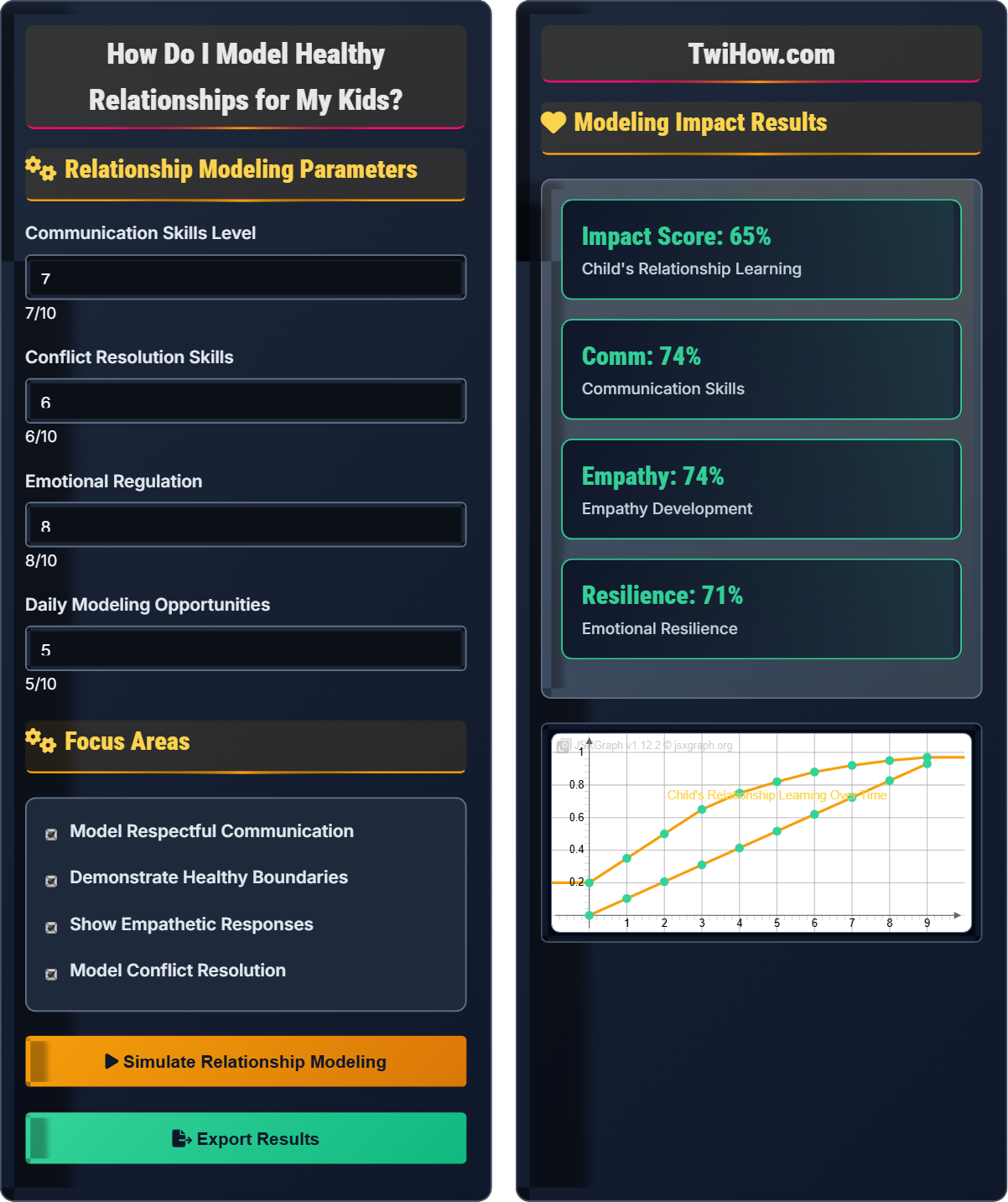
Relationship Modeling Parameters
Focus Areas
Modeling Impact Results
| Skill Area | Current Level | Modeling Impact | Child Learning |
|---|---|---|---|
| Communication | 7/10 | 85% | 82% |
| Respect | 8/10 | 78% | 75% |
| Boundaries | 6/10 | 72% | 68% |
| Empathy | 9/10 | 88% | 85% |
| Conflict Resolution | 6/10 | 70% | 65% |
How to Model Healthy Relationships
Healthy relationships are characterized by mutual respect, trust, open communication, and emotional support. As a parent, you model these behaviors for your children through your daily interactions with partners, friends, family members, and even strangers. Children learn about relationships by watching how adults treat each other and resolve conflicts.
Where:
- Active Listening: Giving full attention and validating others' feelings
- Respectful Expression: Sharing thoughts and feelings without blame or criticism
- Emotional Awareness: Recognizing and managing your own emotions
Behaviors that children learn through observation:
- Respect: How to treat others with dignity and consideration
- Communication: How to express needs and listen to others
- Conflict Resolution: How to handle disagreements peacefully
- Emotional Regulation: How to manage difficult feelings
- Bonding: How to connect with others emotionally
- Trust: How to build and maintain trust in relationships
- Apologize Sincerely: When you make mistakes, show how to take responsibility
- Express Appreciation: Regularly acknowledge others' efforts and kindness
- Handle Disagreements Publicly: Show respectful conflict resolution with your partner
- Set Personal Boundaries: Demonstrate how to say no appropriately
- Show Empathy: Express understanding for others' feelings
- Practice Self-Care: Model the importance of taking care of yourself
Relationship Modeling Fundamentals
Respect, communication, emotional regulation, conflict resolution, empathy, boundaries, trust.
Child's Relationship Skills = (Parent's Behavior × Consistency) + Child's Observation
Where Child's Relationship Skills = future relationship patterns, Parent's Behavior = modeled actions.
- Children learn more from observation than instruction
- Consistency builds trust and understanding
- Emotional safety enables learning
Practical Applications
Family discussions, conflict resolution, showing affection, setting boundaries, apologizing, expressing gratitude.
- Listen actively to your partner and children
- Handle disagreements respectfully in front of children
- Express appreciation regularly
- Apologize when you're wrong
- Set and respect personal boundaries
- Age-appropriate modeling
- Cultural sensitivity
- Individual differences
- Family values alignment
Relationship Modeling Quiz
Which of the following is the most effective way to model healthy communication for children?
Children learn primarily through observation and imitation. While direct instruction has its place, demonstrating active listening with your partner provides children with a live example of respectful communication. When children see you giving your full attention, validating feelings, and responding thoughtfully, they internalize these communication patterns.
The answer is B) Demonstrating active listening with your partner.
Children are natural observers who absorb behavioral patterns unconsciously. The most effective learning occurs when children witness consistent, positive examples in their daily environment. Modeling demonstrates the "why" behind healthy behaviors, not just the "what." When children see parents engage in respectful dialogue, they understand the underlying values of respect, patience, and empathy that drive good communication.
Active Listening: Fully concentrating, understanding, and responding to another person
Modeling: Demonstrating desired behaviors for others to observe and imitate
Observational Learning: Learning by watching and imitating others
• Children learn more from what they see than what they hear
• Consistency in modeling builds trust and understanding
• Live demonstrations are more impactful than instructions
• Make sure children can observe positive interactions
• Practice communication skills during calm moments
• Explain your thought process out loud occasionally
• Assuming children will automatically know how to communicate
Describe how to model healthy conflict resolution between parents in front of children. Include specific strategies and explain why this approach is beneficial.
Specific Strategies:
1. Stay Calm: Maintain emotional regulation and speak in a normal tone of voice
2. Focus on Issues, Not Personal Attacks: Address the specific problem without blaming or criticizing
3. Listen Actively: Give each person a chance to express their perspective
4. Seek Compromise: Work together to find solutions that address both parties' needs
5. Apologize When Needed: Take responsibility for your part in the disagreement
6. Follow Through: Implement agreed-upon solutions and show appreciation for resolution
Benefits: Children learn that disagreements are normal and resolvable, develop conflict resolution skills themselves, feel secure knowing adults can work things out, and understand that relationships can survive and grow through challenges.
When children witness healthy conflict resolution, they learn that disagreements don't have to end relationships. They observe the process of negotiation, compromise, and forgiveness. This modeling helps children develop their own conflict resolution skills and reduces anxiety about family tensions. It also demonstrates that relationships involve ongoing work and mutual respect.
Conflict Resolution: Process of addressing disagreements constructively
Emotional Regulation: Managing emotions in healthy ways
Compromise: Finding middle ground that satisfies all parties
• Keep conflicts age-appropriate for children
• Focus on problem-solving, not winning
• Always follow through on agreements
• Use "I" statements instead of "you" accusations
• Take breaks if emotions get too heated
• Acknowledge your partner's valid points
• Avoiding conflicts completely
• Using children as mediators
• Making children responsible for adult problems
Your child wants to invite friends over every weekend, but you need some quiet time for rest and household tasks. How would you model healthy boundary-setting while maintaining a positive relationship with your child? Describe your approach and explain the lesson your child will learn.
Approach: Have a calm conversation with your child explaining your needs. Say something like, "I love spending time with your friends, but I also need some quiet time on weekends to rest and take care of our home. Let's find a schedule that works for both of us." Then work together to establish guidelines like having friends over 2-3 weekends per month or designating specific quiet hours.
Lesson Learned: Your child learns that everyone has legitimate needs, that it's okay to set limits, that relationships require consideration of others' needs, and that compromise is possible. They also learn that saying no doesn't mean not caring.
Key Elements: Acknowledgment of the child's desire, explanation of your needs, collaborative problem-solving, and clear expectations.
Boundary setting is a crucial life skill that many adults struggle with. By modeling healthy boundary-setting with your child, you teach them that personal limits are normal and necessary. You demonstrate that boundaries don't indicate rejection but rather self-respect and consideration for others. This modeling helps children develop their own boundary-setting skills and understand that relationships involve mutual respect for individual needs.
Boundaries: Limits that protect physical and emotional wellbeing
Self-Advocacy: Communicating your needs respectfully
Collaborative Problem-Solving: Working together to find mutually acceptable solutions
• Explain the reasoning behind boundaries
• Involve children in finding solutions when appropriate
• Be consistent with established boundaries
• Use positive language when setting limits
• Offer alternatives when saying no
• Acknowledge the child's feelings about the boundary
• Setting rigid boundaries without explanation
• Feeling guilty about having needs
• Using shame to enforce boundaries
You're feeling frustrated with your partner about household responsibilities, and you notice your child is nearby. How do you model healthy emotional regulation while addressing the situation? Explain your approach and the long-term impact on your child's emotional development.
Immediate Approach: Take a moment to breathe and collect yourself. Acknowledge your feelings: "I'm feeling frustrated about the dishes that didn't get done." Then address the issue calmly: "Can we talk about this later when we have some private time?" Or if immediate discussion is necessary: "I'd like to discuss our household responsibilities, but I want to do it in a way that's respectful to both of us."
Long-term Impact: Your child learns that emotions are normal and manageable, that it's okay to feel frustrated, that conflicts can be addressed respectfully, and that taking a pause when emotions run high is healthy. They also learn that problems can be solved without yelling or attacking others.
Key Elements: Self-awareness, emotional pause, respectful communication, and problem-solving focus.
Emotional regulation is one of the most important skills children learn from observing their parents. When children see you manage frustration constructively, they learn that intense emotions don't have to control behavior. This modeling teaches them that it's possible to feel upset while still communicating respectfully and working toward solutions. This skill becomes foundational for their own emotional development and future relationships.
Emotional Regulation: Managing emotions in healthy, constructive ways
Self-Awareness: Recognizing your own emotional states
Emotional Pause: Taking time to manage emotions before acting
• Acknowledge emotions without acting on them impulsively
• Model taking breaks when emotions are intense
• Show that all emotions are acceptable to feel
• Use breathing techniques in front of children
• Name your emotions out loud occasionally
• Show how to redirect attention when overwhelmed
• Suppressing emotions completely
• Acting out emotions without regulation
• Telling children not to feel certain emotions
Which scenario best demonstrates modeling empathy for children?
Validating your partner's feelings during a disagreement demonstrates empathy by acknowledging their emotional experience, even when you disagree. This shows children that people can have different perspectives and still respect each other's feelings. It teaches them that empathy doesn't require agreement, and that understanding others' emotions is valuable even during conflicts.
The answer is B) Validating your partner's feelings during a disagreement.
Empathy modeling is particularly powerful during disagreements because it demonstrates that understanding others' emotions doesn't mean abandoning your own perspective. When children see parents acknowledge each other's feelings during conflicts, they learn that empathy is possible even when people disagree. This creates a foundation for compassionate communication and conflict resolution skills.
Empathy: Understanding and sharing others' emotional experiences
Validation: Acknowledging others' feelings as legitimate
Compassionate Communication: Expressing understanding for others' emotions
• Empathy can coexist with different perspectives
• Validating feelings doesn't mean agreeing with actions
• Understanding comes before problem-solving
• Use phrases like "I can see you're upset"
• Ask questions to understand others' perspectives
• Show physical signs of concern (eye contact, posture)
• Equating empathy with agreement
• Trying to fix emotions instead of acknowledging them
• Dismissing others' feelings as irrational
FAQ
Q: What if I'm not perfect at modeling healthy relationships? Will my imperfections harm my children?
A: Perfection isn't the goal – consistency and repair are much more important. Children benefit from seeing you make mistakes and then model how to handle them constructively. When you apologize, take responsibility, and make amends, you're teaching them valuable lessons about accountability and relationship repair. The key is to demonstrate that relationships can survive imperfections and that growth is possible. Aim for "good enough" parenting rather than perfectionism.
Q: How do I model healthy relationships if my marriage isn't perfect?
A: Even in imperfect relationships, you can model healthy behaviors like respectful communication, active listening, and problem-solving. Focus on how you handle disagreements constructively, show appreciation for your partner's positive qualities, and demonstrate that relationships require ongoing effort from both parties. You can also model seeking help when needed, whether through counseling or personal growth. Children learn that relationships involve work and that improvement is always possible.