How Do I Navigate Co-Parenting & Blended Family Dynamics?
Complete parent's guide • Communication & conflict resolution
Co-Parenting & Blended Family Dynamics:
Family PlannerSuccessfully navigating co-parenting and blended family dynamics requires effective communication, clear boundaries, and consistent approaches. These arrangements involve multiple relationships and can be complex, but with proper strategies, they can create stable, loving environments for children. The key is focusing on the children's needs while maintaining respect and cooperation between all adults involved.
Essential elements include:
- Consistent Rules: Unified expectations across households
- Effective Communication: Regular, respectful exchanges about children
- Boundaries: Clear roles and responsibilities for all adults
- Flexibility: Adapting to changing needs and circumstances
- Child-Centered Focus: Prioritizing children's well-being above conflicts
Success in these arrangements takes time, patience, and commitment from all parties involved.
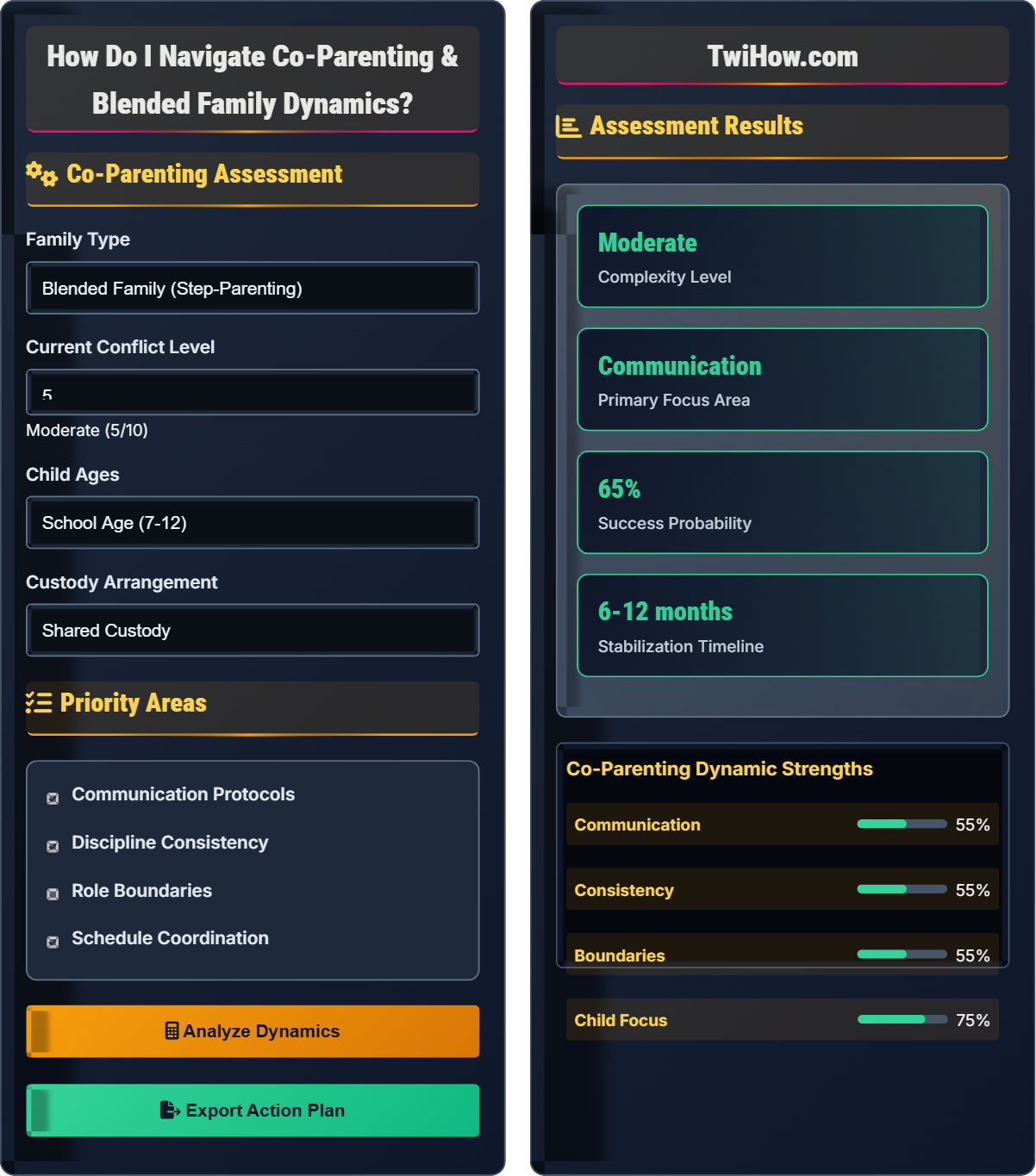
Co-Parenting Assessment
Priority Areas
Assessment Results
Co-Parenting Dynamic Strengths
Recommended Strategies
- Unified Communication: Establish consistent communication channels and protocols between all adults.
- Consistent Rules: Align major rules and consequences across households to provide stability.
- Respect Roles: Clearly define and respect each adult's role in the child's life.
- Child-Centered Decisions: Make choices based on the child's best interests rather than personal conflicts.
Sample Weekly Calendar
Co-Parenting & Blended Family Strategies
Effective communication is the cornerstone of successful co-parenting and blended families:
Successful communication requires focusing on the children while managing adult emotions separately.
- Neutral Tone: Keep communications factual and business-like
- Child Focus: Discuss only child-related matters
- Consistency: Use the same communication methods regularly
- Documentation: Keep records of important decisions and schedules
- Technology: Utilize apps or calendars for coordination
- Boundaries: Avoid personal topics or relationship issues
Creating stability for children requires coordinated approaches:
Clear roles prevent confusion and conflict:
- Biological Parents: Maintain primary decision-making authority
- Step-Parents: Support discipline while respecting primary parent's authority
- Grandparents: Coordinate with parents on rules and expectations
- Other Adults: Clarify roles and responsibilities with children
- Transitions: Establish protocols for different households
- Discipline: Define who handles what situations
- Relationships: Respect existing parent-child bonds
Keeping children's needs at the forefront:
- Emotional Support: Validate children's feelings about family changes
- Security: Provide stability and predictable routines
- Flexibility: Adapt to children's changing needs and ages
- Patience: Allow time for adjustment to new family dynamics
- Listening: Hear children's concerns and perspectives
- Reassurance: Emphasize that love is not divided
- Support: Seek counseling when needed for children
Managing disagreements constructively:
- Focus on Issues: Address specific problems, not personal grievances
- Compromise: Find middle ground that works for children
- Mediation: Use professionals when conflicts escalate
- Time-Outs: Pause heated discussions to cool down
- Written Agreements: Document important decisions and arrangements
- Third Party: Involve counselors or family mediators
- Patience: Allow time for relationships to develop
Implementation Strategies
Communication protocols, consistency, role boundaries, child-centered focus, conflict resolution.
Family Harmony = (Communication × Consistency × Respect) ÷ Conflicts
Where Communication = Effective exchange, Consistency = Unified approaches, Respect = Mutual consideration.
- Keep child's needs first
- Maintain respectful communication
- Align major rules across households
Common Challenges
Communication breakdown, inconsistent discipline, role confusion, loyalty conflicts, jealousy.
- Address issues promptly and privately
- Focus on children's well-being
- Seek professional mediation when needed
- Establish clear boundaries and expectations
- Individual child personalities
- Age-appropriate expectations
- Family cultural values
- Previous family experiences
Co-Parenting & Blended Family Learning Quiz
What is the most effective communication approach in co-parenting situations?
Using neutral, business-like communication focused on children is most effective. This approach keeps discussions productive and centered on the child's needs rather than adult conflicts. It maintains respect and clarity while avoiding emotional escalation.
The answer is B) Use neutral, business-like communication focused on children.
Effective co-parenting communication requires separating adult relationship issues from child-related discussions. Business-like communication maintains focus on the child's needs while reducing opportunities for conflict. This approach helps both parents stay accountable for their child's welfare.
Business-Like Communication: Factual, respectful exchanges focused on child welfare
Child-Centered Focus: Prioritizing child's needs over adult conflicts
Neutral Tone: Avoiding emotional language or personal attacks
• Focus on child's needs
• Maintain respectful tone
• Avoid personal conflicts
• Use email or apps for documentation
• Keep conversations brief and focused
• Plan discussions in advance
• Bringing up past relationship issues
• Using children as messengers
• Emotional communication
Explain how to establish clear role boundaries in a blended family with step-parents involved.
Role Boundary Establishment:
Biological Parents: Maintain primary authority in major decisions while welcoming step-parent input.
Step-Parents: Start as supportive figures, gradually building relationships without rushing into disciplinary roles.
Transitions: Establish clear protocols for how discipline and authority shift between households.
Consistency: Align on major rules while allowing some household-specific variations.
Relationship Building: Allow step-parent/child relationships to develop naturally without pressure.
Decision-Making: Clarify which parent makes which types of decisions in each household.
Support System: Ensure step-parents know when to defer to biological parents.
Patience: Allow time for all family members to adjust to new roles and relationships.
Role boundaries in blended families require careful navigation to respect existing parent-child bonds while allowing new relationships to develop. The key is gradual integration with clear expectations for all parties involved.
Step-Parent: Adult partner who forms parental relationship with partner's children
Biological Parent: Child's genetic parent with primary authority
Gradual Integration: Slow, natural development of new family relationships
• Respect existing parent-child bonds
• Allow relationships to develop naturally
• Maintain clear authority structures
• Start with supportive roles
• Communicate expectations clearly
• Be patient with relationship development
• Rushing into disciplinary roles
• Undermining biological parent authority
• Not allowing natural relationship development
Your 10-year-old child is struggling with discipline consistency between your home and your ex-spouse's home. Your ex enforces strict bedtimes and limits screen time, while you're more lenient. Your child is using this inconsistency to manipulate both parents. How do you address this situation?
Initial Assessment: Recognize that inconsistency is creating problems for the child and both households.
Private Discussion: Approach your ex-spouse to discuss the impact on the child without assigning blame.
Focus on Child: Frame the conversation around the child's need for consistency rather than your preferences.
Identify Core Issues: Agree on major consistency areas (bedtime, homework, screen time, consequences).
Flexible Compromises: Allow for some household-specific differences while maintaining core consistency.
Implementation: Create a joint communication plan to reinforce consistent expectations.
Monitor Progress: Check in regularly about how the child is adapting to the new consistency.
Child Explanation: Help the child understand why consistency is important for their well-being.
Children thrive with consistent expectations across households. When parents have different approaches, children naturally try to exploit these differences. The solution requires both parents to prioritize the child's needs over their individual preferences, working together to create a more unified approach.
Consistency: Similar rules and expectations across different environments
Child Manipulation: Using parent differences to gain advantages Joint Communication: Coordinated approach between parentsYour new spouse is eager to discipline your children from your previous marriage, but the children are resistant and claim the step-parent "doesn't know them" and "isn't their real parent." How do you navigate this situation to support both your spouse and children?
Initial Conversation: Meet with your spouse to discuss realistic expectations for relationship building.
Family Meeting: Facilitate a conversation about new family dynamics and roles.
Gradual Approach: Encourage step-parent to start with supportive, non-disciplinary roles.
Respect Existing Bonds: Acknowledge the children's relationship with their other parent.
Clear Boundaries: Define when step-parent can provide discipline versus when to defer to you.
Patience: Allow time for relationships to develop naturally without pressure.
Support System: Ensure children know they can still turn to you for primary discipline.
Positive Interactions: Focus on activities that build positive relationships first.
Step-parent relationships require careful navigation to respect existing parent-child bonds while allowing new relationships to develop. The key is gradual integration with clear expectations and boundaries for all family members. Rushing into disciplinary roles often creates resistance and conflict.
Gradual Integration: Slow development of new family relationships
Respectful Boundaries: Clear roles that honor existing relationships
Supportive Role: Step-parent providing assistance without primary authority
When co-parenting conflicts escalate, what is the most constructive approach?
Seeking professional mediation or counseling is most constructive. Professionals provide neutral guidance and teach effective communication skills. This approach focuses on the children's needs while providing tools for managing future conflicts constructively.
The answer is C) Seek professional mediation or counseling.
Professional mediators specialize in helping co-parents navigate conflicts constructively. They provide neutral guidance and teach communication skills that can prevent future conflicts. This approach maintains focus on the children's welfare while providing long-term solutions.
Professional Mediation: Neutral third-party facilitation of agreements
Constructive Conflict: Disagreement resolved with child's needs in focus
Neutral Guidance: Third-party perspective without bias
FAQ
Q: How do I handle different parenting styles between households?
A: Managing different parenting styles requires strategic coordination:
Core Consistency: Align on major issues like safety, values, and major consequences.
Minor Flexibility: Allow for some household-specific differences to reduce conflict.
Child Preparation: Help children understand and navigate different approaches respectfully.
Communication: Discuss parenting approaches privately to avoid undermining each other.
Flexibility: Be willing to adjust approaches based on what works for the child.
Professional Input: Consider family counseling to develop unified approaches.
The goal is to provide stability while respecting each parent's individual style.
Q: What are the long-term benefits of successful co-parenting?
A: Children in successful co-parenting arrangements develop numerous long-term benefits:
Resilience: Ability to adapt to change and handle stress effectively.
Relationship Skills: Better communication and conflict resolution abilities.
Flexibility: Comfort with different environments and approaches.
Self-Esteem: Confidence from consistent love and support from both parents.
Problem-Solving: Enhanced ability to navigate complex social situations.
Emotional Regulation: Better ability to manage emotions and stress.
Independence: Self-reliance from managing multiple household transitions.
Research shows these benefits often surpass those of children in high-conflict intact families.
Q: How do I handle holidays and special occasions in blended families?
A: Holiday planning in blended families requires thoughtful coordination:
Advance Planning: Discuss holiday arrangements well in advance to avoid last-minute conflicts.
Rotation System: Develop fair rotation schedules for holidays and special occasions.
Flexibility: Be willing to adapt arrangements based on children's ages and needs.
Separate Celebrations: Consider having separate celebrations to accommodate all family members.
Child Input: Consider children's preferences as they mature and can express them.
New Traditions: Create new family traditions that include all family members.
Communication: Maintain open dialogue about expectations and feelings.
Professional Help: Consider family counseling for complex holiday planning.
The key is prioritizing children's emotional well-being while respecting all family relationships.
Resources
American Academy of Pediatrics: www.aap.org
Family Mediation Council: www.familymediationcouncil.org
Stepfamily Association: www.stepfamily.org
Co-Parenting Institute: www.coparentinginstitute.com