How Do I Practice Self-Care as a Parent?
Complete parenting guide • Step-by-step explanations
Parent Self-Care:
Show Self-Care SimulatorPracticing self-care as a parent is essential for maintaining your physical, emotional, and mental well-being, which ultimately benefits your entire family. Self-care isn't selfish—it's a necessary component of effective parenting. When parents take care of themselves, they have more patience, energy, and emotional stability to care for their children and manage family responsibilities.
Key aspects of parent self-care:
- Physical Health: Exercise, nutrition, sleep, and medical care
- Emotional Wellness: Stress management, emotional regulation, and mental health
- Social Connections: Maintaining friendships and support networks
- Personal Interests: Pursuing hobbies and activities you enjoy
- Professional Development: Continuing education and career growth
Effective self-care strategies can be implemented even with busy schedules and limited time. The goal is to find sustainable practices that fit your lifestyle and family situation.
Self-Care Assessment Parameters
Self-Care Categories
Self-Care Assessment Results
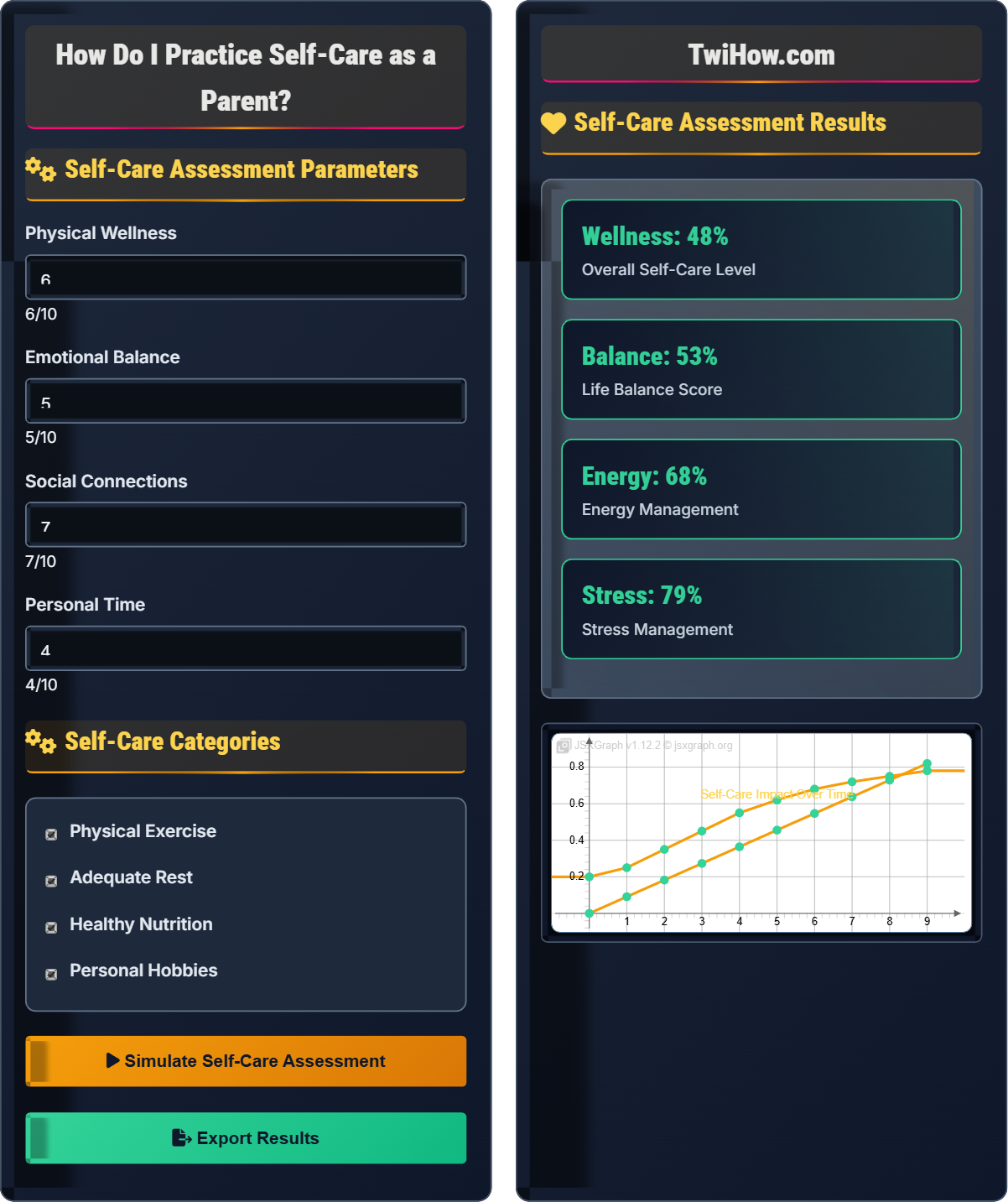
| Category | Current Level | Impact | Recommendation |
|---|---|---|---|
| Physical Health | 6/10 | High | Improve consistency |
| Emotional Wellness | 5/10 | High | Develop coping strategies |
| Social Connections | 7/10 | Medium | Maintain current level |
| Personal Time | 4/10 | High | Significantly increase |
| Professional Growth | 6/10 | Low | Opportunity for growth |
Practicing Self-Care as a Parent
Parent self-care is the practice of taking care of your own physical, emotional, and mental well-being as a parent. It involves intentionally setting aside time and energy for your own needs, interests, and health. Self-care is not selfish—it's essential for being an effective, patient, and emotionally available parent. When parents take care of themselves, they're better equipped to care for their children.
Where:
- Self-Care: Deliberate activities for personal well-being
- Energy Management: Efficient use of physical and mental resources
- Stress Reduction: Techniques to minimize and manage stress
- Support Systems: People and resources that provide assistance
Key areas of self-care:
- Physical: Exercise, sleep, nutrition, medical care
- Emotional: Stress management, therapy, emotional expression
- Social: Friendships, family connections, community involvement
- Mental: Hobbies, learning, creative activities, meditation
- Spiritual: Values, purpose, meaning, faith practices
- Professional: Career development, work-life balance, skill building
- Micro-Self-Care: 5-minute activities throughout the day
- Micro-Breaks: Stepping away for brief moments of calm
- Family Integration: Activities that benefit both you and your children
- Support Sharing: Trading childcare with other parents
- Technology Use: Apps for meditation, exercise, or planning
- Professional Help: Counseling, support groups, or coaching
Self-Care Fundamentals
Self-care, wellness, stress management, work-life balance, emotional regulation, personal time.
Wellness = (Self-Care × Consistency) + (Support × Resilience)
Where Wellness = overall well-being, Self-Care = personal care activities.
- Self-care is necessary, not selfish
- Consistency is more important than intensity
- Start with small, manageable changes
Practical Applications
Busy schedules, work demands, children's needs, family obligations, personal health challenges.
- Identify your current self-care practices
- Assess what areas need more attention
- Start with one small change
- Build consistency before adding more
- Adjust based on your family's needs
- Individual needs vary
- Family situations differ
- Resources and time constraints
- Personal preferences and interests
Parent Self-Care Quiz
Why is self-care important for parents?
Self-care helps parents maintain their physical and emotional well-being, which enables them to be more patient, present, and effective with their children. When parents take care of themselves, they have more resources to give to their families. It's not selfish—it's necessary for effective parenting.
The answer is B) It helps parents be more patient and effective.
Many parents feel guilty about taking time for themselves, viewing it as selfish. However, research consistently shows that parents who practice self-care are more effective, patient, and emotionally available. This concept is often explained using the airplane oxygen mask analogy: you must put on your own mask first before helping others.
Self-Care: Deliberate activities for personal well-being
Effective Parenting: Being emotionally available and responsive
Well-Being: Physical and emotional health
• Self-care benefits the whole family
• Consistency is more important than duration
• Start small and build gradually
• Integrate self-care into existing routines
• Involve children in some activities
• Ask for help when needed
• Believing self-care is selfish
• Waiting for "perfect" time
• Not starting with small changes
Explain how busy parents can incorporate self-care into their daily routine. Include specific strategies and examples.
Strategies: Micro-self-care activities, integrating self-care into existing routines, scheduling short breaks, and finding efficient activities.
Examples: 5-minute meditation during coffee time, stretching while children eat breakfast, taking a walk while children play, practicing deep breathing during transitions.
Integration: Combining activities like exercising with children, listening to podcasts during commute, or journaling before bed.
Time constraints are the biggest barrier to self-care for many parents. The key is to recognize that self-care doesn't have to be time-intensive. Small, consistent activities can be more beneficial than occasional long sessions. The goal is to make self-care a regular part of daily life rather than something that requires special time allocation.
Micro-Self-Care: Short, 5-minute self-care activities
Integration: Combining self-care with existing activities
Efficiency: Maximizing benefit in minimal time
• Consistency beats duration
• Small activities are better than none
• Integrate rather than add
• Use a timer to stay consistent
• Link activities to existing habits
• Prepare in advance for busy periods
• Waiting for large blocks of time
• Setting unrealistic expectations
• Not planning ahead
You're a single parent working full-time with two young children. You feel overwhelmed and realize you need self-care but don't have time or support. How would you build a support system and incorporate self-care?
Support Building: Connect with other parents at school, join online support groups, ask neighbors for help, contact family members, and explore community resources.
Self-Care Integration: Wake up 30 minutes earlier for personal time, use children's nap time for self-care, take advantage of free childcare hours at community centers.
Resource Utilization: Look into parent support groups, respite care services, and family assistance programs.
Single parents face unique challenges in practicing self-care. Building a support network is crucial for sustainability. The key is to start small and gradually build both self-care practices and support systems. Many resources are available specifically for single parents, including community programs, online support groups, and respite care services.
Support System: Network of people providing assistance
Respite Care: Temporary childcare for parent relief
Community Resources: Local support services
• Ask for help when needed
• Start with small changes
• Build support gradually
• Connect with other single parents
• Use online resources and communities
• Look into local family support programs
• Trying to do everything alone
• Not utilizing available resources
• Setting unrealistic expectations
You feel guilty when taking time for yourself, believing you should always prioritize your children's needs. How do you overcome this guilt and maintain consistent self-care?
Reframe Thinking: Recognize that self-care makes you a better parent. You're modeling healthy behavior and teaching children the importance of self-care.
Start Small: Begin with 5-10 minute activities to build comfort with self-care time.
Track Benefits: Notice how self-care improves your patience, mood, and energy, which benefits your children.
Communicate: Explain to children that taking care of yourself helps you take better care of them.
Guilt is a common barrier to self-care for parents. Reframing self-care as beneficial for the entire family helps overcome this obstacle. When parents take care of themselves, they're better equipped to meet their children's needs. Self-care also models healthy behavior for children, teaching them that taking care of oneself is important and acceptable.
Reframing: Changing perspective on a situation
Modeling: Demonstrating behavior for othersBeneficial: Providing advantages to others
• Self-care benefits the entire family
• You deserve care too
• Modeling is teaching
• Start with small, guilt-free activities
• Track positive changes in yourself
• Share your self-care journey with children
• Believing self-care is selfish
• Not recognizing the benefits to children
• Setting unrealistic expectations
Which of the following is the most common barrier to self-care for parents?
Time constraints are the most commonly reported barrier to self-care for parents. Between work, childcare, household responsibilities, and other commitments, parents often feel they don't have time for themselves. However, self-care doesn't require large blocks of time—small, consistent activities can be highly effective.
The answer is B) Lack of time.
While financial constraints, lack of interest, and limited knowledge can be barriers, time is the most universal challenge for parents. The solution lies in reframing self-care as small, integrated activities rather than separate time blocks. This approach makes self-care more accessible and sustainable for busy parents.
Barrier: Obstacle preventing action
Constraint: Limitation on options
Accessibility: Ease of obtaining resources
• Small activities are better than none
• Integrate into existing routines
• Consistency builds habit
• Use micro-self-care activities
• Link to existing habits
• Make it a priority
• Waiting for perfect time
• Believing self-care requires large time blocks
• Not starting small
FAQ
Q: How do I find time for self-care when my schedule is completely filled with work and parenting responsibilities?
A: Start with micro-self-care: 5-minute meditation, deep breathing exercises, or mindful moments during daily activities. Integrate self-care into existing routines: listen to podcasts while commuting, do stretches during TV time, or practice mindfulness while doing household tasks. Even small consistent activities are better than occasional long sessions. Consider early morning or late evening windows, and remember that self-care doesn't have to be elaborate or time-consuming.
Q: What if I feel guilty about taking time for myself?
A: Reframe your thinking: self-care makes you a better parent. When you're rested and emotionally regulated, you're more patient, present, and effective with your children. You're also modeling healthy behavior and showing children that self-care is important. Start with small, guilt-free activities and gradually build up. Remember that taking care of yourself is not selfish—it's necessary for effective parenting.