How Do I Support My Child's Friendships and Social Connections?
Complete parenting guide • Step-by-step explanations
Social Connection Support:
Show Social Skills SimulatorSupporting your child's friendships and social connections is vital for their emotional, social, and cognitive development. Strong social skills help children build confidence, develop empathy, learn cooperation, and create meaningful relationships. This support involves teaching communication skills, facilitating opportunities, modeling appropriate behavior, and providing guidance when social challenges arise.
Key aspects of social connection support:
- Communication Skills: Teaching listening, sharing, and expressing feelings
- Social Opportunities: Creating chances for meaningful interactions
- Emotional Intelligence: Developing empathy and emotional awareness
- Conflict Resolution: Learning to navigate disagreements and misunderstandings
- Self-Confidence: Building self-esteem and social assurance
Children with strong social connections show better academic performance, emotional regulation, and overall well-being. They develop important life skills that will benefit them throughout their lives.
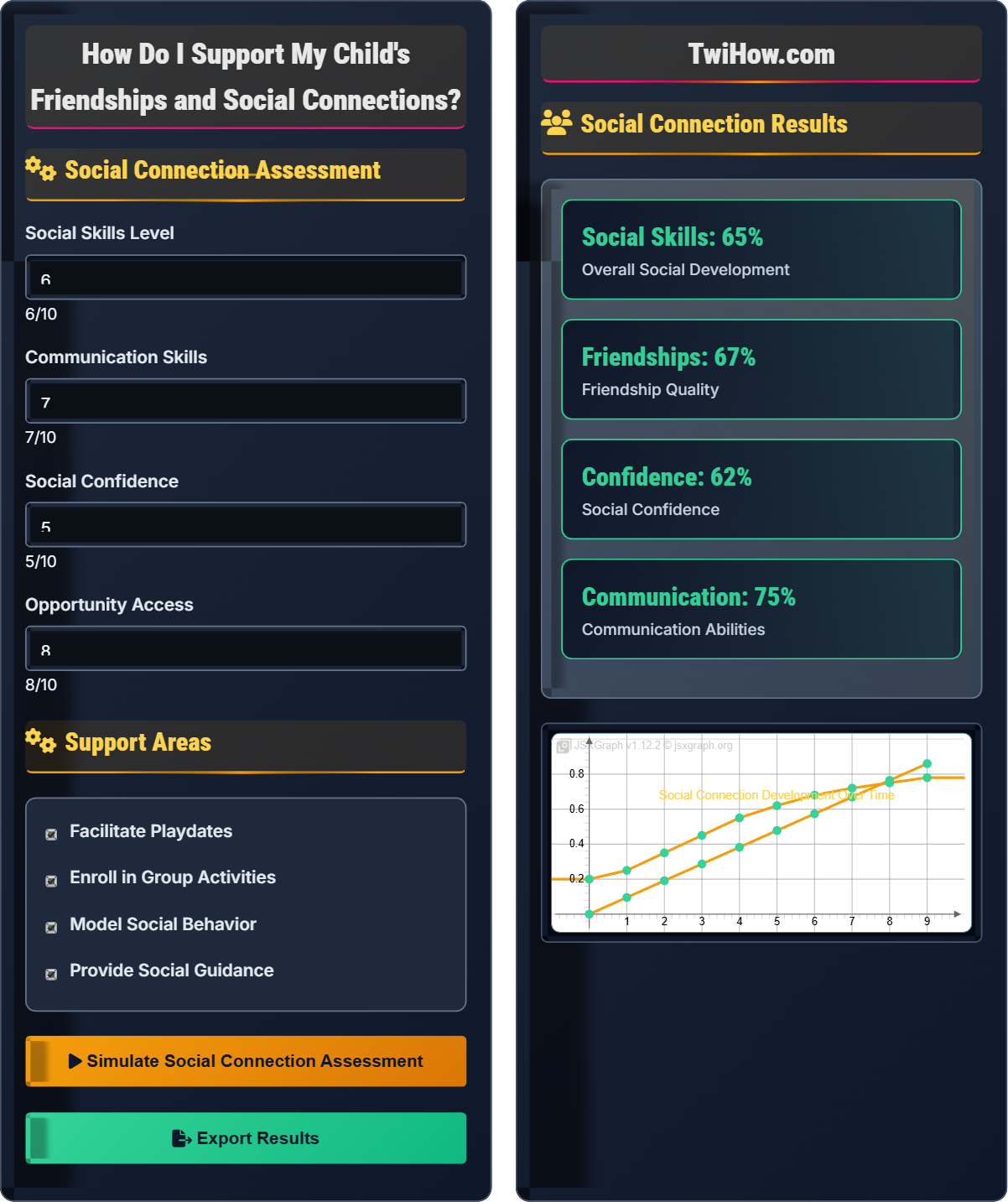
Social Connection Assessment
Support Areas
Social Connection Results
| Social Area | Current Level | Impact Level | Focus Area |
|---|---|---|---|
| Social Skills | 6/10 | High | Improve interaction skills |
| Communication | 7/10 | High | Excellent |
| Confidence | 5/10 | Medium | Build self-assurance |
| Opportunities | 8/10 | Medium | Great access |
| Empathy | 6/10 | High | Develop emotional awareness |
Supporting Children's Social Connections
Social connections refer to the relationships and interactions children form with peers, family members, and community. These connections develop through shared experiences, communication, and mutual interests. Social connections provide emotional support, learning opportunities, and a sense of belonging that is crucial for healthy development. Supporting these connections involves creating opportunities, teaching skills, and providing guidance.
Where:
- Skills: Communication, empathy, and interaction abilities
- Opportunities: Chances for social interaction and practice
- Confidence: Self-assurance in social situations
- Support: Guidance and encouragement from caregivers
Essential skills for social connection:
- Communication: Expressing needs, feelings, and thoughts clearly
- Empathy: Understanding and responding to others' emotions
- Cooperation: Working together and sharing resources
- Conflict Resolution: Managing disagreements constructively
- Emotional Regulation: Managing feelings during social interactions
- Self-Advocacy: Standing up for oneself respectfully
- Role-Playing: Practice social scenarios and interactions
- Group Activities: Enroll in sports, clubs, or classes
- Playdates: Arrange regular one-on-one interactions
- Modeling: Demonstrate positive social behaviors
- Guidance: Provide support during conflicts and challenges
- Reflection: Discuss social experiences and lessons learned
Social Skills Fundamentals
Social skills, friendships, communication, empathy, emotional intelligence, social confidence, peer relationships.
Friendship Quality = (Social Skills × Opportunities) + (Confidence × Support)
Where Friendship Quality = relationship strength, Social Skills = communication abilities.
- Every child develops at their own pace
- Quality matters more than quantity of friendships
- Consistent support builds confidence
Practical Applications
Playdates, school interactions, group activities, birthday parties, social conflicts, new friendships.
- Assess your child's current social abilities
- Identify opportunities for social interaction
- Teach specific social skills through practice
- Arrange age-appropriate social activities
- Provide guidance during social challenges
- Individual personality and temperament
- Developmental stage and maturity
- Family values and social preferences
- Available resources and opportunities
Social Connection Quiz
Which social skill is most important for building friendships?
Active listening and showing genuine interest in others is the most important skill for building friendships. This skill demonstrates respect, empathy, and care for others. It helps children understand their peers and creates reciprocal interest in the relationship. Good listeners tend to make better friends and have stronger relationships.
The answer is B) Active listening and showing interest in others.
Friendship building is fundamentally about connection and mutual interest. Active listening shows respect and creates opportunities for meaningful interaction. Children who learn to listen and show interest in others develop stronger, more lasting friendships. This skill also helps them understand others' perspectives and emotions, which is crucial for social success.
Active Listening: Fully focusing on and understanding what others say
Empathy: Understanding and sharing others' feelings
Reciprocity: Mutual exchange in relationships
• Listening is more important than talking
• Show genuine interest in others
• Respect others' perspectives
• Ask follow-up questions
• Make eye contact during conversations
• Show interest in others' activities
• Dominating conversations
• Not showing interest in others
• Interrupting frequently
Explain how to teach children to resolve conflicts with friends. Include specific strategies and examples.
Strategies: Teach active listening, perspective-taking, compromise, and respectful communication. Practice problem-solving steps: identify the problem, brainstorm solutions, choose the best option, and evaluate results.
Examples: "I feel upset when..." statements, taking turns, sharing, apologizing when wrong, asking for help when needed.
Implementation: Role-play scenarios, discuss real situations, model appropriate responses, and provide guidance during actual conflicts.
Conflict resolution is a crucial social skill that helps children navigate disagreements constructively. Teaching children to express their feelings respectfully, understand others' perspectives, and find mutually acceptable solutions builds their confidence and strengthens relationships. These skills become invaluable as they mature and face more complex social challenges.
Conflict Resolution: Addressing disagreements constructively
Perspective-Taking: Understanding others' viewpoints
Compromise: Finding mutually acceptable solutions
• Address problems directly
• Focus on solutions, not blame
• Respect all parties involved
• Practice "I feel" statements
• Teach to listen before responding
• Encourage compromise and sharing
• Avoiding conflicts entirely
• Not teaching specific strategies
• Focusing only on winning
Your child is naturally shy and hesitant to approach other children. How do you help them build friendships while respecting their temperament? Describe your approach and expected outcomes.
Approach: Start with small, manageable social situations, arrange one-on-one playdates with compatible children, model social interactions, and gradually increase social exposure. Provide support without forcing interactions.
Expected Outcomes: Gradual increase in social confidence, development of close friendships, improved communication skills, and increased comfort in social settings.
Implementation: Observe your child's comfort level, respect their pace, and celebrate small social victories.
Introverted children can develop strong social skills, but they often need different approaches than extroverted children. Gradual exposure to social situations allows them to build confidence without overwhelming them. The key is to support their social development while honoring their natural temperament. This approach helps children feel secure while gradually expanding their comfort zone.
Temperament: Innate personality characteristics
Introversion: Preference for solitude and smaller groups
Gradual Exposure: Slowly increasing social challenges
• Respect individual temperament
• Gradually increase social challenges
• Provide support without pressure
• Start with familiar children
• Use structured activities
• Prepare for social situations in advance
• Forcing interactions beyond comfort level
• Labeling as "shy" permanently
• Not providing social opportunities
Your child's friends are pressuring them to do things that make them uncomfortable. How do you teach them to maintain friendships while standing up for themselves? Explain your strategy and anticipated benefits.
Strategy: Teach assertiveness skills, practice refusal techniques, discuss the difference between good and bad friends, and help them find friends who respect their boundaries.
Techniques: "No" with confidence, suggesting alternatives, leaving uncomfortable situations, and seeking help when needed.
Benefits: Stronger self-confidence, healthier friendships, better decision-making skills, and increased respect from others.
Learning to stand up for oneself while maintaining friendships is a crucial life skill. Children need to understand that true friends respect boundaries and that it's okay to say no to uncomfortable requests. This skill helps them avoid potentially harmful situations while building self-confidence and self-respect.
Assertiveness: Expressing needs and boundaries respectfully
Peer Pressure: Influence from friends to conform to group behavior
Boundaries: Personal limits and standards
• True friends respect boundaries
• It's okay to say no
• Stand up for your values
• Practice saying no in safe environments
• Teach to suggest alternatives
• Encourage finding friends with similar values
• Assuming all friends are good influences
• Not teaching refusal skills
• Focusing only on pleasing others
Which approach is most effective for helping children develop social connections?
Choosing 1-2 activities where the child can build deep connections is most effective. This approach allows children to develop meaningful relationships rather than superficial ones. It provides consistent opportunities to practice social skills and build confidence. Quality friendships are more valuable than numerous shallow connections.
The answer is B) Choosing 1-2 activities where child can build deep connections.
Consistent participation in fewer activities allows children to develop deeper relationships and become more comfortable in social settings. Frequent activity changes can prevent the formation of meaningful connections. Deep friendships provide emotional support and help children develop important social skills through regular interaction.
Deep Connections: Meaningful, lasting friendships
Superficial: Surface-level, temporary relationshipsConsistency: Regular participation in activities
• Quality over quantity in friendships
• Consistency builds relationships
• Meaningful connections are valuable
• Allow time for friendships to develop
• Choose activities based on child's interests
• Encourage regular participation
• Overscheduling with activities
• Not allowing time for relationships to form
• Focusing only on new connections
FAQ
Q: How do I know if my child's social development is on track?
A: Social development varies greatly between children. Generally, look for: age-appropriate communication skills, ability to form and maintain friendships, empathy for others, conflict resolution abilities, and confidence in social settings. If you're concerned about significant delays or social challenges, consult with your pediatrician or a child development specialist. Remember that introversion is not a developmental issue.
Q: What if my child has a friend who influences them negatively?
A: Use this as a teaching opportunity. Discuss the behaviors that concern you, help your child identify positive vs. negative influences, and teach them to evaluate their friends' actions. Encourage them to find friends who share similar values. If the influence is harmful, set appropriate boundaries while helping your child understand why. Focus on building their judgment skills rather than simply forbidding the friendship.