How Do I Support My Child Through Anxiety & Big Emotions?
Complete parent's guide • Emotional regulation & crisis management
Child Emotional Support Overview:
Emotion Support PlannerSupporting children through anxiety and big emotions requires understanding their developmental stage, recognizing emotional triggers, and implementing appropriate regulation strategies. Effective support combines validation, teaching emotional skills, providing security, and gradually building resilience. The key is remaining calm, responsive, and consistent while helping children develop their own emotional regulation abilities.
Essential components include:
- Emotional Validation: Acknowledging and accepting all feelings as valid
- Regulation Techniques: Teaching practical strategies for managing emotions
- Security: Providing consistent, predictable responses
- Communication: Using age-appropriate language and active listening
- Gradual Independence: Building self-regulation skills over time
Successful emotional support creates resilient children who can navigate their feelings effectively throughout life.
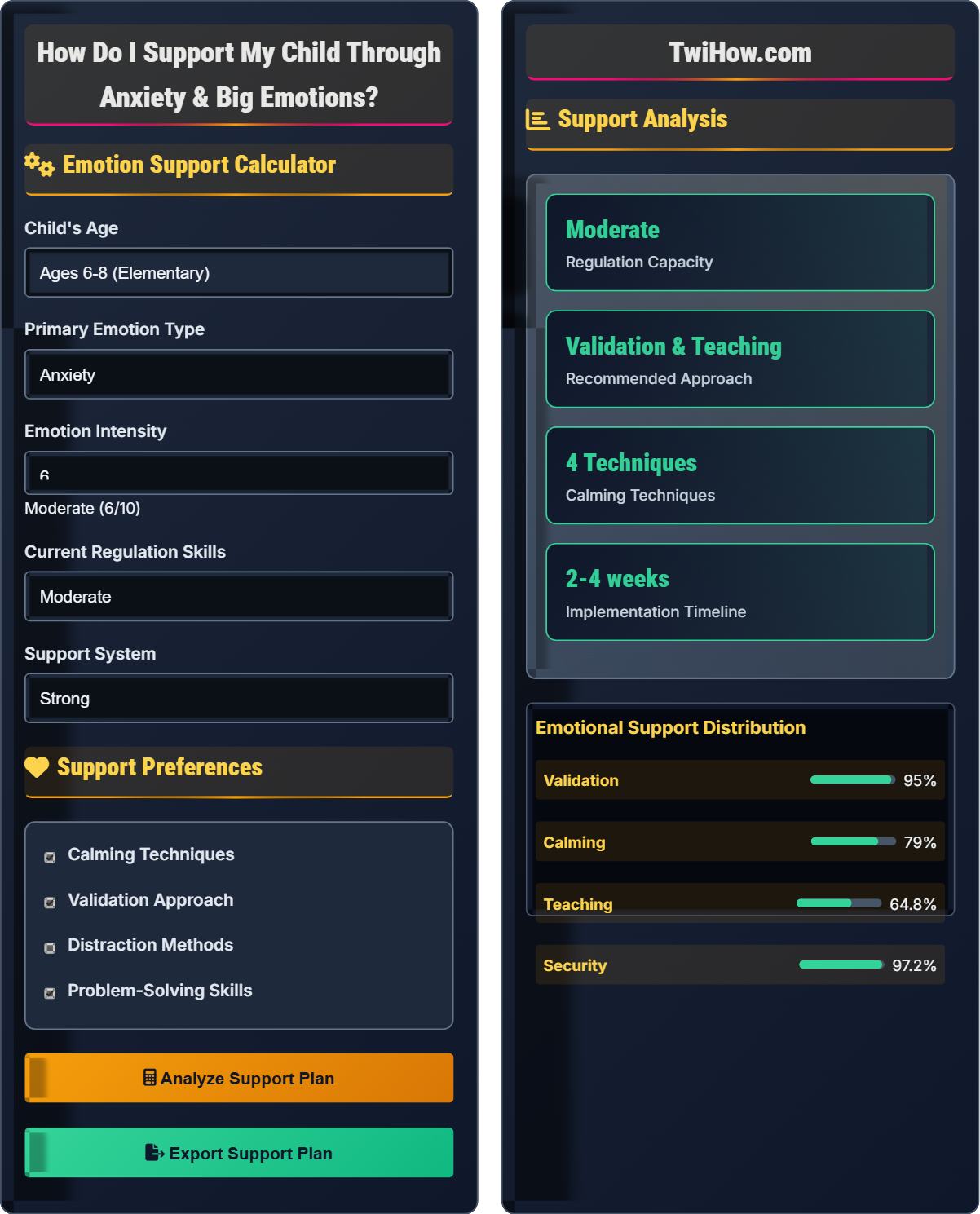
Emotion Support Calculator
Support Preferences
Support Analysis
Emotional Support Distribution
Recommended Strategies
- Emotional Validation: Acknowledge feelings without judgment or attempts to fix immediately.
- Calming Techniques: Teach breathing exercises, progressive muscle relaxation, or mindfulness.
- Security Building: Provide consistent, predictable responses and maintain calm demeanor.
- Problem-Solving: Help child identify solutions when they're ready to think rationally.
Calming Techniques
Emotional Support & Regulation Strategies
Emotional regulation develops progressively through childhood:
Young children rely heavily on caregivers for co-regulation, gradually developing independent regulation skills. The prefrontal cortex, responsible for executive function and emotion regulation, continues developing into the mid-20s.
- 0-2 years: Co-regulation through responsive caregiving
- 2-5 years: Developing basic self-soothing skills
- 5-8 years: Learning to identify and express emotions
- 8-12 years: Developing problem-solving and coping strategies
- 12+ years: Independent emotional regulation with guidance
Different strategies work best for different developmental stages:
When a child is experiencing intense emotions:
Effective techniques for different emotional states:
- Deep Breathing: 4-7-8 technique, belly breathing, counting breaths
- Progressive Relaxation: Tensing and releasing muscle groups
- Grounding Techniques: 5-4-3-2-1 sensory awareness, naming objects
- Physical Movement: Jumping jacks, walking, stretching
- Creative Expression: Drawing, writing, music, dance
- Sensory Soothing: Weighted blankets, fidget toys, textured objects
- Positive Self-Talk: Encouraging phrases and affirmations
Implementation Strategies
Emotional validation, co-regulation, self-soothing, mindfulness, stress management, communication.
Success = (Validation × Teaching) ÷ Reactivity
Where Validation = Acknowledging emotions, Teaching = Skill development, Reactivity = Impulsive responses.
- Validate emotions before problem-solving
- Remain calm and regulated yourself
- Meet the child at their developmental level
Emotional Support Learning Quiz
Which response best demonstrates emotional validation during a child's emotional outburst?
Emotional validation acknowledges the child's feelings without judgment, showing that their emotions are understood and accepted. This creates safety and helps the child feel heard. Validation doesn't mean agreement with the child's behavior, but rather recognition of their emotional experience.
The answer is B) "I can see you're really upset about this."
Validation is the foundation of effective emotional support. When children feel understood, they're more likely to calm down and be receptive to guidance. Validation reduces the intensity of emotions and creates connection between parent and child, which is essential for teaching regulation skills.
Emotional Validation: Acknowledging and accepting someone's emotional experience
Co-regulation: Caregiver helping child manage emotions through presence and support
Emotional Safety: Feeling secure enough to express emotions without fear of judgment
• Acknowledge emotions first
• Stay calm and regulated
• Focus on connection over compliance
• Use "I see" statements
• Reflect back what you observe
• Normalize emotional responses
• Minimizing emotions
• Punishing emotional expression
• Not staying calm yourself
Explain the concept of co-regulation and how it transitions to self-regulation as children develop.
Co-regulation: The process where a caregiver helps a child manage emotions by providing support, modeling calm behavior, and creating a safe environment. This is essential in early childhood when the child's brain is not yet equipped for independent emotional management.
Self-regulation: The ability to independently manage emotions, behaviors, and attention. This develops gradually as the prefrontal cortex matures and children learn and practice emotional skills.
Transition Process: Begins with heavy reliance on co-regulation, gradually introducing self-regulation skills through modeling, teaching, and practice. As children demonstrate competency, caregivers gradually reduce support while remaining available.
Strategies: Provide consistent responses, teach specific techniques, create predictable routines, and gradually increase independence in emotional management.
Age-Appropriate Expectations: Younger children need more co-regulation support, while older children can handle more independent regulation with guidance.
Individual Differences: Some children need more time to develop self-regulation skills.
Co-regulation is the foundation for self-regulation. Children learn emotional management skills by experiencing them with a supportive adult. The transition from co-regulation to self-regulation is gradual and varies by child. Parents must provide appropriate support while gradually encouraging independence.
Co-regulation: Joint emotional management between caregiver and child
Self-regulation: Independent emotional management skills
Executive Function: Cognitive processes that control and manage other functions
• Match support to developmental level
• Gradually reduce co-regulation as skills develop
• Maintain availability during transitions
• Model emotional regulation
• Expecting independence too early
• Not providing enough support
• Removing support too quickly
Your 8-year-old child becomes extremely anxious about a school presentation, crying and refusing to attend school. They've never experienced this level of anxiety before. How would you support them while helping them face the challenge?
Immediate Response: Validate their anxiety without dismissing it. "I can see you're really worried about the presentation."
Calming Techniques: Use breathing exercises or grounding techniques to help them regulate.
Understanding: Explore specific fears: "What's making you most nervous about presenting?"
Problem-Solving: Brainstorm solutions together: practice sessions, bringing a comfort item, teacher support.
Gradual Exposure: Practice the presentation at home with family members.
Collaboration: Communicate with the teacher about accommodations.
Flexibility: Consider if there are alternative ways to demonstrate knowledge.
Long-term: Build confidence through smaller challenges and celebrate successes.
Eight-year-olds are developing more complex emotional awareness but may struggle with anticipatory anxiety. The approach should balance emotional validation with gradual exposure to the feared situation. Supporting the child through anxiety while helping them face challenges builds resilience and confidence.
Anticipatory Anxiety: Worry about future events
Gradual Exposure: Slowly increasing contact with feared situations
Accommodation: Adjustments to reduce anxiety without avoiding challenges
• Validate emotions first
• Address specific fears
• Maintain expectations appropriately
• Practice in safe environments
• Use positive visualization
• Create a "worry box" for concerns
• Avoiding the anxiety-provoking situation
• Minimizing the child's concerns
• Not preparing adequately
Your 5-year-old is having a full meltdown in a public place due to sensory overload. Other people are staring and making comments. How do you manage the situation while supporting your child?
Immediate Safety: Move to a quieter, safer location if possible.
Ignore Onlookers: Focus entirely on your child, don't engage with others.
Reduce Stimuli: Move away from crowds, loud noises, bright lights.
Provide Comfort: Offer physical comfort if the child accepts it.
Use Calming Tools: Offer sensory items or favorite comfort object.
Wait It Out: Allow the child to process without pressure to stop.
Post-Meltdown Connection: Reconnect when the child is calm.
Future Prevention: Identify triggers and prepare strategies.
During a meltdown, the child's rational brain is temporarily offline. The priority is safety and comfort, not teaching or correcting. External pressures (like other people's reactions) can intensify the situation. Post-meltdown connection is crucial for helping the child understand what happened and learn coping strategies.
Meltdown: Loss of behavioral control due to overwhelming emotions
Sensory Overload: Too much sensory input causing distress
Flight-Fight-Freeze: Body's stress response system
• Prioritize child's needs over others' opinions
• Focus on safety and comfort
• Don't try to reason during the episode
• Carry sensory tools in your bag
• Know your child's triggers
• Have an exit strategy ready
• Trying to reason with the child during the episode
• Apologizing excessively to others
• Punishing after the meltdown
Which communication approach is most effective when a child is experiencing intense emotions?
During intense emotional states, children's ability to process complex information is reduced. Simple, calm language with emotional validation helps them feel understood while providing gentle guidance. Validation creates connection and safety, which supports emotional regulation.
The answer is B) Simple, calm language with validation.
When children are emotionally activated, their rational brain (prefrontal cortex) becomes less accessible. Simple language and validation help activate their social engagement system and provide a pathway back to regulation. Complex reasoning requires a calm, regulated state that may not be available during intense emotions.
Bottom-Up Regulation: Starting with emotional validation and safety
Top-Down Regulation: Using cognitive strategies to manage emotions
Social Engagement: Connection that promotes calm and safety
• Match language to emotional state
• Focus on connection first
• Keep instructions simple
• Use "I" statements
• Keep sentences short
• Maintain calm tone and posture
• Using complex reasoning during emotional states
• Not validating emotions first
• Speaking in an agitated tone
FAQ
Q: How do I know if my child's emotional responses are typical or if I should seek professional help?
A: Consider professional support if you notice:
Frequency: Daily meltdowns or emotional outbursts that interfere with daily life.
Intensity: Extreme reactions that seem disproportionate to the situation.
Duration: Episodes lasting longer than 30-45 minutes or taking hours to recover.
Impact: Interference with school, friendships, or family relationships.
Physical Symptoms: Frequent headaches, stomach aches, or sleep disturbances.
Regression: Loss of previously acquired skills or behaviors.
Self-Harm: Any indication of self-injury or suicidal thoughts.
Duration: If concerns persist for more than 2-3 weeks despite your efforts.
When in doubt, consult with a pediatrician or child mental health professional.
Q: What are the long-term benefits of effective emotional support in childhood?
A: Children who receive effective emotional support develop numerous long-term benefits:
Emotional Intelligence: Better ability to understand and manage emotions throughout life.
Resilience: Enhanced ability to bounce back from challenges and setbacks.
Relationship Skills: Improved ability to form and maintain healthy relationships.
Academic Success: Better focus, persistence, and problem-solving abilities.
Self-Esteem: Strong sense of self-worth and confidence.
Stress Management: Effective coping strategies for handling stress.
Empathy: Greater ability to understand and respond to others' emotions.
Mental Health: Lower rates of anxiety and depression in adulthood.
These benefits compound over time and influence all aspects of life.
Resources
American Academy of Pediatrics: www.aap.org
Child Mind Institute: www.childmind.org
Zero to Three: www.zerotothree.org
National Institute of Mental Health: www.nimh.nih.gov