What Are Age-Appropriate Chores for Children?
Complete parent's guide • Developmental milestones & responsibilities
Age-Appropriate Chores Overview:
Chore PlannerAssigning age-appropriate chores helps children develop responsibility, life skills, and a sense of contribution to the family. The key is matching chores to the child's developmental stage, physical abilities, and cognitive skills. Starting with simple tasks and gradually increasing complexity builds confidence and competence.
Benefits include:
- Life Skills: Practical abilities for adulthood
- Responsibility: Understanding duty and accountability
- Self-Esteem: Pride in accomplishments and contributions
- Teamwork: Contributing to family well-being
- Independence: Self-reliance and confidence
Successful chore programs are consistent, age-appropriate, and focused on skill-building rather than perfection.
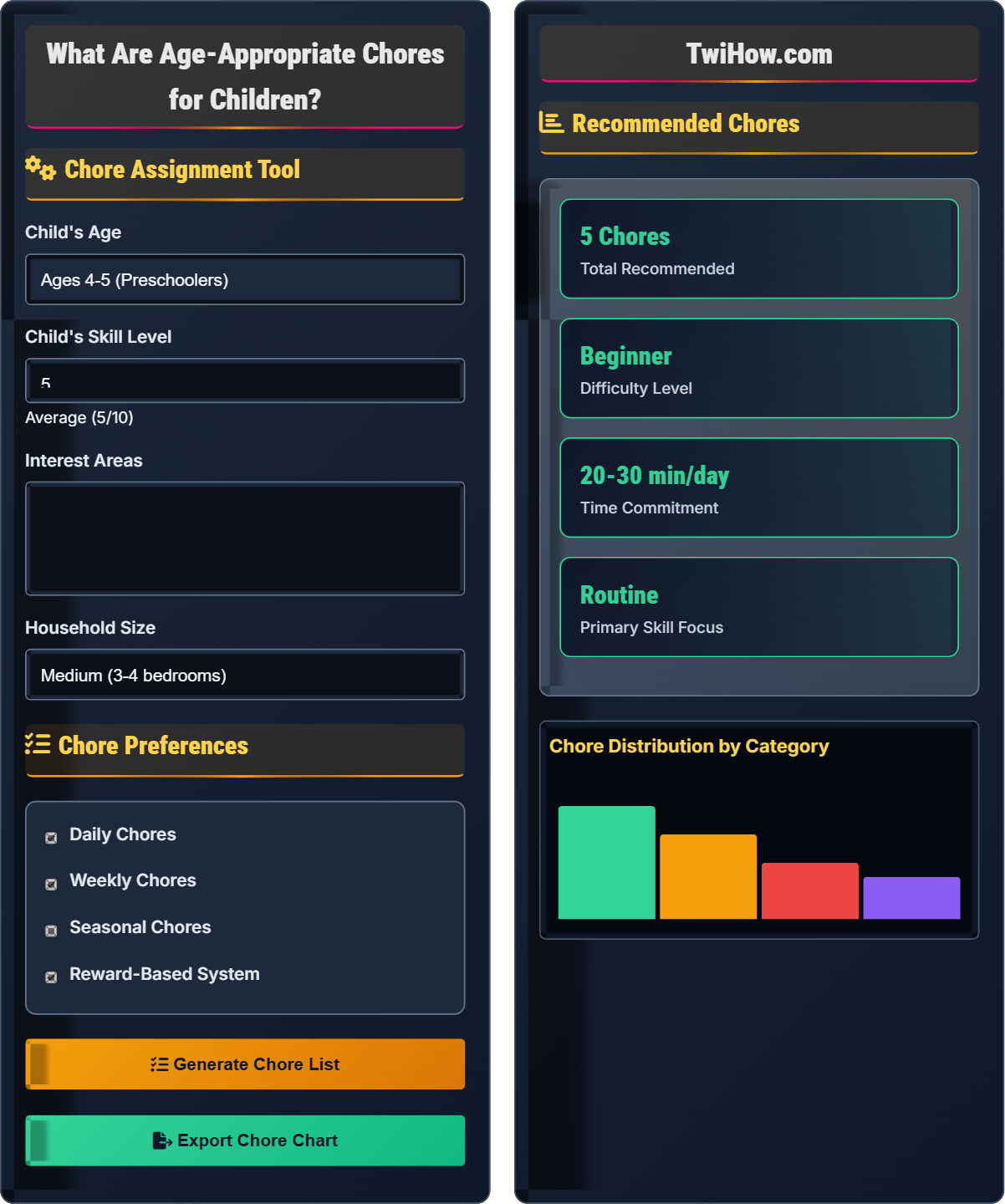
Chore Assignment Tool
Chore Preferences
Recommended Chores
Chore Distribution by Category
| Day | Chore | Time | Frequency |
|---|---|---|---|
| Mon | Make Bed | Morning | Daily |
| Tue | Put Away Toys | After Play | Daily |
| Wed | Empty Trash | Evening | Weekly |
| Thu | Help with Dishes | After Dinner | Daily |
| Fri | Fold Laundry | Weekend | Weekly |
Developmental Chore Progression
Simple tasks that build coordination and cooperation:
At this stage, focus on participation rather than perfection. Toddlers can handle very simple tasks with direct supervision.
- Putting toys in bins: Develops organization skills
- Throwing away trash: Teaches cleanup habits
- Feeding pets: Builds responsibility and empathy
- Carrying lightweight items: Improves coordination
- Pushing toy vacuum: Makes cleaning fun
Tasks that build independence and routine:
Preschoolers can handle slightly more complex tasks with guidance. Focus on building consistent routines.
Independent tasks that build responsibility:
Complex tasks that prepare for independence:
- Laundry: Wash, dry, fold, and put away clothes
- Cooking: Prepare simple meals and snacks
- Cleaning: Vacuum, mop, clean bathrooms
- Organization: Organize family spaces
- Errands: Grocery pickup, pet care
Adult-level responsibilities that build independence:
- Full kitchen duties: Plan and prepare meals
- Home maintenance: Minor repairs, yard work
- Financial responsibility: Budgeting for personal expenses
- Transportation: Car maintenance and driving duties
- Leadership: Mentoring younger siblings
Chore Implementation
Developmental appropriateness, skill building, consistency, motivation, routine establishment.
Task Complexity = (Child's Age × Motor Skills) ÷ Attention Span
Where Motor Skills = Physical coordination, Attention Span = Focus duration.
- Match chores to developmental stage
- Start with simple, achievable tasks
- Maintain consistency in expectations
Motivation Strategies
Sticker charts, privilege systems, monetary rewards, intrinsic motivation, family contribution.
- Explain the purpose of chores
- Demonstrate tasks clearly
- Practice together initially
- Provide positive reinforcement
- Individual differences in maturity
- Family values and culture
- Child's personality and interests
- Family schedule and needs
Chore Assignment Learning Quiz
Which chore is most appropriate for a 3-year-old child?
Putting toys in designated bins is most appropriate for a 3-year-old. At this age, children have developing fine motor skills and can follow simple instructions. This task helps build organizational skills while being achievable with minimal supervision. Loading dishwashers, sweeping entire houses, and making breakfast require more complex motor skills and safety awareness.
The answer is B) Put toys in designated bins.
At age 3, children are developing their fine motor skills and can follow simple, one-step instructions. They enjoy imitating adult activities and feel proud when contributing to family tasks. The key is matching the complexity of the task to their developmental stage to ensure success and build confidence.
Developmental Appropriateness: Matching tasks to child's cognitive and physical abilities
Fine Motor Skills: Small muscle movements required for precise tasks
One-Step Instructions: Simple commands that can be completed in sequence
• Match task complexity to developmental stage
• Focus on participation over perfection
• Provide supervision and encouragement
• Make chores feel like games
• Provide specific locations for items
• Use visual cues and labels
• Assigning tasks too complex for age
• Expecting adult-level results
• Not providing adequate supervision
Explain the process for introducing chores to a child for the first time. Include specific steps and considerations.
Introduction Process:
1. Explain the Purpose: Tell the child why everyone in the family helps with chores and how their contribution matters.
2. Start Small: Begin with one simple task that matches their abilities and interests.
3. Demonstrate Clearly: Show them exactly how to do the chore step-by-step.
4. Practice Together: Work alongside them initially to build confidence and skills.
5. Provide Positive Reinforcement: Praise effort and progress, not just results.
6. Create a Routine: Establish consistent times for chores to build habits.
7. Gradually Increase Complexity: Add more challenging tasks as they master simpler ones.
8. Be Patient: Allow time for skill development and expect mistakes as learning opportunities.
Successful chore introduction requires a systematic approach that builds confidence while teaching skills. Children need to understand the purpose behind chores to feel motivated. Starting with simple, achievable tasks ensures early success, which builds the foundation for tackling more complex responsibilities.
Positive Reinforcement: Rewarding desired behavior to encourage repetition
Developmental Appropriateness: Matching tasks to child's abilities and maturity
Consistency: Regular practice to build habits and expectations
• Start with simple, achievable tasks
• Demonstrate before expecting performance
• Focus on effort and improvement
• Make chores part of daily routine
• Use visual schedules and checklists
• Celebrate successes and progress
• Starting with tasks too complex
• Expecting immediate perfection
• Not providing adequate guidance
Your 7-year-old child is resistant to helping with chores and complains that it's "not fair" that they have to help while their older sibling doesn't seem to have as many responsibilities. How would you address this situation while maintaining a consistent chore system?
Address the Fairness Issue: Explain that everyone contributes according to their age and abilities. Show how different family members have different responsibilities.
Review Chore Assignments: Ensure the 7-year-old's chores are truly age-appropriate and not too overwhelming compared to their capabilities.
Highlight Benefits: Explain how doing chores helps them learn important life skills and contribute to the family.
Involve in Decision-Making: Allow the child to choose from a selection of appropriate chores to increase buy-in.
Address Sibling Comparison: If the older sibling isn't pulling their weight, have a separate conversation with them about their responsibilities.
Create Accountability: Establish clear expectations and consequences for completing or not completing chores.
Focus on Growth: Emphasize how chores help them become more independent and capable.
Seven-year-olds are developing their sense of fairness and justice. Resistance often stems from feeling overwhelmed or unfairly treated. Addressing both the emotional and practical aspects of chore resistance helps children understand the value of contributing to family life while ensuring the system remains fair and appropriate for each family member's developmental stage.
Developmental Appropriateness: Matching responsibilities to age and abilities
Fairness Perception: Child's understanding of equitable distribution of tasks
Buy-In: Willing participation based on understanding and agreement
• Explain rationale behind chore assignments
• Ensure tasks match developmental stage
• Address sibling comparisons fairly
• Create visual chore charts
• Allow choice within boundaries
• Celebrate contributions
• Ignoring child's perspective on fairness
• Not involving child in chore planning
• Comparing children directly
Your 10-year-old completes chores inconsistently and seems unmotivated despite various reward systems. They often forget tasks or do them poorly. How would you redesign the chore system to increase engagement and accountability?
Assess Current System: Evaluate if chores are too complex or not aligned with child's interests.
Improve Structure: Create visual chore charts with clear deadlines and expectations.
Increase Ownership: Involve the child in selecting their chores and setting expectations.
Connect to Values: Emphasize how chores contribute to family life and personal growth.
Build Accountability: Implement regular check-ins and consistent consequences.
Reduce Rewards: Transition from external rewards to intrinsic motivation.
Provide Feedback: Offer specific praise for improvement and effort.
Consider Alternatives: Explore if the child might have attention or executive function challenges.
Ten-year-olds are capable of more complex responsibilities but may resist if they feel the system is imposed upon them. Shifting from external rewards to intrinsic motivation involves helping children understand the value of their contributions. Consistency and clear expectations are crucial at this age as children are developing their sense of responsibility.
Intrinsic Motivation: Internal drive to perform activities for inherent satisfaction
Executive Function: Cognitive processes that help plan and execute tasks
Accountability: Taking responsibility for completing assigned tasks
• Involve child in system design
• Focus on intrinsic rather than extrinsic motivation
• Maintain consistency in expectations
• Use technology for reminders
• Create chore partnerships
• Link chores to privileges
• Continuing ineffective reward systems
• Not involving child in solutions
• Focusing only on consequences
Which chore would be most appropriate for a 12-year-old to complete independently?
Loading and running the dishwasher safely is most appropriate for a 12-year-old to complete independently. This task requires following instructions, handling appliances safely, and understanding cleaning procedures - all within the capabilities of a 12-year-old. Operating gas-powered equipment, cooking without supervision, and using harsh chemicals pose safety risks for this age group.
The answer is B) Load and run dishwasher safely.
Twelve-year-olds have developed the cognitive and physical skills to handle many household appliances safely, but safety remains paramount. Dishwashers are generally safe to operate with proper instruction, while tasks involving sharp objects, heat, or hazardous chemicals require more supervision or are better suited for older teens.
Developmental Appropriateness: Matching tasks to cognitive and physical abilities
Safety Considerations: Evaluating risks associated with different tasks
Supervision Needs: Determining appropriate level of adult oversight
• Prioritize safety over independence
• Assess individual maturity levels
• Provide proper instruction before independence
• Demonstrate tasks multiple times
• Test understanding before independence
• Start with supervision, then gradually reduce oversight
• Underestimating safety risks
• Assuming all 12-year-olds have same capabilities
• Not providing adequate safety instruction
FAQ
Q: Should I pay my child for doing chores?
A: This depends on the chore and your family values:
Family Responsibilities: Daily household chores should be seen as part of contributing to the family, not earning opportunities. These help build character and responsibility.
Extra Tasks: Additional tasks beyond normal expectations could earn payment, teaching work-for-pay concepts.
Special Projects: Larger projects like deep cleaning or organizing could be paid opportunities.
Age Considerations: Younger children benefit more from intrinsic rewards, while older children can understand work-for-pay relationships.
Long-term Goals: Focus on building habits and life skills rather than transactional relationships with chores.
Many experts recommend paying for extra tasks while treating basic chores as family responsibilities.
Q: What are the long-term benefits of assigning age-appropriate chores?
A: Children who regularly complete age-appropriate chores develop numerous long-term benefits:
Life Skills: Practical abilities needed for independent living.
Responsibility: Understanding of duty and accountability.
Self-Esteem: Confidence from contributing meaningfully to family life.
Work Ethic: Appreciation for effort and persistence.
Time Management: Skills for organizing and prioritizing tasks.
Problem-Solving: Ability to figure out how to complete unfamiliar tasks.
Teamwork: Understanding of collective responsibility.
Independence: Self-reliance and confidence in abilities.
Research shows that children who do chores regularly are more successful as adults.
Q: How do I handle a child who refuses to do chores?
A: When children refuse chores, consider these approaches:
Understand the Reason: Is the task too difficult? Boring? Unfair? Listen to their concerns.
Make It Fun: Turn chores into games or challenges with music or timers.
Give Choices: Allow them to pick from several appropriate chores.
Start Small: Reduce the scope of tasks initially, then gradually increase.
Be Consistent: Follow through with expectations and consequences.
Lead by Example: Work alongside them to show the value of contributing.
Connect to Values: Explain how chores help the family and build character.
Stay Calm: Avoid power struggles; remain firm but loving in expectations.
Remember that some resistance is normal during development.
Resources
American Academy of Pediatrics: www.aap.org
Child Development Institute: www.childdevelopmentinfo.com
Safe Kids Worldwide: www.safekids.org
Center for Parent Information and Resources: www.parentcenterhub.org