Effective Ways to Praise and Encourage Children
Complete parenting guide • Step-by-step explanations
Child Encouragement Fundamentals:
Show Praise SimulatorEffective praising and encouraging children involves recognizing effort, progress, and character rather than just outcomes. Research shows that specific, genuine praise builds self-esteem, motivation, and resilience. The key is focusing on process over product, effort over results, and using descriptive language that helps children understand exactly what they did well.
At its core, effective praise works by reinforcing positive behaviors and building intrinsic motivation. When children receive specific feedback about their efforts, they're more likely to continue those behaviors and develop a growth mindset.
Key praising and encouraging concepts:
- Process Praise: Acknowledging effort, strategy, and improvement
- Descriptive Praise: Specific details about what was observed
- Character Praise: Recognizing traits like persistence and kindness
- Growth Mindset: Emphasizing learning and development
Modern parenting approaches emphasize the importance of building intrinsic motivation through meaningful praise that helps children develop confidence, resilience, and a love of learning.
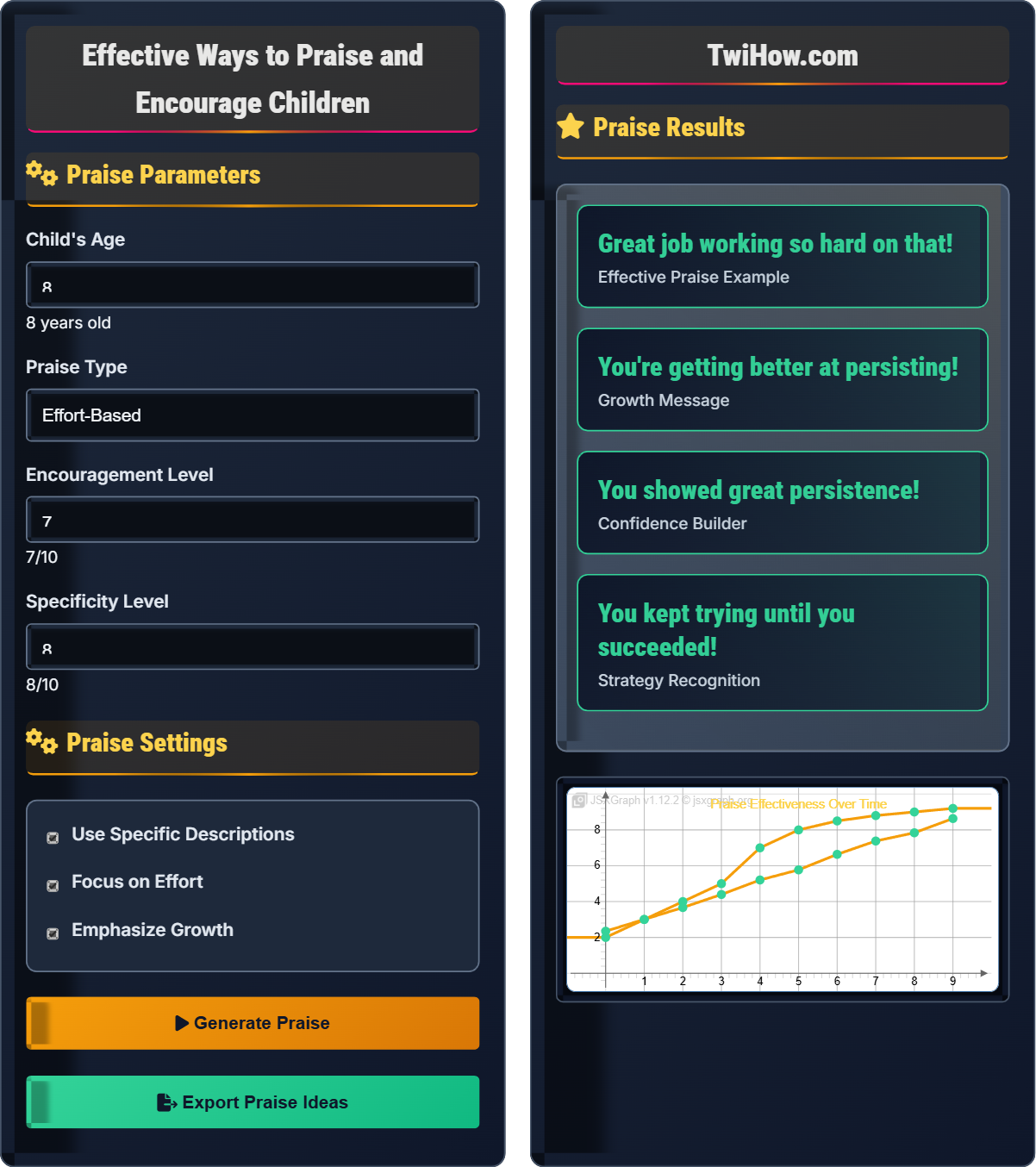
Praise Parameters
Praise Settings
Praise Results
| Situation | Effective Praise | Why It Works | Impact |
|---|---|---|---|
| Math homework | You really focused on that problem | Recognizes effort | Built confidence |
| Cleaning room | I noticed you organized everything | Descriptive | Reinforces behavior |
| Art project | Your creativity really shows | Character focus | Builds identity |
| Trying new food | You were brave to try | Effort recognition | Encourages risk-taking |
| Helping sibling | You're such a caring helper | Character praise | Builds values |
How to Praise and Encourage Children Effectively
Effective praise is specific, genuine recognition of a child's efforts, strategies, and character traits rather than just outcomes. It builds self-esteem, motivation, and resilience by helping children understand what they did well and why it matters. Good praise focuses on process over product, effort over results, and uses descriptive language that helps children internalize positive behaviors.
Effective praise follows specific patterns that maximize impact:
Where:
- Specific Observation: What exactly did the child do?
- Effort Recognition: Acknowledge the work put in
- Growth Message: Connect to learning and improvement
Key types of effective praise and encouragement:
- Effort-Based: "You worked so hard on that project!"
- Process-Based: "You tried different strategies until you found one that worked!"
- Character-Based: "You're showing great kindness to your friends."
- Growth-Based: "Look how much better you are at this now!"
- Toddlers (2-4): Simple, immediate praise with physical affection
- Preschoolers (4-6): Concrete descriptions of actions
- Elementary (6-12): Effort and strategy recognition
- Teens (12-18): Respectful acknowledgment of independence and choices
Praise Fundamentals
Process praise, effort recognition, growth mindset, specific feedback, character building.
Effective Praise = Specific Observation + Effort Recognition + Growth Message
Where Effective Praise = lasting positive impact, Specific Observation = detailed description, Effort Recognition = acknowledging work.
- Be specific rather than generic
- Focus on effort over outcome
- Use descriptive language
- Match praise to child's age and developmental stage
Practical Applications
Daily routines, academic challenges, social interactions, creative activities, problem-solving situations.
- Observe and notice positive behaviors
- Describe what you see specifically
- Connect to effort or character
- Encourage continued growth
- Be genuine and authentic
- Avoid comparisons with others
- Focus on progress, not perfection
- Balance praise with constructive feedback
Child Encouragement Learning Quiz
Which of the following is the most effective type of praise for building long-term motivation?
Option B ("You worked really hard on that math problem") is the most effective type of praise because it focuses on effort rather than innate ability. Research shows that effort-based praise builds resilience and encourages children to tackle challenges, while ability-based praise can lead to fear of failure and avoidance of difficult tasks.
The answer is B) "You worked really hard on that math problem."
Effective praise should focus on factors within the child's control (effort, strategy, persistence) rather than fixed traits (intelligence, talent). When children receive praise for effort, they're more likely to believe they can improve through hard work, developing what researchers call a "growth mindset." This approach builds resilience and encourages continued learning even when facing challenges.
Fixed Mindset: Belief that abilities are unchangeable
Growth Mindset: Belief that abilities can be developed
Process Praise: Acknowledgment of how something was done
• Focus on effort over ability
• Be specific rather than general
• Connect praise to growth and learning
• Use "I noticed..." statements
• Describe what you see happening
• Connect effort to outcomes
• Praising only for good results
Explain the difference between growth mindset and fixed mindset in children, and how praise can influence which mindset develops. Provide examples of how to shift from fixed to growth-oriented praise.
Fixed Mindset: Children believe their abilities are innate and unchangeable. They avoid challenges, give up easily when faced with difficulties, and see effort as fruitless or negative. They may interpret criticism as evidence of their lack of ability.
Growth Mindset: Children believe their abilities can be developed through dedication and hard work. They embrace challenges, persist in the face of setbacks, and see effort as the path to mastery. They learn from criticism and find lessons in the success of others.
Shifting Praise Examples:
From Fixed: "You're so talented!" → To Growth: "You practiced until you got it right!"
From Fixed: "You're naturally gifted!" → To Growth: "You used great strategies!"
From Fixed: "You're smart!" → To Growth: "You thought that through carefully!"
The way we praise children has a profound impact on their developing beliefs about themselves and their abilities. Carol Dweck's research shows that praising intelligence can actually decrease motivation and performance, while praising effort and process increases both. This happens because fixed-trait praise creates pressure to maintain that trait, leading to avoidance of challenges that might reveal limitations.
Growth Mindset: Belief that abilities can be developed through effort
Fixed Mindset: Belief that abilities are unchangeable
Self-Theories: Beliefs about the nature of human attributes
• Always connect praise to effort or strategy
• Use "yet" when discussing skills: "not yet"
• Celebrate mistakes as learning opportunities
• Ask about strategies used, not just results
• Praising only for success
Your 7-year-old child spent 30 minutes trying to solve a difficult puzzle, made several mistakes, but eventually completed it. Their friend finished a similar puzzle in 5 minutes. How would you effectively praise your child to build their confidence and encourage future persistence, considering age-appropriate strategies?
Effective Response: "I noticed how you kept trying different pieces and didn't give up, even when it was challenging. You showed great patience and problem-solving skills! Look at how you figured out that tricky part by rotating the pieces differently."
Why This Works: This praise focuses on effort, strategy, and persistence rather than comparing to the friend. It describes specific actions the child took, acknowledges their perseverance, and connects their actions to success.
Age-Appropriate Elements: Uses concrete language, recognizes persistence (important for 7-year-olds), and describes observable behaviors rather than abstract traits.
Avoid: Comparisons ("Your friend finished faster"), ability-focused praise ("You're so smart"), or generic praise ("Good job").
At age 7, children are developing their sense of competence and learning to handle challenges. Effective praise for this age group should be specific, descriptive, and focused on effort and strategy. It's crucial to avoid comparisons with peers, as this can undermine confidence and create unhealthy competition. Instead, focus on the individual child's progress and effort.
Developmental Appropriateness: Matching communication to child's cognitive level
Descriptive Praise: Specific acknowledgment of observed behaviors
Individual Progress: Focusing on personal improvement
• Never compare to siblings or peers
• Use "I noticed..." to describe behaviors
• Ask about strategies used
• Celebrate small improvements
• Making comparisons to others
You have two children: one who is very confident and seeks constant praise, and another who is shy and uncomfortable with public recognition. How would you adapt your praising and encouraging strategies for each child while maintaining consistency in your parenting approach?
For the Confident Child: Use specific, effort-focused praise that challenges them to grow further. Avoid excessive praise which can become dependency. "I noticed how you helped your sister with her math problem. That shows great patience and teaching skills."
For the Shy Child: Use private recognition, written notes, or quiet acknowledgments. Focus on internal qualities rather than public performance. "I saw how quietly you shared your snack with your friend today. That was very thoughtful."
Maintaining Consistency: Apply the same principles of effort-focused, specific praise to both children, but vary the delivery method based on their comfort levels. Both should receive recognition for effort, strategy, and character, just in ways that match their personalities.
Effective parenting involves adapting communication styles to individual children while maintaining consistent underlying principles. Both children benefit from effort-focused praise, but the delivery method should match their temperamental differences. The goal is to build internal motivation rather than external validation, regardless of personality type.
Temperamental Differences: Individual variations in behavioral patterns
Individualized Parenting: Adapting approach to child's needs
Internal Motivation: Drive from within rather than external rewards
• Maintain consistent principles
• Observe each child's response to praise
• Adjust volume and setting as needed
• Keep core message consistent
• Using one-size-fits-all approach
Which approach is most appropriate for praising a 4-year-old who successfully tied their shoes for the first time?
Option B ("I saw you keep trying and trying until you got it!") is most appropriate because it focuses on the child's effort and persistence, which are within their control. For a 4-year-old, this praise is specific, concrete, and emphasizes the process rather than an innate trait. It also acknowledges the effort they put in, which builds resilience for future challenges.
The answer is B) "I saw you keep trying and trying until you got it!"
For preschoolers (ages 3-5), effective praise should be concrete, immediate, and focus on observable behaviors. At this age, children are developing their sense of competence and learning that effort leads to results. Abstract concepts like "talent" or "intelligence" are not meaningful to them, but they can understand and internalize the connection between effort and achievement.
Concrete Praise: Focus on observable, specific behaviors
Developmental Stage: Cognitive abilities at different ages
Immediate Feedback: Timely recognition of behaviors
• Match praise to developmental level
• Use simple, clear language
• Describe what you see
• Connect effort to success
• Using abstract trait-based praise
FAQ
Q: How often should I praise my child, and won't they become dependent on it?
A: The frequency of praise should be balanced - enough to reinforce positive behaviors but not so much that it becomes meaningless. Quality matters more than quantity. Focus on praising specific behaviors and efforts rather than giving generic "good jobs." To prevent dependence:
1. Gradual Fade: Start with frequent praise when teaching new behaviors, then gradually reduce as the behavior becomes routine
2. Shift Focus: Move from external praise to helping children feel internal satisfaction
3. Ask Questions: Instead of always praising, ask "How do you feel about what you accomplished?"
4. Highlight Progress: Help children notice their own growth and improvements
Remember, the goal is to build internal motivation, not dependence on external validation.
Q: What's the difference between praising effort and praising results, and why does it matter?
A: The difference lies in what children learn about success and their abilities:
Praising Effort: "You worked so hard on that project" or "I noticed you tried different strategies." This teaches children that success comes from effort and strategy, encouraging them to tackle challenges.
Praising Results: "You're so smart" or "You got an A!" This focuses on the outcome and can teach children that success depends on fixed traits.
Research by Carol Dweck shows that effort-focused praise builds resilience and a growth mindset. Children praised for effort are more likely to choose challenging tasks, persist through difficulties, and view mistakes as learning opportunities. Result-focused praise can lead to fear of failure and avoidance of challenges.