What Are Signs of Bullying and How Do I Address It?
Complete parenting guide • Step-by-step explanations
Bullying Prevention:
Show Bullying Detection SimulatorBullying is a serious issue that affects millions of children worldwide. Recognizing the signs early and taking appropriate action is crucial for protecting your child's mental health, academic success, and overall well-being. Bullying involves repeated aggressive behavior intended to harm, intimidate, or control another person who has difficulty defending themselves.
Key aspects of bullying identification and intervention:
- Signs to Watch: Behavioral changes, academic decline, physical symptoms
- Types of Bullying: Physical, verbal, social, cyberbullying
- Intervention Strategies: Immediate response, documentation, reporting
- Support Systems: Building resilience and confidence
- Prevention: Teaching assertiveness and social skills
Early detection and appropriate intervention can prevent long-term psychological damage and help children develop resilience and coping strategies that will serve them throughout life.
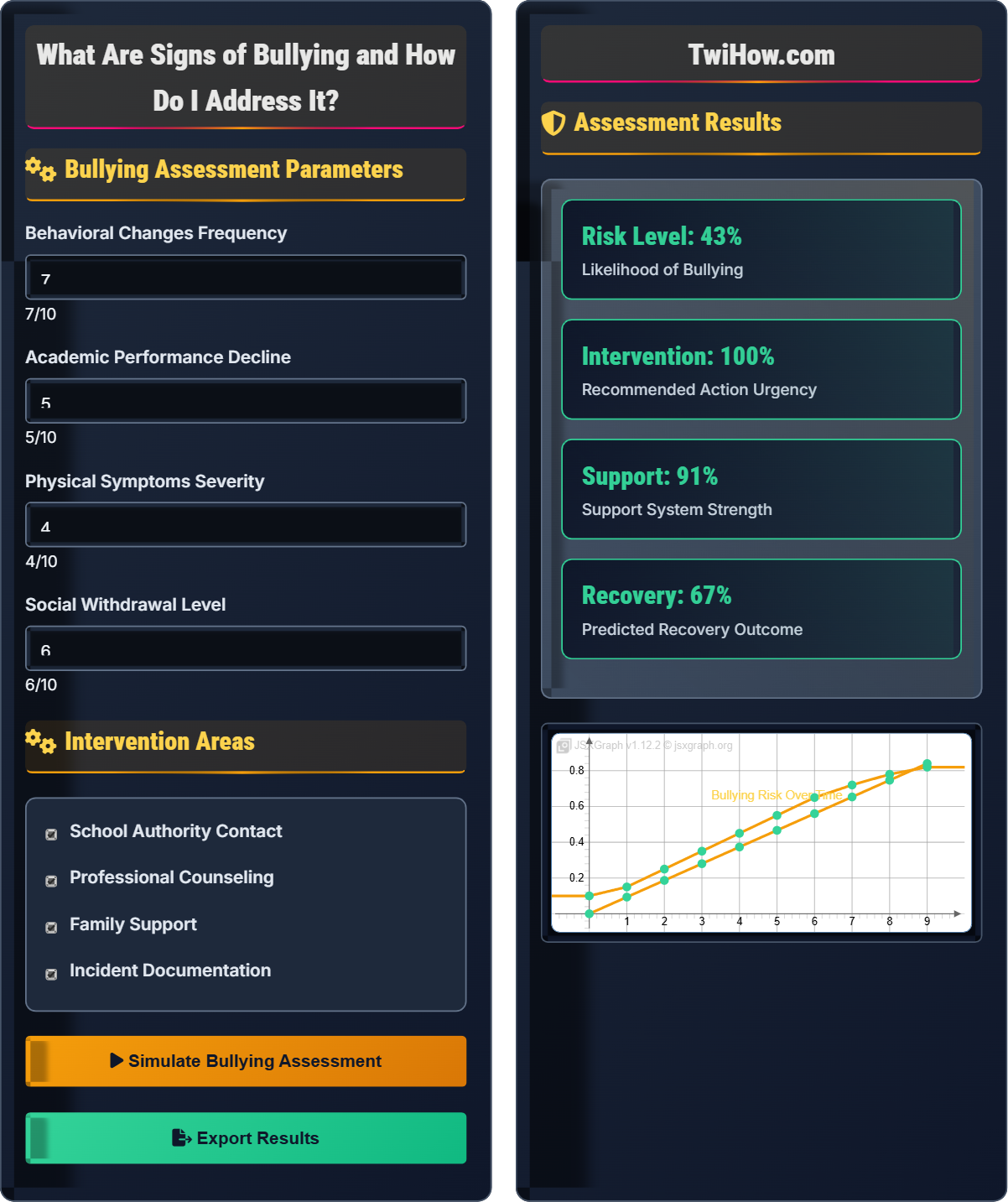
Bullying Assessment Parameters
Intervention Areas
Assessment Results
| Indicator | Severity | Impact Level | Urgency |
|---|---|---|---|
| Behavioral Changes | 7/10 | High | Immediate |
| Academic Decline | 5/10 | Moderate | Soon |
| Physical Symptoms | 4/10 | Low | Monitor |
| Social Withdrawal | 6/10 | Medium | Within Week |
| Emotional Distress | 8/10 | High | Today |
Understanding and Addressing Bullying
Bullying is repeated aggressive behavior intended to harm, intimidate, or control another person who has difficulty defending themselves. It involves an imbalance of power and occurs repeatedly over time. Bullying can take many forms: physical, verbal, social, or cyberbullying. Understanding the definition helps parents identify when intervention is needed.
Where:
- Frequency: How often the behavior occurs
- Severity: How harmful the behavior is
- Duration: How long the behavior continues
- Power Imbalance: Difference in strength, popularity, or influence
Common forms of bullying:
- Physical: Hitting, pushing, stealing, or damaging property
- Verbal: Teasing, name-calling, threats, or inappropriate sexual comments
- Social: Spreading rumors, excluding from groups, embarrassing in public
- Cyberbullying: Harassment through digital platforms, texts, or social media
- Relational: Manipulating relationships to cause harm
- Sexual: Unwanted sexual comments, touching, or pressure
- Immediate Response: Address the situation promptly and directly
- School Collaboration: Work with teachers and administrators
- Documentation: Keep records of all incidents and communications
- Professional Support: Seek counseling if needed
- Building Resilience: Strengthen your child's confidence
- Follow-up: Monitor the situation and effectiveness of interventions
Bullying Identification Fundamentals
Bullying, harassment, intimidation, power imbalance, repetition, victim, perpetrator, intervention.
Risk Assessment = (Frequency × Severity × Duration) ÷ 3
Where Risk Assessment = likelihood of ongoing bullying, Frequency = how often incidents occur.
- Take all reports seriously regardless of severity
- Document incidents with specific details
- Work collaboratively with school authorities
Intervention Strategies
School bullying, cyberbullying, social exclusion, physical aggression, verbal harassment, peer pressure.
- Observe and document concerning behaviors
- Talk to your child about their experiences
- Contact school officials immediately
- Document all communications
- Seek professional support if needed
- Child's safety is the priority
- Maintain open communication
- Follow school policies
- Consider legal options if necessary
Bullying Identification and Intervention Quiz
Which of the following best defines bullying?
Bullying is defined as repeated aggressive behavior that involves an imbalance of power. It's not a single incident but occurs over time with a pattern of behavior. The key elements are repetition, intent to harm, and a power differential between the bully and victim.
The answer is B) Repeated aggressive behavior with a power imbalance.
Understanding the precise definition of bullying is crucial for proper identification and response. Many parents mistake normal childhood conflicts for bullying or vice versa. The repetition and power imbalance elements distinguish bullying from isolated incidents of meanness or typical peer disagreements. This knowledge helps parents respond appropriately to different situations.
Bullying: Repeated aggressive behavior with power imbalance
Power Imbalance: Difference in strength, popularity, or influence
Repetition: Behavior that occurs multiple times over time
• Bullying involves repetition, not single incidents
• Power imbalance is a key characteristic
• Intent to harm distinguishes bullying from accidents
• Look for patterns in behavior, not isolated incidents
• Consider the relationship between children
• Observe both online and offline interactions
• Confusing bullying with normal childhood conflicts
• Assuming all mean behavior is bullying
• Ignoring single incidents that might escalate
Identify and explain the warning signs of bullying that parents should watch for. Include behavioral, emotional, and physical indicators.
Behavioral Signs: Changes in eating habits, declining academic performance, reluctance to attend school, avoiding certain places or activities, sudden loss of friends, damaged or missing belongings.
Emotional Signs: Increased sadness, anxiety, depression, low self-esteem, frequent mood changes, fear of going to school, nightmares, regression to earlier behaviors.
Physical Signs: Unexplained injuries, frequent headaches or stomach aches, changes in sleep patterns, poor appetite, self-harm, or attempts to hide physical evidence.
Recognizing warning signs early is crucial for effective intervention. Children may not directly report bullying due to shame, fear, or believing nothing can be done. Parents must be observant of subtle changes in their child's behavior, emotions, and physical condition. These signs often appear before children verbalize their experiences, allowing for earlier support and protection.
Warning Signs: Indicators suggesting potential problems
Academic Performance: School grades and engagement
Regression: Returning to earlier developmental behaviors
• Changes in behavior may be gradual
• Physical symptoms can be indicators
• Emotional changes often accompany behavioral ones
• Establish regular check-ins with your child
• Monitor online activity and social media
• Notice changes in sleep and eating patterns
• Attributing all changes to normal development
• Dismissing physical complaints as minor
• Not connecting emotional changes to possible bullying
Your child receives hurtful messages and photos on social media from classmates. They are reluctant to tell anyone and worried about getting in trouble. How would you approach this situation? Describe your immediate actions and longer-term strategies.
Immediate Actions: Reassure your child that they did the right thing by telling you, save screenshots of the messages/photos as evidence, document the dates and times, and avoid retaliating or deleting evidence.
Longer-term Strategy: Report to the school, contact the platform to report violations, block the bullies if possible, provide emotional support, consider counseling, and educate about safe online practices.
Communication: Emphasize that they won't get in trouble for being victims, that this isn't their fault, and that you're there to help.
Cyberbullying presents unique challenges compared to traditional bullying. Evidence can be documented digitally, but it can also spread rapidly and be permanent. Children may feel helpless or embarrassed about online harassment. Parents must act quickly to preserve evidence while providing emotional support and taking appropriate reporting steps. The anonymity of online platforms can make intervention more complex.
Cyberbullying: Harassment through digital platforms
Evidence: Documentation proving the occurrence
Platform: Social media or messaging service
• Preserve digital evidence immediately
• Never retaliate online
• Report to appropriate authorities
• Take screenshots before content is deleted
• Review privacy settings together
• Monitor online activity without invading privacy
• Deleting evidence immediately
• Responding aggressively online
• Not reporting to school or platform
You've documented bullying behavior and want to work with your child's school, but the administration seems dismissive. How do you advocate effectively for your child while maintaining a productive relationship with the school? Explain your approach and anticipated challenges.
Approach: Present documented evidence professionally, schedule formal meetings, follow school policies, remain calm and focused on solutions, request specific interventions, and keep detailed records of all communications.
Anticipated Challenges: Administrative pushback, lack of immediate action, confidentiality concerns, policy limitations, and potential retaliation.
Escalation: Contact district administrators, file formal complaints, consider legal consultation, and document all steps taken.
Working with schools requires a balance between advocating for your child and maintaining collaborative relationships. Documentation is crucial for credibility and tracking progress. Parents must understand school policies while insisting on appropriate interventions. Persistence is often necessary, as bullying cases may not be resolved quickly. Professional demeanor helps maintain productive communication channels.
Advocacy: Speaking and acting on behalf of your child
Documentation: Recording incidents and communications
Escalation: Increasing the level of intervention
• Follow proper reporting channels
• Maintain professional communication
• Document all interactions
• Know your school's anti-bullying policy
• Request written responses to concerns
• Bring an advocate to meetings if needed
• Becoming confrontational with staff
• Not following proper procedures
• Failing to document communications
When addressing bullying, what should be the parent's highest priority?
The child's safety and well-being should always be the highest priority when addressing bullying. While holding bullies accountable is important, the immediate concern must be protecting the child and addressing their emotional and physical needs. Everything else follows from ensuring the child feels safe and supported.
The answer is B) Ensuring child's safety and well-being.
Parents sometimes get distracted by wanting justice or revenge rather than focusing on their child's immediate needs. The primary goal should always be to stop the bullying and support the child's recovery. This approach also tends to be more effective in resolving the situation, as interventions focused on the child's welfare are more likely to gain cooperation from schools and other authorities.
Safety: Protection from physical and emotional harm
Well-being: Physical and mental health
Priority: Most important consideration
• Child's safety comes first
• Emotional support is crucial
• Focus on stopping the behavior
• Ask your child what they need to feel safe
• Provide reassurance regularly
• Monitor for signs of trauma
• Focusing on punishment rather than protection
• Minimizing the child's emotional response
• Seeking revenge instead of resolution
FAQ
Q: How do I talk to my child about bullying without making them more anxious?
A: Approach the conversation with empathy and support. Use calm, reassuring language. Let your child know they're not alone and that you're there to help. Focus on solutions and your commitment to their safety. Avoid making promises you can't keep, like "this will never happen again." Instead, emphasize that you'll work together to address the situation and that they can always come to you with concerns.
Q: What if my child is accused of bullying others?
A: Listen to all sides of the story without judgment. Investigate thoroughly and speak with school personnel. Help your child understand the impact of their actions while maintaining their dignity. Work with school counselors to address any underlying issues. Teach empathy and appropriate social skills. If the accusation is unfounded, advocate for your child while maintaining respect for the process. If there are issues, take appropriate corrective action.