What Is Neurodiversity-Affirming Parenting?
Complete parent's guide • Understanding & supporting neurodivergent children
Neurodiversity-Affirming Parenting:
Support PlannerNeurodiversity-affirming parenting recognizes and celebrates neurological differences as natural variations in human diversity. This approach focuses on accepting, supporting, and empowering neurodivergent children rather than trying to make them conform to neurotypical standards. It emphasizes understanding and accommodating differences while fostering the child's strengths and unique perspective.
Core principles include:
- Acceptance: Embracing neurological differences as valid and valuable
- Accommodation: Adapting environments and expectations to meet needs
- Advocacy: Supporting rights and inclusion in all settings
- Strengths-Based: Focusing on abilities and potential rather than deficits
- Collaboration: Working with the child to understand their perspective
Successful neurodiversity-affirming parenting requires shifting from a deficit-based to a difference-based perspective.
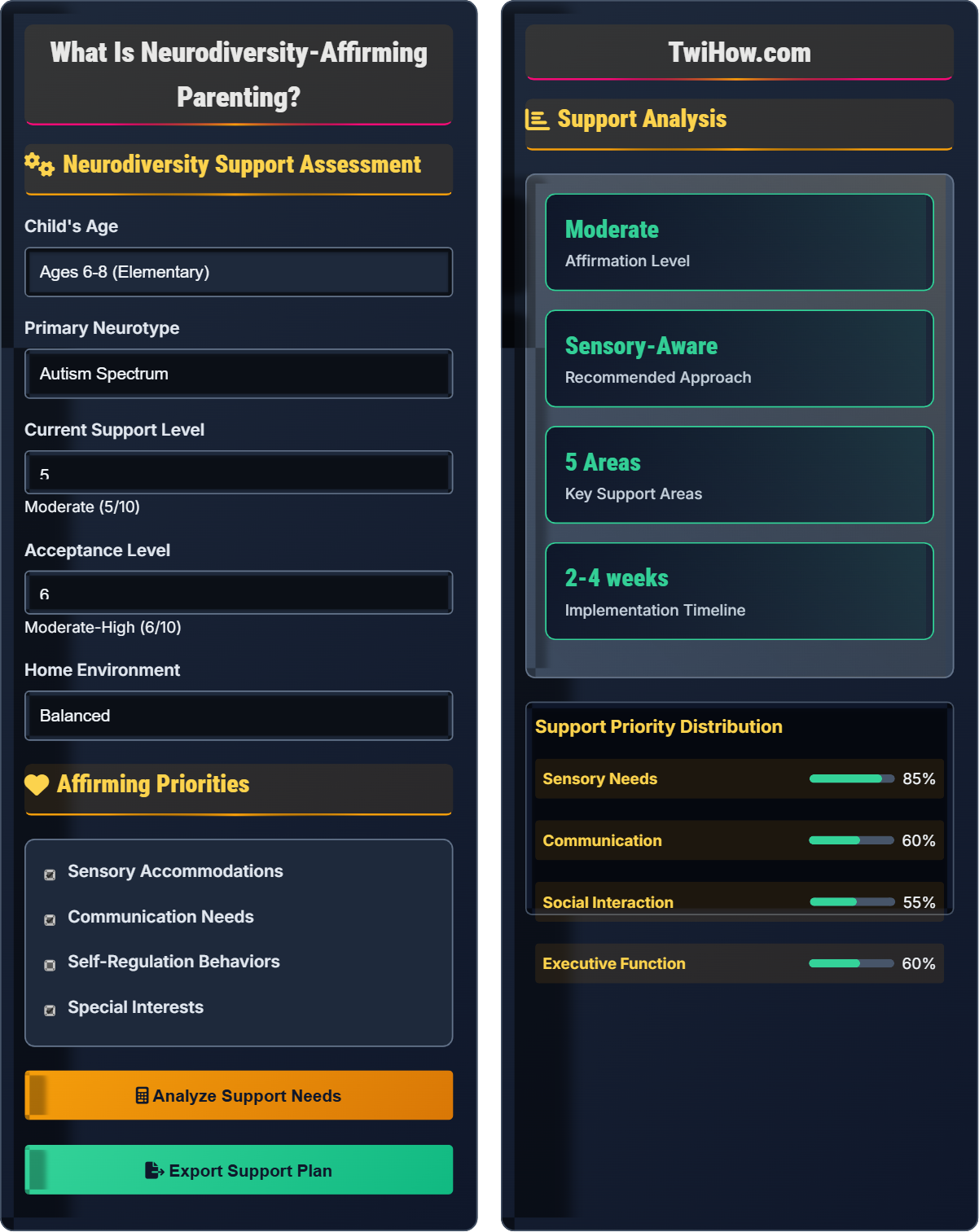
Neurodiversity Support Assessment
Affirming Priorities
Support Analysis
Support Priority Distribution
Affirming Strategies
- Accept Differences: Recognize that neurodivergent behaviors serve a purpose and are valid.
- Accommodate Needs: Modify environments and expectations to support success.
- Advocate: Support your child's rights and inclusion in all settings.
- Focus on Strengths: Emphasize abilities and unique perspectives rather than deficits.
Recommended Accommodations
Neurodiversity-Affirming Parenting Principles
Neurodiversity is the concept that neurological differences are natural variations in the human genome:
This perspective recognizes that conditions like autism, ADHD, dyslexia, and others are differences rather than disorders. The goal is to support individuals while celebrating their unique contributions.
- Neurotypical: Standard neurological configuration
- Neurodivergent: Different neurological configuration
- Neurodiverse: Including both neurotypical and neurodivergent individuals
- Medical Model: Views differences as deficits to fix
- Social Model: Views differences as requiring accommodation
- Affirming Model: Celebrates differences as valuable diversity
Neurodivergent conditions often overlap and co-occur:
• Sensory processing differences
• Communication variations
• Repetitive behaviors
• Special interests
• Attention regulation differences
• Hyperactivity/hypoactivity
• Executive function variations
• Time perception differences
• Reading/writing differences
• Visual processing variations
• Strengths in creativity
• Alternative learning styles
• Motor coordination differences
• Planning and sequencing challenges
• Spatial awareness variations
• Need for practice and support
Practical ways to implement neurodiversity-affirming parenting:
Myths about neurodivergent children that need correction:
- They're "defective": Neurological differences are natural variations
- They need to be "fixed": They need support and accommodation
- They can't succeed: Many excel in areas that match their strengths
- They're manipulative: Behaviors serve legitimate needs
- They don't feel emotions: They may express emotions differently
- They can't form relationships: They may need different social approaches
Implementation Strategies
Acceptance, accommodation, advocacy, strengths-based approach, neurodiversity paradigm.
Success = (Acceptance × Accommodation) ÷ Deficit Focus
Where Acceptance = Embracing differences, Accommodation = Environmental support.
- Focus on strengths and abilities
- Modify environments, not children
- Respect neurodivergent communication styles
Avoiding Pitfalls
Deficit-focused parenting, forcing conformity, ignoring sensory needs, invalidating experiences.
- Focus on understanding, not changing
- Ask for the child's perspective
- Provide appropriate accommodations
- Seek support from neurodivergent communities
- Individual differences in needs
- Family values and beliefs
- Community resources and support
- Child's age and developmental stage
Neurodiversity Learning Quiz
What is the core principle of the neurodiversity-affirming model?
The neurodiversity-affirming model recognizes that neurological differences are natural variations in human neurology, similar to other forms of diversity like race, gender, or sexuality. The approach emphasizes acceptance, accommodation, and celebration of differences rather than attempting to eliminate or "fix" them.
The answer is B) Accepting neurological differences as natural variations.
Understanding the neurodiversity paradigm is foundational to implementing affirming practices. This model shifts from viewing differences as pathological deficits to seeing them as natural human variations. This perspective reduces stigma, promotes self-acceptance, and leads to more effective support strategies.
Neurodiversity: Natural variation in human neurology
Neurotypical: Standard neurological configuration
Neurodivergent: Different neurological configuration
• Differences are natural variations
• Accommodation is more effective than change
• Strengths should be emphasized
• Learn about your child's specific needs
• Viewing differences as problems to fix
• Ignoring sensory needs
• Invalidating experiences
Explain how to create a sensory-friendly environment for a neurodivergent child and why this is important.
Understanding Sensory Differences: Neurodivergent children often experience sensory input differently, with some being hypersensitive (over-responsive) and others being hyposensitive (under-responsive) to various stimuli.
Visual Accommodations: Reduce bright lighting, provide dimmer options, minimize visual clutter, use soft colors.
Auditory Accommodations: Reduce background noise, provide quiet spaces, use noise-canceling headphones if needed.
Tactile Accommodations: Offer different textures, provide fidget tools, consider clothing tags and fabric.
Smell/Taste Accommodations: Be aware of strong scents, offer preferred foods, allow time for sensory integration.
Movement Accommodations: Provide opportunities for movement breaks, allow for stimming behaviors.
Importance: Sensory-friendly environments reduce stress, prevent meltdowns, improve focus, and allow children to access their full potential.
Implementation: Observe your child's responses, ask for their input, make gradual changes, and maintain flexibility.
Sensory processing differences are central to many neurodivergent experiences. Creating accommodating environments acknowledges that neurodivergent children process sensory information differently and need support to regulate their responses. This approach reduces stress and promotes learning and development.
Sensory Processing: How the nervous system receives and responds to sensory input
Hypersensitivity: Over-responsiveness to sensory stimuli
Hyposensitivity: Under-responsiveness to sensory stimuli
• Individualize to the child's needs
• Ask for the child's input
• Maintain flexibility
• Create sensory toolkits
• Use visual schedules
• Establish quiet zones
• Assuming all children have same needs
• Not asking for child's input
• Over- or under-stimulating
Your 8-year-old child with ADHD is struggling with homework completion and organization. They often become overwhelmed and shut down when faced with multiple assignments. How would you apply neurodiversity-affirming principles to support them?
Acceptance: Recognize that ADHD affects executive function differently, not that the child is lazy or unmotivated.
Accommodation: Break assignments into smaller chunks, provide visual organizers, offer movement breaks.
Strengths-Based: Acknowledge their creativity, energy, and unique perspectives.
Environment: Create a structured workspace with minimal distractions.
Communication: Use clear, direct instructions and check for understanding.
Self-Advocacy: Teach them to recognize their needs and communicate them.
Flexibility: Allow for different ways of completing tasks.
Patience: Understand that executive function development takes time.
ADHD affects executive function, which impacts organization, time management, and task completion. Rather than viewing these challenges as character flaws, neurodiversity-affirming approaches recognize them as neurological differences requiring appropriate accommodations and support.
Executive Function: Cognitive processes that manage and regulate other functions
Self-Regulation: Ability to manage attention and behavior
Task Initiation: Ability to begin tasks independently
• Focus on support, not punishment
• Accommodate executive function differences
• Celebrate unique strengths
• Use timers and visual cues
• Offer movement breaks
• Break tasks into smaller steps
• Assuming lack of effort
• Not providing adequate structure
• Ignoring executive function challenges
Your 10-year-old autistic child prefers solitary play and seems to struggle with social interactions. Other children sometimes exclude them from group activities. How would you support their social development while respecting their preferences?
Respect Preferences: Acknowledge that some neurodivergent children prefer solitary activities and that's okay.
Interest-Based Connections: Help them find peers with similar interests.
Social Scripts: Teach social skills through explicit instruction and role-playing.
Acceptance: Help them understand that different social styles are valid.
Advocacy: Educate others about autism and inclusion.
Safe Spaces: Ensure they have environments where they feel comfortable.
Self-Advocacy: Teach them to communicate their needs and preferences.
Flexibility: Allow for different types of social interaction.
Autistic children may have different social preferences and communication styles. Rather than pushing for typical social interactions, support them in finding meaningful connections that align with their interests and comfort level. Social development should be child-led and respectful of their individual needs.
Stimming: Self-stimulatory behaviors that help with regulation
Special Interests: Intense focus on particular topics
Camouflaging: Masking autistic traits to fit in
• Respect individual social preferences
• Focus on meaningful connections
• Avoid forcing social interaction
• Find interest-based groups
• Teach social scripts explicitly
• Create inclusive environments
• Forcing social interaction
• Ignoring stimming behaviors
• Not respecting solitary preferences
How should you respond when your neurodivergent child uses stimming behaviors during a challenging moment?
Stimming (self-stimulatory behavior) is a natural self-regulation strategy that helps neurodivergent individuals manage sensory input, emotions, and stress. Rather than stopping the behavior, recognize it as a helpful coping mechanism. If the stimming is harmful, find alternative safe stims that serve the same function.
The answer is B) Recognize it as a self-regulation strategy.
Stimming serves important regulatory functions for neurodivergent individuals. It helps with sensory processing, emotional regulation, and focus. Suppressing stims can increase stress and anxiety. The goal is to support safe stims while addressing any that might be harmful.
Stimming: Self-stimulatory behavior for regulation
Self-Regulation: Managing one's own emotional and sensory state
Neurological Differences: Variations in brain function and processing
• Respect self-regulation strategies
• Support safe stims
• Address only harmful behaviors
• Provide safe stim toys
• Understand function of behaviors
• Create accepting environments
• Suppressing all stims
• Not understanding function
• Judging regulatory behaviors
FAQ
Q: How do I balance accepting my child's differences while still providing structure and guidance?
A: Acceptance and structure are complementary, not contradictory:
Acceptance: Embrace your child's neurological differences and unique characteristics.
Accommodation: Provide structure that works with, not against, their needs.
Flexibility: Adjust expectations based on your child's capabilities.
Clear Communication: Explain expectations in ways they understand.
Collaboration: Involve your child in creating structures that work for them.
Supportive Guidance: Help them develop skills rather than demanding compliance.
Recognition: Acknowledge their efforts and progress.
The goal is to support your child's development while respecting their individual needs.
Q: What are the long-term benefits of neurodiversity-affirming parenting?
A: Children who experience neurodiversity-affirming parenting develop numerous long-term benefits:
Self-Acceptance: Strong sense of self-worth and identity.
Confidence: Belief in their abilities and potential.
Advocacy Skills: Ability to communicate needs and stand up for rights.
Resilience: Better ability to cope with challenges.
Independence: Self-reliance and confidence in abilities.
Relationships: Authentic connections with others.
Academic Success: Better learning outcomes when supported.
Emotional Well-being: Reduced anxiety and depression.
These benefits contribute to lifelong success and happiness.
Resources
Autistic Self Advocacy Network: www.autisticadvocacy.org
CHADD (ADHD Support): www.chadd.org
International Dyslexia Association: www.interdys.org
Neurodiversity in the Workplace: www.neurodiversity.com