What Is the Best Way to Support My Child's Unique Interests?
Complete parent's guide • Nurturing passion & talent
Supporting Child's Interests:
Interest PlannerSupporting your child's unique interests is crucial for their development, self-confidence, and overall well-being. Children thrive when they feel supported in pursuing their passions, whether they're traditional or unconventional. The key is to provide resources, encouragement, and opportunities while respecting their autonomy and developmental stage.
Effective support strategies include:
- Observation: Carefully watch for signs of genuine interest and enthusiasm
- Resource Provision: Supply books, materials, and access to learning opportunities
- Encouragement: Offer positive reinforcement without pressure
- Flexibility: Allow interests to evolve naturally over time
- Community Connection: Find like-minded peers and mentors
Remember that interests may change over time, and that's perfectly normal and healthy for development.
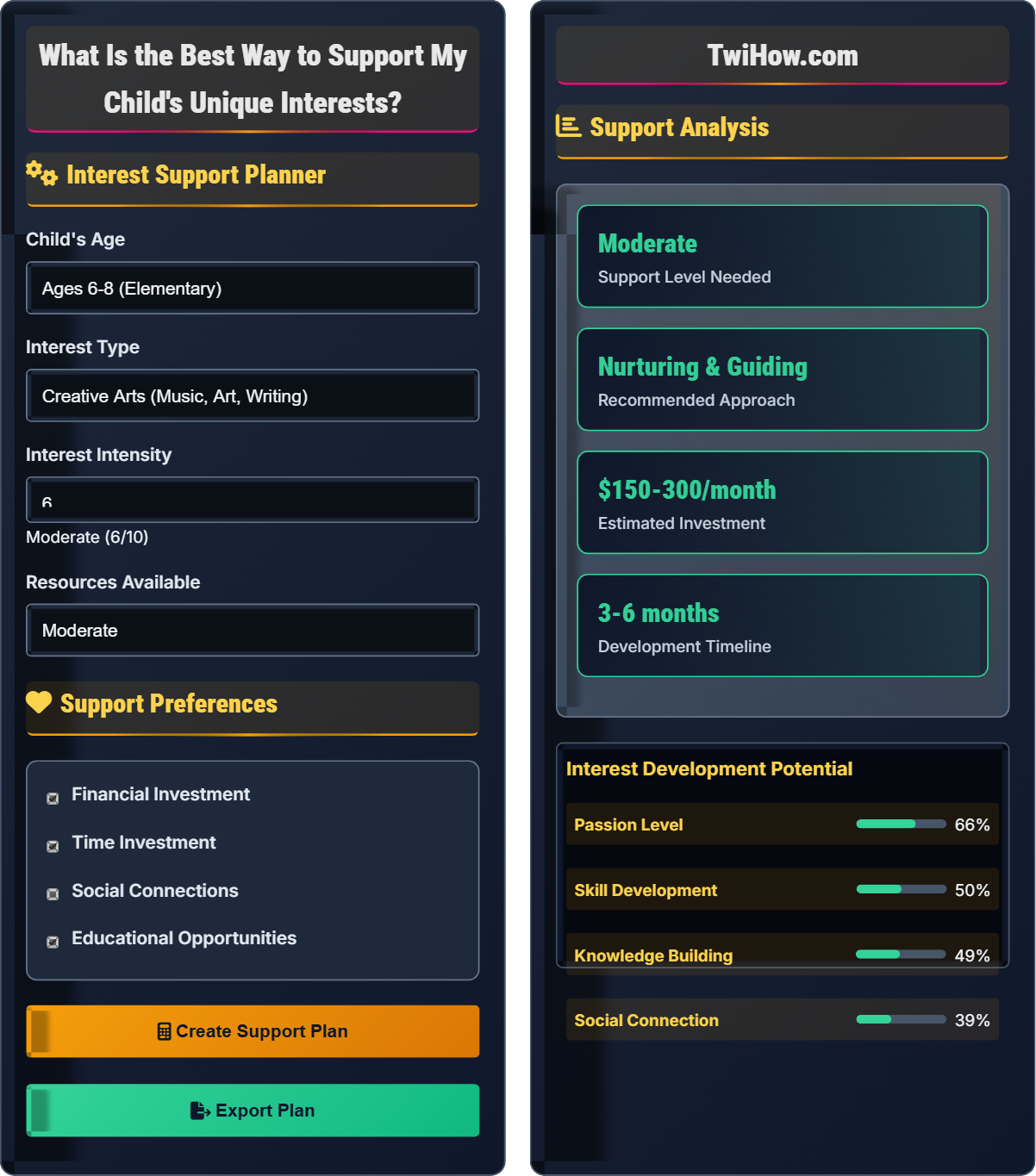
Interest Support Planner
Support Preferences
Support Analysis
Interest Development Potential
Recommended Strategies
- Observe & Listen: Pay attention to what your child gravitates toward naturally and listens to their questions and observations.
- Provide Resources: Supply books, materials, tools, and access to learning opportunities related to their interests.
- Encourage Exploration: Allow your child to experiment and make mistakes as part of the learning process.
- Connect with Peers: Help them find communities of like-minded individuals and mentors.
Development Timeline
Supporting Child's Unique Interests
Recognizing your child's genuine interests requires careful observation:
Look for signs that indicate authentic interest versus fleeting curiosity or external influence.
- Spontaneous Engagement: Child seeks out activities without prompting
- Persistence: Continued effort despite challenges or setbacks
- Questions: Curiosity-driven inquiries about the topic
- Time Investment: Voluntary extended time spent on the activity
- Emotional Response: Genuine excitement and joy when engaged
Different approaches work best for different developmental stages:
Creating the right balance between support and autonomy:
- Provide Resources: Books, materials, classes, and tools
- Offer Encouragement: Positive reinforcement without pressure
- Allow Autonomy: Let child make choices about their pursuit
- Set Boundaries: Time, cost, and safety limits
- Respect Changes: Interests may evolve naturally
Types of resources to provide based on interests:
- Educational: Books, online courses, workshops, classes
- Material: Tools, supplies, equipment, costumes
- Social: Clubs, teams, camps, mentorships
- Experiential: Museums, performances, competitions, travel
- Financial: Budget for supplies, lessons, and opportunities
Providing the right emotional foundation:
- Validation: Acknowledge and respect their interests
- Patience: Allow time for skill development
- Encouragement: Focus on effort rather than outcome
- Resilience: Help them cope with setbacks
- Autonomy: Respect their decision-making
Implementation Strategies
Observation, resource provision, emotional support, autonomy, community connection.
Success = (Observation × Resources × Emotional Support) ÷ External Pressure
Where Observation = Careful attention to child's interests, Resources = Materials and opportunities.
- Follow your child's lead
- Provide resources without strings
- Respect their autonomy
Avoiding Pitfalls
Imposing interests, excessive pressure, inadequate resources, ignoring child's autonomy.
- Listen to your child's preferences
- Provide balanced support
- Maintain realistic expectations
- Respect changing interests
- Individual differences in development
- Family values and priorities
- Available resources
- Child's personality and temperament
Interest Support Learning Quiz
Which behavior best indicates a genuine interest rather than a passing phase?
Spontaneously practicing the activity indicates genuine interest because it shows intrinsic motivation and engagement without external prompting. This behavior demonstrates that the child finds personal satisfaction in the activity itself, rather than just seeking rewards or social approval.
The answer is B) Spontaneously practicing the activity.
Intrinsic motivation is a key indicator of genuine interest. When children engage in activities without external pressure, it suggests they find personal meaning and satisfaction in the pursuit. This type of motivation is more sustainable and leads to deeper learning.
Intrinsic Motivation: Internal drive to engage in an activity for its own sake
Extrinsic Motivation: External rewards or pressures driving behavior
Spontaneous Engagement: Self-initiated participation without prompting
• Look for self-initiated activities
• Observe consistency over time
• Note emotional responses
• Keep a journal of observed behaviors
• Note what activities child chooses during free time
• Look for questions and curiosity
• Assuming all interests are equal
• Not observing carefully enough
• Mistaking peer influence for genuine interest
Explain the appropriate level of financial and material investment in supporting a child's interest.
Appropriate Investment Strategy:
Initial Phase: Start with low-cost materials and resources to gauge genuine interest. Invest minimally until the child demonstrates sustained engagement.
Development Phase: Gradually increase investment as the child shows continued interest and begins developing skills. Focus on quality resources that support learning.
Advanced Phase: Consider higher investments for specialized equipment, advanced instruction, or competitive opportunities if the child remains committed.
Financial Limits: Set clear family budget boundaries that don't compromise other necessities. Explain financial decisions to the child.
Alternative Resources: Utilize libraries, community centers, online resources, and free programs to supplement paid options.
Cost-Benefit Analysis: Evaluate the return on investment in terms of child's happiness, skill development, and personal growth.
Graduated investment allows parents to support genuine interests while managing financial risk. Starting small prevents waste if the interest doesn't persist, while allowing for expansion if it proves enduring. This approach teaches children about resource management and the value of their interests.
Graduated Investment: Progressive increase in resources based on demonstrated commitment
Financial Boundaries: Pre-established limits on spending
Return on Investment: Value gained relative to resources spent
• Start with minimal investment
• Increase based on sustained interest
• Set clear financial boundaries
• Use free community resources first
• Borrow or rent expensive equipment
• Look for group discounts
• Overspending on fleeting interests
• Not setting financial limits
• Investing more than child is interested
Your 8-year-old daughter has shown interest in robotics after attending a summer camp. She asks for expensive robot kits and programming classes, but you're concerned about the cost and whether this interest will last. How would you balance supporting her interest while managing your budget and expectations?
Initial Assessment: Observe if her interest extends beyond the camp experience. Does she talk about robotics, draw robots, or ask related questions?
Graduated Approach: Start with a basic, affordable robotics kit that introduces concepts without major expense. This tests sustained interest.
Resource Research: Look for free online programming resources, library programs, or community center classes before investing in expensive private instruction.
Family Discussion: Explain your budget constraints honestly and involve her in setting priorities. Let her help decide how to allocate resources.
Time-Based Evaluation: Set a trial period (3-6 months) to assess if interest persists before committing to larger investments.
Alternative Opportunities: Explore robotics clubs, maker spaces, or school programs that provide access to equipment without purchase.
Value Teaching: Use this opportunity to teach about budgeting, commitment, and the value of resources.
At age 8, children can understand basic budget concepts and participate in decision-making. This approach teaches financial literacy while supporting genuine interests. The graduated investment strategy protects against wasted resources while allowing for growth if interest persists.
Graduated Investment: Progressive increase in resources based on demonstrated commitment
Financial Literacy: Understanding of money management concepts
Opportunity Cost: What you sacrifice when choosing one option over another
• Test interest before major investment
Your 12-year-old son was passionate about violin for two years, but now wants to switch to rock guitar. You've invested significantly in violin lessons and equipment. How do you handle this change while supporting his evolving interests?
Validate His Interest: Acknowledge his new passion and explore what attracted him to guitar.
Assess Musical Foundation: Recognize that violin skills transfer to guitar, including rhythm, reading music, and discipline.
Inventory Resources: Evaluate what violin resources can be repurposed or sold to fund guitar exploration.
Transition Plan: Allow him to maintain violin practice while exploring guitar, then make a gradual transition.
Flexible Timeline: Set a reasonable period to explore guitar before fully committing to switching instruments.
Financial Strategy: Rent guitar initially to test interest before purchasing, and consider selling violin equipment.
Emotional Support: Emphasize that changing interests is normal and healthy development.
Transfer Skills: Help him see how violin experience supports his new musical direction.
At 12, children often experience shifts in interests as they discover their identity. Supporting these changes while acknowledging past investments teaches adaptability and growth mindset. The skills and discipline learned from violin provide a strong foundation for guitar.
Interest Evolution: Natural changes in preferences and passions
Skill Transfer: Application of learned abilities to new contexts Growth Mindset: Belief that abilities can develop over timeWhich approach is most effective for connecting your child with others who share their interests?
Researching and selecting programs that match the child's personality is most effective. This approach considers the child's social comfort level, learning style, and interests while providing appropriate peer connections. It avoids overwhelming introverted children or under-stimulating extroverted ones.
The answer is B) Research and select programs that match child's personality.
Matching social opportunities to personality ensures positive experiences that encourage continued engagement. A mismatch can lead to anxiety, frustration, or disengagement. Understanding your child's social preferences helps create successful peer connections.
Personality-Environment Fit: Alignment between individual traits and social context
Social Comfort: Feeling at ease in peer interactions
Peer Connection: Meaningful relationships with like-minded individuals
FAQ
Q: How do I know if my child's interest is just a phase or something more permanent?
A: Look for these indicators of lasting interest:
Consistency: Does your child continue to engage with the interest during free time over several months?
Depth: Do they seek to learn more about the subject, ask detailed questions, or explore related areas?
Emotional Investment: Do they show genuine excitement and disappointment when unable to pursue the interest?
Resilience: Do they persist despite challenges or setbacks?
Integration: Does the interest influence their play, conversation, or choices?
Volition: Do they initiate activities related to the interest without prompting?
Remember that interests can evolve naturally, and what starts as a phase may develop into a lasting passion with appropriate support.
Q: What are the long-term benefits of supporting children's unique interests?
A: Children who receive support for their unique interests develop numerous long-term benefits:
Self-Confidence: Belief in their abilities and judgment leads to greater self-esteem.
Perseverance: Learning to overcome challenges builds resilience and determination.
Creativity: Pursuing personal interests fosters innovative thinking and problem-solving.
Autonomy: Making choices about their pursuits builds independence and decision-making skills.
Expertise: Deep exploration of interests can lead to specialized knowledge and skills.
Identity Formation: Pursuing interests helps children understand their strengths and preferences.
Lifelong Learning: Positive early experiences with learning encourage continued curiosity.
Research shows that supported interests often become sources of joy and accomplishment throughout life.
Q: How do I support interests that are different from my own values or expectations?
A: Supporting divergent interests requires intentional effort:
Separate Identity: Recognize that your child is a separate individual with their own interests.
Focus on Values: Support the underlying values (curiosity, dedication, creativity) even if the interest differs.
Learn Together: Explore the interest together to better understand its appeal.
Seek Allies: Find other adults who can mentor and support the interest.
Set Boundaries: Maintain family values while allowing space for personal interests.
Find Connections: Help the child see how their interest relates to broader life goals.
Model Respect: Show that you respect their individuality and choices.
Stay Connected: Maintain relationship while supporting their autonomy.
Children who feel supported despite differences often develop stronger family bonds.
Resources
American Academy of Pediatrics: www.aap.org
Child Development Institute: www.childdevelopmentinfo.com
National Association for Gifted Children: www.nagc.org
Zero to Three: www.zerotothree.org