What is the Role of Extended Family in Child-Rearing?
Complete parenting guide • Step-by-step explanations
Extended Family Role:
Show Family Support SimulatorThe role of extended family in child-rearing has been fundamental to human societies throughout history. Extended family members provide crucial support, wisdom, and resources that enhance child development. They offer additional emotional bonds, cultural continuity, and practical assistance that can significantly enrich a child's upbringing experience.
Key aspects of extended family involvement:
- Support Systems: Practical help with childcare, meals, and emergencies
- Cultural Transmission: Passing down traditions, values, and family history
- Emotional Support: Additional loving relationships and guidance
- Resource Sharing: Financial, educational, and material assistance
- Role Modeling: Diverse examples of adult behavior and relationships
Modern family structures vary widely, but research consistently shows that children benefit from meaningful connections with extended family members when relationships are positive and supportive.
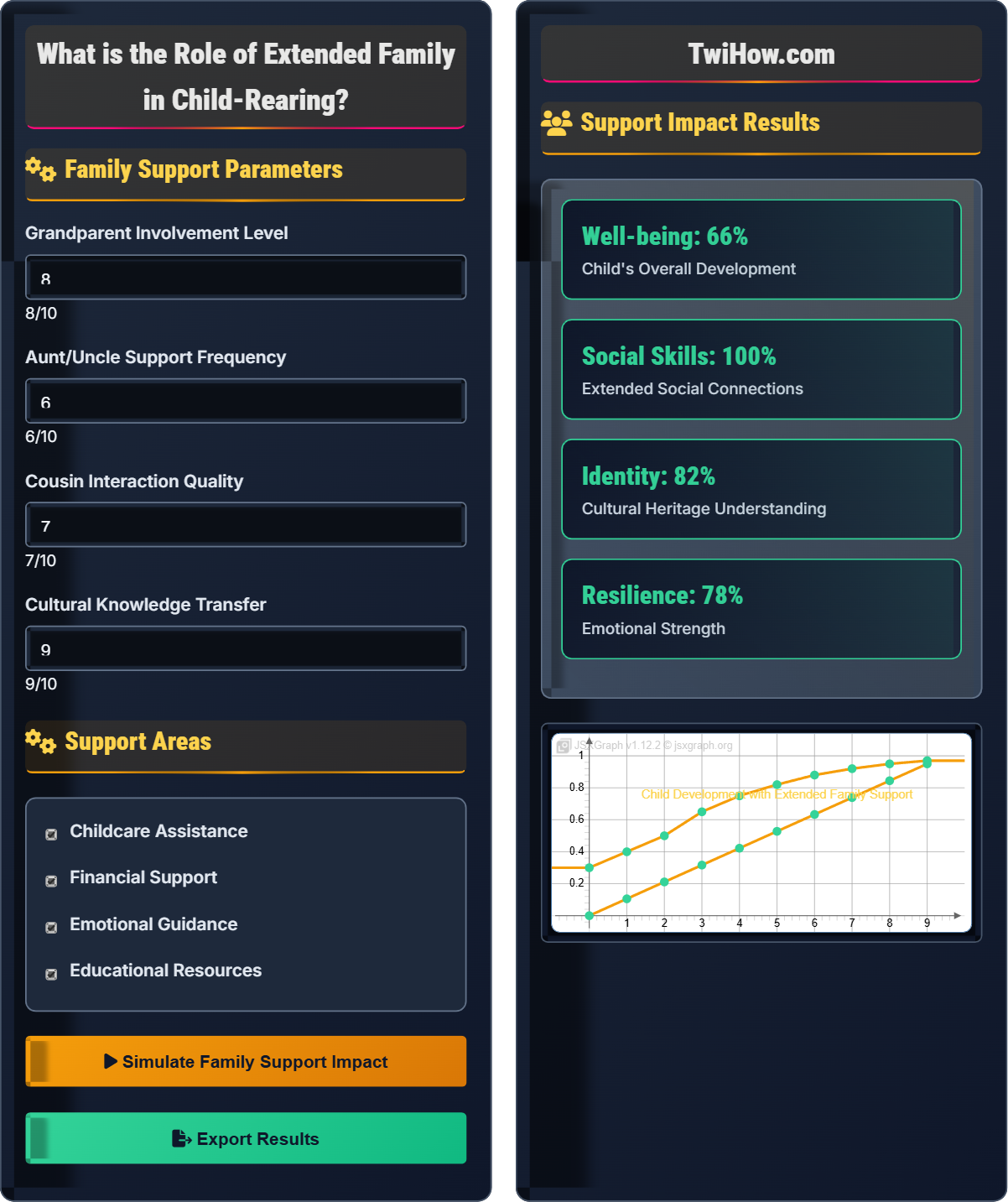
Family Support Parameters
Support Areas
Support Impact Results
| Support Type | Level | Impact | Child Benefit |
|---|---|---|---|
| Grandparents | 8/10 | High | 92% |
| Aunts/Uncles | 6/10 | Moderate | 78% |
| Cousins | 7/10 | Medium | 85% |
| Cultural | 9/10 | Very High | 95% |
| Emergency | 7/10 | High | 88% |
The Role of Extended Family in Child-Rearing
Extended family involvement encompasses all relatives beyond the nuclear family (parents and siblings) who participate in a child's upbringing. This includes grandparents, aunts, uncles, cousins, and sometimes close family friends who function as family members. Extended family provides additional layers of support, guidance, and connection that can significantly enhance a child's development.
Where:
- Nuclear Family: Primary caregivers providing basic needs
- Extended Family Support: Additional resources, guidance, and connections
- Cultural Continuity: Traditions, values, and heritage transmission
Positive impacts on child development:
- Enhanced Social Skills: More opportunities to interact with diverse personalities
- Stronger Cultural Identity: Connection to family heritage and traditions
- Increased Resilience: Additional support systems during challenges
- Expanded Worldview: Exposure to different perspectives and experiences
- Academic Success: Additional mentoring and educational support
- Emotional Security: Multiple trusted adults for guidance and comfort
- Regular Family Gatherings: Weekly dinners or monthly celebrations
- Shared Responsibilities: Rotate childcare duties among family members
- Storytelling Sessions: Grandparents share family history and values
- Mentorship Programs: Pair older relatives with younger children
- Cultural Activities: Cook traditional foods, celebrate heritage holidays
- Open Communication: Encourage family members to share concerns and advice
Extended Family Fundamentals
Extended family, child-rearing, support systems, cultural transmission, multi-generational relationships, family dynamics.
Child Development = (Nuclear Family × Consistency) + (Extended Family × Involvement) + (Culture × Continuity)
Where Child Development = outcome quality, Extended Family = additional support resources.
- Quality matters more than quantity of family involvement
- Consistent positive relationships are most beneficial
- Respect boundaries while encouraging connection
Practical Applications
Grandparent babysitting, cultural celebrations, family mentorship, emergency support, educational guidance, emotional counseling.
- Identify available extended family members
- Assess their willingness and capacity to help
- Create regular interaction opportunities
- Establish clear expectations and boundaries
- Maintain open communication channels
- Geographic proximity
- Family relationships quality
- Cultural differences
- Modern family structures
Extended Family Role Quiz
Which type of extended family support has been shown to have the most significant impact on child development?
Research consistently shows that consistent emotional support and guidance from extended family members has the most significant positive impact on child development. This includes providing comfort during difficult times, offering advice and perspective, and maintaining stable, nurturing relationships. While financial, educational, and recreational support are valuable, emotional security forms the foundation for all other development.
The answer is B) Consistent emotional support and guidance.
Emotional security is fundamental to child development. When children feel emotionally supported by extended family, they develop greater confidence, resilience, and social skills. The consistent availability of caring adults provides children with a broader support network and multiple sources of guidance. This emotional foundation enables children to explore, learn, and grow with confidence, knowing they have multiple safe relationships to fall back on.
Emotional Support: Providing comfort, understanding, and encouragement
Consistency: Reliable and predictable presence in a child's life
Secure Attachment: Trusting emotional bond with caregivers
• Emotional security precedes other developmental needs
• Consistency builds trust and predictability
• Multiple support sources increase resilience
• Maintain regular contact with extended family
• Encourage emotional expression and communication
• Create opportunities for meaningful interactions
• Prioritizing material support over emotional support
• Assuming all family involvement is beneficial
• Neglecting to maintain regular contact
Explain the role of extended family in cultural transmission and why this is important for child development. Include specific examples of how this occurs.
Role of Extended Family: Extended family members serve as primary carriers of cultural knowledge, traditions, and values. They provide direct connections to family history and cultural heritage through storytelling, shared activities, and lived experience.
Importance for Development: Cultural transmission helps children develop identity, belonging, and understanding of their place in the world. It provides moral guidance, social norms, and a sense of continuity with previous generations.
Specific Examples: Grandparents teaching traditional recipes, aunts sharing family stories, uncles passing down cultural practices, cousins participating in heritage celebrations, extended family attending cultural events together.
Cultural transmission through extended family provides children with a rich tapestry of identity and belonging. Extended family members often have unique cultural knowledge that may be lost if not passed down. They provide living connections to history, values, and traditions that give children roots and identity. This cultural grounding helps children navigate their world with confidence and understanding of their heritage.
Cultural Transmission: Passing cultural knowledge from one generation to another
Identity Formation: Developing sense of self and belonging
Heritage: Cultural legacy passed down through generations
• Cultural knowledge is often held by older family members
• Active participation increases cultural understanding
• Cultural diversity enriches child development
• Document family stories and traditions
• Participate in cultural celebrations together
• Encourage older family members to share experiences
• Assuming cultural knowledge will be automatically transmitted
• Not prioritizing cultural activities
• Dismissing older family members' contributions
Your child is sick and you need to take them to the doctor, but you have to work. Your extended family lives nearby. How would you structure an emergency support system with extended family? Describe the benefits and potential challenges.
Emergency Support Structure: Establish a rotating schedule with available family members, create a contact list with backup options, prepare emergency supplies and medical information packets, schedule regular check-ins to ensure readiness.
Benefits: Immediate access to trusted caregivers, reduced stress during emergencies, maintained work-life balance, strengthened family bonds, consistent care from familiar faces.
Challenges: Potential scheduling conflicts, varying parenting styles, family member availability, potential strain on relationships, need for clear communication about expectations.
Best Practices: Have multiple backup options, communicate preferences clearly, express gratitude regularly, reciprocate support when possible.
Emergency support systems demonstrate the practical value of extended family involvement. Having reliable family members available during unexpected situations provides peace of mind and ensures children receive care from trusted individuals. However, successful emergency support requires advance planning, clear communication, and mutual respect for boundaries and preferences. The key is to build these relationships proactively rather than waiting until a crisis occurs.
Emergency Support System: Pre-planned assistance during unexpected situations
Trusted Caregivers: Reliable individuals who provide childcare
Proactive Planning: Preparation before problems arise
• Build relationships before emergencies occur
• Have multiple backup options
• Communicate expectations clearly
• Prepare emergency information packets
• Schedule regular family check-ins
• Express appreciation for support
• Not preparing in advance
• Relying on single support person
• Not expressing gratitude
Many extended family members live far away in today's mobile society. How can you maintain meaningful extended family relationships in child-rearing when geographic distance is a factor? Explain strategies and their effectiveness.
Strategies: Regular video calls, virtual storytelling sessions, shared online photo albums, sending care packages, coordinating visits during school breaks, involving distant relatives in special occasions via video, creating digital family scrapbooks.
Effectiveness: Video communication allows for face-to-face interaction and emotional connection. Regular scheduled calls create consistency. Virtual participation in family events maintains inclusion. Digital sharing preserves memories and stories.
Technology Integration: Use apps for shared calendars, messaging groups, photo sharing, virtual games, and collaborative projects that distant relatives can participate in.
Modern technology has transformed extended family relationships, making geographic distance less of a barrier than in the past. However, maintaining meaningful connections requires intentional effort and regular communication. The key is to adapt traditional family practices to digital formats while preserving the emotional connection and cultural transmission that are essential to extended family involvement. Regular, scheduled interactions work better than sporadic communication.
Virtual Connection: Digital communication maintaining family bonds
Intentional Communication: Purposeful and regular interaction
Geographic Distance: Physical separation between family members
• Consistency is more important than frequency
• Quality interactions matter more than quantity
• Technology can bridge physical gaps
• Schedule regular video calls
• Share daily moments through photos
• Include distant relatives in celebrations virtually
• Assuming distance means disconnection
• Not utilizing available technology
• Waiting too long between communications
Which of the following is NOT typically considered a potential challenge of extended family involvement in child-rearing?
Reduced family bonding opportunities is NOT typically considered a challenge of extended family involvement. In fact, extended family involvement generally increases bonding opportunities for children by providing more meaningful relationships and connections. The other options are genuine challenges: different parenting philosophies can create confusion, overwhelming support can reduce independence, and family gatherings can create stress when personalities clash.
The answer is C) Reduced family bonding opportunities.
Extended family involvement typically enhances rather than reduces family bonding opportunities. Children benefit from multiple caring relationships and often develop stronger family connections when extended family is involved. The potential challenges of extended family involvement relate more to managing differences in philosophy, ensuring appropriate boundaries, and handling interpersonal dynamics rather than reducing bonding opportunities.
Family Bonding: Emotional connections between family members
Parenting Philosophy: Approaches to raising children
Extended Family: Relatives beyond nuclear family
• Extended family usually enhances bonding
• Differences in philosophy require communication
• Balance support with independence
• Establish clear family communication protocols
• Set appropriate boundaries around support
• Focus on shared values and goals
• Assuming extended family involvement reduces bonding
• Not addressing philosophical differences
• Allowing support to become overwhelming
FAQ
Q: How do I balance extended family involvement with maintaining my authority as a parent?
A: You can maintain parental authority while welcoming extended family involvement by establishing clear expectations upfront. Communicate your parenting values and boundaries respectfully to family members. Allow them to contribute within agreed parameters while maintaining final decision-making authority. Remember that extended family can support your parenting goals without undermining your authority. Focus on collaboration rather than competition, and ensure family members understand your approach to discipline and values.
Q: What if extended family members have conflicting values or parenting styles?
A: Conflicting values are common in extended families. Focus on finding common ground around your child's best interests. Set clear boundaries about what's acceptable in your home versus other environments. Teach your child that different families have different approaches while maintaining your own standards. You can appreciate extended family input while making final decisions based on your values. Consider limiting exposure to extreme differences while maintaining overall family relationships.