How to Avoid Procrastination?
Complete procrastination guide • Step-by-step explanations
Procrastination Fundamentals:
Show Anti-Procrastination ToolsProcrastination is the act of delaying or postponing tasks despite knowing that this delay may have negative consequences. It affects productivity, increases stress, and can lead to missed opportunities. Understanding the psychology behind procrastination and implementing effective strategies can significantly improve academic performance and personal achievement.
Key anti-procrastination techniques:
- Two-Minute Rule: If a task takes less than two minutes, do it immediately
- Pomodoro Technique: 25-minute focused work sessions with 5-minute breaks
- Task Breakdown: Dividing large projects into smaller, manageable chunks
- Implementation Intentions: Creating specific if-then plans
- Environmental Design: Removing distractions and creating focus zones
Modern approaches combine behavioral psychology with practical tools to create sustainable systems that prevent procrastination and promote consistent action.
Procrastination Prevention Parameters
Additional Options
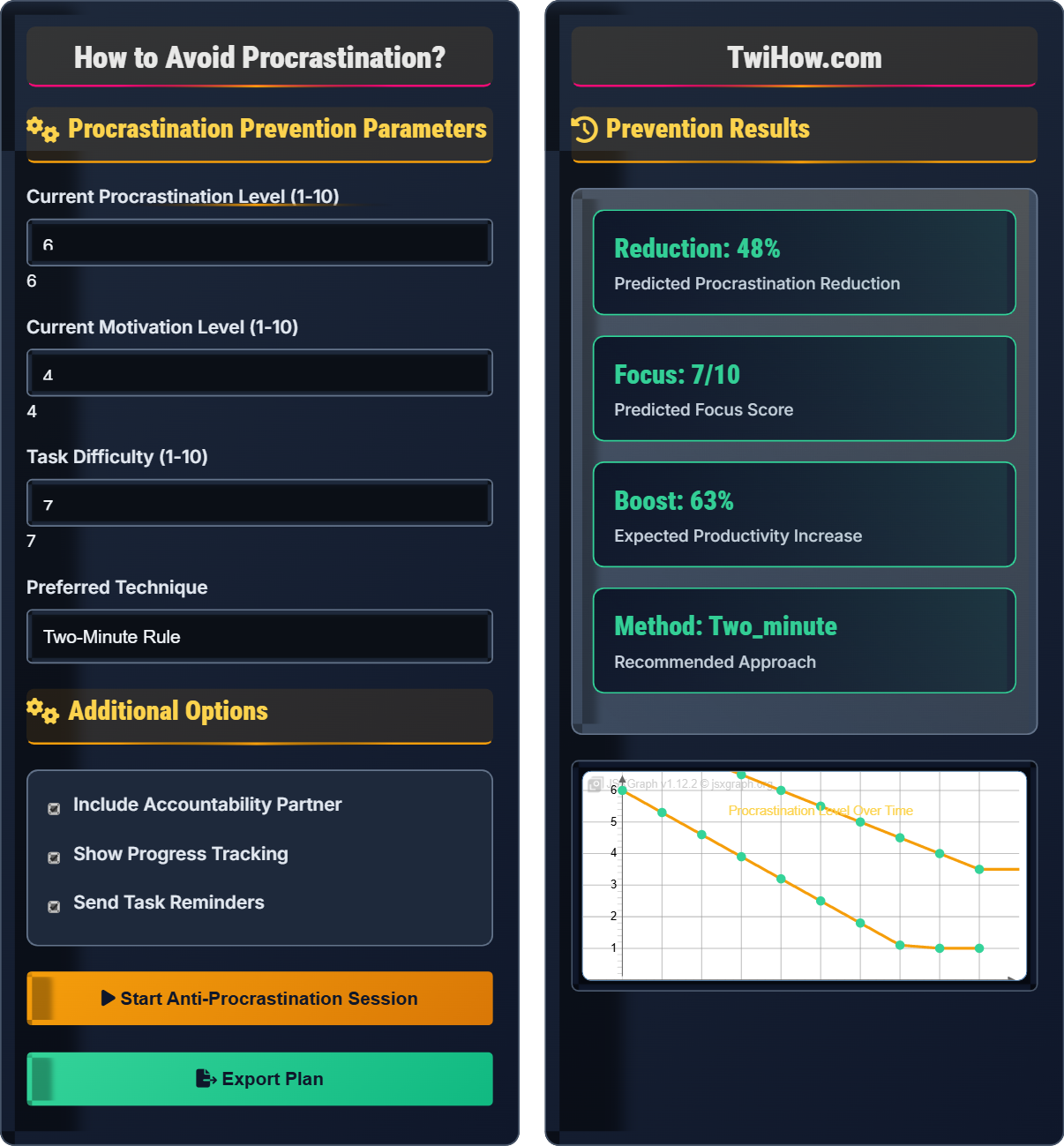
Prevention Results
| Day | Procrastination | Focus | Productivity |
|---|---|---|---|
| 1 | 8 | 3 | 4 |
| 2 | 7 | 4 | 5 |
| 3 | 6 | 5 | 6 |
| 4 | 5 | 6 | 7 |
| 5 | 4 | 7 | 8 |
How to Avoid Procrastination Explained
Procrastination is not simply laziness or poor time management—it's a complex psychological behavior involving the voluntary delay of tasks despite expecting negative consequences. It often stems from emotional regulation difficulties, perfectionism, fear of failure, or task aversion.
The procrastination cycle typically begins with a task that feels overwhelming or unpleasant, leading to avoidance behaviors that provide temporary relief but ultimately increase stress and reduce performance.
Successfully avoiding procrastination follows the principle of motivation overcoming delay:
Where:
- Motivation: Drive to complete the task
- Expectation of Success: Confidence in completing the task
- Delay Factor: Perceived difficulty or unpleasantness
- Impulsiveness Control: Ability to resist distractions
Proven techniques for avoiding procrastination:
- Two-Minute Rule: If it takes less than 2 minutes, do it now
- Pomodoro Technique: 25-minute focused work sessions with breaks
- Task Chunking: Breaking large projects into smaller, manageable pieces
- Implementation Intentions: Creating specific if-then plans
- Environmental Design: Removing distractions and creating focus zones
- Accountability Systems: Sharing goals with others for support
- Reduced Stress: Eliminate last-minute rushes and panic
- Higher Quality Work: Time for thorough completion
- Increased Confidence: Consistent progress toward goals
- Better Time Management: More control over your schedule
- Improved Self-Esteem: Feeling accomplished and in control
- Enhanced Performance: Consistent productivity
Procrastination Fundamentals
Procrastination, delay, motivation, task aversion, perfectionism, time management, productivity.
If a task takes less than two minutes to complete, do it immediately instead of postponing it.
This technique prevents small tasks from accumulating and becoming overwhelming. It also builds momentum for tackling larger tasks.
- Start with the smallest possible action
- Focus on starting, not finishing
- Make starting easier than continuing to avoid
Practical Applications
Homework assignments, project deadlines, studying for exams, household chores, work tasks.
- Task identification and categorization
- Breaking down large projects
- Selecting appropriate techniques
- Creating supportive systems
- Start with small wins
- Be consistent with techniques
- Adjust methods as needed
- Celebrate progress
Procrastination Prevention Quiz
Which of the following is the primary psychological driver of procrastination?
Research shows that procrastination is primarily driven by emotional regulation issues, particularly fear of failure, perfectionism, and task aversion. People often procrastinate because they fear not meeting their own or others' expectations, or because the task feels overwhelming. While lack of motivation and poor time management contribute, the core issue is usually emotional rather than cognitive.
The answer is B) Fear of failure or perfectionism.
Understanding the psychological roots of procrastination is crucial for developing effective strategies. The emotional regulation model suggests that procrastination serves as a temporary mood repair strategy—people delay tasks to avoid negative emotions associated with them. This insight helps explain why willpower alone is often insufficient to overcome procrastination.
Task Aversion: Dislike or resistance toward a particular task
Perfectionism: Setting unrealistically high standards
Emotional Regulation: Managing emotional responses to tasks
• Address emotional barriers, not just practical ones
• Recognize that procrastination is normal
• Focus on starting, not perfecting
• Lower expectations for first attempts
• Focus on effort, not outcome
• Use positive self-talk
• Blaming lack of willpower
• Not addressing underlying fears
• Setting unrealistic standards
Explain the Pomodoro Technique and how it specifically helps overcome procrastination. Include the psychological mechanisms behind its effectiveness and describe how to adapt it for different types of tasks.
Pomodoro Technique Steps: 1) Choose a task, 2) Set a 25-minute timer, 3) Work until the timer rings, 4) Take a 5-minute break, 5) After 4 "pomodoros," take a longer 15-30 minute break.
Psychological Mechanisms: The technique addresses procrastination by making large tasks feel manageable (commitment to only 25 minutes), providing structure and accountability, and using time constraints to create focus. The technique also leverages the "Zeigarnik effect"—we remember incomplete tasks better, so starting a task makes us want to finish it.
Task Adaptation: For reading, read actively for 25 minutes. For writing, draft for the time period. For problem-solving, work on problems continuously. For creative tasks, brainstorm or create during the period.
The Pomodoro Technique is effective against procrastination because it breaks the "start-stop" pattern that often leads to avoidance. By committing to only 25 minutes, the barrier to starting is lowered significantly. The technique also provides external structure that helps override the emotional urge to delay. The regular breaks prevent mental fatigue and maintain motivation.
Pomodoro: One work interval (25 minutes)
Zeigarnik Effect: Tendency to remember incomplete tasks better
Commitment Device: Tool that helps overcome future temptation
• Work without interruptions during pomodoro
• Take breaks even if not tired
• Track completed pomodoros
• Start with 25-minute intervals
• Use breaks for movement or breathing exercises
• Track your most productive times
• Extending work sessions beyond 25 minutes
• Skipping breaks
• Starting new tasks during breaks
David consistently procrastinates on his major research paper, which is due in 4 weeks. He knows the paper is worth 40% of his grade and requires 20+ hours of work, but he keeps finding other things to do instead. His anxiety increases as the deadline approaches. Design a procrastination prevention plan for David that includes specific techniques, timeline, and accountability measures. Explain why each component of your plan addresses his particular procrastination challenges.
Timeline Strategy: Break the 20-hour project into 1-hour daily sessions over 4 weeks (16 sessions), leaving buffer time. Week 1: Research and outline. Week 2: First draft. Week 3: Revisions. Week 4: Final touches.
Techniques: Use implementation intentions ("If it's 7 PM, then I will work on the paper for 1 hour"), environmental design (remove phone from study area), and the two-minute rule for small tasks.
Accountability: Share progress with a friend weekly, use a public tracker, and set up small rewards for completing each stage.
Reasoning: The breakdown makes the large task feel manageable, implementation intentions address decision paralysis, environmental design removes temptation, and accountability provides external motivation.
Large, important tasks with distant deadlines are particularly prone to procrastination due to the combination of high stakes and delayed consequences. The key is to make the task feel more immediate and manageable. Breaking it down creates multiple "deadlines" and reduces the overwhelming nature of the project.
Implementation Intentions: Specific if-then action plans
Decision Paralysis: Inability to make decisions due to overwhelm
Buffer Time: Extra time allocated for unexpected delays
• Start with the smallest possible action
• Make starting easier than stopping
• Build in flexibility
• Prepare workspace in advance
• Focus on process, not outcome
• Celebrate small wins
• Waiting until the last week
• Not accounting for perfectionism
• Working in distracting environments
Sarah finds herself constantly distracted by social media and notifications while studying, leading to frequent procrastination. She spends more time on her phone than intended and loses focus easily. Design a comprehensive plan to help Sarah overcome digital distraction-based procrastination. Include environmental modifications, digital tools, and behavioral strategies. Explain how each component addresses different aspects of digital distraction.
Environmental Modifications: Create a dedicated study space without devices, use website blockers during study hours, place phone in another room.
Digital Tools: Use apps like Forest or Cold Turkey to block distracting websites, set up "Do Not Disturb" mode, use browser extensions to block social media.
Behavioral Strategies: Implement the Pomodoro Technique, practice mindfulness when urges arise, create alternative activities for breaks.
Addressing Aspects: Environmental changes address accessibility, digital tools address automatic access, behavioral strategies address the psychological urge to check devices.
Digital distractions exploit our brain's reward system, creating a cycle of seeking instant gratification. The most effective approach combines removing the stimulus (environmental changes), preventing access (digital tools), and building tolerance for discomfort (behavioral strategies). This multi-layered approach addresses both the external triggers and internal urges.
Reward System: Brain circuitry that reinforces pleasurable behaviors
Instant Gratification: Preference for immediate rewards
Stimulus Control: Managing environmental cues
• Remove temptation, don't rely on willpower
• Prepare alternative activities
• Build tolerance gradually
• Use grayscale mode on phones
• Charge devices away from study area
• Replace phone time with physical activities
• Relying solely on willpower
• Not preparing alternatives
• Underestimating the power of digital addiction
Which of the following is the most important factor for successfully forming anti-procrastination habits?
While sophisticated techniques, perfect conditions, and minimal distractions can help, the most important factor for habit formation is consistent daily practice. Research shows that habits form through repetition and consistency rather than perfection. Even imperfect practice that is regular is more effective than sporadic perfect practice. The key is building the behavior into your routine until it becomes automatic.
The answer is B) Consistent daily practice.
Habit formation is a neurological process that requires repetition to create new neural pathways. The brain needs consistent practice to make new behaviors automatic. This is why starting small and maintaining consistency is more effective than trying to implement complex systems perfectly. The goal is to make anti-procrastination behaviors as automatic as brushing teeth.
Habit Formation: Process of creating automatic behaviors
Neural Pathways: Brain circuits that support automatic behaviors
Automaticity: Ability to perform tasks without conscious thought
• Focus on consistency over perfection
• Start with small changes
• Build gradually
• Link new habits to existing ones
• Use implementation intentions
• Track progress consistently
• Trying to change too much at once
• Giving up after missing a day
• Expecting immediate results
FAQ
Q: I've tried many anti-procrastination techniques but always fall back into old patterns. How can I make the changes stick long-term?
A: The key to lasting change is gradual implementation and addressing the root causes of your procrastination. Instead of trying multiple techniques at once, master one at a time. Focus on understanding your specific procrastination triggers (perfectionism, fear of failure, task aversion) and choose techniques that directly address those triggers. Also, create an environment that supports your new behaviors—remove temptations and make desired behaviors easier. Most importantly, expect setbacks and have a plan for getting back on track rather than abandoning the system entirely.
Q: I only procrastinate on certain types of tasks. Should I use different techniques for different subjects or activities?
A: Yes, different tasks may require different approaches! For example, if you procrastinate on math because it feels overwhelming, use task chunking and start with just 5 minutes of work. If you avoid writing because you're perfectionistic, use the "shitty first draft" approach where you deliberately write poorly to overcome the blank page fear. If you delay reading because it's boring, try the Pomodoro Technique with active engagement strategies. The key is matching the technique to the specific reason for procrastination on that task type.
Q: I work better under pressure and often get my best work done right before deadlines. Is this really procrastination, and should I try to change this pattern?
A: What you're describing is called "functional procrastination" or "productive delay." Some people do perform better with time pressure due to increased adrenaline and focus. However, there are risks: you may not produce your best work, you'll likely experience more stress, and if unexpected obstacles arise, you won't have buffer time. Consider whether you're truly performing optimally or just satisfactorily. If you're consistently meeting your standards under pressure, you might not need to change, but if you want higher quality work or less stress, gradually shifting earlier could be beneficial. The key is understanding your personal patterns and choosing what works best for your goals.