How to Learn Faster?
Complete learning acceleration guide • Step-by-step explanations
Learning Acceleration Fundamentals:
Show Learning Acceleration ToolsAccelerated learning involves using scientifically-backed techniques and strategies to enhance memory retention, comprehension, and knowledge acquisition. It's based on cognitive science research about how the brain processes and stores information most effectively. The key is understanding your learning style and applying evidence-based methods that optimize your brain's natural learning mechanisms.
Key learning acceleration techniques:
- Active Recall: Retrieving information from memory without looking at notes
- Spaced Repetition: Reviewing material at increasing intervals
- Elaborative Interrogation: Asking "why" and "how" questions
- Interleaving: Mixing different topics or types of problems
- Multimodal Learning: Engaging multiple senses and learning styles
Modern learning acceleration combines cognitive science with practical techniques to create personalized systems that maximize retention and comprehension.
Learning Acceleration Parameters
Additional Options
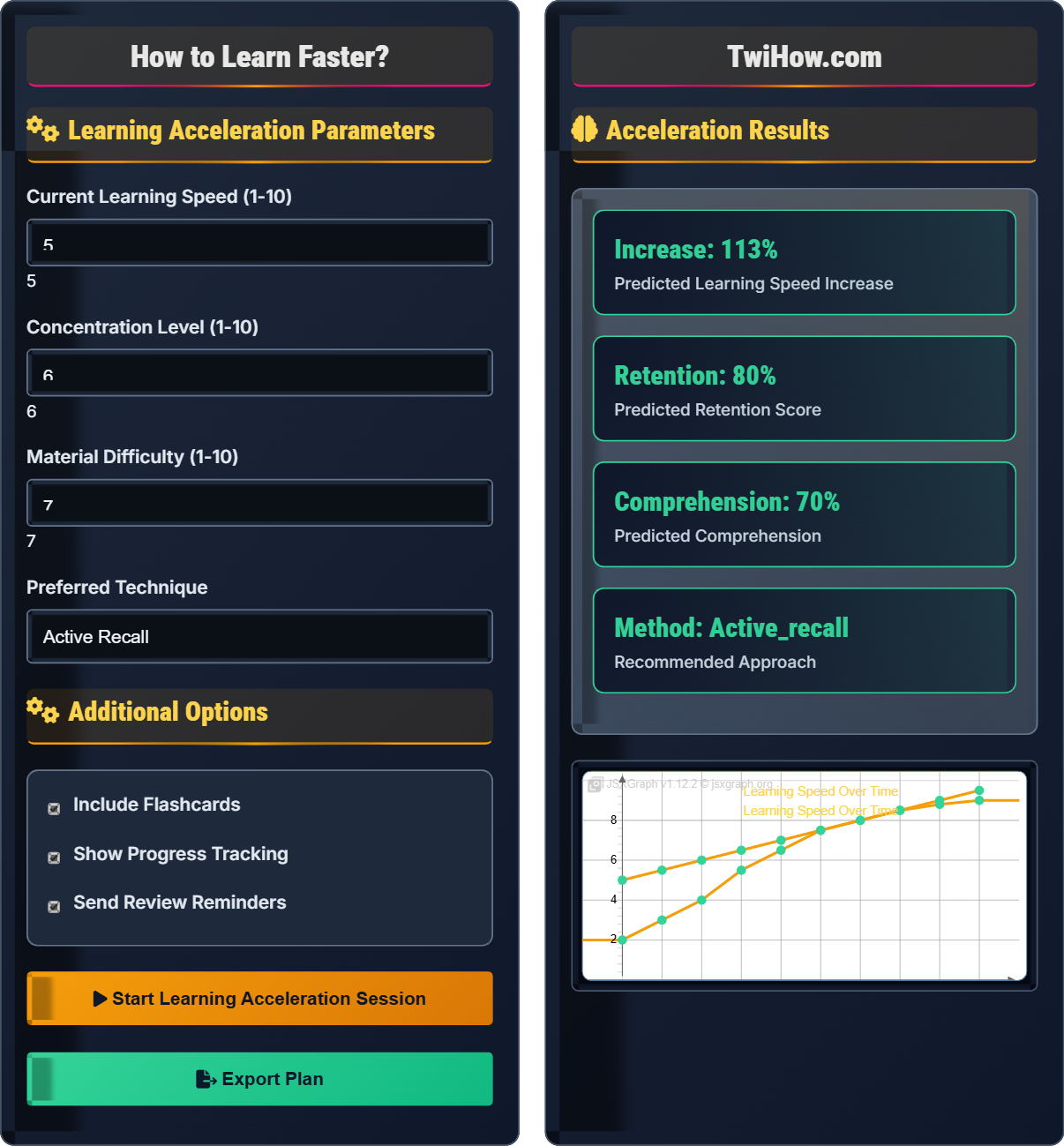
Acceleration Results
| Day | Speed | Retention | Comprehension |
|---|---|---|---|
| 1 | 5 | 45% | 50% |
| 2 | 6 | 55% | 58% |
| 3 | 7 | 65% | 65% |
| 4 | 8 | 75% | 72% |
| 5 | 9 | 85% | 78% |
How to Learn Faster Explained
Learning acceleration is the process of using evidence-based techniques to enhance the speed and effectiveness of learning. It's grounded in cognitive science research about how the brain processes, stores, and retrieves information. The goal is to work with your brain's natural mechanisms rather than against them.
Research shows that passive learning (like rereading notes) is far less effective than active learning techniques. The most effective methods involve engaging with material in ways that require retrieval, elaboration, and application of knowledge.
Successful learning acceleration follows the principle of optimized encoding and retrieval:
Where:
- Active Engagement: Level of mental involvement with the material
- Retrieval Practice: Effort to recall information from memory
- Spacing Factor: Optimal timing of review sessions
- Cognitive Load Management: Managing mental resources effectively
Proven techniques for accelerating learning:
- Active Recall: Closing books and trying to recall information
- Spaced Repetition: Reviewing material at increasing intervals
- Elaborative Interrogation: Asking "why" and "how" questions
- Interleaving: Mixing different topics or problem types
- Self-Explanation: Explaining concepts in your own words
- Testing Effect: Taking practice tests frequently
- Improved Retention: Information stays in memory longer
- Faster Comprehension: Better understanding of complex concepts
- Reduced Study Time: Learn more in less time
- Enhanced Transfer: Apply knowledge to new situations
- Increased Confidence: Better prepared for assessments
- Deeper Understanding: Connect concepts meaningfully
Learning Acceleration Fundamentals
Active recall, spaced repetition, elaborative interrogation, interleaving, cognitive load, metacognition, retrieval practice.
After reading a section, close the book and write down everything you remember without looking. Then check what you missed and repeat the process.
This technique is 50% more effective than rereading because it forces your brain to retrieve information, strengthening memory pathways.
- Test yourself before you feel ready
- Space reviews at increasing intervals
- Focus on understanding, not just memorization
Practical Applications
Exam preparation, language learning, skill acquisition, professional development, academic courses.
- Material assessment and categorization
- Technique selection and combination
- Session planning and scheduling
- Progress tracking and adjustment
- Start with easier material
- Gradually increase difficulty
- Combine multiple techniques
- Take regular breaks
Learning Acceleration Quiz
According to cognitive science research, which of the following is the most effective study technique?
Research consistently shows that active recall and testing are the most effective study techniques. This is known as the "testing effect" - the act of retrieving information strengthens memory pathways more than passive review. Rereading, highlighting, and outlining are all forms of passive learning that are significantly less effective than active retrieval.
The answer is B) Active recall and testing.
The testing effect demonstrates that the effort required to retrieve information from memory strengthens that memory trace. When you actively try to recall information without looking at notes, you're forcing your brain to reconstruct the knowledge, which creates stronger neural connections. This is why practice tests and self-quizzing are so effective compared to passive review methods.
Active Recall: Retrieving information from memory without external cues
Testing Effect: Superior retention when information is tested vs. reviewed
Memory Trace: Neural pathway formed during learning
• Test yourself before you feel ready
• Focus on retrieval, not recognition
• Use flashcards for active recall
• Explain concepts aloud
• Practice under test-like conditions
• Confusing familiarity with knowledge
• Over-relying on passive techniques
• Not spacing practice sessions
Explain the spaced repetition technique and why it's effective for long-term learning. Include the psychological mechanisms behind its effectiveness and describe how to implement it for different types of material.
Spaced Repetition: Reviewing material at increasing intervals (e.g., 1 day, 3 days, 1 week, 2 weeks, 1 month) just as you're about to forget it.
Psychological Mechanisms: This technique exploits the "spacing effect" - memories are strengthened when retrieval is difficult. Each time you retrieve information after a gap, the memory becomes more durable. The "desirable difficulty" of spaced retrieval strengthens neural pathways more than easy retrieval.
Implementation: For vocabulary, review words at increasing intervals. For concepts, quiz yourself on definitions and applications. For procedures, practice steps after progressively longer gaps. Digital tools like Anki can automate the spacing.
Spaced repetition works because forgetting is actually beneficial for learning. When you struggle to retrieve information, you strengthen the memory trace. This is why cramming leads to rapid forgetting while spaced practice leads to durable learning. The key is timing reviews just before you would forget, which maximizes the strengthening effect.
Spaced Repetition: Reviewing material at increasing intervals
Spacing Effect: Superior retention with distributed practice
Desirable Difficulty: Beneficial challenge that strengthens learning
• Review just before you'd forget
• Increase intervals gradually
• Focus on difficult items
• Use spaced repetition apps
• Track your forgetting curves
• Adjust intervals based on difficulty
• Reviewing too frequently
• Not adjusting for difficulty
• Stopping after initial mastery
Emma needs to learn 200 vocabulary words for her Spanish exam in 4 weeks. She has studied Spanish before but struggles with long-term retention. Design a learning acceleration plan for Emma that incorporates multiple evidence-based techniques. Include a specific schedule, recommended tools, and strategies for maintaining motivation. Explain how each component of your plan addresses the challenges of vocabulary retention.
Plan Structure: 4 weeks with daily 45-minute sessions using spaced repetition and active recall. Week 1: Learn 50 new words. Weeks 2-4: Mix new learning with review of previous words.
Techniques: Use Anki flashcards with spaced repetition, practice active recall by writing sentences using new words, and use elaborative interrogation by connecting new words to familiar concepts.
Motivation: Set daily goals, track progress, create a reward system, and practice with meaningful contexts (reading Spanish articles).
Addressing Challenges: Spaced repetition combats forgetting, active recall strengthens memory traces, and meaningful contexts improve retention beyond rote memorization.
Vocabulary learning requires both encoding (initial learning) and consolidation (long-term storage). The combination of spaced repetition and active recall addresses both phases. Spaced repetition optimizes the timing of reviews to strengthen memories, while active recall ensures deep processing during each session. Connecting new words to existing knowledge creates multiple retrieval pathways.
Encoding: Initial learning and storage of information
Consolidation: Stabilization of memory traces
Retrieval Pathways: Routes to access stored information
• Combine multiple techniques
• Practice in context
• Maintain consistent schedule
• Use mnemonic devices
• Practice with native speakers
• Read in target language
• Relying on rote memorization only
• Not reviewing regularly
• Studying in isolation from context
David is struggling to understand calculus concepts, particularly integration and differentiation. He can follow examples but can't solve problems independently. Design a learning acceleration strategy that helps David move from procedural understanding to conceptual mastery. Include specific techniques for complex concept learning and explain how each addresses his particular challenges.
Strategy Components: Elaborative interrogation (asking "why" questions), self-explanation (explaining concepts in own words), interleaving (mixing different problem types), and concrete examples.
Implementation: After each example, David should explain why each step works. He should alternate between different types of problems rather than practicing one type repeatedly. He should connect concepts to visual representations and real-world applications.
Addressing Challenges: Elaborative interrogation builds understanding beyond procedures, interleaving improves transfer and discrimination, and concrete examples make abstract concepts tangible.
Complex concept learning requires moving beyond surface-level procedural knowledge to deep conceptual understanding. This involves making connections between different representations of concepts, understanding the "why" behind procedures, and being able to transfer knowledge to novel situations. The key is active processing that goes beyond mimicking examples.
Procedural Knowledge: Knowing how to perform operations
Conceptual Understanding: Understanding underlying principles
Transfer: Applying knowledge to new situations
• Focus on understanding, not just procedures
• Connect concepts to multiple representations
• Practice with varied problems
• Draw diagrams to visualize concepts
• Explain concepts to others
• Connect to prior knowledge
• Memorizing procedures without understanding
• Practicing the same problem type repeatedly
• Not questioning why methods work
Which of the following statements about learning styles and modalities is supported by scientific research?
Research has found little evidence supporting the learning styles hypothesis (that people learn better when taught in their preferred modality). However, multimodal learning (engaging multiple senses) is generally more effective than single-modality learning because it creates multiple pathways for retrieval and deeper processing of information. The key is using multiple modalities for all learners, not matching to supposed preferences.
The answer is B) Multimodal learning is more effective than single-modality.
While people may have preferences for how they receive information, research shows that learning is not enhanced by matching instruction to these preferences. However, using multiple modalities (visual, auditory, kinesthetic) simultaneously enhances learning by creating multiple memory traces and deeper processing. This is different from the debunked learning styles theory.
Learning Styles: Supposed preference for particular modalities (debunked)
Multimodal Learning: Engaging multiple senses simultaneously
Memory Traces: Neural pathways formed during learning
• Use multiple modalities for all learners
• Focus on active engagement over style matching
• Combine visual, auditory, and kinesthetic elements
• Draw diagrams while reading
• Explain concepts aloud
• Use hands-on activities when possible
• Believing in fixed learning styles
• Using only one modality
• Not engaging actively with material
FAQ
Q: I've tried active recall but I can barely remember anything when I close my book. Am I doing it wrong?
A: This is completely normal and actually shows you're doing active recall correctly! The difficulty you feel when trying to recall information is precisely what strengthens your memory. Don't worry if you can only remember 20% initially - the effort of trying to retrieve the information is what builds the memory trace. Start with smaller chunks of information, and gradually increase complexity. After attempting to recall, check your answers and repeat the process. The struggle is part of the learning!
Q: How do I know if I'm learning faster? What metrics should I track?
A: Track specific, measurable outcomes: 1) Retention over time - test yourself after 1 day, 1 week, 1 month and see how much you remember. 2) Time to proficiency - how long does it take to reach mastery? 3) Transfer ability - can you apply knowledge to new situations? 4) Confidence ratings - do you feel more prepared for tests? 5) Efficiency - are you spending less time to achieve the same results? The key is measuring long-term retention, not just immediate recall.
Q: Do learning acceleration techniques work for all subjects, or are some subjects resistant to these methods?
A: The core principles of learning acceleration apply to all subjects, but implementation varies. For factual subjects (history, biology), active recall and spaced repetition work excellently. For procedural subjects (math, programming), interleaving different problem types is crucial. For creative subjects (art, music), deliberate practice with feedback is key. The universal principles are active engagement, spaced practice, and testing - but how you implement them depends on the subject matter. The key is adapting the techniques to the nature of the content.