How to Choose Between Different Heating and Cooling Systems
Complete HVAC guide • Step-by-step comparisons
HVAC Fundamentals:
Show HVAC CalculatorChoosing the right heating and cooling system is crucial for home comfort, energy efficiency, and cost savings. There are several types of HVAC systems available, each with unique advantages and disadvantages. The best choice depends on factors like climate, home size, budget, and energy efficiency goals.
Key HVAC types include:
- Furnaces: Gas, electric, or oil-powered heating systems
- Heat Pumps: Efficient systems that move heat rather than generate it
- Central Air Conditioning: Whole-home cooling systems
- Ductless Mini-Splits: Flexible zoning and energy-efficient options
- Geothermal Systems: Ground-source systems for maximum efficiency
Modern HVAC systems are designed to optimize energy consumption while maintaining consistent indoor temperatures. The SEER (Seasonal Energy Efficiency Ratio) and HSPF (Heating Seasonal Performance Factor) ratings help measure system efficiency.
HVAC Parameters
System Preferences
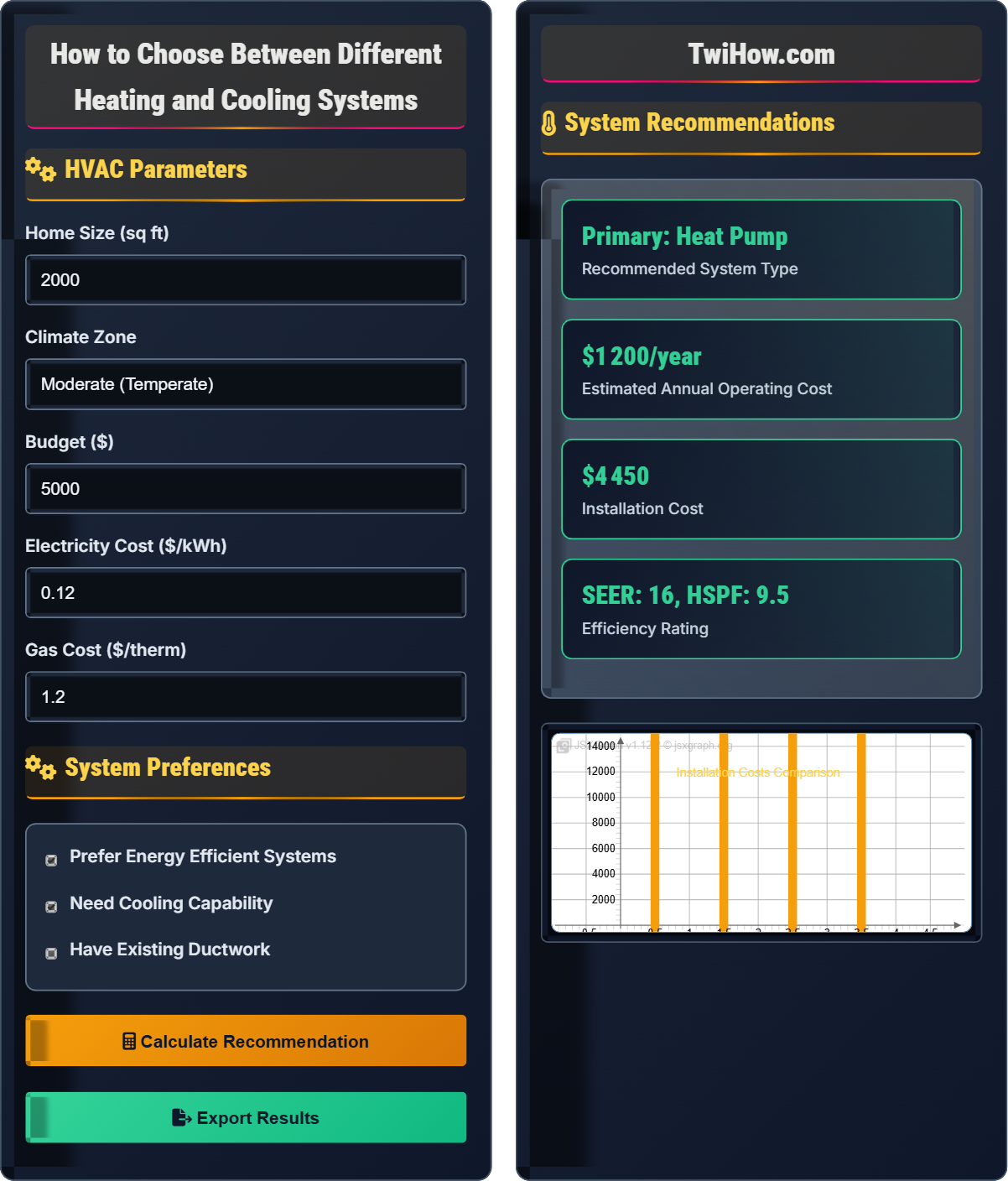
System Recommendations
| System Type | Initial Cost | Annual Cost | Efficiency |
|---|---|---|---|
| Heat Pump | $4,500 | $1,200 | SEER: 16 |
| Furnace + AC | $5,200 | $1,400 | AFUE: 95% |
| Geothermal | $12,000 | $800 | Efficiency: 400% |
| Ductless Mini-Split | $3,800 | $1,100 | SEER: 22 |
Heat Pump System Details
Heat pumps are ideal for moderate climates and offer both heating and cooling. They work by moving heat rather than generating it, making them extremely efficient. With proper maintenance, they can last 15-20 years.
Advantages: Dual functionality, energy efficient, lower operating costs
Disadvantages: Less effective in extreme cold, higher upfront cost
HVAC System Types Explained
Furnaces generate heat by burning fuel (gas, oil, or electricity) and distribute warm air through ducts. They're reliable and effective in cold climates.
Where AFUE (Annual Fuel Utilization Efficiency) measures furnace efficiency. Modern furnaces have AFUE ratings of 80-98%.
Heat pumps move heat from one place to another rather than generating it. They can provide both heating and cooling efficiently.
Where COP (Coefficient of Performance) indicates efficiency. Higher COP values mean greater efficiency. Heat pumps typically have COP values of 3-4.
Central AC systems cool homes by removing heat and humidity from indoor air. They're paired with furnaces or heat pumps.
SEER (Seasonal Energy Efficiency Ratio) rates cooling efficiency. Higher SEER ratings indicate more efficient systems. Minimum standard is 13 SEER, with high-efficiency models reaching 26 SEER.
Proper system sizing is crucial for efficiency and comfort. Oversized systems short-cycle, reducing efficiency and comfort. Undersized systems can't maintain desired temperatures.
Where Climate Factor ranges from 30-60 BTU/sq ft depending on location, and Insulation Factor adjusts for home efficiency.
HVAC Fundamentals
BTU, SEER, HSPF, AFUE, COP, ductwork, zoning, heat exchanger.
BTU/hr = Square Feet × Climate Factor × Insulation Factor
Where Climate Factor = 30-60 BTU/sq ft, Insulation Factor = 0.8-1.2.
- Proper sizing prevents short cycling
- Higher efficiency systems save money long-term
- Regular maintenance extends system life
System Comparisons
Gas furnaces, electric furnaces, heat pumps, geothermal, ductless mini-splits.
- SEER: Seasonal Energy Efficiency Ratio (cooling)
- AFUE: Annual Fuel Utilization Efficiency (heating)
- HSPF: Heating Seasonal Performance Factor (heat pumps)
- COP: Coefficient of Performance (heat pumps)
- Climate suitability
- Upfront vs. operational costs
- Space availability
- Existing infrastructure
HVAC Learning Quiz
Which efficiency rating applies to heat pumps during the heating season?
HSPF (Heating Seasonal Performance Factor) is the efficiency rating specifically for heat pumps during the heating season. SEER is for cooling efficiency, AFUE is for furnaces, and EER is the Energy Efficiency Ratio for air conditioners.
The answer is B) HSPF.
Understanding HVAC efficiency ratings is crucial for making informed decisions. Each system type has its own rating system: HSPF for heat pump heating, SEER for cooling efficiency, AFUE for furnace efficiency, and COP for instantaneous efficiency. Higher numbers indicate greater efficiency and lower operating costs.
HSPF: Heating Seasonal Performance Factor for heat pump heating efficiency
SEER: Seasonal Energy Efficiency Ratio for cooling systems
AFUE: Annual Fuel Utilization Efficiency for furnaces
• HSPF rates heat pump heating efficiency
• Higher efficiency ratings save money
• Match rating to system type
• Look for HSPF > 8.2 for good efficiency
• SEER ratings above 16 are high efficiency
• Compare ratings within same system type
• Confusing efficiency ratings between system types
• Ignoring seasonal variations
• Not considering climate impact
Explain why proper HVAC system sizing is important and describe the consequences of incorrectly sized systems.
Importance of Proper Sizing: Correctly sized HVAC systems operate efficiently, maintain consistent temperatures, and provide optimal comfort. They run full cycles, allowing for proper dehumidification and temperature distribution.
Consequences of Oversized Systems: Short cycling (frequent on/off cycles), reduced efficiency, poor humidity control, uneven temperatures, and shortened equipment lifespan.
Consequences of Undersized Systems: Cannot maintain desired temperatures during peak conditions, constant operation, increased wear and tear, higher energy bills, and reduced comfort.
Proper sizing requires Manual J calculations considering square footage, insulation levels, window characteristics, and local climate.
System sizing is often overlooked but is one of the most critical factors in HVAC performance. Many homeowners assume bigger is better, but oversized systems actually perform worse than properly sized ones. The goal is to match system capacity to actual heating and cooling loads, accounting for heat gain and loss through walls, windows, and roofs.
Short Cycling: Frequent turning on and off of HVAC systems
Manual J: Standard method for calculating heating and cooling loads
Heat Load: Amount of heating or cooling required to maintain comfort
• Always perform load calculations
• Avoid oversizing systems
• Account for all heat sources
• Use Manual J calculations
• Consider future additions to home
• Account for insulation improvements
• Guessing system size
• Using old inefficient assumptions
• Not accounting for home improvements
A homeowner in Phoenix, Arizona (hot climate) wants to replace their old central AC system. Their 2,500 sq ft home has good insulation but lacks ductwork. The family wants to minimize energy costs while having precise temperature control in different rooms. Recommend the best HVAC solution and explain your reasoning.
Recommended Solution: Ductless Mini-Split System
Reasoning: In hot climates like Phoenix, ductless systems offer superior efficiency since there's no ductwork to lose cooled air. The lack of existing ductwork makes ductless installation more cost-effective than installing new ductwork. Mini-splits provide individual room control (zoning), allowing for customized comfort and reduced energy usage by cooling only occupied rooms. With good insulation, the mini-split can maintain consistent temperatures efficiently.
Benefits: High SEER ratings (20+), no duct losses, precise zone control, easy installation, quiet operation.
Considerations: Higher upfront cost per ton compared to central AC, visible indoor units.
Real-world HVAC decisions require balancing multiple factors: climate, existing infrastructure, user preferences, and budget. In hot climates, duct losses can be significant (up to 30% in poorly sealed ducts), making ductless systems particularly attractive. The absence of existing ductwork removes a major installation barrier. Zoning capabilities allow for more efficient operation by only conditioning occupied spaces.
Ductless Mini-Split: Split system without ductwork, individual room control
Zoning: Independent temperature control of different areas
Duct Losses: Energy lost through poorly sealed ductwork
• Consider existing infrastructure
• Match system to climate needs
• Evaluate long-term operating costs
• Calculate potential duct losses
• Consider future occupancy patterns
• Factor in maintenance accessibility
• Installing ducted systems without proper ductwork
• Ignoring climate-specific efficiency
• Not considering zoning needs
A homeowner in Minnesota (very cold climate) is considering a heat pump system. Explain the challenges of heat pumps in cold climates and suggest solutions to overcome these challenges.
Challenges: Heat pumps become less efficient as outdoor temperatures drop. Below freezing, they may struggle to extract sufficient heat from cold air. At very low temperatures (-10°F), some heat pumps stop working efficiently.
Solutions:
1. Cold Climate Heat Pumps: Specialized units designed for sub-zero temperatures
2. Hybrid Systems: Heat pump with backup furnace for extreme cold
3. Supplemental Electric Heat: Backup resistance heating elements
4. Proper Sizing: Oversize slightly to compensate for efficiency loss
Modern cold-climate heat pumps can operate efficiently down to -15°F with COP values above 2.0.
Traditional heat pumps face challenges in cold climates because they rely on extracting heat from outdoor air, which becomes scarcer as temperatures drop. However, technological advances have made cold-climate heat pumps viable in northern regions. The key is matching the right technology to the climate, sometimes using hybrid approaches for optimal performance.
Cold Climate Heat Pump: Heat pump designed for sub-zero temperatures
Hybrid System: Combination of heat pump and conventional furnace
Defrost Cycle: Process to remove ice buildup on outdoor coils
• Traditional heat pumps struggle below 25°F
• Cold climate models available for colder regions
• Hybrid systems offer reliable backup
• Research cold climate models specifically
• Consider hybrid systems for reliability
• Verify performance at local temperatures
• Installing standard heat pumps in very cold climates
• Not considering backup heating
• Ignoring defrost cycle impacts
Which of the following is a primary advantage of geothermal HVAC systems?
Geothermal systems achieve extremely high efficiency (300-600%) because they tap into stable ground temperatures rather than air temperatures. They use significantly less electricity than conventional systems, resulting in very low operating costs. While they have high upfront costs and complex installation, their efficiency advantage is unmatched.
The answer is B) Extremely high efficiency year-round.
Geothermal systems leverage the earth's relatively constant underground temperature (typically 50-60°F) to exchange heat. This allows them to maintain consistent efficiency regardless of seasonal temperature variations. The initial investment is high due to ground loop installation, but operating costs are minimal, often paying for themselves over 10-15 years.
Geothermal: HVAC system using ground temperature for heat exchange
Ground Loop: Underground piping system for heat exchange
Thermal Efficiency: Heat output divided by energy input
• High upfront cost but low operating cost
• Requires adequate land for loops
• Consistent efficiency year-round
• Consider long-term energy savings
• Verify soil conditions for loops
• Research local regulations
• Focusing only on upfront cost
• Not evaluating land requirements
• Ignoring long-term savings potential
FAQ
Q: How do I know if my HVAC system is the right size for my home?
A: Proper HVAC sizing requires a Manual J calculation, which considers your home's square footage, insulation levels, window characteristics, number of occupants, and local climate. Signs of improper sizing include:
• Oversized: Short cycling (turning on/off frequently), high humidity, uneven temperatures
• Undersized: System runs constantly during peak conditions, can't maintain set temperature
A qualified HVAC contractor should perform these calculations before recommending a system. Simply using square footage guidelines is insufficient for proper sizing.
Q: What's the difference between SEER and HSPF ratings?
A: SEER (Seasonal Energy Efficiency Ratio) measures cooling efficiency over a typical cooling season. It represents the total cooling output (in BTUs) divided by total energy input (in watt-hours). Higher SEER values indicate more efficient cooling.
HSPF (Heating Seasonal Performance Factor) measures heating efficiency for heat pumps over a typical heating season. Like SEER, higher values indicate better efficiency. Minimum standards are 13 SEER and 8.2 HSPF, though high-efficiency models exceed 16 SEER and 9.5 HSPF.
Both ratings are calculated under standardized test conditions to allow for fair comparison between systems.