Home Energy Audit & Improvement Guide
Complete guide • Step-by-step explanations
Home Energy Audit:
Show Audit SimulatorA home energy audit is a comprehensive assessment of your home's energy efficiency that identifies areas of energy loss and opportunities for improvement. It involves examining insulation, windows, doors, HVAC systems, and other components that affect your home's energy consumption. The audit helps prioritize improvements based on cost-effectiveness and energy savings potential.
Key audit components include:
- Thermal Envelope: Insulation, windows, doors, and air sealing
- HVAC Systems: Heating, cooling, and ventilation efficiency
- Lighting & Appliances: Energy-efficient fixtures and equipment
- Water Heating: Efficiency and distribution systems
- Renewable Energy: Solar, wind, and other clean energy options
- Behavioral Factors: Usage patterns and lifestyle changes
Effective audits lead to significant energy savings, reduced utility bills, and improved comfort while contributing to environmental sustainability.
Audit Parameters
Audit Focus Areas
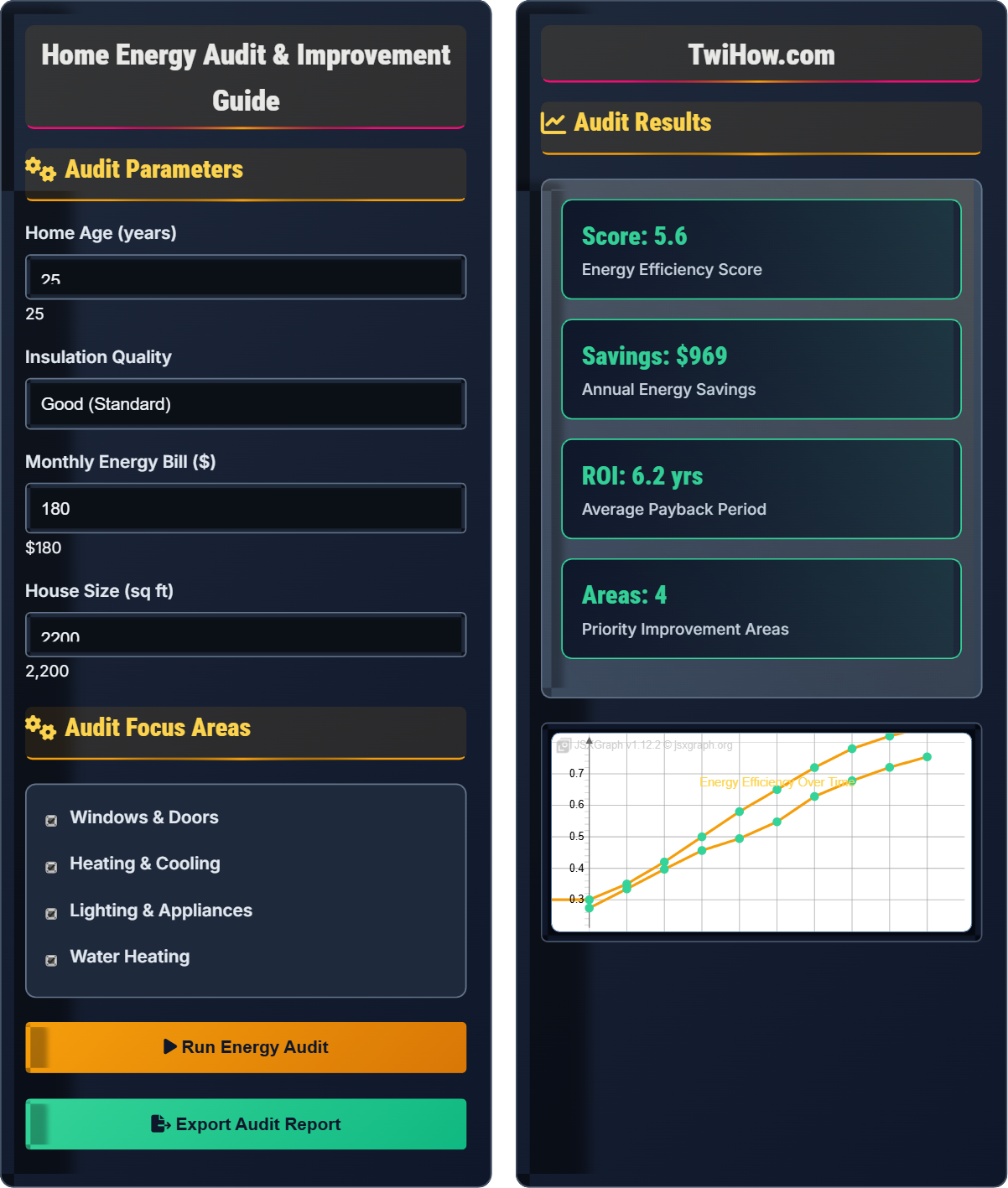
Audit Results
| Area | Current Score | Improvement Potential | Priority |
|---|---|---|---|
| Windows & Doors | 4.2 | 35% | High |
| Insulation | 5.8 | 28% | High |
| HVAC System | 6.1 | 22% | Medium |
| Lighting | 7.5 | 12% | Low |
Home Energy Audit & Improvement Process
A home energy audit is a systematic examination of your home's energy efficiency that identifies areas where energy is being wasted and opportunities for improvement. It involves inspecting insulation, windows, doors, HVAC systems, and other components that affect energy consumption, then prioritizing improvements based on cost-effectiveness and energy savings potential.
Energy audit follows a structured approach:
Where:
- Current Consumption: Baseline energy usage
- Potential Consumption: Projected usage after improvements
- Energy Efficiency Score: Percentage improvement potential
Key areas where energy audits apply:
- Thermal Envelope: Walls, roof, floors, windows, and doors
- HVAC Systems: Heating, cooling, and ventilation equipment
- Water Heating: Efficiency and distribution systems
- Lighting: LED upgrades and smart controls
- Appliances: Energy-efficient replacements
- Renewable Energy: Solar panel and wind system potential
- Quick Wins: Air sealing, programmable thermostats, LED bulbs
- Moderate Upgrades: Insulation, weatherstripping, HVAC tune-ups
- Major Improvements: Windows, HVAC replacement, solar panels
- Long-term Investments: Geothermal, smart home systems
- Behavioral Changes: Usage patterns and lifestyle modifications
- Professional Services: Comprehensive system upgrades
Fundamentals of Home Energy Audits
Energy audit, thermal envelope, R-value, air infiltration, energy efficiency, home performance, utility bills, energy savings.
Annual Savings = (Current Usage - Improved Usage) × Utility Rate
Where higher values indicate greater potential savings.
- Start with air sealing and insulation
- Prioritize improvements by ROI
- Consider whole-home approach
Applications
DIY energy audits, professional assessments, retrofit planning, utility programs, financing applications.
- Residential homes
- Commercial buildings
- Apartment complexes
- Industrial facilities
- Government buildings
- Climate and regional factors
- Utility rates and programs
- Home age and construction
Home Energy Audit Quiz
What should be the first priority in a home energy audit?
Air sealing and insulation should be the first priority in a home energy audit. These improvements address the building envelope, which is responsible for the largest percentage of energy loss. Sealing air leaks and adding insulation provide immediate benefits and improve the effectiveness of other upgrades.
The answer is B) Air sealing and insulation.
The building envelope (walls, roof, floors, windows, doors) is the foundation of energy efficiency. Air sealing prevents conditioned air from escaping and outdoor air from entering, while insulation reduces heat transfer through surfaces. These improvements have the highest return on investment and should be addressed before upgrading equipment or fixtures.
Building Envelope: Physical separator between indoors and outdoors
Air Sealing: Blocking air leaks in the building envelope
Insulation: Material that reduces heat transfer
• Address building envelope first
• Seal air leaks before adding insulation
• Prioritize improvements by ROI
• Check around windows, doors, and penetrations
• Use caulk, weatherstripping, and foam sealants
• Focus on attic, basement, and crawl spaces
• Upgrading equipment before fixing envelope
• Not sealing all air leak sources
• Inadequate insulation coverage
Explain what a blower door test is and how it helps identify energy loss in a home.
Blower Door Test: A blower door test uses a powerful fan mounted in an exterior door to depressurize the home, creating a pressure difference between inside and outside. This exaggerates air leaks, making them easier to locate and measure.
How It Helps:
1. Quantifies Air Leakage: Measures the total amount of air infiltration
2. Locates Specific Leaks: Smoke pens can identify exact leak locations
3. Measures Effectiveness: Tests improvements after sealing
4. Provides Data: Gives precise measurements for energy calculations
Results: Typically measured in air changes per hour (ACH) or cubic feet per minute (CFM).
A blower door test is the gold standard for measuring air leakage in homes. It creates a controlled environment where small air leaks become dramatically visible. This quantitative measurement helps prioritize sealing efforts and provides verification of improvement effectiveness. The test results are essential for accurate energy modeling and savings projections.
Blower Door Test: Diagnostic tool for measuring air leakage
Air Changes per Hour (ACH): Volume of air exchanged per hour
CFM: Cubic feet per minute of airflow
• Professional testing provides accurate results
• Test before and after improvements
• Combine with visual inspection
• Hire certified professionals for testing
• Schedule during mild weather
• Test all major areas of the home
• Attempting DIY testing without proper equipment
• Not testing all areas of the home
• Failing to verify improvements
You're considering installing $2,500 worth of attic insulation that will save you $400 per year in heating and cooling costs. Calculate the simple payback period and determine if this is a good investment. Also calculate the 10-year savings compared to the initial investment.
Payback Period Calculation:
• Initial Investment: $2,500
• Annual Savings: $400
• Payback Period: $2,500 ÷ $400 = 6.25 years
10-Year Savings:
• Total Savings: $400 × 10 = $4,000
• Net Benefit: $4,000 - $2,500 = $1,500
Assessment: With a 6.25-year payback period and $1,500 net benefit over 10 years, this is a good investment. The 16% annual return (inverse of 6.25 years) is competitive with other home improvements.
Additional Benefits: Improved comfort, reduced HVAC wear, increased home value.
Simple payback period is a useful tool for comparing energy efficiency investments. A payback period of 5-10 years is generally considered acceptable for home improvements. However, the calculation doesn't account for the time value of money or additional benefits like comfort and equipment longevity. For attic insulation, the long-term benefits often exceed the basic financial calculations.
Payback Period: Time to recover initial investment
Net Present Value: Future savings discounted to present value
Return on Investment: Financial gain relative to cost
• 5-10 year payback is typically acceptable
• Consider non-financial benefits
• Account for maintenance savings
• Factor in utility rebates and tax credits
• Consider inflation in energy costs
• Account for equipment life extension
• Not considering utility rebates
• Ignoring non-financial benefits
• Using outdated energy cost assumptions
Your home has a 15-year-old HVAC system with a SEER rating of 10. You're considering upgrading to a new system with a SEER rating of 16. If your current system costs $1,200 annually to operate, calculate the potential energy savings and determine the factors to consider before making this upgrade.
Energy Savings Calculation:
• Current SEER: 10, New SEER: 16
• Efficiency Ratio: 16 ÷ 10 = 1.6
• New Operating Cost: $1,200 ÷ 1.6 = $750
• Annual Savings: $1,200 - $750 = $450
Factors to Consider:
• System Age: 15 years is approaching replacement time
• Installation Costs: $5,000-$10,000 depending on complexity
• Payback Period: $7,500 ÷ $450 = 16.7 years
• Additional Benefits: Better humidity control, quieter operation
• Maintenance: New system requires less maintenance
• Warranty: 10-year parts warranty typical
SEER (Seasonal Energy Efficiency Ratio) measures cooling efficiency. Higher SEER ratings mean lower operating costs. While the payback period for HVAC replacement is typically longer than other improvements, consider the system's remaining life and other benefits. A 15-year-old system may need replacement soon anyway, making the efficiency improvement a bonus.
SEER: Seasonal Energy Efficiency Ratio
Energy Efficiency: Output energy divided by input energy
Payback Period: Time to recover investment through savings
• Consider system age and condition
• Factor in installation complexity
• Account for maintenance savings
• Consider HVAC tune-ups before replacement
• Look for utility rebates
• Ensure proper sizing for your home
• Oversizing the new system
• Not considering ductwork condition
• Ignoring installation quality
For a home in a cold climate, what is the recommended R-value for attic insulation?
For cold climates, the recommended R-value for attic insulation is R-38 to R-49. This level of insulation provides optimal energy efficiency in regions with severe winters. The higher R-value significantly reduces heat loss through the roof, which is typically the largest source of heat loss in winter.
The answer is C) R-38 to R-49.
R-value measures thermal resistance - higher values indicate better insulation. Climate zones have different recommendations because heating and cooling needs vary. Cold climates require higher R-values to combat significant temperature differences between indoor and outdoor temperatures. The R-38 to R-49 range provides optimal energy efficiency without excessive cost.
R-Value: Thermal resistance measurement
Climate Zones: Geographic regions with similar weather patterns
Heat Loss: Transfer of thermal energy from warm to cool areas
• Higher R-values provide better insulation
• Climate zones have different recommendations
• Balance cost with energy savings
• Check local building codes for requirements
• Consider radiant barriers in hot climates
• Ensure proper ventilation with insulation
• Using the same R-value for all climates
• Not considering existing insulation levels
• Blocking ventilation with insulation
FAQ
Q: Should I hire a professional or do a DIY energy audit?
A: A hybrid approach works best:
DIY Audit: Great for identifying obvious issues like air leaks, inefficient lighting, and simple improvements
Professional Audit: Essential for comprehensive analysis using specialized tools like blower door tests and thermal imaging
Best Practice: Start with a DIY audit to identify obvious issues, then hire a professional for detailed analysis and recommendations for major improvements. Professionals can identify hidden issues and provide accurate savings projections.
Many utilities offer free or low-cost professional audits, making this approach cost-effective.
Q: What are the most cost-effective energy improvements for homeowners?
A: Most cost-effective improvements include:
Quick Wins: Air sealing (payback: 1-3 years), LED lighting (payback: 1-2 years), programmable thermostats (payback: 1-3 years)
Moderate Upgrades: Attic insulation (payback: 3-7 years), weatherstripping (payback: 2-5 years)
Larger Investments: HVAC system upgrades (payback: 8-15 years), window replacement (payback: 10-20 years)
Priority Order: Address air leaks and insulation first, then equipment efficiency, followed by major system replacements. This sequence maximizes the effectiveness of each improvement.