How to Evaluate Efficiency Ratings of Appliances and HVAC Equipment
Complete Efficiency Rating Guide • Step-by-step explanations
Appliance & HVAC Efficiency:
Show Efficiency CalculatorEfficiency ratings help consumers make informed decisions about appliances and HVAC equipment. These ratings measure how effectively products convert energy into useful output. Common ratings include ENERGY STAR, SEER, EER, AFUE, HSPF, and more, each tailored to specific equipment types.
Key efficiency metrics include:
- ENERGY STAR: Government-backed certification for superior efficiency
- SEER: Seasonal Energy Efficiency Ratio (cooling equipment)
- AFUE: Annual Fuel Utilization Efficiency (heating equipment)
- HSPF: Heating Seasonal Performance Factor (heat pumps)
- EER: Energy Efficiency Ratio (instantaneous efficiency)
Higher efficiency ratings typically translate to lower operating costs and reduced environmental impact, though they may have higher upfront costs.
Equipment Parameters
Rating Standards
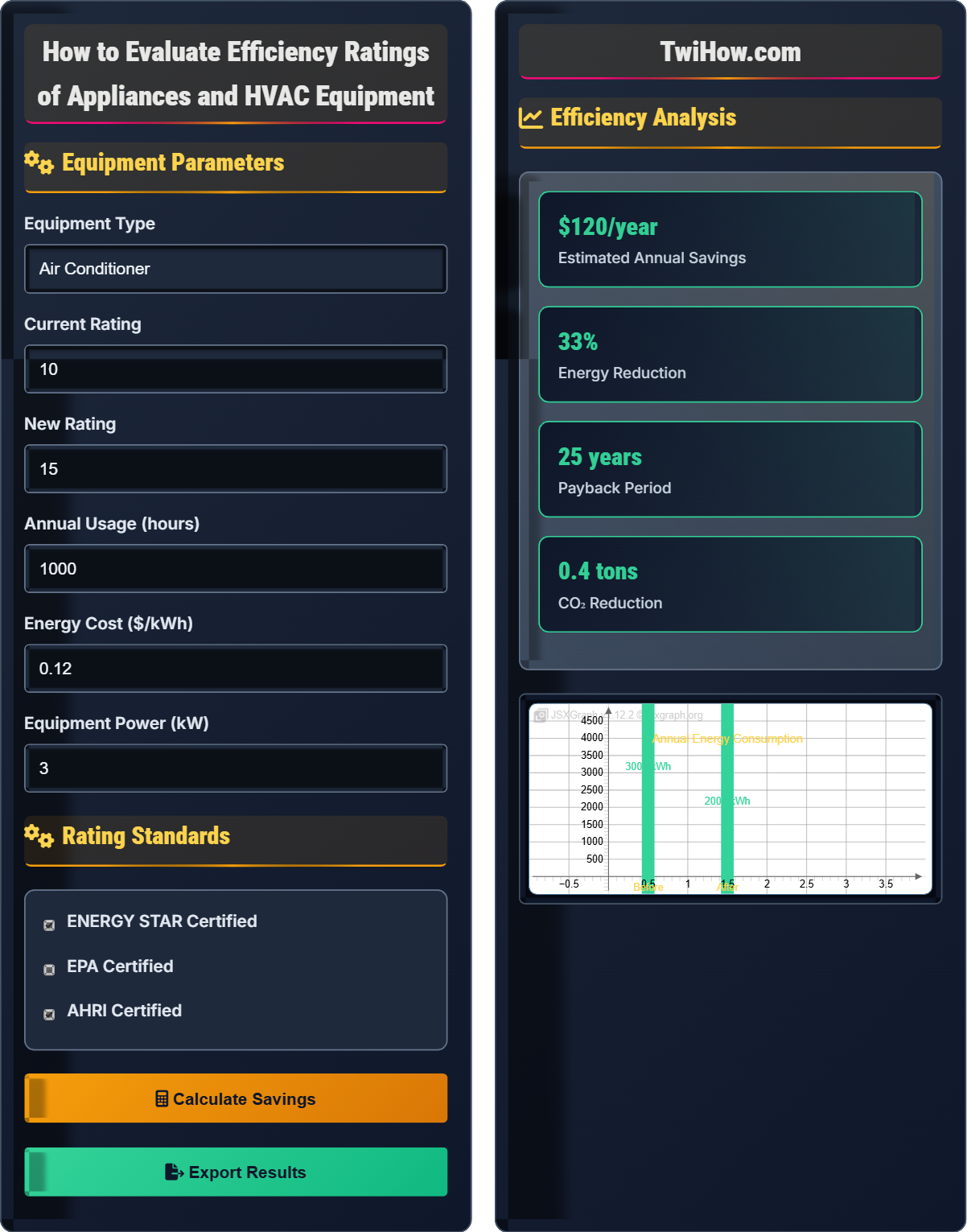
Efficiency Analysis
| Rating | Current | New | Improvement |
|---|---|---|---|
| SEER | 10.0 | 15.0 | 50% better |
| Energy Use | 3000 kWh | 2000 kWh | 33% reduction |
| Annual Cost | $360 | $240 | $120 savings |
Efficiency Rating Standards
- ENERGY STAR: Meets strict efficiency criteria set by EPA
- SEER: Seasonal Energy Efficiency Ratio for cooling equipment
- AFUE: Annual Fuel Utilization Efficiency for heating equipment
- HSPF: Heating Seasonal Performance Factor for heat pumps
- EER: Energy Efficiency Ratio for instantaneous efficiency
Minimum Standards
- Central AC: SEER ≥ 13 (ENERGY STAR ≥ 14.5)
- Heat Pumps: HSPF ≥ 8.2 (ENERGY STAR ≥ 8.5)
- Furnaces: AFUE ≥ 78% (ENERGY STAR ≥ 95%)
Efficiency Ratings Explained
ENERGY STAR is a government-backed program that identifies products meeting strict energy efficiency criteria. Products must exceed federal minimum efficiency standards by 10-50% depending on the product category.
Where the standard multiplier varies by product type and ensures superior performance compared to conventional alternatives.
Various ratios measure different aspects of HVAC performance. Each rating has specific testing protocols and applications.
Where SEER measures seasonal cooling efficiency, EER measures instantaneous efficiency, and AFUE measures heating efficiency as a percentage.
Energy savings from efficiency upgrades can be calculated using the performance improvement ratio.
Where efficiency values are expressed as ratios or percentages depending on the rating system.
Different regions prioritize different efficiency metrics based on climate and energy costs:
- Cold Climates: Prioritize AFUE for heating efficiency
- Hot Climates: Prioritize SEER and EER for cooling efficiency
- Temperate: Balanced approach with HSPF for heat pumps
- High Electricity Costs: Focus on energy consumption metrics
- High Fuel Costs: Focus on fuel utilization efficiency
Efficiency Rating Systems
SEER, EER, AFUE, HSPF, COP, ENERGY STAR, AHRI certification.
Efficiency = Useful Output / Energy Input
Higher ratios indicate better efficiency performance.
- ENERGY STAR exceeds federal standards by 10-50%
- Higher ratings generally cost more upfront
- Payback period varies by usage and cost
Rating Standards
ENERGY STAR, EPA, AHRI, DOE, CEE, and regional standards.
- Central AC: SEER ≥ 13 (ENERGY STAR ≥ 14.5)
- Heat Pumps: HSPF ≥ 8.2 (ENERGY STAR ≥ 8.5)
- Furnaces: AFUE ≥ 78% (ENERGY STAR ≥ 95%)
- Water Heaters: EF ≥ 0.67 (ENERGY STAR ≥ 0.95)
- Regional variations exist
- Standards updated periodically
- Third-party verification required
- Installation affects performance
Efficiency Ratings Quiz
What does SEER stand for and what does it measure?
SEER stands for Seasonal Energy Efficiency Ratio and measures cooling efficiency. It represents the total cooling output during a typical cooling season divided by the total energy input during the same period. Higher SEER values indicate more efficient cooling equipment.
The answer is B) Seasonal Energy Efficiency Ratio - measures cooling efficiency.
SEER measures how efficiently air conditioners and heat pumps operate over an entire cooling season, taking into account varying outdoor temperatures. A unit with SEER of 16 is more efficient than one with SEER of 13, meaning it uses less electricity to provide the same amount of cooling. Federal minimum is 13 SEER, with ENERGY STAR requiring 14.5+ SEER.
SEER: Seasonal Energy Efficiency Ratio (cooling)
Cooling Efficiency: Amount of cooling produced per unit of energy consumed
BTU: British Thermal Unit (cooling measurement)
• Higher SEER = more efficient
• Minimum SEER = 13 (federal)
• ENERGY STAR SEER ≥ 14.5
• Look for SEER 16+ for best efficiency
• Compare SEER ratings within same equipment type
• Consider climate when selecting SEER
• Confusing SEER with AFUE
• Not comparing same equipment types
• Ignoring installation quality
Explain the AFUE rating system, its significance, and calculate the AFUE for a furnace that produces 80,000 BTU of heat from 100,000 BTU of fuel input.
AFUE Definition: Annual Fuel Utilization Efficiency measures how efficiently a furnace converts fuel to heat over a typical year. It's expressed as a percentage.
Formula: AFUE = (Heat Output / Fuel Input) × 100
Calculation: AFUE = (80,000 BTU / 100,000 BTU) × 100 = 80%
This means 80% of the fuel energy becomes usable heat, while 20% is lost through exhaust gases and other losses.
Significance: Higher AFUE ratings indicate more efficient furnaces, with 80% being the federal minimum and 90%+ considered high-efficiency.
AFUE represents the efficiency of fuel-burning heating equipment. An 80% AFUE furnace means that for every dollar spent on fuel, 80 cents worth of heat reaches your home. The remaining 20 cents is lost through the flue and other inefficiencies. High-efficiency furnaces (90%+) capture more heat from exhaust gases.
AFUE: Annual Fuel Utilization Efficiency (percentage)
Fuel Efficiency: Conversion of fuel energy to useful heat
Heat Output: Usable energy delivered to home
• Minimum AFUE = 80%
• ENERGY STAR AFUE ≥ 95%
• Higher AFUE = lower fuel costs
• Look for AFUE 90%+ for best efficiency
• Consider condensing furnaces for higher AFUE
• Factor in fuel cost differences
• Confusing AFUE with cooling ratings
• Not considering installation costs
• Ignoring maintenance requirements
A homeowner is replacing an old air conditioner with SEER of 8 with a new unit with SEER of 16. The old unit consumed 4,000 kWh annually and cost $480/year to operate. Calculate the expected annual energy consumption and operating cost of the new unit, assuming the same cooling load. Also calculate the payback period if the new unit costs $3,000 more than a standard efficiency unit.
Energy Consumption Calculation:
Since efficiency doubled (SEER 8 to 16), energy consumption should halve:
New annual consumption = 4,000 kWh ÷ 2 = 2,000 kWh
Operating Cost Calculation:
Current cost: $480/year
New cost = $480 ÷ 2 = $240/year
Annual Savings:
$480 - $240 = $240/year
Payback Period:
$3,000 ÷ $240/year = 12.5 years
The new unit will consume half the energy and save $240 annually, with a payback period of 12.5 years.
This example demonstrates that doubling SEER rating approximately halves energy consumption for the same cooling output. The calculation assumes the same cooling load, which depends on climate, home insulation, and usage patterns. The payback period is quite long, so other factors like comfort and reliability should also be considered.
Cooling Load: Amount of cooling needed for space
Energy Consumption: Electricity used by equipment
Payback Period: Time to recover investment through savings
• SEER directly affects energy consumption
• Higher efficiency costs more upfront
• Payback period varies by usage
• Calculate based on actual usage patterns
• Consider tax incentives
• Factor in maintenance costs
• Assuming all efficiency gains are linear
• Not considering installation costs
• Ignoring other performance factors
A manufacturer claims their new heat pump has an HSPF of 9.0 and wants to qualify for ENERGY STAR certification. The federal minimum for heat pumps is HSPF of 8.2. Determine if this unit qualifies for ENERGY STAR, and explain the additional requirements beyond HSPF. Also calculate the efficiency improvement over the federal minimum.
ENERGY STAR Qualification:
For heat pumps, ENERGY STAR requires HSPF ≥ 8.5, so the unit with HSPF of 9.0 qualifies.
Additional Requirements:
• Must also meet minimum SEER requirements (15+)
• Third-party certification required
• Performance verified by independent testing
• Meets specific environmental criteria
• Manufacturer must participate in ENERGY STAR program
Efficiency Improvement:
(9.0 - 8.2) ÷ 8.2 × 100 = 9.8% improvement over federal minimum
(9.0 - 8.5) ÷ 8.5 × 100 = 5.9% improvement over ENERGY STAR minimum
The unit exceeds both federal and ENERGY STAR minimums.
ENERGY STAR qualification requires meeting multiple criteria, not just one rating. Heat pumps must satisfy both heating (HSPF) and cooling (SEER) efficiency standards. The certification process involves rigorous testing and verification to ensure performance claims are accurate. Manufacturers must also commit to ongoing quality assurance.
ENERGY STAR: Government efficiency certification program
HSPF: Heating Seasonal Performance Factor
Third-Party Verification: Independent testing and certification
• Multiple criteria for certification
• Independent verification required
• Standards exceed federal minimums
• Look for official ENERGY STAR logo
• Verify certification online
• Consider total cost of ownership
• Assuming any high rating qualifies
• Not verifying certification
• Confusing marketing claims with certification
What does COP (Coefficient of Performance) measure and in which type of equipment is it commonly used?
COP (Coefficient of Performance) measures heating efficiency in heat pumps and refrigeration systems. It represents the ratio of heat delivered to energy consumed. For example, a heat pump with COP of 3.0 delivers 3 units of heat for every 1 unit of electrical energy consumed.
The answer is B) Heating efficiency in heat pumps and refrigeration.
COP is a dimensionless ratio that can exceed 1.0 because heat pumps move heat rather than generate it. A COP of 3.0 means the system is 300% efficient at moving heat. This is fundamentally different from combustion efficiency which cannot exceed 100%. COP values vary with outdoor temperature, with higher values at mild temperatures.
COP: Coefficient of Performance (ratio)
Heat Pump Efficiency: Ratio of heat output to energy input
Dimensionless Ratio: Unitless efficiency measurement
• COP > 1.0 for heat pumps
• Higher COP = better efficiency
• COP varies with temperature
• Look for COP > 3.0 for good efficiency
• Consider temperature ratings
• Compare with other efficiency metrics
• Confusing COP with AFUE
• Not understanding COP can exceed 100%
• Ignoring temperature variations
FAQ
Q: How much money can I expect to save by choosing ENERGY STAR appliances?
A: ENERGY STAR appliances typically use 10-50% less energy than standard models, depending on the product category. For example:
• Refrigerators: 15% savings (about $50-100 annually)
• Air Conditioners: 20% savings (about $100-300 annually)
• Washers/Dryers: 25-40% savings (about $30-100 annually)
Actual savings depend on usage patterns, local energy costs, and how much more efficient your old equipment was. The upfront cost premium is typically recovered in 3-7 years through energy savings.
Q: What should I look for when evaluating HVAC efficiency ratings?
A: When evaluating HVAC efficiency ratings, consider:
• SEER: For cooling efficiency (minimum 13, ENERGY STAR 14.5+)
• AFUE: For heating efficiency (minimum 80%, ENERGY STAR 90%+)
• HSPF: For heat pump heating efficiency (minimum 8.2, ENERGY STAR 8.5+)
• Proper Sizing: Efficiency ratings assume proper installation and sizing
• Third-Party Certification: Verify AHRI database listing
• Climate Matching: Select ratings appropriate for your region
Remember that installation quality significantly affects actual performance.