How to Take Advantage of Rebates and Incentives for Energy Upgrades
Complete energy rebate guide • Step-by-step instructions
Energy rebates and incentives can significantly reduce the cost of home energy upgrades. Government programs, utility companies, and manufacturers offer financial assistance for installing energy-efficient appliances, solar panels, insulation, and other improvements that lower energy consumption.
Common energy upgrade incentives include:
- Tax Credits: Federal and state tax deductions for qualifying energy improvements
- Cash Rebates: Direct payments from utilities or governments
- Net Metering: Credit for excess energy generated by solar systems
- Low-Interest Loans: Financing options for energy projects
These programs help homeowners offset the upfront costs of energy-efficient upgrades while reducing long-term energy expenses.
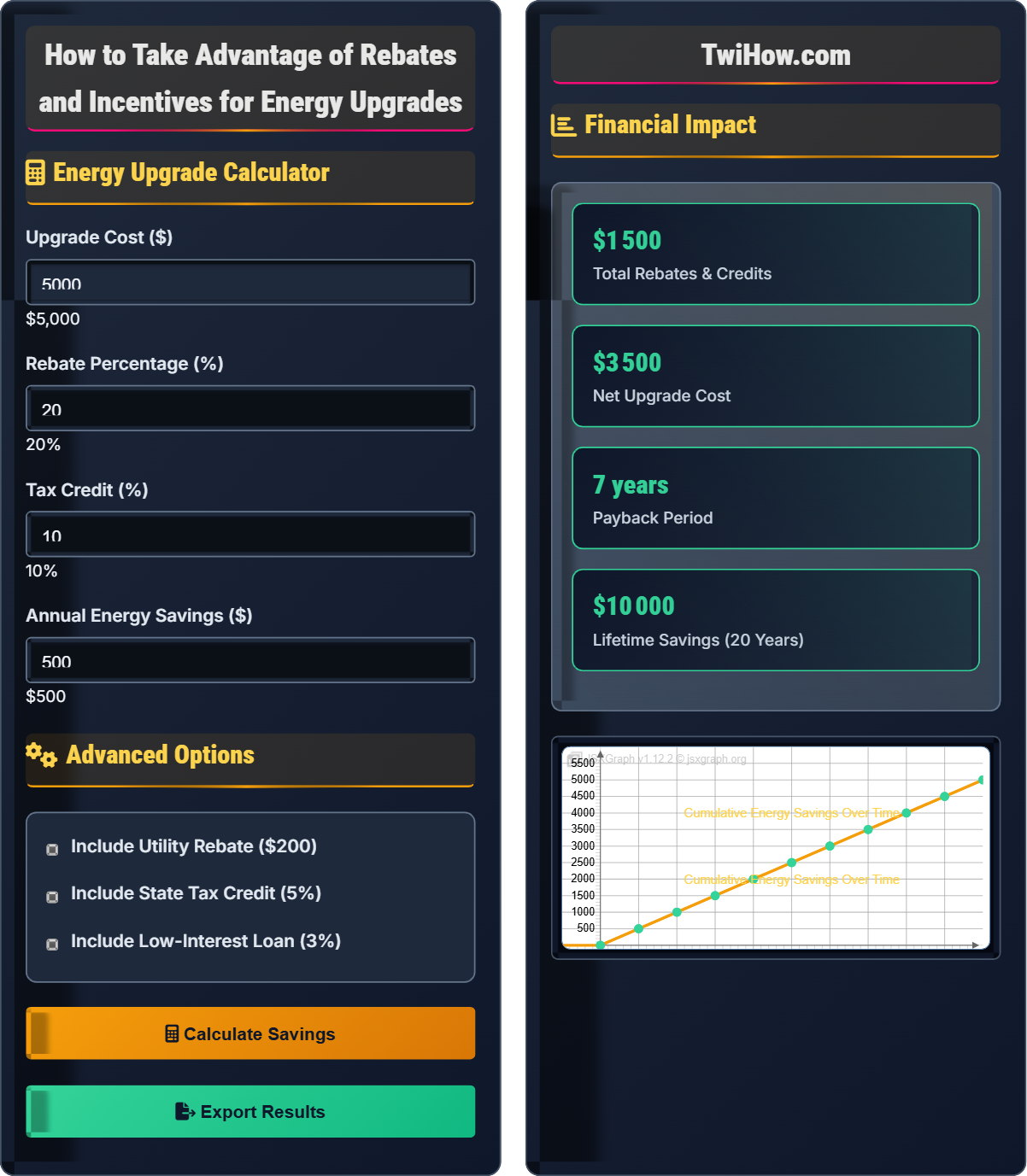
Energy Upgrade Calculator
Advanced Options
Financial Impact
| Category | Amount | % of Total |
|---|---|---|
| Base Upgrade Cost | $5,000 | 100% |
| Federal Tax Credit | $500 | 10% |
| State Rebate | $250 | 5% |
| Utility Rebate | $200 | 4% |
| Net Cost | $4,050 | 81% |
- Federal Solar Tax Credit (30% until 2032)
- ENERGY STAR Appliance Rebates
- State-Specific Efficiency Programs
- Utility Company Incentives
- Property Assessed Clean Energy (PACE) Loans
How Energy Rebates and Incentives Work
Energy rebates and incentives are financial programs designed to encourage homeowners to invest in energy-efficient upgrades. These programs are offered by federal, state, and local governments, as well as utility companies, to promote sustainability and reduce energy consumption.
Where:
- Upgrade Cost: Total cost of energy improvement project
- Rebates: Cash refunds from utilities or governments
- Tax Credits: Direct reductions in tax liability
- Annual Savings: Yearly reduction in energy bills
Common energy-efficient improvements that qualify for rebates:
- Solar Panels: Federal tax credit up to 30%
- Heat Pumps: Up to $2,000 federal tax credit
- Insulation: Various state and utility rebates
- Energy-Efficient Windows: ENERGY STAR rebates
- Smart Thermostats: Utility company discounts
- LED Lighting: Immediate rebates available
Many energy incentive programs have limited funding or expire:
- Federal Solar Tax Credit: 30% until 2032, then decreases
- Residential Clean Energy Credit: Applies to various renewable upgrades
- State Programs: Vary by location and availability
- Utility Rebates: Often first-come, first-served
Check program websites regularly for updates on availability and deadlines.
Incentive Programs
Federal tax credits, state rebates, utility incentives, net metering, PACE financing.
Net Cost = Base Cost - (Federal Credit + State Rebate + Utility Incentive)
Where Net Cost = final amount paid after incentives.
- Programs often require pre-approval
- Documentation must be preserved
- Some incentives are first-come, first-served
Maximizing Benefits
Timing installations with incentive availability, combining multiple programs, choosing high-efficiency equipment.
- Research all available programs
- Apply before installation
- Keep detailed records
- Verify contractor eligibility
- Program requirements change frequently
- Equipment must meet specific standards
- Contractors may need certification
- Processing times vary by program
Energy Rebates Quiz
As of 2023, what percentage federal tax credit is available for residential solar installations under the Inflation Reduction Act?
Under the Inflation Reduction Act, residential solar installations qualify for a 30% federal tax credit through 2032. This credit covers the total cost of the solar system, including panels, inverters, and installation.
The answer is B) 30%.
The federal solar investment tax credit (ITC) is one of the most significant incentives for homeowners considering solar installation. The 30% rate is available through 2032, after which it decreases to 26% in 2033 and 22% in 2034. Understanding these timelines is crucial for timing investments to maximize benefits.
Federal Tax Credit: Direct reduction in tax liability dollar-for-dollar
Inflation Reduction Act: 2022 legislation extending and expanding energy incentives
Investment Tax Credit (ITC): Credit for investing in solar energy systems
• Tax credits reduce taxes owed, not taxable income
• Credits may be carried forward if unused
• Equipment must meet specific standards
• Plan installations before 2032 to get 30% rate
• Consult tax professionals for claiming credits
• Combine with state and utility incentives
• Confusing tax credits with tax deductions
• Missing application deadlines
• Installing non-qualifying equipment
Explain why timing is crucial when planning energy upgrades to maximize rebates and incentives. Include specific examples of time-sensitive programs.
Timing Importance: Many energy incentive programs operate on a first-come, first-served basis or have expiration dates, making timing crucial for maximizing benefits.
Examples of Time-Sensitive Programs:
1. Federal Solar Tax Credit: Decreases from 30% (through 2032) to 26% (2033) to 22% (2034), then expires without congressional action
2. State Rebate Programs: Many states allocate limited annual budgets that deplete quickly (e.g., California's solar rebate funds often exhaust within weeks of opening)
3. Utility Incentives: Programs may have enrollment caps or seasonal restrictions
4. Manufacturer Promotions: Limited-time offers that complement government incentives
Proper timing allows homeowners to stack multiple incentives and achieve maximum cost savings.
Energy incentives are designed to drive adoption of efficient technologies while managing program costs. Governments and utilities set time limits and funding caps to control participation rates. Understanding these constraints helps homeowners plan installations to capture the highest possible value. Early planning also allows time for pre-approval processes that many programs require.
First-Come, First-Served: Programs with limited funding allocated to earliest applicants
Expiration Dates: Deadlines after which incentives are no longer available
Pre-Approval: Requirement to register before installation to qualify
• Research deadlines before starting projects
• Apply early for first-come programs
• Verify current program status
• Set calendar reminders for deadline dates
• Subscribe to program email notifications
• Plan installations during spring/summer for faster processing
• Installing before researching incentives
• Missing application deadlines
• Assuming programs are always available
Sarah is planning to install a $15,000 solar panel system. She qualifies for a 30% federal tax credit, a $1,000 state rebate, and a $500 utility incentive. Her annual electricity savings are estimated at $1,800. Calculate her net cost, effective discount, and payback period. What percentage of the original cost is covered by incentives?
Calculations:
Federal tax credit: $15,000 × 30% = $4,500
State rebate: $1,000
Utility incentive: $500
Total incentives: $4,500 + $1,000 + $500 = $6,000
Net cost: $15,000 - $6,000 = $9,000
Effective discount: ($6,000 ÷ $15,000) × 100 = 40%
Payback period: $9,000 ÷ $1,800 = 5 years
Percentage of original cost covered by incentives: 40%
This example demonstrates how multiple incentive layers can significantly reduce the effective cost of energy upgrades. The combination of federal, state, and utility incentives creates a substantial reduction in the homeowner's out-of-pocket expense. Understanding these calculations helps evaluate whether an energy investment makes financial sense.
Net Cost: Final amount paid after applying all incentives
Payback Period: Time to recover investment through savings
Effective Discount: Total savings expressed as percentage of original cost
• Add all applicable incentives together
• Subtract total incentives from original cost
• Divide net cost by annual savings for payback period
• Use online calculators to verify manual calculations
• Factor in equipment lifespan when calculating returns
• Consider increasing energy costs in future savings
• Forgetting to include all available incentives
• Calculating percentages incorrectly
• Not accounting for tax credit carryforward rules
John wants to replace his old HVAC system with an energy-efficient heat pump. He has identified three contractors offering different prices and services. Contractor A offers $8,000 installation with $1,500 in rebates processed for him. Contractor B offers $7,500 installation but leaves rebate applications to John. Contractor C offers $9,000 installation but guarantees qualification for $2,000 in rebates and tax credits. Which option provides the best value after considering rebates and processing effort? Explain your reasoning.
Analysis of Options:
Contractor A: $8,000 - $1,500 = $6,500 net cost, with convenience of handled paperwork
Contractor B: $7,500 - $1,500 = $6,000 net cost, but John must handle rebate applications
Contractor C: $9,000 - $2,000 = $7,000 net cost, with guaranteed qualification
Best Value: Contractor B offers the lowest net cost ($6,000), but requires John to handle paperwork. Contractor A offers a reasonable balance of cost ($6,500) and convenience. Contractor C costs the most despite higher rebates.
The decision depends on John's comfort with paperwork versus willingness to pay extra for convenience.
This scenario illustrates the trade-offs between cost, convenience, and certainty when selecting contractors for energy upgrades. Some contractors specialize in navigating incentive programs and may charge premium prices for handling paperwork. Others focus on installation costs but leave incentive applications to the homeowner. The optimal choice balances financial savings with personal time and expertise.
Contractor Value Proposition: Balance of price, service, and expertise
Rebate Processing: Administrative work required to claim incentives
Qualification Guarantee: Assurance that installation meets incentive requirements
• Compare net costs after incentives
• Ask contractors about incentive experience
• Request itemized quotes showing incentive values
• Verify contractor eligibility for programs
• Focusing only on installation price
• Assuming all contractors can process rebates
• Not verifying contractor credentials
Which of the following energy upgrades typically offers the fastest payback period combined with high rebate availability?
Smart thermostats typically cost $100-$300, reduce heating/cooling costs by 10-15% annually, and many utility companies offer immediate rebates of $50-$100. This results in a payback period of 1-2 years, much faster than major upgrades like solar panels (5-8 years) or insulation (3-7 years).
The answer is B) Smart thermostat installation.
Energy efficiency improvements follow a hierarchy of payback periods. Simple, low-cost measures like LED lighting and smart thermostats often provide the quickest returns on investment. Larger projects like solar installations offer greater long-term savings but require longer payback periods. Starting with quick-payback improvements builds momentum for larger investments.
Payback Period: Time to recoup investment through savings
Energy Hierarchy: Order of improvements based on cost-effectiveness
Quick Wins: Improvements with fast payback periods
• Start with low-cost, high-impact improvements
• Consider maintenance requirements
• Evaluate whole-home energy picture
• Begin with no/low-cost measures
• Stack incentives for larger projects
• Consider financing options for bigger upgrades
• Tackling expensive projects first
• Ignoring small, impactful improvements
• Not considering maintenance costs
FAQ
Q: How do I find out what energy rebates are available in my area?
A: To find available energy rebates in your area:
1. Database Searches: Use the Database of State Incentives for Renewables & Efficiency (DSIRE) at dsireusa.org
2. Utility Websites: Visit your electric/gas utility's website for customer programs
3. Government Resources: Check Energy.gov for federal incentives
4. Local Programs: Contact your city/county sustainability office
5. Manufacturer Offers: Check websites of equipment manufacturers
6. Contractor Networks: Ask certified installers about current promotions
These resources update regularly, so check back periodically for new opportunities.
Q: Can renters take advantage of energy rebates for improvements?
A: Renters face challenges accessing traditional energy rebates since most programs require property ownership. However, there are options:
Eligible Improvements: Some utilities offer rebates for renter-installed measures like programmable thermostats, weatherstripping, or LED bulbs with landlord permission.
Landlord Partnerships: Propose shared-cost improvements where both parties benefit from reduced energy bills.
Multi-Family Programs: Some utilities offer special programs for apartment buildings or complexes.
Personal Incentives: Look for manufacturer rebates on energy-efficient appliances you own.
Always verify eligibility requirements for each specific program.