How to Understand and Compare Utility Rates and Time-of-Use Pricing
Complete Utility Rate Guide • Step-by-step explanations
Utility Rate Fundamentals:
Show Rate CalculatorUnderstanding utility rates is crucial for managing energy costs. There are several types of rate structures: flat rates, tiered rates, and time-of-use (TOU) rates. TOU pricing charges different rates based on the time of day, with higher rates during peak hours and lower rates during off-peak hours.
Key concepts include:
- Base Rate: Fixed charge regardless of usage
- Usage Charge: Variable rate based on kWh consumed
- Peak Hours: Highest demand times (usually 3-9 PM weekdays)
- Off-Peak Hours: Lowest demand times (overnight, weekends)
- Demand Charges: Fees based on maximum power usage
Time-of-use rates can significantly impact your bill depending on when you use electricity. Shifting energy-intensive activities to off-peak hours can lead to substantial savings.
Rate Parameters
Rate Comparison
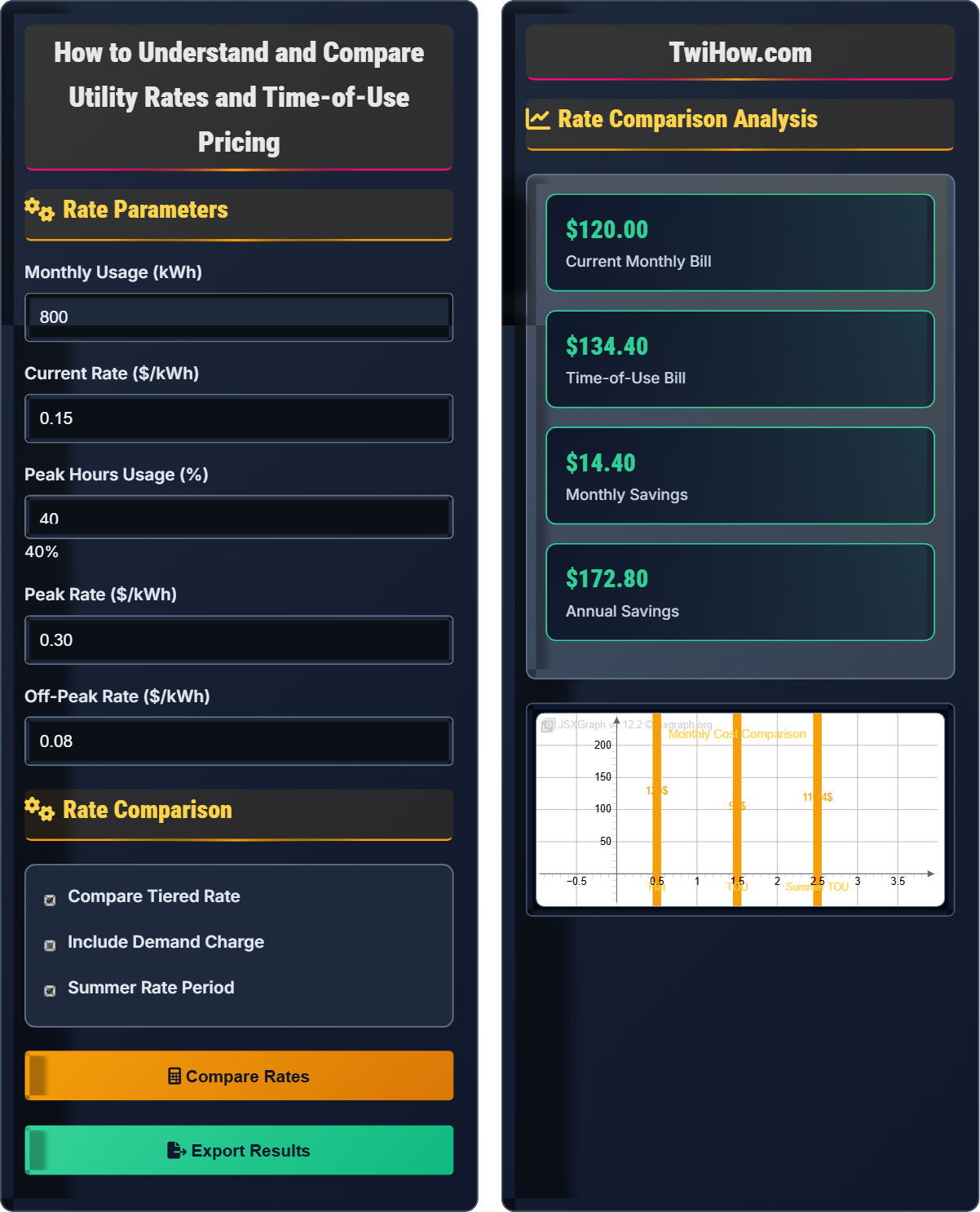
Rate Comparison Analysis
| Rate Structure | Peak Usage | Off-Peak Usage | Total Cost |
|---|---|---|---|
| Flat Rate | 800 kWh | - | $120.00 |
| Time-of-Use | 320 kWh @ $0.30 | 480 kWh @ $0.08 | $96.00 |
| Summer TOU | 320 kWh @ $0.35 | 480 kWh @ $0.10 | $110.40 |
Time-of-Use Savings Strategies
- Run dishwasher after 9 PM
- Charge electric vehicles overnight
- Use programmable thermostat to pre-cool during off-peak
- Operate washing machine and dryer during off-peak hours
- Run pool pumps during off-peak hours
Tiered Rate Optimization
- Monitor usage to stay in lower tiers
- Spread usage across days to avoid peak daily usage
- Invest in energy-efficient appliances
- Implement demand management strategies
Utility Rates and Time-of-Use Pricing Explained
Utility rates determine how much you pay for electricity. The most common structures include flat rates, tiered rates, and time-of-use rates. Each structure affects your bill differently based on your consumption patterns.
This basic formula applies to all rate structures, though the rate per unit may vary based on usage level or time of day.
Time-of-use rates charge different prices based on the time of day, with peak hours being more expensive than off-peak hours.
For example, if you use 300 kWh during peak hours at $0.30/kWh and 500 kWh during off-peak hours at $0.08/kWh, your total cost would be $130.
Tiered rates increase in price as your usage increases. The first tier has the lowest rate, and subsequent tiers have higher rates.
Where each tier has its own rate and usage limit. If you exceed a tier's limit, additional usage moves to the next tier.
Each rate structure has unique advantages and disadvantages that affect different households differently:
- Flat Rates: Simple billing, predictable costs, but no incentive to conserve
- Tiered Rates: Encourage conservation, but can penalize larger users
- Time-of-Use: Reward shifting usage to off-peak hours, but require behavioral changes
- Demand Charges: Based on peak power usage, encourage load spreading
- Real-Time Pricing: Prices fluctuate with market conditions
Rate Structure Fundamentals
Time-of-use pricing, peak hours, off-peak hours, demand charges, tiered rates, kilowatt-hour (kWh).
TOU Cost = (Peak Usage × Peak Rate) + (Off-Peak Usage × Off-Peak Rate)
Where Peak Rate > Off-Peak Rate by 2-5x during peak demand hours.
- Peak hours typically 3-9 PM weekdays
- Off-peak hours overnight and weekends
- Savings depend on usage shifting
Rate Comparison
Flat rates, tiered rates, time-of-use, demand charges, seasonal rates.
- Analyze current usage patterns
- Calculate costs under different structures
- Consider behavioral changes possible
- Factor in seasonal variations
- Household schedule flexibility
- Energy-intensive appliances
- Climate and seasonal needs
- Electric vehicle charging
Utility Rate Quiz
Which time period typically represents peak hours for time-of-use pricing?
Peak hours typically occur during the evening when demand is highest, usually from 3 PM to 9 PM on weekdays. This is when people return home from work and school, leading to increased electricity usage for lighting, cooking, and cooling.
The answer is B) 3 PM to 9 PM weekdays.
Peak hours represent the times when electricity demand is highest across the grid. During these periods, utilities must use more expensive generation sources to meet demand, which is why they charge higher rates. Understanding peak hours is crucial for maximizing savings under time-of-use pricing plans.
Peak Hours: Highest electricity demand times with highest rates
Off-Peak Hours: Lowest demand times with lowest rates
Shoulder Hours: Moderate demand times with intermediate rates
• Peak hours vary by utility
• Summer peak hours may differ
• Weekend hours often different
• Check your utility's specific peak hours
• Consider seasonal variations
• Plan energy-intensive activities accordingly
• Assuming all utilities have same peak hours
• Not accounting for seasonal differences
• Charging EVs during peak hours
Explain how tiered utility rates work and calculate the monthly cost for a customer using 1,200 kWh with the following rate structure: Tier 1: First 500 kWh at $0.12/kWh, Tier 2: Next 400 kWh at $0.15/kWh, Tier 3: Remaining kWh at $0.18/kWh.
Tiered Rate Mechanism: Tiered rates increase in price as usage increases. Each tier has a limit, and once you exceed that limit, additional usage is charged at the next tier's rate.
Calculation:
Tier 1: 500 kWh × $0.12/kWh = $60.00
Tier 2: 400 kWh × $0.15/kWh = $60.00
Tier 3: 300 kWh × $0.18/kWh = $54.00
Total Cost: $174.00
This structure encourages conservation by increasing costs as usage increases, providing economic incentives to reduce consumption.
Tiered rates are designed to promote energy conservation by making high usage progressively more expensive. The concept is similar to progressive taxation, where higher usage levels are charged at higher rates. This structure rewards efficient users with lower average rates while generating revenue from high-usage customers.
Tiered Rate: Increasing rate structure based on usage volume
Progressive Pricing: Price increases with higher consumption
Rate Tier: Usage level with specific rate and limits
• Each tier has a usage limit
• Excess moves to next tier
• Higher tiers are more expensive
• Monitor usage to stay in lower tiers
• Spread usage across billing periods
• Invest in efficiency measures
• Calculating entire usage at highest tier rate
• Not understanding tier limits
• Ignoring seasonal tier variations
A family living in California uses 1,000 kWh per month, with 50% of their usage occurring during peak hours (3 PM - 9 PM weekdays). Their utility offers two rate options: Option A (flat rate) at $0.18/kWh, and Option B (time-of-use) with peak rate at $0.35/kWh and off-peak rate at $0.10/kWh. Calculate the monthly cost for each option and determine which is more economical if they shift 20% of their peak usage to off-peak hours.
Option A (Flat Rate):
1,000 kWh × $0.18/kWh = $180.00/month
Option B (TOU) - Original Usage:
Peak: 500 kWh × $0.35/kWh = $175.00
Off-peak: 500 kWh × $0.10/kWh = $50.00
Total: $225.00/month
Option B (TOU) - With Usage Shift:
Peak: 400 kWh × $0.35/kWh = $140.00 (500 - 100)
Off-peak: 600 kWh × $0.10/kWh = $60.00 (500 + 100)
Total: $200.00/month
With usage shifting, Option B costs $200.00 vs $180.00 for Option A, so Option A is still more economical. However, if they shift more usage (e.g., to 30%), TOU could become advantageous.
This example demonstrates that time-of-use rates don't always result in savings. The effectiveness depends on both the rate differential and the ability to shift usage. In this case, the high peak rate ($0.35 vs $0.18) would require significant usage shifting to realize savings.
Rate Differential: Difference between peak and off-peak rates
Usage Shifting: Moving consumption to lower-rate periods
Behavioral Change: Modifying consumption patterns
• Savings depend on rate differential
• Calculate break-even point for TOU rates
• Consider seasonal rate variations
• Factor in convenience of usage changes
• Assuming TOU always saves money
• Not accounting for usage shifting capability
• Ignoring fixed charges in comparison
Some utilities charge demand fees based on the highest power usage (kW) during a billing period, in addition to energy charges. If a customer has a demand charge of $15/kW and reached a peak demand of 8 kW during the month, calculate the total monthly bill including: demand charge, 1,000 kWh at $0.12/kWh, and a $10 monthly service fee.
Demand Charge:
8 kW × $15/kW = $120.00
Energy Charge:
1,000 kWh × $0.12/kWh = $120.00
Service Fee:
$10.00
Total Monthly Bill:
$120.00 + $120.00 + $10.00 = $250.00
Strategies to Reduce Demand Charges:
1. Stagger startup of high-power appliances
2. Use programmable controls to avoid simultaneous operation
3. Install energy storage systems to smooth demand
4. Upgrade to more efficient equipment
Demand charges can represent a significant portion of the bill, especially for commercial customers.
Demand charges reflect the utility's cost to maintain sufficient capacity to meet peak demand. Even if you use little total energy, high peak demand requires the utility to maintain expensive generation and transmission capacity. This structure incentivizes customers to spread out their usage rather than consuming large amounts simultaneously.
Demand Charge: Fee based on peak power usage during billing period
Kilowatt (kW): Measure of power (rate of energy use)
Kilowatt-hour (kWh): Measure of energy (power used over time)
• Demand charges based on peak usage
• Can be very expensive per kW
• Applies even if peak is brief
• Monitor demand throughout the month
• Stagger high-power appliances
• Consider load management systems
• Confusing kW with kWh
• Not understanding demand charge timing
• Starting multiple high-power devices simultaneously
Which factor has the greatest impact on whether time-of-use pricing will save money?
The peak-to-off-peak rate differential has the greatest impact on TOU savings potential. The larger the difference between peak and off-peak rates, the more money can be saved by shifting usage. For example, a differential of $0.25/kWh (peak $0.35, off-peak $0.10) offers much greater savings potential than a differential of $0.05/kWh (peak $0.18, off-peak $0.13).
The answer is B) Peak-to-off-peak rate differential.
The rate differential determines the economic incentive for shifting usage. A small differential provides minimal savings even with perfect usage shifting, while a large differential can yield substantial savings with modest behavioral changes. This is why utilities with high renewable energy penetration (which causes variable wholesale prices) often have the most attractive TOU rates.
Rate Differential: Difference between peak and off-peak rates
Price Signal: Rate structure that influences consumer behavior
Economic Incentive: Financial motivation to change behavior
• Larger differential = more savings potential
• Savings depend on shifting capability
• Fixed charges affect overall savings
• Calculate rate differential before switching
• Assess household flexibility
• Consider all rate components
• Focusing only on peak rate
• Not considering off-peak rate
• Ignoring other rate components
FAQ
Q: Is time-of-use pricing always better than flat rates?
A: No, time-of-use pricing is not always better than flat rates. The effectiveness depends on several factors:
• The rate differential between peak and off-peak hours
• Your current usage patterns
• Your ability to shift usage to off-peak hours
• The presence of fixed charges
If your current usage is already aligned with off-peak hours, or if the rate differential is small, flat rates might be more economical. Always calculate your specific situation before switching.
Q: How do I find out what my current utility rate is?
A: You can find your utility rate information in several ways:
• Check your monthly utility bill - the rate is usually listed on the first page
• Visit your utility's website and look for "rates" or "tariffs"
• Call your utility's customer service directly
• Download your utility's mobile app
• Request a rate analysis from your utility
Your bill will show the rate name, rate structure (flat, tiered, TOU), and component charges (fixed, usage, demand, etc.). Understanding these details is crucial for accurate rate comparisons.