How to Understand and Participate in Demand Response Programs
Complete energy efficiency guide • Step-by-step participation
Demand Response Programs:
Show DR SimulatorDemand response (DR) programs are initiatives offered by utilities and energy providers that reward customers for reducing electricity consumption during peak demand periods. These programs help balance the electrical grid, reduce strain on power plants, and lower overall energy costs.
Participation involves temporarily reducing or shifting energy usage during specified times, typically during hot summer afternoons or cold winter evenings when electricity demand is highest. Participants receive financial incentives for their contribution to grid stability.
Key benefits include:
- Financial Rewards: Payments and bill credits for participating
- Grid Stability: Helping prevent blackouts and brownouts
- Environmental Impact: Reducing need for fossil fuel peaker plants
- Energy Independence: Contributing to sustainable energy management
Modern demand response programs often leverage smart thermostats, automated systems, and mobile apps to make participation seamless and convenient.
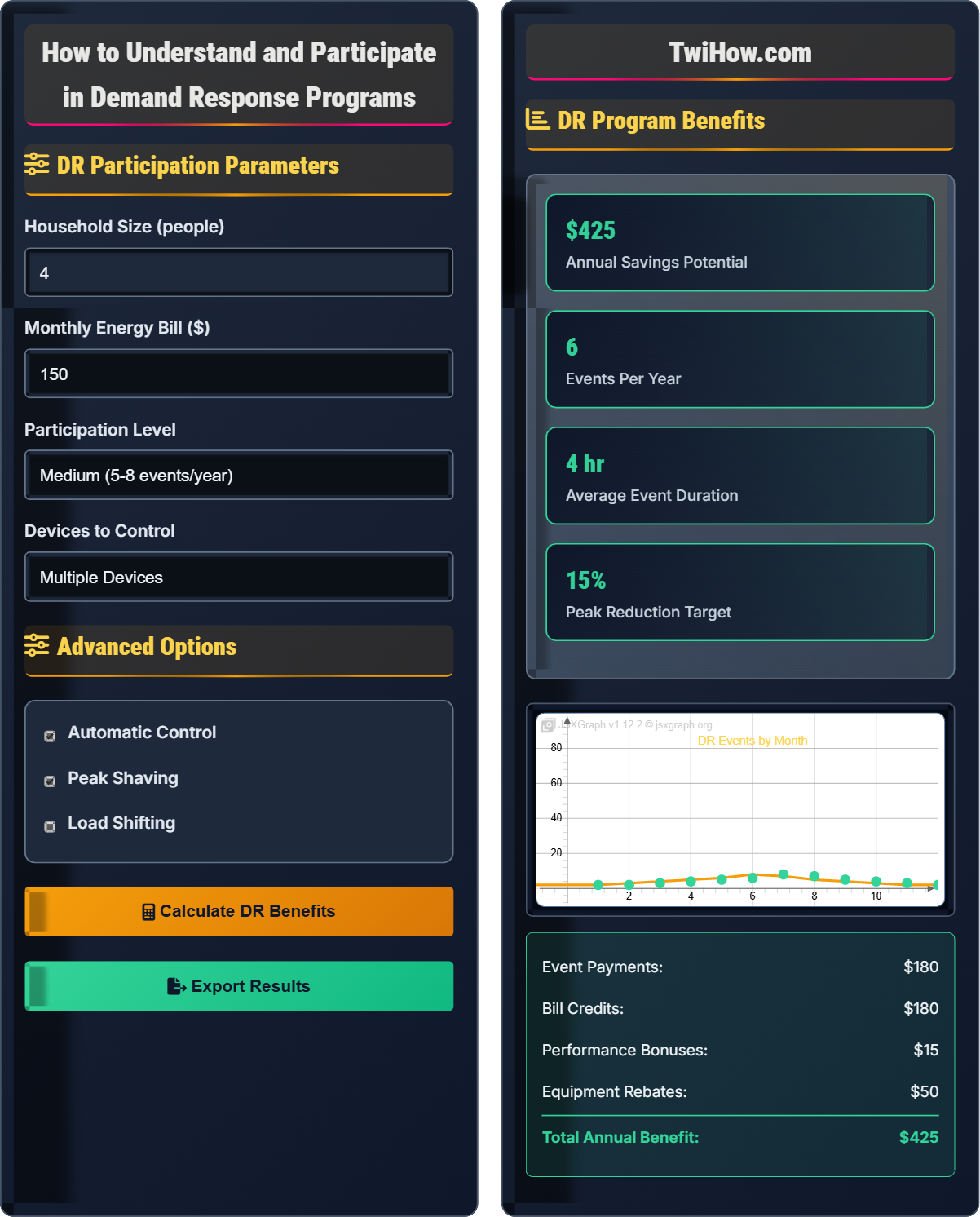
DR Participation Parameters
Advanced Options
DR Program Benefits
| Program Type | Payment | Reduction | Frequency |
|---|---|---|---|
| Cooling Curtailment | $30/event | 2kW | 4x/year |
| Peak Shaving | $20/event | 1.5kW | 2x/year |
| Emergency DR | $50/event | 3kW | 1x/year |
Payment: $30 event payment + $15 bill credit
Payment: $35 event payment + $20 bill credit
Understanding Demand Response
Demand response (DR) is a mechanism where electricity consumers modify their usage patterns in response to price signals or incentives from utilities. During periods of high electricity demand—typically hot summer afternoons or cold winter evenings—utilities offer financial incentives to customers who agree to reduce their energy consumption.
DR programs help maintain grid stability, defer infrastructure investments, and reduce reliance on expensive and polluting peaker power plants. They are an integral part of modern smart grid operations and energy management strategies.
Where:
- Event Count: Number of DR events participated in
- Payment per Event: Fixed amount paid for participation
- Bill Credit: Percentage reduction in monthly bill
Effective demand response strategies include:
- Thermal Setpoint Adjustment: Modifying HVAC temperatures during events
- Load Shedding: Temporarily shutting off non-essential equipment
- Load Shifting: Moving energy-intensive tasks to off-peak hours
- On-Site Generation: Using backup generators or battery systems
- Smart Device Control: Automating device operation during events
- Direct Load Control: Utility controls specific devices remotely
- Incentive-Based: Customers receive payments for voluntary reductions
- Time-of-Use Pricing: Dynamic rates encourage off-peak usage
- Critical Peak Pricing: Very high rates during peak events
- Emergency DR: Voluntary reductions during grid emergencies
Benefits of DR Participation
Participation Timeline
Demand Response Learning Quiz
Which type of demand response program allows utilities to directly control customer equipment?
Direct Load Control (DLC) programs allow utilities to remotely control specific customer equipment such as air conditioners, pool pumps, or water heaters during peak demand periods. This type of program provides utilities with predictable load reduction.
The answer is B) Direct Load Control.
Understanding different types of demand response programs helps participants choose the option that best fits their lifestyle and comfort preferences. Direct Load Control offers the highest reliability for utilities but requires participants to surrender some control over their equipment. Other programs offer more flexibility but less predictable load reductions.
Direct Load Control: Program where utility has remote access to customer equipment
Time-of-Use Pricing: Dynamic rates based on time of day
Critical Peak Pricing: Very high rates during peak events
• DLC requires customer consent for equipment access
• Equipment returns to normal operation after events
• Participants receive compensation for inconvenience
• Review program terms carefully before enrolling
• Consider which equipment you're comfortable controlling
• Compare payment structures across programs
• Confusing DLC with voluntary programs
• Not understanding equipment limitations
• Overlooking notification timing requirements
Explain the environmental benefits of demand response programs and how they contribute to sustainability goals.
Environmental Benefits: Demand response programs significantly reduce the need for fossil fuel-powered peaker plants that operate only during periods of high electricity demand. These plants are typically older, less efficient, and produce higher emissions per unit of electricity compared to base-load power plants.
Contribution to Sustainability: By reducing peak demand, DR programs help defer the construction of new power plants and transmission infrastructure. They also support the integration of renewable energy sources by providing flexible load that can be reduced when renewable generation is low.
Carbon Reduction: Studies show that DR programs can reduce carbon emissions by 0.5-2.0 tons per MW of peak demand reduced annually.
Environmental benefits of DR are often overlooked but are crucial for understanding the full value proposition. DR complements renewable energy by providing demand-side flexibility that helps balance variable generation from wind and solar. This creates a more resilient and sustainable energy system.
Peaker Plants: Power plants used only during high demand periods
Base-load Plants: Power plants operating continuously
Renewable Integration: Incorporating variable renewable sources into grid
• Peaker plants have higher emissions than base-load plants
• DR reduces need for new infrastructure
• Environmental benefits increase with program scale
• Look for utilities with strong sustainability commitments
• Consider programs that support renewable energy
• Track your personal environmental impact
• Underestimating environmental benefits
• Not considering long-term sustainability impacts
• Ignoring utility environmental reporting
A household participates in a demand response program offering $35 per event plus 10% bill credit. The program runs 8 events per year, each lasting 4 hours. The household's average monthly bill is $180. Calculate the annual financial benefit and determine the percentage return on investment if the smart thermostat costs $250.
Event Payments: 8 events × $35 = $280
Bill Credits: 10% × $180 × 12 months = $216
Total Annual Benefit: $280 + $216 = $496
ROI Calculation: ($496 - $250) / $250 × 100% = 98.4%
The household receives $496 in annual benefits with a 98.4% return on the $250 thermostat investment. The payback period is approximately 6 months.
Financial analysis of DR programs should consider both direct payments and ongoing bill credits. The ROI calculation demonstrates that DR participation can provide significant returns on smart device investments, making it financially attractive for many households.
Return on Investment (ROI): Gain/loss relative to investment cost
Payback Period: Time to recover initial investment
Bill Credit: Percentage reduction in monthly bills
• Always calculate total annual benefits
• Include equipment costs in ROI
• Consider program longevity
• Factor in equipment rebates
• Consider maintenance savings
• Account for increasing program values
• Only calculating event payments
• Forgetting to include bill credits
• Not accounting for equipment costs
A family of four lives in a 2,500 sq ft home with central air conditioning, electric water heater, and dishwasher. They work during the day (9 AM - 5 PM). Develop a demand response strategy that maximizes benefits while minimizing comfort disruption during summer peak events (2-6 PM).
Pre-Event Preparation: Set programmable thermostat to pre-cool home to 70°F before 2 PM. Run dishwasher and other high-energy appliances before peak period.
During Event (2-6 PM): Raise thermostat to 78°F (still comfortable), turn off pool pump, delay laundry until evening. Use ceiling fans to maintain comfort at higher temperature.
Post-Event: Resume normal operations and take advantage of cooler evening temperatures for additional cooling. Schedule weekly deep cleaning during off-peak hours.
Expected Reduction: 2-3 kW during peak hours with minimal comfort impact.
Effective DR strategy planning requires understanding household schedules, energy usage patterns, and comfort tolerance levels. The key is to shift loads rather than simply reducing them, which provides greater flexibility and maintains quality of life.
Load Shifting: Moving energy use to different time periods
Pre-cooling: Cooling space before peak period
Thermal Mass: Building's ability to store coolness
• Plan ahead for maximum effectiveness
• Maintain comfort during events
• Use thermal mass strategically
• Install programmable thermostats for automation
• Use timers for non-smart devices
• Keep blinds closed during peak hours
• Starting preparations too late
• Sacrificing too much comfort
• Not considering all controllable loads
Which of the following is the most significant challenge for residential demand response participation?
Comfort concerns are the most significant barrier to residential DR participation. Many homeowners are reluctant to compromise their comfort during peak events, especially during extreme weather conditions. While equipment costs and payment amounts matter, the psychological barrier of giving up comfort often prevents participation.
The answer is B) Comfort concerns.
Understanding barriers to adoption is crucial for successful DR program design. Modern programs address comfort concerns through smart thermostats, gradual adjustments, and customer education. Success depends on finding the balance between grid needs and consumer preferences.
Comfort Tolerance: Acceptable range of temperature variation
Behavioral Change: Adjusting habits for DR participation
User Adoption: Willingness to participate in programs
• Comfort concerns drive participation decisions
• Smart technology can minimize discomfort
• Gradual adaptation increases acceptance
• Start with minimal adjustments
• Use fans to enhance comfort at higher temps
• Focus on non-essential loads first
• Overestimating comfort sacrifices
• Not leveraging smart technology
• Ignoring individual comfort preferences
FAQ
Q: How do I know if my utility offers demand response programs?
A: Most major utilities offer demand response programs, though availability varies by region. Check your utility's website under "Energy Efficiency," "Customer Programs," or "Smart Grid." You can also call their customer service line directly. Many utilities have dedicated DR program pages with enrollment information, eligibility requirements, and contact details.
Look for programs like "Cool California," "Save-a-Watt," or "PeakRewards" depending on your utility. Some programs may require specific equipment like smart thermostats, while others work with standard programmable models.
Q: Can renters participate in demand response programs?
A: Yes, renters can participate in demand response programs in most cases. Many programs focus on portable devices like smart thermostats that renters can install themselves (with landlord permission). Some utilities offer programs specifically for renters with no installation required.
However, if the program requires permanent installations like smart meters or hardwired devices, you'll need landlord approval. Some landlords participate in DR programs for their rental properties and share the benefits with tenants through lower utility allowances.