What are the Benefits of Smart Thermostats and Home Energy Monitors?
Complete Energy Management Guide • Step-by-step explanations
Smart Home Energy Management:
Show Energy Savings CalculatorSmart thermostats and home energy monitors are revolutionary technologies that help homeowners manage energy consumption, reduce utility bills, and enhance comfort. Smart thermostats automatically adjust temperatures based on schedules, occupancy, and weather forecasts, while energy monitors track real-time power usage to identify inefficiencies.
Key benefits include:
- Energy Savings: Reduce heating and cooling costs by 10-15%
- Remote Control: Adjust settings from anywhere via smartphone
- Learning Capabilities: Adapt to household routines automatically
- Real-Time Monitoring: Track energy usage patterns
- Environmental Impact: Reduce carbon footprint
Modern smart devices integrate with home automation systems, providing comprehensive energy management solutions that adapt to changing needs and preferences.
Energy Parameters
Device Preferences
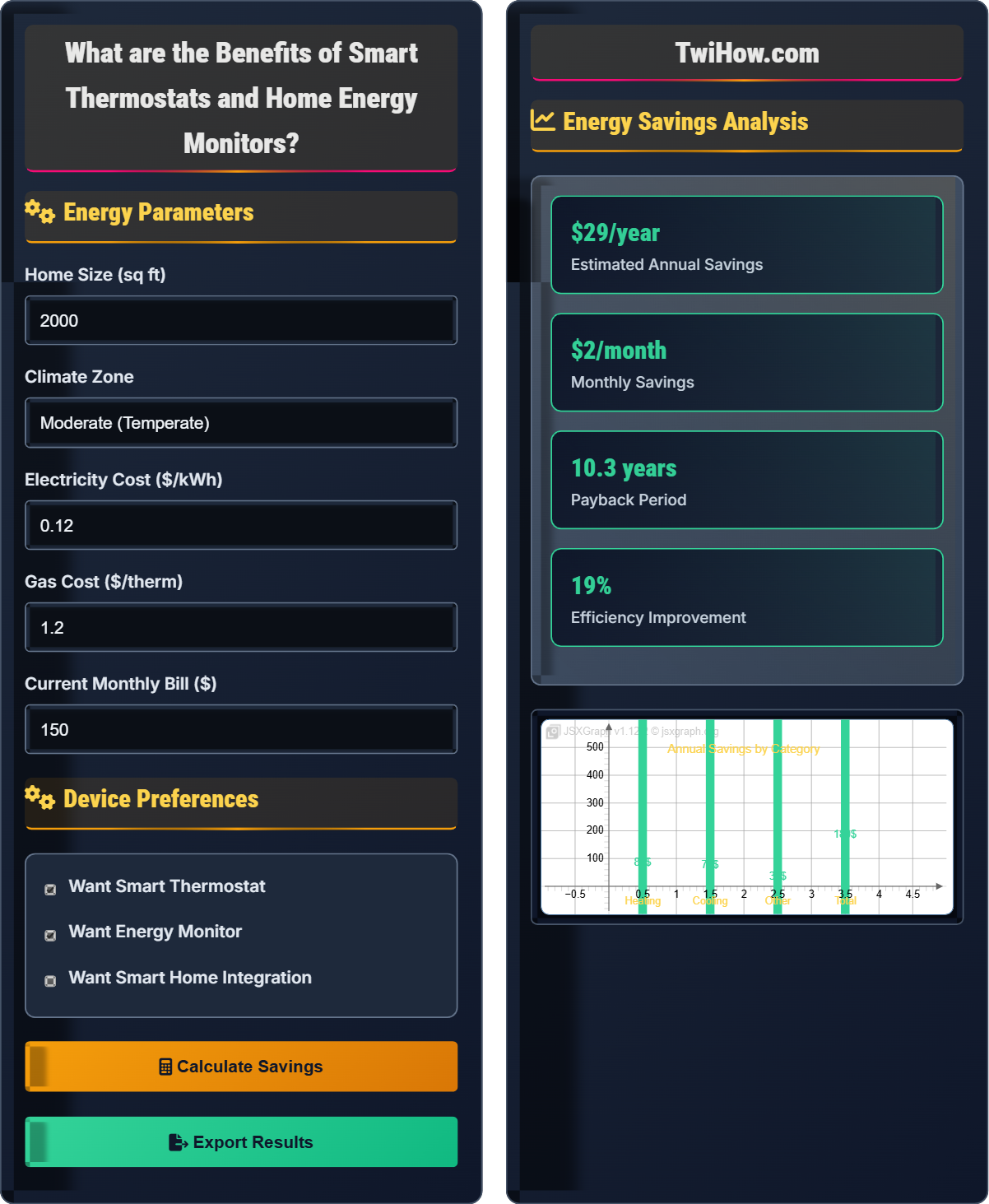
Energy Savings Analysis
| Category | Current Cost | New Cost | Savings |
|---|---|---|---|
| Heating | $600 | $520 | $80 |
| Cooling | $450 | $380 | $70 |
| Other HVAC | $100 | $70 | $30 |
| Total | $1,150 | $970 | $180 |
Smart Thermostat Benefits
- Automatic scheduling and learning
- Remote access via smartphone
- Weather-based adjustments
- Energy usage reports
- Integration with smart home systems
Home Energy Monitor Benefits
- Real-time energy consumption tracking
- Appliance-level monitoring
- Identify energy waste
- Historical usage trends
- Alerts for unusual consumption
Smart Thermostats and Energy Monitors Explained
Smart thermostats use sensors, algorithms, and connectivity to optimize home heating and cooling. They learn household patterns and adjust temperatures automatically for maximum efficiency.
Where Efficiency Factor typically ranges from 0.10 to 0.15 (10-15% savings) for smart thermostats. The formula helps estimate potential savings based on current consumption patterns.
Energy monitors measure real-time electricity usage and provide detailed insights into consumption patterns. They help identify the largest energy consumers in a home.
Monitors continuously measure voltage and current to calculate real-time power consumption. Advanced models can identify specific appliances based on their unique electrical signatures.
Energy savings depend on several factors including home size, climate, and usage patterns. The payback period helps determine the financial viability of the investment.
Typical smart thermostats cost $150-$300, with average annual savings of $100-$200, resulting in payback periods of 1-3 years.
Smart thermostats typically deliver consistent energy savings across different seasons and climates. Performance varies based on home characteristics and user behavior.
- Heating Savings: 10-12% reduction in winter heating costs
- Cooling Savings: 15-20% reduction in summer cooling costs
- Overall Savings: 10-15% reduction in total HVAC energy use
- Comfort Level: Maintains consistent temperatures with improved scheduling
- Convenience: Remote access and automatic adjustments
Smart Home Energy Benefits
Smart thermostat, energy monitor, automation, scheduling, learning algorithms, IoT integration.
Annual Savings = (Current Consumption × Efficiency Factor) × Utility Rate
Where Efficiency Factor = 0.10-0.15 for smart thermostats.
- Smart thermostats save 10-15% on HVAC costs
- Payback period typically 1-3 years
- Energy monitors help identify waste
Device Comparison
Smart thermostats control HVAC systems; energy monitors track consumption patterns.
- Smart Thermostat: Automatic scheduling and optimization
- Energy Monitor: Detailed consumption insights
- Combined: Comprehensive energy management
- Smart Home: Automation and convenience
- Compatibility with existing systems
- Installation complexity
- Learning curve
- Data privacy
Energy Management Quiz
On average, what percentage of HVAC energy costs can a smart thermostat save?
Smart thermostats typically save 10-15% on HVAC energy costs by optimizing temperature settings based on occupancy, weather forecasts, and learned schedules. This translates to approximately $100-$200 in annual savings for the average home.
The answer is B) 10-15%.
The energy savings from smart thermostats come from eliminating unnecessary heating and cooling when homes are unoccupied. By automatically adjusting temperatures during these periods, smart thermostats prevent energy waste while maintaining comfort when people are home. The savings vary based on climate, home size, and initial thermostat settings.
HVAC: Heating, Ventilation, and Air Conditioning systems
Energy Savings: Reduction in energy consumption through optimization
Occupancy-Based Control: Adjusting temperature based on presence
• Savings depend on usage patterns
• Higher savings in extreme climates
• Set appropriate setback temperatures
• Enable weather compensation
• Review usage reports regularly
• Setting setbacks too extreme
• Not enabling learning features
• Ignoring energy reports
Explain how home energy monitors help identify energy waste and provide specific examples of what they can detect.
Energy Monitoring Process: Energy monitors measure real-time electricity usage and analyze patterns to identify inefficiencies. They provide detailed breakdowns of consumption by appliance and time of day.
Examples of Waste Detection:
• Identifying always-on appliances that consume standby power
• Detecting HVAC systems running inefficiently
• Showing peak usage times for rate optimization
• Alerting to unusual consumption patterns indicating problems
• Revealing seasonal variations in energy use
By providing granular data, energy monitors empower homeowners to make targeted improvements that maximize savings.
Energy monitors act like a diagnostic tool for home electricity usage. They reveal the "hidden" energy consumers that many homeowners aren't aware of, such as phantom loads from electronics in standby mode. The detailed data allows for targeted interventions that address the biggest sources of waste first.
Phantom Load: Electricity consumed by devices in standby mode
Granular Data: Detailed, specific information
Peak Demand: Highest energy usage periods
• Monitor for at least 30 days for accurate baseline
• Focus on largest consumption items first
• Compare usage across seasons
• Look for appliances that run continuously
• Check for seasonal variations
• Compare usage to similar homes
• Not monitoring long enough for patterns
• Focusing on small instead of large consumers
• Ignoring seasonal variations
A family of four lives in a 2,500 sq ft home in Phoenix, Arizona. Their monthly electricity bill averages $180, with about 60% attributed to cooling costs. They're considering a smart thermostat and energy monitor. Calculate their potential annual savings and explain why these devices would be particularly beneficial in their climate.
Current Cooling Costs: $180 × 0.60 = $108/month or $1,296/year
Potential Cooling Savings: $1,296 × 0.18 (18% savings for cooling) = $233/year
Total HVAC Savings: Approximately $280/year (including some heating savings)
Additional Savings from Energy Monitor: $50-$100/year from identifying other waste
Total Potential Savings: $330-$380/year
Climate Benefits: In hot climates like Phoenix, cooling costs are substantial, making smart thermostats particularly valuable. The ability to pre-cool before peak demand hours and avoid overheating during the day maximizes savings. Smart thermostats can also prevent the common issue of overcooling when nobody's home during the day.
In hot climates, the majority of energy costs come from cooling, making smart thermostats especially valuable. The ability to schedule pre-cooling during off-peak hours and maintain comfortable temperatures during peak occupancy maximizes both comfort and efficiency. The energy monitor would help identify other significant consumers like pool pumps, water heaters, and electronics.
Peak Demand Hours: Times when electricity rates are highest
Pre-Cooling: Cooling home before peak heat of day
Setback Temperature: Reduced heating/cooling when away
• Savings are proportional to current costs
• Hot climates favor cooling optimization
• Combined devices maximize benefits
• Schedule pre-cooling before afternoon
• Use fan mode strategically
• Consider time-of-use rates
• Not accounting for climate-specific savings
• Ignoring time-of-use rate opportunities
• Overestimating cooling-only savings
A homeowner wants to integrate their smart thermostat with other smart home devices (security system, lighting, occupancy sensors). Explain how this integration can enhance energy savings and provide specific examples of coordinated actions.
Integration Benefits: Coordinated smart home systems can achieve greater energy savings than individual devices by sharing data and coordinating actions.
Specific Examples:
1. Occupancy-Based Control: Security system detects when home is empty and signals thermostat to enter setback mode
2. Window/Door Alerts: When doors open, thermostat temporarily pauses cooling to prevent energy waste
3. Lighting Coordination: When lights turn off in a room, thermostat can reduce heating/cooling to that area
4. Weather Integration: Smart weather stations provide hyperlocal data for more precise adjustments
5. Vacation Mode: All systems coordinate for maximum efficiency during extended absences
This integration can increase total savings by an additional 5-10% beyond standalone smart thermostat savings.
Smart home integration creates a synergistic effect where the whole is greater than the sum of its parts. Individual devices make decisions based on limited information, but integrated systems share data to make more intelligent decisions. For example, knowing when someone is approaching home allows the system to begin conditioning the house just before arrival.
Smart Home Integration: Devices communicating and coordinating
Synergistic Effect: Combined benefits exceeding individual benefits
Hyperlocal Weather: Weather data specific to exact location
• Ensure device compatibility
• Protect data privacy
• Start with basic integration
• Use platforms like HomeKit or SmartThings
• Create automations gradually
• Monitor for unexpected behaviors
• Overcomplicating automation rules
• Not considering privacy implications
• Integrating incompatible devices
What is the typical payback period for a smart thermostat?
The typical payback period for a smart thermostat is 1-3 years. With device costs ranging from $150-$300 and average annual savings of $100-$200, the investment typically pays for itself within this timeframe. In homes with higher energy costs or extreme climates, payback can be faster.
The answer is B) 1-3 years.
The payback period is calculated by dividing the device cost by annual savings. For a $200 thermostat saving $150/year, the payback is 1.33 years. The actual period varies based on climate, home size, energy rates, and initial usage patterns. Homes with older, inefficient systems typically see faster payback.
Payback Period: Time to recover initial investment
Return on Investment: Financial benefit relative to cost
Net Present Value: Total value considering time value of money
• Higher energy costs = faster payback
• Extreme climates = faster payback
• Older systems = faster payback
• Calculate your specific payback
• Consider utility rebates
• Factor in comfort benefits
• Ignoring comfort benefits in ROI
• Not considering rebates
• Using national averages for local calculations
FAQ
Q: Will a smart thermostat really save me money, or is it just a gimmick?
A: Smart thermostats are definitely not a gimmick. Studies consistently show 10-15% savings on HVAC energy costs. The savings come from:
• Automatically adjusting temperatures when you're away
• Learning your schedule and preferences
• Weather-based adjustments to optimize efficiency
• Preventing overheating or overcooling during unoccupied periods
For an average home spending $1,000/year on heating and cooling, that's $100-$150 in annual savings, with most thermostats costing $200-$300, meaning a 1.5-3 year payback period.
Q: How do home energy monitors work and what can they tell me that my utility bill doesn't?
A: Home energy monitors measure electricity usage in real-time (every second or minute) rather than monthly totals like utility bills. They can tell you:
• Which appliances use the most energy and when
• Real-time consumption during different activities
• Phantom loads from devices in standby mode
• How weather affects your energy use
• Identify problems like a failing refrigerator or HVAC system
While your bill shows you spent $150 this month, a monitor shows you that your old refrigerator is consuming $40/month and running inefficiently, allowing targeted improvements.