What are the Best Practices for Efficient Lighting and Appliance Use?
Complete efficiency guide • Step-by-step practices
Efficient lighting and appliance use can reduce household energy consumption by 20-30%. By choosing ENERGY STAR certified products, optimizing usage patterns, and implementing smart controls, homeowners can significantly lower utility bills while maintaining comfort and convenience.
Key best practices include:
- LED Lighting: Use 75-80% less energy than incandescent bulbs
- ENERGY STAR Appliances: Up to 50% more efficient than standard models
- Smart Controls: Timers, sensors, and automation for optimal operation
- Load Management: Run high-energy appliances during off-peak hours
- Regular Maintenance: Keep appliances running efficiently
These practices not only save money but also extend equipment life and reduce environmental impact.
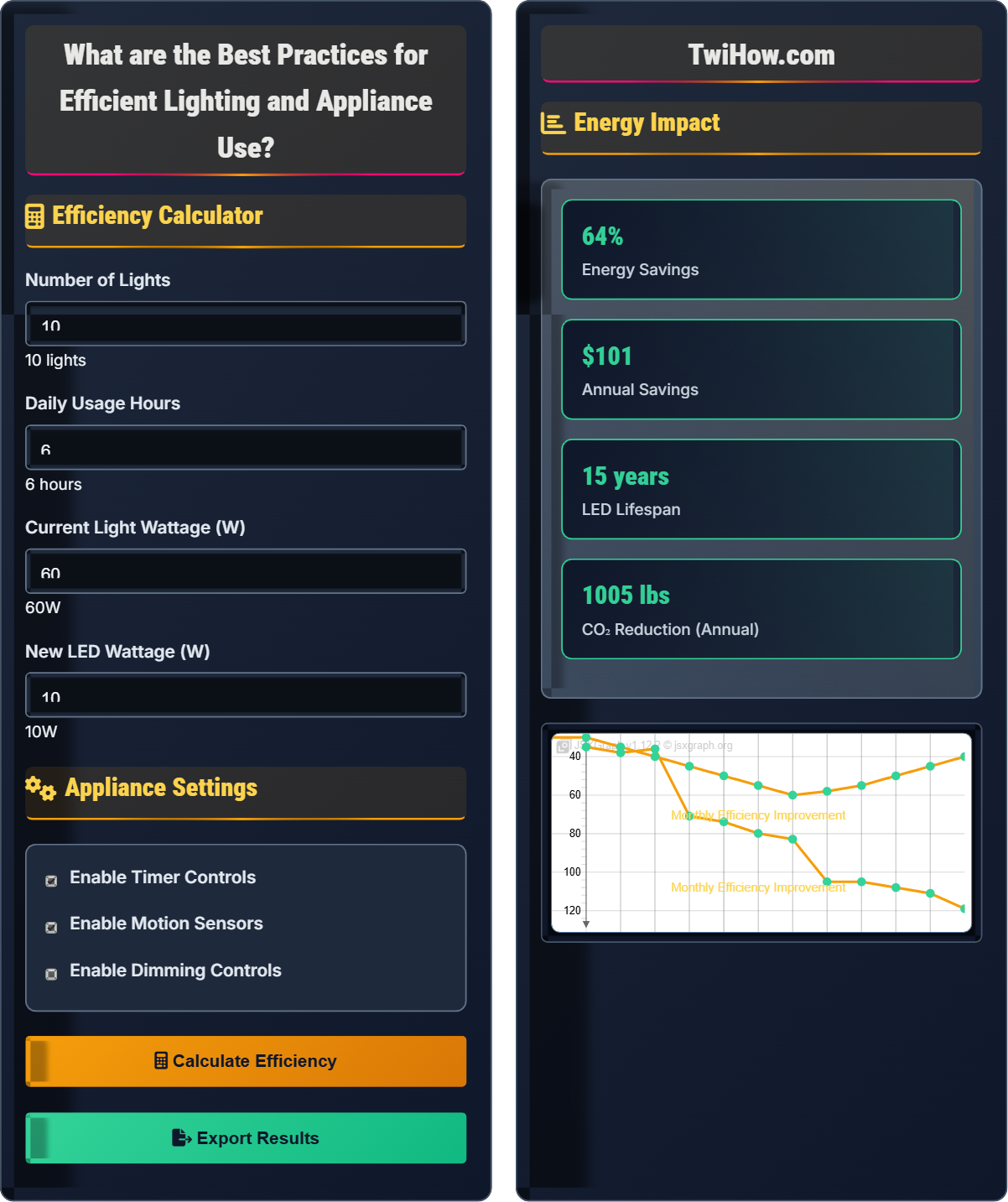
Efficiency Calculator
Appliance Settings
Energy Impact
| Item | Current | New | Savings |
|---|---|---|---|
| Power Consumption | 600W | 100W | 83% |
| Daily Usage | 60 kWh | 10 kWh | 83% |
| Annual Cost | $72 | $12 | $60 |
| Lifespan | 1 year | 15 years | 14 years |
| CO₂ Emissions | 2,700 lbs | 450 lbs | 2,250 lbs |
- Replace all incandescent bulbs with LED equivalents
- Install occupancy sensors in less-used rooms
- Use dimmers for ambient lighting control
- Turn off lights when leaving rooms
- Maximize natural daylight during daytime
How Efficient Lighting and Appliance Use Works
Energy efficiency in lighting and appliances is measured by how effectively they convert electrical energy into useful output. Efficient devices deliver the same or better performance while consuming less power. This is achieved through advanced technologies, improved designs, and better materials.
Where:
- Power: Electrical consumption in watts (W) or kilowatts (kW)
- Electricity Rate: Cost per kilowatt-hour (typically $0.10-0.20/kWh)
- Annual Energy: Total consumption over one year
- Energy Savings: Percentage reduction in consumption
Comparison of lighting technologies:
- Incandescent: 10-15 lumens/watt, 1,000 hour lifespan
- Halogen: 15-25 lumens/watt, 2,000-4,000 hour lifespan
- CFL: 50-70 lumens/watt, 8,000-10,000 hour lifespan
- LED: 80-120 lumens/watt, 25,000-50,000 hour lifespan
ENERGY STAR certified appliances typically exceed federal efficiency standards by:
- Refrigerators: 15-20% more efficient
- Washing Machines: 25% more efficient
- Dryers: 20% more efficient
- Dishwashers: 12% more efficient
- Water Heaters: 10% more efficient
- Heating/Cooling: 15-30% more efficient
Efficiency Strategies
LED replacement, smart controls, ENERGY STAR appliances, load management, maintenance, behavioral changes.
Energy Savings = (Old Power - New Power) × Hours × Days × Rate
Where Savings = total reduction in energy consumption and cost.
- Replace highest-consumption items first
- Look for ENERGY STAR certification
- Use smart controls for automatic efficiency
Benefits
Reduced electricity bills, extended equipment life, improved comfort, environmental impact reduction, rebates and incentives.
- Lower monthly utility bills
- Reduced replacement costs
- Increased home value
- Rebate opportunities
- Initial investment may be higher
- Quality varies among products
- Proper installation is essential
- Compatibility with existing systems
Efficient Lighting & Appliances Quiz
Compared to traditional incandescent bulbs, LED bulbs typically use what percentage less energy?
LED bulbs use approximately 75-80% less energy than traditional incandescent bulbs while providing the same light output. This dramatic reduction in energy consumption makes LED lighting one of the most impactful efficiency improvements for homes.
The answer is C) 75-80%.
The efficiency difference between LED and incandescent bulbs is due to their fundamental operating principles. Incandescent bulbs waste 90% of energy as heat, while LEDs convert most energy directly to light. This means for every 100W incandescent bulb replaced with a 20W LED, you save 80W of power while maintaining similar brightness.
Lumen: Measure of light output
Watt: Measure of power consumption
Luminous Efficacy: Lumens per watt efficiency rating
• Always compare lumens, not watts, for brightness
• Look for ENERGY STAR certification
• Consider color temperature preferences
• Replace bulbs in frequently used areas first
• Choose warm white (2700K) for living spaces
• Use daylight (5000K) for task lighting
• Comparing watts instead of lumens
• Not considering dimmer compatibility
• Choosing poor quality LEDs
Calculate the annual energy savings when replacing a 1,500W space heater with a 1,000W energy-efficient model, if both are used for 4 hours daily during a 120-day heating season. Assume an electricity rate of $0.15/kWh. Show your calculations and explain the significance.
Step 1: Calculate current energy consumption
Current usage = 1,500W × 4 hours/day × 120 days = 720,000 Wh = 720 kWh
Step 2: Calculate new energy consumption
New usage = 1,000W × 4 hours/day × 120 days = 480,000 Wh = 480 kWh
Step 3: Calculate energy savings
Savings = 720 kWh - 480 kWh = 240 kWh
Step 4: Calculate cost savings
Cost savings = 240 kWh × $0.15/kWh = $36
Significance: The 33% reduction in power consumption results in $36 in annual savings and a 240 kWh reduction in energy use, which equates to approximately 180 pounds of CO₂ reduction annually.
This calculation demonstrates how even modest efficiency improvements in high-use appliances can yield significant savings. The 33% reduction in power consumption directly translates to proportional savings in energy and cost. High-power appliances used frequently have the greatest potential for savings, making them priority targets for efficiency improvements.
kWh: Kilowatt-hour, measure of energy consumption
Electricity Rate: Cost per kilowatt-hour from utility provider
Heating Season: Period when supplemental heating is typically used
• Always use actual usage hours for accurate calculations
• Consider seasonal variations in usage
• Factor in utility rate fluctuations
• Use power meters to measure actual appliance consumption
• Consider duty cycles for intermittent-use appliances
• Account for standby power consumption
• Using rated power instead of actual consumption
• Not accounting for actual usage patterns
• Forgetting to convert units properly
A homeowner has 20 old 60W incandescent bulbs that are on for an average of 3 hours per day. They plan to replace them with 10W LED equivalents. Calculate the annual energy savings, cost savings (at $0.12/kWh), and payback period if each LED bulb costs $8. Also estimate the CO₂ reduction assuming 1.2 lbs CO₂ per kWh.
Step 1: Calculate current annual consumption
Current = 20 bulbs × 60W × 3 hrs/day × 365 days = 1,314,000 Wh = 1,314 kWh
Step 2: Calculate new annual consumption
New = 20 bulbs × 10W × 3 hrs/day × 365 days = 219,000 Wh = 219 kWh
Step 3: Calculate energy savings
Savings = 1,314 - 219 = 1,095 kWh/year
Step 4: Calculate cost savings
Cost savings = 1,095 kWh × $0.12/kWh = $131.40/year
Step 5: Calculate investment cost
Investment = 20 bulbs × $8 = $160
Step 6: Calculate payback period
Payback = $160 ÷ $131.40/year = 1.22 years
Step 7: Calculate CO₂ reduction
CO₂ reduction = 1,095 kWh × 1.2 lbs/kWh = 1,314 lbs CO₂/year
This example demonstrates the compelling economics of LED conversion. The payback period of just over 1 year shows that efficiency improvements often pay for themselves quickly. The significant CO₂ reduction (equivalent to planting 11 trees) highlights the environmental benefits. The 83% energy reduction showcases the dramatic efficiency gains possible with LED technology.
Payback Period: Time to recover investment through savings
CO₂ Emissions Factor: Amount of CO₂ produced per unit of energy
Annual Savings: Total savings over one year of operation
• Always calculate actual usage, not maximum capacity
• Consider bulb longevity in payback calculations
• Factor in environmental benefits alongside cost savings
• Group bulbs by usage patterns for targeted replacement
• Look for bulk purchase discounts
• Consider smart bulbs for additional control
• Using rated hours instead of actual usage
• Not accounting for bulb longevity
• Forgetting to include installation costs
A family has 12 outdoor lights that are often left on accidentally, consuming 100W each. They're considering installing motion sensors and timers that would limit usage to 4 hours per night instead of the current 10 hours. Calculate the annual savings and determine if the $150 installation cost is worthwhile, assuming $0.13/kWh electricity rate.
Current Usage: 12 lights × 100W × 10 hrs/night × 365 nights = 438,000 Wh = 438 kWh
New Usage: 12 lights × 100W × 4 hrs/night × 365 nights = 175,200 Wh = 175.2 kWh
Energy Savings: 438 - 175.2 = 262.8 kWh
Cost Savings: 262.8 kWh × $0.13/kWh = $34.16/year
Payback Period: $150 ÷ $34.16/year = 4.39 years
Recommendation: Yes, the installation is worthwhile. The 4.4-year payback period is reasonable for a home improvement project, and the system will continue saving money for many years after payback. Additionally, it provides convenience and security benefits.
This example shows how behavioral inefficiencies can be addressed through automation. The family was unknowingly wasting 60% of their outdoor lighting energy. Smart controls eliminate human error and ensure optimal usage patterns. The payback period is longer than the LED example but still reasonable, and the controls provide ongoing benefits beyond energy savings.
Occupancy Sensor: Device that detects presence and controls lighting
Photocell: Light sensor that activates based on ambient light levels
Timed Controls: Programmable switches with scheduling capabilities
• Calculate actual usage patterns before implementing controls
• Consider maintenance and replacement costs
• Ensure controls match intended use patterns
• Use dimmers with occupancy sensors for gradual transitions
• Install photocells for automatic day/night switching
• Consider smart home integration for centralized control
• Installing controls without understanding usage patterns
• Not accounting for false triggers or dead zones
• Choosing inappropriate sensitivity settings
When implementing efficiency improvements, which of the following represents the correct priority order based on potential energy savings?
Option B represents the correct priority order. Water heaters and HVAC systems typically consume the most energy in homes (30-50% combined), followed by clothes dryers and refrigerators. These high-energy appliances offer the greatest potential for savings. Electronics and smaller appliances, while important, generally have lower individual consumption.
The answer is B) Water heater, HVAC, clothes dryer, refrigerator.
The priority order follows the principle of targeting the largest energy consumers first. Water heaters and HVAC systems operate continuously and consume significant amounts of energy. Clothes dryers and refrigerators also have high power ratings and usage patterns that result in substantial energy consumption. Efficiency improvements to these appliances yield the highest returns on investment.
Energy Hierarchy: Ranking of energy consumers by consumption level
Return on Investment: Financial benefit relative to cost
Energy Payback: Time to recover investment through energy savings
• Target highest-consumption appliances first
• Consider both power rating and usage time
• Factor in replacement timing
• Use energy monitors to measure actual consumption
• Replace appliances when they fail or reach end of life
• Look for utility rebates on efficient replacements
• Focusing on small appliances before major systems
• Not considering actual usage patterns
• Replacing working appliances too early
FAQ
Q: Is it worth replacing all my light bulbs at once or should I do it gradually?
A: The approach depends on your situation:
Replace Gradually: If budget is tight, prioritize high-use areas first (living room, kitchen, bathroom). Replace bulbs as they burn out to spread costs over time.
Replace All: If you can afford it, replacing all bulbs at once provides maximum immediate savings and eliminates the need to stock multiple bulb types.
Priority Areas: Focus on bulbs that are on 4+ hours daily, as these offer the fastest payback. A 60W bulb used 6 hours daily saves about $6-8 annually when replaced with a 10W LED.
Consider both approaches: replace highest-use bulbs immediately and plan for remaining areas.
Q: What are the most cost-effective appliance efficiency improvements for renters?
A: As a renter, focus on improvements you can take with you or that don't require landlord approval:
Lighting: Replace your own bulbs with LEDs (take them when you move)
Electronics: Unplug devices when not in use; use smart power strips
Small Appliances: Choose energy-efficient models when replacing
Behavioral Changes: Wash clothes in cold water, air-dry dishes, optimize thermostat settings
Window Treatments: Use curtains/blinds for temperature control
Discuss with Landlord: Suggest ENERGY STAR appliances for replacement, offering to share costs.
These changes can reduce your energy bill by 10-20% without major investments.