Cost-Effective Ways to Reduce Your Electricity Bill
Complete guide • Step-by-step explanations
Electricity Bill Reduction:
Show Savings SimulatorReducing your electricity bill involves a combination of energy efficiency improvements, behavioral changes, and strategic use of technology. The most cost-effective approaches typically start with no-cost behavioral changes, followed by low-cost improvements like LED lighting, and then progress to larger investments like smart thermostats and renewable energy systems.
Key cost-effective strategies include:
- Behavioral Changes: Turning off lights and unplugging devices
- LED Lighting: Replacing incandescent bulbs with efficient LEDs
- Smart Thermostats: Optimizing heating and cooling schedules
- Energy-Efficient Appliances: Upgrading to ENERGY STAR models
- Home Insulation: Reducing heating and cooling loads
- Renewable Energy: Solar panels and other clean energy options
Implementing these strategies can reduce electricity bills by 20-30% with minimal investment, and up to 50% with more substantial improvements.
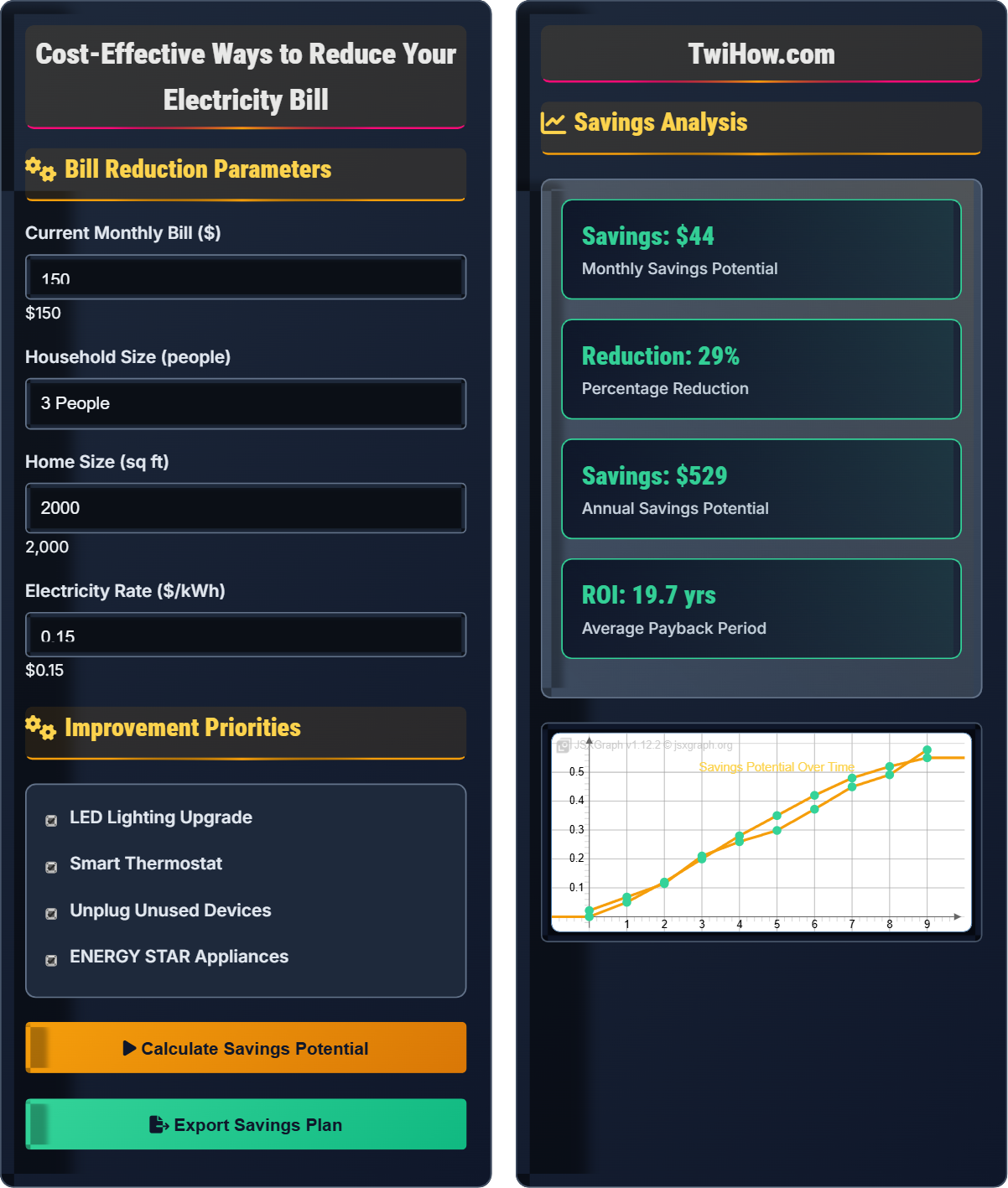
Bill Reduction Parameters
Improvement Priorities
Savings Analysis
| Strategy | Investment | Monthly Savings | Payback Period |
|---|---|---|---|
| LED Lighting | $120 | $18 | 6.7 mo |
| Smart Thermostat | $250 | $25 | 10 mo |
| Unplug Devices | $0 | $12 | 0 mo |
| ENERGY STAR | $500 | $13 | 3.2 yr |
Cost-Effective Ways to Reduce Your Electricity Bill
Electricity bill reduction strategies involve identifying and implementing measures that decrease energy consumption while maintaining comfort and functionality. These strategies range from simple behavioral changes to technological upgrades, with varying levels of investment and return on investment.
Electricity savings follow a structured approach:
Where:
- Current Usage: Baseline kWh consumption
- Improved Usage: Projected kWh after improvements
- Electricity Rate: Cost per kilowatt-hour
- Monthly Savings: Dollar amount saved per month
Key areas where electricity savings apply:
- Lighting: LED upgrades and smart controls
- HVAC: Heating, cooling, and ventilation efficiency
- Appliances: ENERGY STAR models and efficient usage
- Electronics: Phantom load reduction
- Water Heating: Efficient systems and usage
- Renewable Energy: Solar panels and other clean energy
- No-Cost Strategies: Behavioral changes and habit modifications
- Low-Cost Improvements: Lighting, weatherstripping, filters
- Moderate Investments: Smart thermostats, efficient appliances
- Major Upgrades: HVAC systems, insulation, solar panels
- Long-term Projects: Home efficiency retrofits
- Utility Programs: Rebates and incentives
Fundamentals of Electricity Bill Reduction
Electricity consumption, energy efficiency, kilowatt-hours, utility rates, energy audit, phantom load, demand charges, time-of-use rates.
Monthly Savings = (Old Usage - New Usage) × Rate per kWh
Where higher values indicate greater potential savings.
- Start with no-cost behavioral changes
- Prioritize improvements by ROI
- Consider time-of-use rates
Applications
Home energy audits, appliance upgrades, lighting improvements, smart home systems, renewable energy installations.
- Residential homes
- Small businesses
- Apartments and condos
- Offices and workspaces
- Industrial facilities
- Climate and regional factors
- Utility rate structures
- Home age and condition
Electricity Bill Reduction Quiz
How much electricity does an LED bulb use compared to an incandescent bulb?
LED bulbs use approximately 25% of the electricity of an equivalent incandescent bulb. A 10-watt LED bulb produces the same light as a 60-watt incandescent bulb, resulting in 75% energy savings. LEDs also last 15-25 times longer than incandescent bulbs.
The answer is A) 25% of an incandescent bulb.
LED technology represents a dramatic improvement in lighting efficiency. The significant energy savings result from the different mechanisms of light production: LEDs convert more energy directly to light rather than heat. This efficiency translates directly to electricity bill reductions, making LED replacement one of the most cost-effective energy-saving measures.
LED: Light Emitting Diode technology
Incandescent: Filament-based lighting technology
Lumens: Measure of light output
• Replace bulbs with equivalent lumens
• Consider color temperature preferences
• Factor in long lifespan benefits
• Start with frequently used bulbs
• Look for ENERGY STAR certified LEDs
• Consider smart bulbs for additional savings
• Not considering light quality and color
• Buying low-quality LEDs that fail quickly
• Forgetting to replace all bulbs in fixtures
Explain how a smart thermostat can reduce electricity bills and calculate the potential savings for a home with a monthly bill of $200.
How Smart Thermostats Save Energy: Smart thermostats optimize heating and cooling schedules based on occupancy patterns, weather forecasts, and user preferences. They prevent unnecessary heating/cooling when nobody is home and can learn optimal temperature settings.
Calculation:
• Typical savings: 10-15% on heating/cooling costs
• Average heating/cooling percentage: 45% of total bill
• Heating/cooling cost: $200 × 0.45 = $90
• Annual savings: $90 × 0.12 × 12 = $129.60
• Monthly savings: $129.60 ÷ 12 = $10.80
Payback Period: $250 (thermostat cost) ÷ $10.80 (monthly savings) = 23 months
Smart thermostats provide both immediate and long-term savings. The immediate savings come from eliminating unnecessary heating/cooling, while long-term savings result from optimized temperature settings that maintain comfort while reducing energy use. The learning capabilities of smart thermostats continue to improve efficiency over time.
Smart Thermostat: Programmable device with learning capabilities
Setback Thermostat: Adjusts temperature when away
Time-of-Use: Variable rates based on time of day
• Proper installation is crucial for savings
• Set appropriate temperature setbacks
• Use learning features effectively
• Program setbacks of 7-10°F when away
• Use geofencing to adjust for occupancy
• Monitor energy usage reports
• Setting temperature setbacks too extreme
• Not using learning features properly
• Poor installation location
Your home has 20 devices that draw power even when turned off (phantom loads), averaging 5 watts each. Calculate the monthly electricity cost of these phantom loads at a rate of $0.15 per kWh. Then calculate the annual savings if you eliminate these loads using smart power strips.
Phantom Load Calculation:
• Total phantom load: 20 devices × 5 watts = 100 watts
• Daily consumption: 100 watts × 24 hours = 2,400 watt-hours = 2.4 kWh
• Monthly consumption: 2.4 kWh × 30 days = 72 kWh
• Monthly cost: 72 kWh × $0.15/kWh = $10.80
• Annual cost: $10.80 × 12 = $129.60
Smart Power Strip Solution:
• Annual savings: $129.60
• Cost of smart power strips: $80 (approx.)
• Payback period: $80 ÷ $10.80 = 7.4 months
Result: Smart power strips provide a quick payback with significant annual savings.
This example demonstrates how small, constant loads can add up to significant costs over time. Phantom loads operate 24/7, making their impact multiply continuously. Smart power strips automatically cut power to devices when not in use, eliminating these unnecessary costs with minimal investment and effort.
Phantom Load: Power drawn by devices when off
Vampire Power: Alternative term for phantom load
Smart Power Strip: Automatically cuts power to idle devices
• Phantom loads operate 24/7
• Small loads add up over time
• Smart strips provide automatic control
• Focus on entertainment centers and computers
• Look for devices with LED indicators
• Use timer controls for additional savings
• Not identifying all phantom load sources
• Forgetting about chargers and adapters
• Not considering seasonal variations
Your utility offers time-of-use rates: $0.25/kWh during peak hours (2-7 PM weekdays) and $0.10/kWh during off-peak hours. If you shift 30% of your electricity usage from peak to off-peak hours, calculate the potential monthly savings on a $200 bill.
Current Cost Breakdown:
• Assume 40% of usage occurs during peak hours
• Peak usage cost: $200 × 0.40 = $80
• Off-peak usage cost: $200 × 0.60 = $120
After Shifting 30% of Peak to Off-Peak:
• Amount shifted: $80 × 0.30 = $24
• New peak cost: $80 - $24 = $56
• New off-peak cost: $120 + $24 = $144
• New total: $56 + $144 = $200 (same usage, different rates)
Cost Comparison:
• Old peak cost for shifted amount: $24 at $0.25/kWh
• New off-peak cost for same amount: $24 × ($0.10/$0.25) = $9.60
• Monthly savings: $24 - $9.60 = $14.40
Result: Shifting usage to off-peak hours saves $14.40 monthly.
Time-of-use rates provide significant savings opportunities for customers who can shift their electricity usage. By running major appliances like dishwashers, washing machines, and electric vehicle charging during off-peak hours, homeowners can achieve substantial savings. Smart scheduling and programmable devices make this easier to implement.
Time-of-Use Rates: Variable rates based on time of day
Peak Hours: Highest demand and cost periods
Off-Peak Hours: Lowest demand and cost periods
• Check your utility's specific rate structure
• Shift high-energy appliances to off-peak
• Consider smart devices for automatic shifting
• Program appliances to run during off-peak hours
• Charge EVs overnight
• Use timers for water heaters
• Not understanding rate structure
• Forgetting about heating/cooling loads
• Not considering seasonal rate changes
Which appliance typically consumes the most electricity in a residential home?
Heating and cooling systems (HVAC) typically consume the most electricity in a residential home, accounting for 40-50% of total electricity usage. In many homes, air conditioning alone can represent 30-40% of the electricity bill during summer months.
The answer is B) Air conditioning/heating.
HVAC systems are the largest energy consumers in most homes because they must overcome the temperature difference between indoor and outdoor air continuously. The larger the temperature difference and the longer the system runs, the higher the energy consumption. This makes HVAC efficiency improvements the most impactful for electricity bill reduction.
HVAC: Heating, Ventilation, and Air Conditioning
Load Factor: Energy consumption relative to capacity
SEER: Seasonal Energy Efficiency Ratio
• HVAC systems run longest during peak seasons
• Proper maintenance is crucial for efficiency
• Sealing and insulation affect HVAC loads
• Change filters regularly
• Seal air leaks around the home
• Use ceiling fans to reduce cooling needs
• Overlooking HVAC as the largest energy user
• Not considering home insulation
• Setting thermostats too extreme
FAQ
Q: What's the fastest way to see electricity bill reductions?
A: The fastest ways to see reductions include:
No-Cost Behavioral Changes: Turn off lights, unplug devices, adjust thermostat by a few degrees
Low-Cost Improvements: Replace incandescent bulbs with LEDs, use smart power strips
Immediate Actions: Adjust thermostat setbacks, close blinds during hot days, use ceiling fans
Quick Payback: Install a programmable thermostat, seal obvious air leaks
These changes can reduce your bill by 10-20% within the first month, with behavioral changes providing immediate results.
Q: What can renters do to reduce electricity costs?
A: Renters can implement many effective strategies:
Portable Solutions: Use space heaters efficiently, portable fans, LED desk lamps
Behavioral Changes: Turn off electronics when leaving, use natural lighting, adjust thermostat
Appliance Choices: Use energy-efficient small appliances, unplug when not needed
Window Treatments: Use curtains, blinds, or window film to manage heat gain
Communication: Discuss energy efficiency with landlords for improvements like weatherstripping
Many renters can achieve 15-25% savings without permanent modifications to the property.