Best Way to Insulate Your Home for Energy Efficiency
Complete guide • Step-by-step explanations
Home Insulation Guide:
Show Insulation CalculatorProper home insulation is one of the most effective ways to improve energy efficiency and reduce heating and cooling costs. The best insulation approach depends on your climate, home type, budget, and specific areas that need attention. Effective insulation reduces energy consumption, improves comfort, and can significantly lower utility bills.
Key insulation areas include:
- Attic/roof: Primary area for heat loss prevention
- Walls: Both interior and exterior walls
- Basement/Crawl Space: Foundation insulation
- Floors: Especially over unheated spaces
- Windows/Doors: Air sealing and weatherstripping
- Ductwork: Insulating HVAC system components
Choosing the right insulation type and R-value for your specific situation maximizes energy savings and comfort while ensuring proper installation and safety.
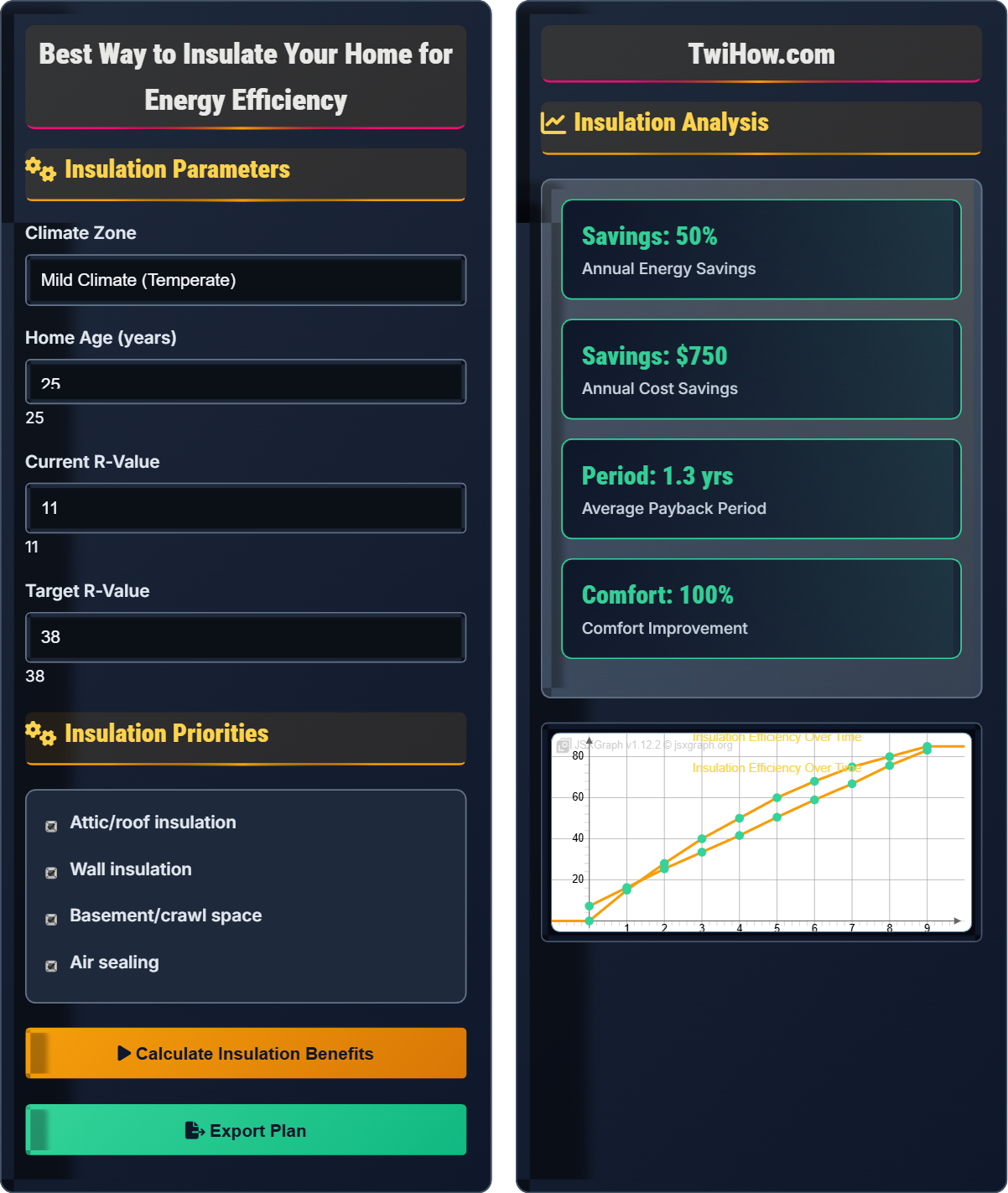
Insulation Parameters
Insulation Priorities
Insulation Analysis
| Area | Current R-Value | Target R-Value | Improvement |
|---|---|---|---|
| Attic | R-11 | R-38 | +27 |
| Walls | R-13 | R-21 | +8 |
| Basement | R-5 | R-11 | +6 |
| Floor | R-8 | R-25 | +17 |
Best Home Insulation for Energy Efficiency
Home insulation is a material or combination of materials used to reduce heat transfer between the interior and exterior of a building. It works by slowing the rate of heat flow, keeping homes warmer in winter and cooler in summer. Proper insulation significantly reduces energy consumption and improves comfort.
Effective home insulation follows a structured approach:
Where:
- Heat Loss Reduction: Percentage reduction in heat transfer
- New R-Value: Insulation thermal resistance after improvements
- Old R-Value: Insulation thermal resistance before improvements
Key areas where insulation provides maximum benefits:
- Attic Spaces: Primary heat loss area in most homes
- Exterior Walls: Significant energy loss through walls
- Basements/Floors: Heat loss through foundation
- Crawl Spaces: Unconditioned spaces under homes
- Windows/Doors: Air sealing and thermal breaks
- Ductwork: HVAC system efficiency
- Batt/Blanket: Fiberglass, mineral wool, or natural fiber rolls
- Loose-Fill: Cellulose, fiberglass, or mineral wool blown in
- Spray Foam: Expanding foam for air sealing and insulation
- Rigid Foam: Polystyrene, polyisocyanurate, or polyurethane boards
- Reflective: Radiant barriers that reflect heat
- Specialty: Aerogel, vacuum insulated panels, or phase change materials
Fundamentals of Home Insulation
Insulation, R-value, thermal resistance, heat transfer, conduction, convection, radiation, air sealing, vapor barrier.
Energy Savings = (Old R-Value / New R-Value) × 100
Where higher values indicate greater energy efficiency improvement.
- Higher R-values provide better insulation
- Air sealing is crucial for effectiveness
- Proper installation is essential
Applications
Residential homes, commercial buildings, industrial facilities, energy audits, retrofit projects.
- Attic and roof insulation
- Wall cavity insulation
- Basement and foundation
- Floor and subfloor
- Garage and shed insulation
- Climate and regional factors
- Home age and construction
- Moisture and ventilation
Home Insulation Quiz
What does R-value measure in insulation?
R-value measures thermal resistance - the ability of insulation to resist heat flow. Higher R-values indicate better insulating properties. The R-value depends on the type of insulation, thickness, and density of the material. It's the standard measure used to compare insulation effectiveness.
The answer is B) Thermal resistance to heat flow.
R-value is the fundamental measurement for insulation effectiveness. It quantifies how well a material resists heat transfer. When comparing insulation products, R-value allows you to make apples-to-apples comparisons. However, installation quality and proper air sealing are equally important for achieving the rated R-value performance.
R-Value: Thermal resistance measurement
Heat Flow: Transfer of thermal energy
Thermal Resistance: Opposition to heat transfer
• Higher R-values provide better insulation
• R-value depends on material and thickness
• Proper installation is crucial for performance
• Compare R-values per inch for different materials
• Consider total R-value for layered insulation
• Account for compression and installation factors
• Not considering installation quality
• Ignoring air sealing requirements
• Comparing different thicknesses without R-value
Why is attic insulation typically the most important area for home energy efficiency?
Heat Flow Direction: Heat rises naturally, making the attic the primary escape route for warm air in winter and entry point for heat in summer.
Temperature Difference: The attic often has the largest temperature differential between inside and outside, creating the strongest driving force for heat transfer.
Surface Area: The attic typically represents the largest horizontal surface area of the home, providing the most opportunity for heat loss/gain.
Accessibility: Attics are usually easier to access for insulation upgrades compared to walls or foundations.
Cost-Effectiveness: Improving attic insulation typically provides the highest return on investment for energy efficiency upgrades.
Understanding heat flow patterns is crucial for effective insulation strategy. Warm air naturally moves upward, concentrating heat loss in the attic during winter. During summer, the roof absorbs solar radiation and transfers heat downward. This makes the attic the critical barrier for maintaining indoor comfort and energy efficiency.
Heat Transfer: Movement of thermal energy
Convection: Heat transfer through fluid movement
Thermal Bridge: Pathway for heat transfer through materials
• Address heat flow direction first
• Focus on largest surface areas
• Ensure proper ventilation
• Seal air leaks before adding insulation
• Consider radiant barriers in hot climates
• Not sealing air leaks first
• Blocking ventilation pathways
• Insufficient R-value for climate
You currently have R-11 insulation in your attic and want to upgrade to R-38. If your current heating bill is $200 per month, calculate the potential monthly savings assuming insulation accounts for 40% of your heating costs and the improvement will reduce heat loss by 70%.
Current Heat Loss Related Costs:
• Monthly heating bill: $200
• Heat loss portion: $200 × 0.40 = $80
After R-Value Improvement:
• Heat loss reduction: $80 × 0.70 = $56
• New heat loss cost: $80 - $56 = $24
• Total monthly savings: $56
Annual Savings: $56 × 12 = $672
Result: Upgrading from R-11 to R-38 could save $672 annually, representing a 38% reduction in your heating bill.
This calculation demonstrates the relationship between R-value improvements and energy savings. The formula shows that increasing R-value reduces heat loss proportionally. The actual savings depend on the baseline heat loss percentage and the effectiveness of the upgrade. This type of calculation helps prioritize insulation investments.
R-Value Improvement: Increase in thermal resistance
Heat Loss Reduction: Decrease in thermal energy transfer
Energy Savings: Reduction in energy consumption
• Savings are proportional to heat loss reduction
• Account for other energy factors
• Calculate percentage of total bill affected
• Consider seasonal variations
• Factor in other efficiency improvements
• Assuming 100% of bill is affected by insulation
• Not accounting for other efficiency factors
• Ignoring seasonal variations
You live in a hot, humid climate where cooling costs are high. Which insulation strategies would be most effective for your situation, and how do they differ from cold climate approaches?
Hot Climate Strategies:
1. Radiant Barriers: Reflect solar heat from roof before it enters attic
2. High R-Value Attic: Prevent heat from penetrating into living space
3. Sealed Attic: Conditioned attic space to reduce cooling load
4. Proper Ventilation: Remove heat buildup in attic space
Differences from Cold Climate:
• Focus on blocking heat entry rather than retaining heat
• Radiant barriers are more valuable in hot climates
• Vapor barriers placed differently (on warm side)
• Air sealing priorities may differ
• Cooling season is longer than heating season
Insulation strategies must be tailored to climate conditions. Hot climates face the challenge of preventing heat gain, while cold climates focus on preventing heat loss. The same principles apply, but the priorities and specific solutions may differ significantly. Understanding your climate's specific challenges is crucial for effective insulation planning.
Radiant Barrier: Reflective material that blocks radiant heat
Sealed Attic: Conditioned attic space approach
Vapor Barrier: Moisture control layer
• Tailor strategy to climate conditions
• Consider seasonal variations
• Account for moisture management
• Research local climate recommendations
• Consider combined heating/cooling needs
• Account for humidity levels
• Using cold climate approach in hot climates
• Not considering humidity effects
• Ignoring local building codes
Which insulation type provides the highest R-value per inch?
Closed-cell spray foam provides the highest R-value per inch at approximately R-6.0 per inch. This makes it ideal for situations where space is limited but high insulation performance is needed. However, it's also typically the most expensive option.
The answer is C) Closed-cell spray foam (R-6.0 per inch).
Different insulation materials have varying R-values per inch, which affects their suitability for different applications. Spray foam provides excellent air sealing in addition to high R-value, making it particularly effective. However, cost and installation requirements must also be considered when selecting insulation materials.
R-Value per Inch: Thermal resistance per unit thickness
Spray Foam: Expanding insulation material
Air Sealing: Blocking air leakage pathways
• Consider R-value per inch for space-constrained areas
• Factor in air sealing benefits
• Account for installation costs
• Consider total cost including installation
• Evaluate air sealing properties
• Check for moisture resistance
• Only comparing R-values without considering cost
• Not accounting for air sealing properties
• Ignoring installation requirements
FAQ
Q: Should I DIY insulation or hire professionals?
A: The decision depends on the area and type of insulation:
DIY Suitable: Attic floor insulation with unfaced batts, simple air sealing tasks
Professional Recommended: Spray foam installation, wall cavity insulation, basement/crawl space work
Considerations:
• Safety requirements (protective equipment, ventilation)
• Building codes and permits
• Warranty and performance guarantees
• Proper installation technique requirements
For most homeowners, DIY works for attic floor insulation, but professional installation ensures proper coverage and performance for complex areas.
Q: What can renters do to improve insulation?
A: Renters can implement several insulation improvements:
Removable Options: Draft stoppers, window insulation kits, weatherstripping
Temporary Solutions: Heavy curtains, rugs for floors, door sweeps
Communication: Discuss insulation needs with landlords
Portable Solutions: Space heaters, fans for air circulation
Behavioral Changes: Adjust thermostat settings, close unused rooms
Many renters can achieve 15-25% energy savings through these non-permanent improvements while advocating for building-level upgrades.