What is the Impact of Behavior Changes on Home Energy Use?
Complete behavioral efficiency guide • Step-by-step practices
Behavioral changes can reduce home energy consumption by 10-30% without any equipment upgrades. Simple actions like adjusting thermostat settings, turning off lights, unplugging devices, and modifying daily routines have a significant cumulative effect on energy bills and environmental impact.
Key behavioral impacts include:
- Thermostat Management: 5-10% savings by adjusting temperatures
- Lighting Habits: 5-10% savings by turning off unused lights
- Electronics Management: 5-15% savings by reducing phantom loads
- Laundry Optimization: 2-5% savings by washing in cold water
- Water Conservation: 2-8% savings by reducing hot water use
These changes require no financial investment but can save hundreds of dollars annually.
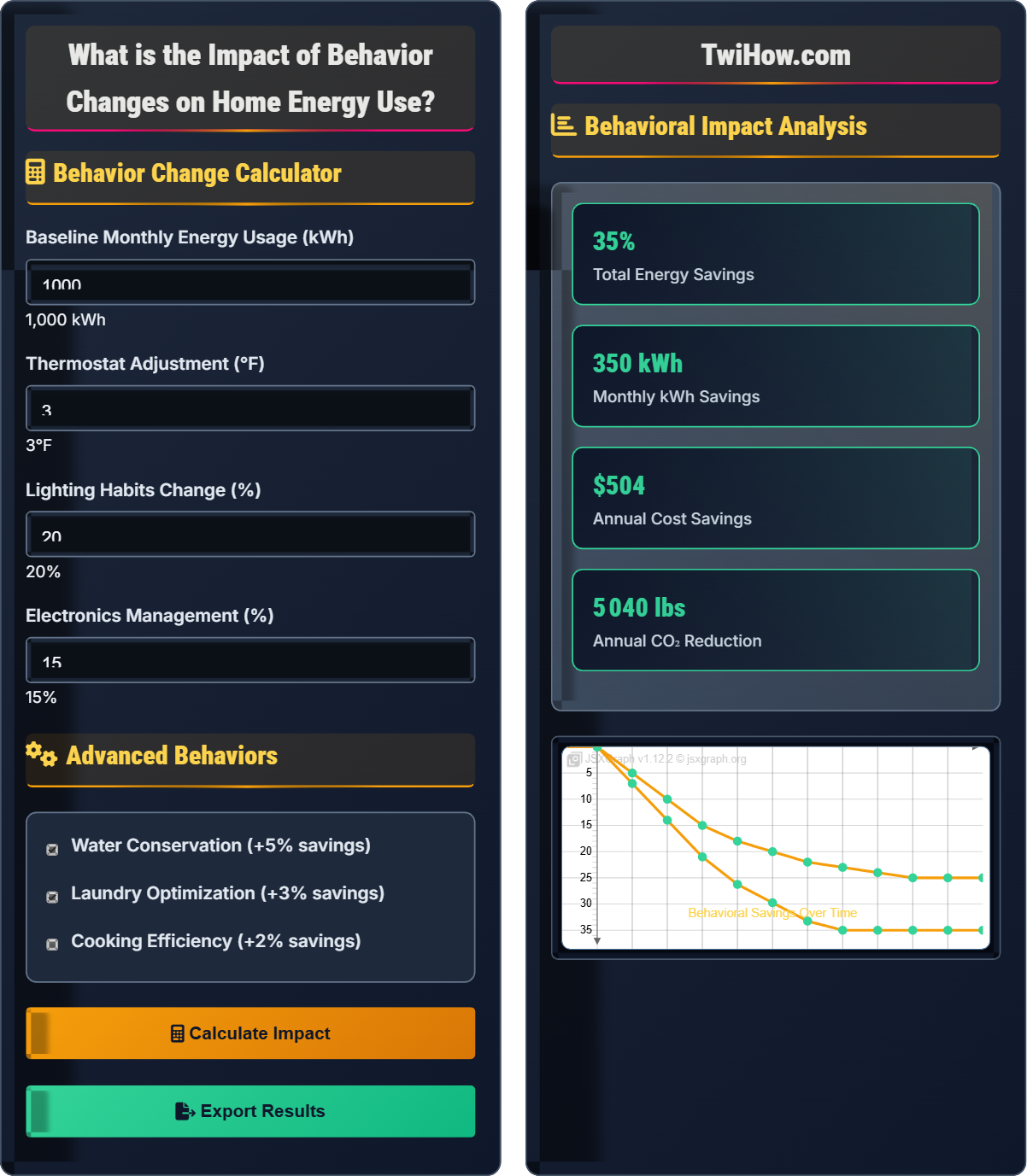
Behavior Change Calculator
Advanced Behaviors
Behavioral Impact Analysis
| Behavior | Contribution | Monthly Savings | Annual Savings |
|---|---|---|---|
| Thermostat Management | 12% | 120 kWh | $144 |
| Lighting Habits | 8% | 80 kWh | $96 |
| Electronics Management | 5% | 50 kWh | $60 |
| Water Conservation | 5% | 50 kWh | $60 |
| Laundry Optimization | 3% | 30 kWh | $36 |
- Adjust thermostat by 3°F when away or sleeping
- Turn off lights when leaving rooms
- Unplug electronics when not in use
- Wash clothes in cold water
- Take shorter showers
- Use ceiling fans to reduce cooling needs
How Behavior Changes Impact Energy Use
Behavioral changes affect energy consumption by modifying how and when energy-consuming devices are used. Unlike physical improvements (insulation, efficiency upgrades), behavioral changes rely on human decision-making and habit formation to reduce energy consumption without altering the home's physical infrastructure.
Where:
- Baseline Usage: Energy consumption without behavioral changes
- Behavior Factor: Cumulative impact of all behavioral modifications
- Individual Behavior Impact: Percentage reduction from each behavior
- Daily Savings: Energy saved per day through behavior changes
Most effective behavior changes by energy impact:
- Thermostat Management: 5-10% savings with 3-5°F adjustments
- Phantom Load Reduction: 5-10% savings from electronics management
- Laundry Optimization: 3-5% savings from cold water washing
- Water Heating: 2-8% savings from reduced hot water use
- Space Conditioning: 5-15% savings from strategic usage
- Lighting Habits: 5-10% savings from efficient use
Factors that influence successful behavior adoption:
- Immediate Feedback: Smart meters, energy monitors
- Visible Reminders: Labels, stickers, apps
- Social Influence: Family members, community support
- Convenience: Easy-to-implement changes
- Financial Motivation: Visible cost savings
- Environmental Awareness: Personal values alignment
Behavior Categories
Thermostat management, lighting habits, electronics use, water conservation, laundry practices, cooking efficiency.
Energy Savings = Baseline × Σ(Behavior Impact Percentage)
Where total savings is the sum of all individual behavior changes.
- Start with easiest behaviors to build momentum
- Focus on high-impact, low-effort changes
- Track progress to maintain motivation
Benefits
Reduced utility bills, no equipment costs, improved comfort, environmental impact reduction, increased awareness.
- Immediate cost reduction
- No capital investment required
- Quick implementation
- Compound savings over time
- Requires consistent effort and discipline
- Family cooperation essential
- May require initial habit adjustment
- Results vary by household size and usage
Behavioral Energy Quiz
By adjusting the thermostat 3°F cooler in winter or warmer in summer, what percentage of energy savings can typically be achieved?
Adjusting the thermostat by 3°F typically achieves 5-10% energy savings. This is because heating and cooling account for 40-60% of home energy use, so even small temperature adjustments have a significant impact. The exact savings depend on climate, home insulation, and HVAC system efficiency.
The answer is B) 5-10%.
The relationship between thermostat setting and energy use is approximately linear. For every 1°F change, heating and cooling energy use changes by about 3-5%. So a 3°F change results in roughly 9-15% change in heating/cooling energy, which represents 5-10% of total home energy use since heating/cooling is about 50% of total usage.
Setback Temperature: Reduced temperature when away or sleeping
Thermal Load: Energy required to maintain desired temperature
Heat Transfer: Movement of heat through building envelope
• 3°F is optimal balance of comfort and savings
• Greater setbacks may cause recovery penalties
• Consider humidity in cooling season
• Use programmable thermostats for consistent setbacks
• Adjust gradually to maintain comfort
• Consider occupancy patterns for optimal scheduling
• Setting temperatures too extreme
• Not accounting for recovery time
• Ignoring humidity in cooling
Explain what phantom loads are, provide examples of common phantom load devices, and calculate the annual energy consumption of a TV that draws 5W in standby mode when left plugged in 24/7. Assume an electricity rate of $0.12/kWh.
Phantom Loads: Devices that consume electricity when turned off or in standby mode. These "vampire" loads continue drawing power through transformers, clocks, remote controls, and other circuitry.
Common Examples: TVs, cable boxes, chargers, microwaves with digital displays, gaming consoles, computers, audio equipment, and smart speakers.
Calculation:
Standby power: 5W = 0.005 kW
Annual hours: 24 × 365 = 8,760 hours
Annual energy: 0.005 kW × 8,760 hours = 43.8 kWh
Annual cost: 43.8 kWh × $0.12/kWh = $5.26
Significance: Phantom loads can account for 5-10% of total home energy use. Multiple devices can add up to significant costs.
Phantom loads represent energy waste that occurs continuously without providing any benefit. The cumulative effect of multiple devices can be substantial. A typical home may have 20-40 devices drawing phantom power, totaling 50-100W continuously, which equals 438-876 kWh annually.
Phantom Load: Power consumed by devices in standby mode
Vampire Power: Alternative term for phantom loads
Standby Mode: Low-power state when device appears off
• Many devices draw power even when "off"
• Small loads multiply over time
• Use power strips for easy disconnection
• Use smart power strips with timers
• Unplug chargers when not in use
• Look for ENERGY STAR certified devices
• Not realizing all devices draw phantom power
• Underestimating cumulative impact
• Forgetting about entertainment centers
A family of four has a monthly electricity bill of $150. They decide to implement several behavior changes: reduce thermostat setting by 4°F during sleeping hours (8 hours daily), turn off lights in unused rooms (reducing lighting energy by 30%), unplug electronics when not in use (reducing phantom loads by 50%), and wash clothes in cold water (reducing laundry energy by 75%). Calculate their expected monthly and annual savings if heating/cooling is 50% of their bill, lighting is 10%, electronics phantom loads are 8%, and laundry is 4% of their total bill.
Current Bill Breakdown:
Heating/Cooling: $150 × 50% = $75
Lighting: $150 × 10% = $15
Electronics: $150 × 8% = $12
Laundry: $150 × 4% = $6
Other: $150 - $108 = $42
Savings Calculations:
Thermostat: $75 × 10% (4°F setback) = $7.50
Lighting: $15 × 30% = $4.50
Electronics: $12 × 50% = $6.00
Laundry: $6 × 75% = $4.50
Total Monthly Savings: $7.50 + $4.50 + $6.00 + $4.50 = $22.50
Annual Savings: $22.50 × 12 = $270
New Monthly Bill: $150 - $22.50 = $127.50
Overall Savings: $22.50 ÷ $150 = 15%
This example demonstrates how multiple small behavioral changes can add up to significant savings. Each behavior targets a different portion of the energy bill, showing that a comprehensive approach is most effective. The 15% total savings from these changes is substantial and achievable without any equipment purchases.
Energy Audit: Analysis of energy use by category
Behavioral Baseline: Current energy consumption patterns
Cumulative Savings: Total savings from multiple behaviors
• Analyze energy use by category first
• Target high-impact categories
• Combine multiple behaviors for maximum effect
• Use utility bills to identify major energy categories
• Start with easiest behaviors to build momentum
• Track monthly bills to verify savings
• Focusing on low-impact behaviors only
• Not tracking actual savings
• Trying to change too many habits at once
A homeowner wants to establish energy-saving habits but struggles with consistency. Research shows that habits take 21-66 days to form. If they want to reduce energy use by 20% through behavioral changes, and each week they can successfully adopt one new behavior that saves 3% of their energy bill, how long will it take to reach their goal? What is the recommended approach to make these changes stick?
Calculation:
Target savings: 20%
Savings per week: 3%
Weeks needed: 20% ÷ 3% = 6.67 weeks ≈ 7 weeks
Timeline: Approximately 7 weeks to reach 20% savings
Recommended Approach:
1. Start Small: Begin with 1-2 easy behaviors
2. Make Specific: Define exactly what to do (e.g., "turn off lights when leaving any room")
3. Create Triggers: Link new behaviors to existing routines
4. Track Progress: Monitor energy bills or use smart meters
5. Provide Rewards: Celebrate milestones and savings
6. Build Gradually: Add new behaviors once previous ones are automatic
Habit formation research shows that consistency is more important than perfection. The "21-66 days" range reflects individual differences in forming new behaviors. Starting with small, manageable changes and gradually building complexity helps ensure long-term success. Each new habit should be practiced consistently until it becomes automatic before adding another.
Habit Loop: Cue → Routine → Reward cycle
Implementation Intentions: Specific if-then plans
Self-Efficacy: Confidence in one's ability to perform behaviors
• Don't try to change everything at once
• Focus on consistency over perfection
• Make behaviors as easy as possible
• Use visual reminders like sticky notes
• Enlist family members for accountability
• Use apps to track energy-saving behaviors
• Attempting too many changes simultaneously
• Not planning for obstacles and setbacks
• Failing to celebrate small wins
Which behavior change would have the greatest impact on water heating energy consumption?
Option C (lowering water heater temperature) has the greatest impact. Water heating accounts for about 18% of home energy use. Lowering the temperature from 140°F to 120°F can reduce water heating energy use by 6-10% and save $25-50 annually. This change affects all hot water use throughout the home continuously.
The answer is C) Lowering water heater temperature.
Water heating energy use is determined by both the temperature differential and the amount of hot water used. Lowering the thermostat reduces the temperature difference the water heater must maintain, which reduces standby losses and energy needed for reheating. This change affects every use of hot water (showers, laundry, dishwashing, etc.) making it more impactful than single-use behaviors.
Standby Losses: Heat lost from hot water tank to surroundings
Temperature Differential: Difference between tank and ambient temperature
Recovery Efficiency: Energy required to reheat water
• Set water heater to 120°F for safety and efficiency
• Insulate hot water pipes to reduce losses
• Consider timing for hot water use
• Insulate your water heater tank
• Use low-flow showerheads
• Run full loads for dishwashers and washing machines
• Setting temperature too high for safety
• Not insulating hot water distribution
• Running partial loads frequently
FAQ
Q: How can we get our whole family to participate in energy-saving behaviors?
A: Successful family-wide behavior change requires:
Lead by Example: Adults demonstrate desired behaviors consistently.
Make it Fun: Create games, challenges, or competitions around energy-saving activities.
Explain the Why: Help family members understand the environmental and financial benefits.
Assign Age-Appropriate Tasks: Younger children can turn off lights, teens can manage electronics.
Track Progress Together: Use charts, apps, or utility bills to monitor collective savings.
Provide Positive Reinforcement: Celebrate successes and acknowledge efforts.
Research shows that social norms and group identity significantly influence behavior adoption.
Q: Are behavior changes still worth it if I'm only renting and can't make physical improvements?
A: Absolutely! Behavioral changes are particularly valuable for renters because:
Immediate Impact: Savings start right away with no investment required.
Portable Skills: Habits developed now will benefit you in future homes.
No Landlord Approval: You control your daily actions regardless of property owner.
Typical Savings: 10-25% reduction in energy bills through behavior alone.
Additional Benefits: Develops environmental awareness and financial discipline.
Future Value: Demonstrates energy-conscious lifestyle to potential landlords.
Behavior changes are the most accessible way to reduce energy costs while renting.