What is the Role of Home Energy Education and Behavioral Interventions?
Complete behavioral intervention guide • Step-by-step engagement process
Energy Education & Behavior:
Show Intervention PlannerHome energy education and behavioral interventions focus on changing human behavior to reduce energy consumption through awareness, feedback, and engagement strategies. These approaches complement technological improvements by addressing the human element in energy use.
Behavioral interventions leverage psychology, social norms, and feedback mechanisms to motivate energy-saving actions. They can achieve 5-15% energy savings at relatively low cost compared to hardware upgrades.
Key intervention types include:
- Education Programs: Knowledge transfer and awareness building
- Feedback Systems: Real-time energy monitoring and alerts
- Goal Setting: Personalized targets and progress tracking
- Normative Feedback: Comparison with peer group performance
- Financial Incentives: Rewards for energy-saving behaviors
- Social Engagement: Community challenges and social support
Research shows that combining multiple intervention types achieves better results than single approaches.
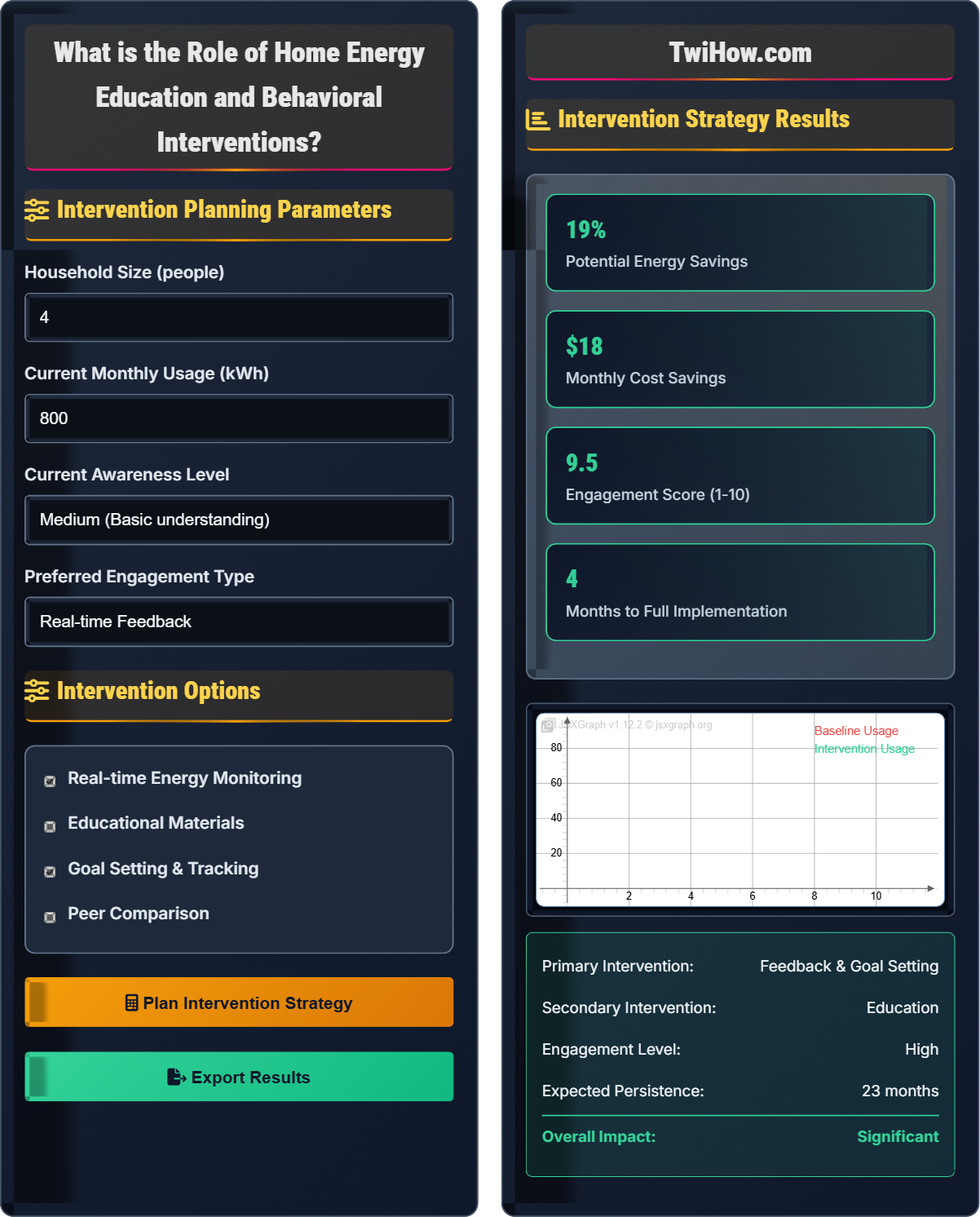
Intervention Planning Parameters
Intervention Options
Intervention Strategy Results
| Method | Effectiveness | Cost | Implementation |
|---|---|---|---|
| Real-time Feedback | 10-15% | Low | Easy |
| Goal Setting | 8-12% | Free | Easy |
| Education | 5-8% | Low | Moderate |
| Social Comparison | 6-10% | Moderate | Hard |
- Immediate awareness of usage
- Quick behavior adjustment
- Requires monitoring device
- Builds long-term awareness
- Sustainable behavior change
- Slower initial impact
Understanding Energy Education and Behavioral Interventions
Behavioral intervention in home energy use refers to strategies designed to influence human behavior to reduce energy consumption. These interventions are based on psychological principles and aim to change attitudes, knowledge, and practices related to energy use.
Unlike technological solutions that reduce energy consumption through efficiency improvements, behavioral interventions target the human decision-making process and daily routines that drive energy consumption patterns.
Where:
- Awareness: Knowledge of current usage and potential savings
- Motivation: Drive to change behavior (financial, environmental, social)
- Ability: Skills and resources to implement changes
- Feedback: Information on progress and effectiveness
Effective behavioral interventions include:
- Real-time Feedback: Immediate information about energy use through monitors
- Goal Setting: Specific targets with progress tracking
- Education: Knowledge transfer about energy efficiency
- Normative Feedback: Comparison with peer group performance
- Social Incentives: Community challenges and recognition
- Financial Incentives: Monetary rewards for conservation
- Cost-Effective: Achieve savings at lower cost than hardware upgrades
- Quick Implementation: Can be deployed rapidly without physical changes
- Complementary: Enhance effectiveness of efficiency improvements
- Empowering: Increase household energy awareness and control
- Sustainable: Build long-term conservation habits
- Scalable: Can be implemented broadly with minimal infrastructure
Intervention Methods
Intervention Timeline
Intervention Methods
Energy Education & Behavioral Interventions Learning Quiz
Which behavioral intervention typically produces the largest energy savings?
Real-time feedback typically produces the largest energy savings, usually 10-15% of total consumption. This intervention provides immediate information about energy use, allowing for quick behavioral adjustments. The visibility of consumption patterns drives rapid and significant changes.
The answer is B) Real-time feedback.
Real-time feedback is most effective because it connects behavior directly with consequences, providing immediate reinforcement. When people see the immediate impact of their actions on energy use, they are more likely to make lasting changes. This principle is supported by behavioral psychology research.
Real-time Feedback: Immediate information about energy use
Behavioral Response: Quick action based on feedback
Energy Savings: Reduction in consumption
• Immediate feedback is most effective
• Visibility drives action
• Consistent messaging reinforces
• Use smart meters for real-time data
• Display information prominently
• Make feedback easy to understand
• Delayed feedback reduces effectiveness
• Complex data overwhelms users
• Not providing actionable information
Explain the COM-B model and how it applies to energy behavior interventions.
COM-B Model: The COM-B model states that behavior occurs when three conditions are met: Capability (C), Opportunity (O), and Motivation (M).
Capability: Physical and psychological ability to perform the behavior (knowledge, skills, physical capacity).
Opportunity: External factors that enable or inhibit behavior (environmental, social, cultural).
Motivation: Internal processes that energize and direct behavior (automatic - habits, emotions; reflective - goals, plans).
Application to Energy: Effective interventions must address all three components. For example, installing a programmable thermostat (capability) while providing education (opportunity) and setting energy goals (motivation) creates conditions for behavior change.
The COM-B model provides a systematic framework for understanding behavior change. It recognizes that knowledge alone is insufficient - capability, opportunity, and motivation must all be present for behavior change to occur. This model helps design comprehensive interventions.
COM-B Model: Framework for behavior change
Capability: Ability to perform behavior
Opportunity: Environmental factors
• All three components must be present
• Address deficits in each area
• Comprehensive approach is most effective
• Assess all three components
• Address capability first
• Create supportive environment
• Focusing only on knowledge
• Not addressing environmental barriers
• Assuming motivation is enough
A household currently uses 1,000 kWh/month. They implement a combination of interventions: real-time feedback (12% savings), educational program (6% savings), and goal setting (8% savings). Calculate the total expected monthly savings, assuming interventions have a 20% synergistic effect when combined.
Individual Savings:
- Real-time feedback: 1,000 × 0.12 = 120 kWh
- Education: 1,000 × 0.06 = 60 kWh
- Goal setting: 1,000 × 0.08 = 80 kWh
- Total individual: 120 + 60 + 80 = 260 kWh
Combined Savings with Synergy:
- Base savings: 260 kWh
- Synergistic effect: 260 × 0.20 = 52 kWh
- Total combined savings: 260 + 52 = 312 kWh
Monthly Savings Percentage: (312 ÷ 1,000) × 100% = 31.2%
The combined intervention strategy is expected to save 312 kWh monthly (31.2% of original usage).
This example demonstrates the synergistic effect of combining interventions. Rather than simply adding individual effects, combined interventions can reinforce each other, creating larger impacts than the sum of parts. This is why comprehensive programs are often more effective than single interventions.
Synergistic Effect: Combined impact exceeds sum of individual
Complementary Interventions: Methods that reinforce each other
Cumulative Savings: Total savings from multiple interventions
• Combined effects can exceed individual
• Interventions should complement
• Synergy increases effectiveness
• Combine different intervention types
• Use reinforcing strategies
• Monitor combined effectiveness
• Assuming linear addition of effects
• Not considering synergy
• Using conflicting interventions
A utility sends energy bills showing that a household uses 800 kWh/month while neighbors use an average of 700 kWh/month. The household reduces usage to 750 kWh/month. After 6 months, they learn their neighbors actually use 600 kWh/month. How might this change in normative information affect their energy use, and what does this suggest about effective normative feedback?
Initial Response: The household reduced usage from 800 to 750 kWh/month after learning they used more than neighbors (700 kWh), showing positive response to normative feedback.
Revised Information: When learning neighbors actually use 600 kWh/month, the household may feel they're now performing well compared to peers and potentially increase usage toward the new perceived norm (this is called "boomerang effect").
Implications: Effective normative feedback should include aspirational benchmarks rather than just average performance. Comparing to top performers (best-in-class) tends to drive continued improvement rather than complacency.
Best Practice: Use multiple comparison points: average, best-in-class, and target benchmarks.
This example illustrates the boomerang effect in social comparison. People often adjust behavior to match perceived norms. If feedback suggests they're already performing well, they may relax conservation efforts. Aspirational benchmarks help maintain motivation for continued improvement.
Social Norms: Perceived standards of behavior
Boomerang Effect: Relaxation after initial improvement
Aspirational Benchmarks: High-performance targets
• Use aspirational rather than average norms
• Provide multiple comparison points
• Monitor for boomerang effects
• Compare to top performers
• Set stretch goals
• Provide regular updates
• Using average performance as target
• Not updating comparison data
• Failing to monitor for regression
Which factor is most important for maintaining long-term behavioral change in energy use?
Habit formation and routine integration are most important for maintaining long-term behavioral change. Once energy-saving behaviors become automatic habits integrated into daily routines, they persist even without external motivators or monitoring. This creates sustainable, long-lasting change.
The answer is B) Habit formation and routine integration.
Research in behavioral science shows that habits are formed through repetition and become automatic over time. Initial motivators like incentives or monitoring are important for starting behavior change, but habit formation ensures long-term persistence. This is why sustainable interventions focus on routine integration.
Habit Formation: Automatic behavior through repetition
Behavior Persistence: Long-term maintenance
Routine Integration: Making behavior automatic
• Habits ensure long-term persistence
• Repetition builds automaticity
• Routine integration is key
• Link new behaviors to existing routines
• Practice consistently
• Create environmental cues
• Relying solely on external motivators
• Not establishing routines
• Assuming knowledge equals behavior
FAQ
Q: How much energy can behavioral changes actually save?
A: Well-designed behavioral interventions can achieve 5-15% energy savings, with some studies showing up to 20% in optimal conditions. Real-time feedback systems typically achieve 10-15% savings, while educational programs alone achieve 5-8%.
The key is combining multiple intervention types and maintaining engagement over time. The most effective programs use a layered approach with feedback, goal setting, and social elements.
Q: What are the most cost-effective behavioral programs for utilities?
A: The most cost-effective behavioral programs include:
1. Smart meter feedback: Low-cost, high-impact (10-15% savings)
2. Energy audits with education: Moderate cost, good engagement
3. Community challenges: Social approach with peer influence
4. Goal-setting programs: Simple to implement, effective
Programs that combine multiple approaches typically achieve 15-25% savings at reasonable cost per kWh saved.