Renewable Energy Policies and Energy Justice
Complete energy guide • Step-by-step explanations
Energy Justice & Community Benefits:
Show Justice Impact SimulatorRenewable energy policies play a crucial role in advancing energy justice by ensuring equitable access to clean energy benefits and preventing the disproportionate burden of environmental harms on vulnerable communities. Energy justice encompasses distributive justice (fair distribution of benefits and burdens), procedural justice (inclusive decision-making), and recognition justice (acknowledging diverse needs).
Effective policies must address historical inequities, promote community ownership, and ensure that renewable energy development benefits all communities, particularly those that have been historically marginalized or overburdened by pollution. This includes low-income communities, indigenous peoples, and communities of color.
Key justice principles:
- Distributive Justice: Equitable sharing of renewable energy benefits
- Procedural Justice: Inclusive participation in decision-making
- Recognition Justice: Acknowledging diverse community needs
- Restorative Justice: Addressing historical inequities
Implementing energy justice requires intentional policy design that centers community voices and prioritizes benefits for frontline communities.
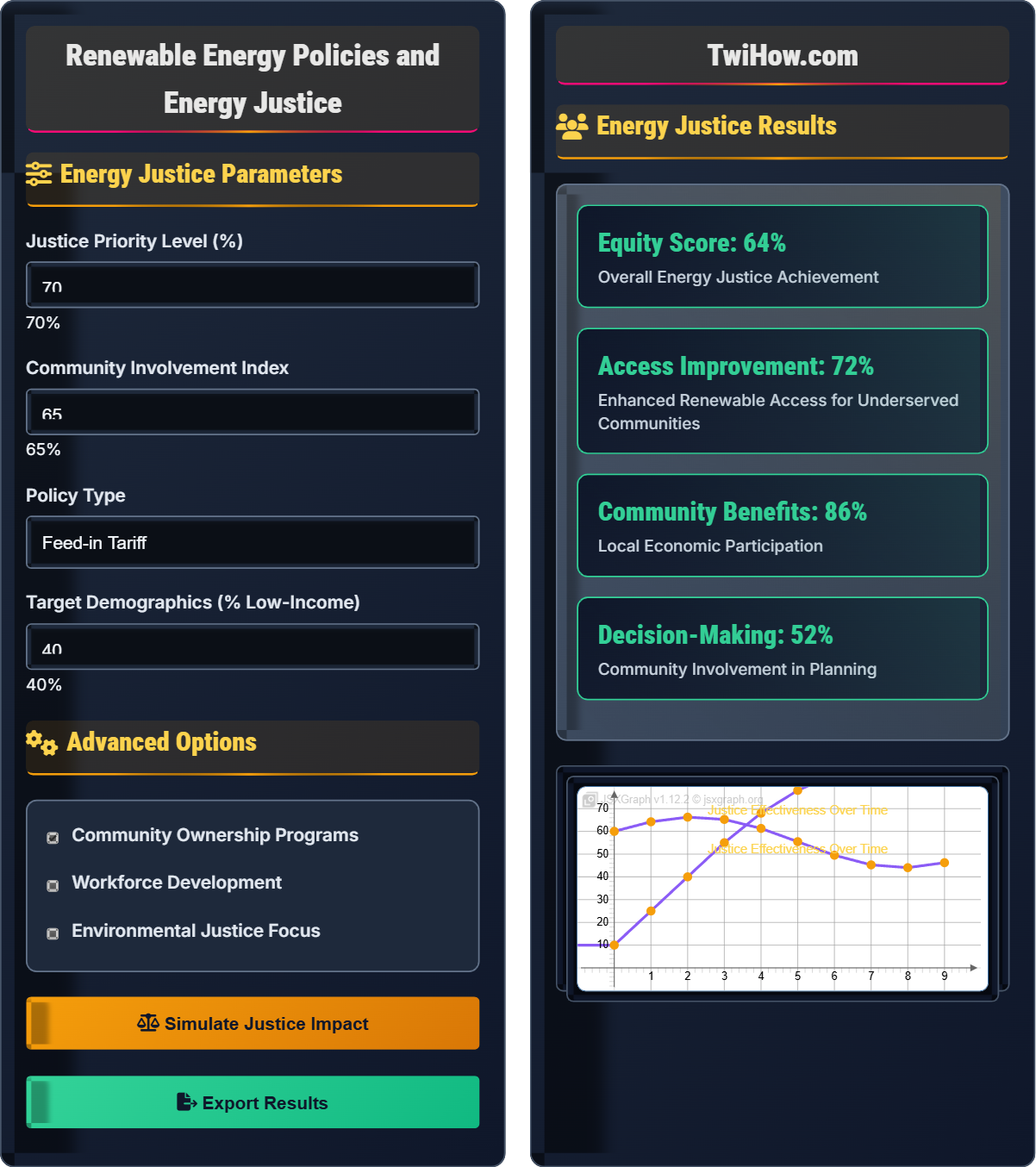
Energy Justice Parameters
Advanced Options
Energy Justice Results
| Justice Dimension | Current Status | Policy Target | Progress |
|---|---|---|---|
| Distributive Justice | 45% | 75% | 60% |
| Procedural Justice | 35% | 80% | 44% |
| Recognition Justice | 50% | 90% | 56% |
| Restorative Justice | 25% | 70% | 36% |
| Community Benefit | Without Justice Policy | With Justice Policy | Improvement |
|---|---|---|---|
| Local Employment | 15% | 45% | +200% |
| Community Ownership | 5% | 35% | +600% |
| Local Procurement | 10% | 40% | +300% |
| Environmental Benefits | 20% | 65% | +225% |
Renewable Energy Justice and Community Benefits Explained
Energy justice encompasses the fair and equitable distribution of energy benefits and burdens across all communities. It addresses historical inequities where marginalized communities have borne disproportionate environmental and health burdens while having limited access to energy benefits. Renewable energy policies must intentionally incorporate justice principles to ensure that the transition to clean energy does not perpetuate or exacerbate existing inequalities.
Energy justice can be evaluated using:
Where:
- Community Benefits: Economic and social advantages to local communities
- Procedural Equity: Inclusive participation in decision-making
- Recognition: Acknowledgment of diverse community needs
- Historical Burdens: Past environmental injustices and impacts
- Access Factor: Equitable access to renewable energy benefits
Three core dimensions of energy justice:
- Distributive Justice: Fair allocation of energy benefits and burdens across communities
- Procedural Justice: Inclusive and participatory decision-making processes
- Recognition Justice: Acknowledgment of diverse community needs and identities
- Restorative Justice: Addressing and remedying historical inequities
- Intergenerational Justice: Considering future generations' needs
- Spatial Justice: Addressing geographic disparities in energy access
- Local Economic Development: Job creation and business opportunities
- Energy Democracy: Community ownership and control of energy systems
- Health Improvements: Reduced pollution and environmental health benefits
- Financial Benefits: Revenue sharing and energy cost savings
- Capacity Building: Skills development and institutional strengthening
- Environmental Restoration: Remediation of contaminated sites
Energy Justice Fundamentals
Energy justice, distributive justice, procedural justice, recognition justice, environmental justice, community benefits.
Justice Index = (Community Benefits + Procedural Equity + Recognition) / (Historical Burdens × Access Barriers)
Where Index = fairness measure, Benefits = positive outcomes, Burdens = negative impacts.
- Frontline communities should receive priority benefits
- Community voice must be central in decision-making
- Historical inequities require targeted remedies
Applications
Community solar programs, energy democracy initiatives, environmental justice policies, tribal energy sovereignty, low-income solar access programs.
- Community engagement and consultation
- Equitable policy design and targeting
- Capacity building and support programs
- Monitoring and accountability mechanisms
- Historical trauma and trust issues
- Resource and capacity constraints
- Structural and systemic barriers
- Power dynamics and representation
Energy Justice Quiz
Which of the following best describes the three core dimensions of energy justice?
Energy justice is fundamentally composed of three core dimensions: distributive justice (fair distribution of energy benefits and burdens), procedural justice (inclusive decision-making processes), and recognition justice (acknowledgment of diverse community needs and identities). These dimensions ensure that energy systems serve all communities equitably.
The answer is B) Distributive, procedural, and recognition justice.
These three dimensions of justice work together to create a comprehensive framework for equitable energy systems. Distributive justice focuses on outcomes, procedural justice on processes, and recognition justice on identity and cultural needs. All three must be addressed to achieve true energy justice.
Distributive Justice: Fair allocation of benefits and burdens
Procedural Justice: Inclusive decision-making processes
Recognition Justice: Acknowledgment of diverse needs
• All three dimensions must be addressed
• Process and outcomes both matter
• Cultural recognition is essential
• Think of justice as a three-legged stool
• Consider both who benefits and how decisions are made
• Recognize diverse community needs and identities
• Focusing only on distributive justice
• Assuming equal processes mean equal outcomes
• Not considering cultural differences
Explain how renewable energy policies can be designed to maximize community benefits and describe specific mechanisms that ensure local economic participation.
Community Benefit Design: Policies should prioritize local ownership, employment, and economic participation in renewable energy development.
Specific Mechanisms:
1. Community Ownership Requirements: Mandate local ownership percentages in renewable projects
2. Local Hiring Preferences: Require prioritization of local workers in construction and operations
3. Procurement Priorities: Give preference to local businesses for supplies and services
4. Revenue Sharing: Distribute project revenues to host communities
5. Workforce Development: Provide training programs for local residents
6. Community Benefit Funds: Establish funds for local infrastructure and services
These mechanisms ensure that renewable energy development creates tangible benefits for local communities rather than merely passing through without local economic impact.
Community benefits must be actively designed into renewable energy policies rather than assumed to occur automatically. Without intentional mechanisms, renewable projects may provide few local benefits while imposing environmental and social costs. Active policy design ensures that communities have meaningful participation in and benefit from clean energy development.
Community Ownership: Local control and equity in energy projects
Local Economic Impact: Economic benefits retained in communities
Benefit-Sharing: Distribution of project revenues to communities
• Benefits must be planned, not assumed
• Local participation requires capacity building
• Long-term benefits need institutional support
• Include local ownership requirements in permits
• Partner with community organizations
• Provide ongoing support beyond initial project
• Not requiring local participation in planning
• Focusing only on short-term construction jobs
A city has identified 5 neighborhoods that have experienced historical environmental burdens: 3 low-income communities of color and 2 industrial areas. The city plans to develop 100 MW of community solar with 70% of benefits going to these frontline communities. If each neighborhood has 5,000 residents, calculate the equitable distribution of solar capacity and benefits. Assume the city wants to allocate benefits proportional to historical burdens, with the low-income communities receiving 60% of benefits and industrial areas receiving 40%. How much capacity should be allocated to each community type?
Total Frontline Community Capacity: 100 MW × 70% = 70 MW
Low-Income Community Allocation: 70 MW × 60% = 42 MW
Industrial Area Allocation: 70 MW × 40% = 28 MW
Per Low-Income Community: 42 MW ÷ 3 communities = 14 MW each
Per Industrial Area: 28 MW ÷ 2 areas = 14 MW each
Remaining Capacity: 100 MW - 70 MW = 30 MW for general distribution
This allocation ensures that historically burdened communities receive priority benefits while distributing capacity equitably based on historical burdens.
This calculation demonstrates how environmental justice principles can be translated into specific allocation mechanisms. The policy prioritizes communities with historical environmental burdens while ensuring proportional distribution based on different types of burdens. This approach addresses both distributive and restorative justice principles.
Frontline Communities: Communities facing multiple environmental burdens
Environmental Burdens: Cumulative environmental exposures and impacts
Priority Benefits: Preferential allocation to disadvantaged communities
• Historical burdens justify priority allocation
• Use quantitative targets for accountability
• Consider different types of environmental burdens
• Ensure proportional allocation within priority groups
• Not quantifying allocation requirements
• Ignoring different types of environmental burdens
A Native American tribe seeks to develop renewable energy on their reservation to achieve energy sovereignty while providing economic benefits. The tribe has 2,000 acres of suitable land and wants to develop solar capacity that meets 150% of their electrical needs. If their current annual consumption is 15 GWh, calculate the required solar capacity and describe how energy justice principles should guide the development to ensure tribal sovereignty and community benefits. Assume 1 MW of solar produces 1,500 MWh annually.
Required Capacity: 15 GWh × 1.5 (150%) = 22.5 GWh needed annually
Solar Capacity Required: 22,500 MWh ÷ 1,500 MWh/MW = 15 MW
Land Requirements: Approximately 150 acres for 15 MW (1 acre per MW)
Energy Justice Principles:
1. Tribal Sovereignty: Ensure tribal control over energy development and decision-making
2. Cultural Recognition: Respect sacred sites and cultural values in siting decisions
3. Economic Benefits: Maximize local employment, business opportunities, and revenue retention
4. Capacity Building: Invest in tribal technical and administrative capabilities
5. Long-term Control: Structure ownership to maintain tribal control over time
This approach ensures that renewable energy development serves tribal self-determination while providing economic benefits.
Tribal energy sovereignty represents a unique application of energy justice principles that recognizes Indigenous rights and self-determination. The calculation shows how energy needs translate to capacity requirements, while the justice principles ensure that development respects tribal sovereignty and cultural values while providing economic benefits.
Energy Sovereignty: Indigenous control over energy systems
Tribal Self-Determination: Right to govern internal affairs
Cultural Recognition: Respect for sacred sites and traditions
• Tribal sovereignty must be respected in all decisions
• Cultural values require protection
• Economic benefits should strengthen tribal governance
• Engage tribal leadership from the beginning
• Conduct cultural impact assessments
• Structure agreements to maintain tribal control
• Ignoring cultural and spiritual considerations
• Not ensuring long-term tribal control
Which of the following best exemplifies procedural justice in renewable energy policy development?
Procedural justice focuses on the fairness of decision-making processes. Community-led planning processes with actual decision-making authority exemplify procedural justice because they ensure that affected communities have meaningful participation in decisions that impact them, rather than merely being consulted or informed after decisions are made.
The answer is B) Community-led planning processes with decision-making authority.
Procedural justice goes beyond token consultation to ensure that communities have genuine decision-making power. True procedural justice requires that communities affected by energy decisions have authority to shape those decisions, not just provide input that may or may not be considered.
Procedural Justice: Fairness of decision-making processes
Meaningful Participation: Genuine involvement in decision-making
Community Authority: Decision-making power for affected communities
• Participation must be meaningful, not tokenistic
• Affected communities need decision-making authority
• Processes must accommodate diverse needs
• Ensure communities have real decision-making power
• Accommodate different communication preferences
• Provide resources for effective participation
• Not providing decision-making authority
• Assuming one-size-fits-all processes
FAQ
Q: How can renewable energy policies ensure meaningful community participation in decision-making?
A: Meaningful community participation requires:
Early Engagement: Involve communities from the earliest planning stages
Accessible Information: Provide information in multiple languages and formats
Multiple Channels: Offer various ways to participate beyond formal meetings
Capacity Building: Support community organizations and leaders
Decision-Making Authority: Give communities real power over outcomes
Compensation: Pay community members for their time and expertise
Feedback Loops: Show how community input shaped decisions
True participation means communities have authority over decisions that affect them.
Q: What are the challenges in implementing justice-oriented renewable energy policies?
A: Major challenges include:
Institutional Resistance: Existing systems may resist structural changes
Resource Constraints: Limited funding and capacity in disadvantaged communities
Power Dynamics: Unequal relationships between communities and institutions
Complexity: Multiple overlapping justice dimensions to address
Time Constraints: Pressure for quick renewable deployment
Measurement Difficulties: Challenging to quantify justice outcomes
Scalability: Balancing local needs with system-wide goals
Success requires sustained commitment and adaptive implementation approaches.