How do renewable energy policies address technology neutrality and innovation?
Complete renewable energy policy guide • Innovation & neutrality
Policy Innovation Framework:
Show Policy SimulatorTechnology neutrality in renewable energy policy means that government regulations and incentives do not favor one technology over another. Instead, they create a level playing field that allows the most efficient and cost-effective technologies to emerge organically. Innovation policies support research, development, and deployment of new technologies while maintaining market competition.
Key policy mechanisms include technology-neutral renewable portfolio standards, innovation grants, tax incentives for R&D, and procurement policies that specify performance outcomes rather than technology types. These approaches encourage technological diversity and prevent market distortions.
Benefits of technology-neutral policies:
- Market Efficiency: Allows most competitive technologies to win
- Innovation Stimulation: Encourages development of new solutions
- Cost Reduction: Promotes price competition among technologies
- Future-Proofing: Adapts to emerging technologies without policy changes
Successful implementation requires balancing neutrality with targeted support for emerging technologies that may not yet be commercially viable.
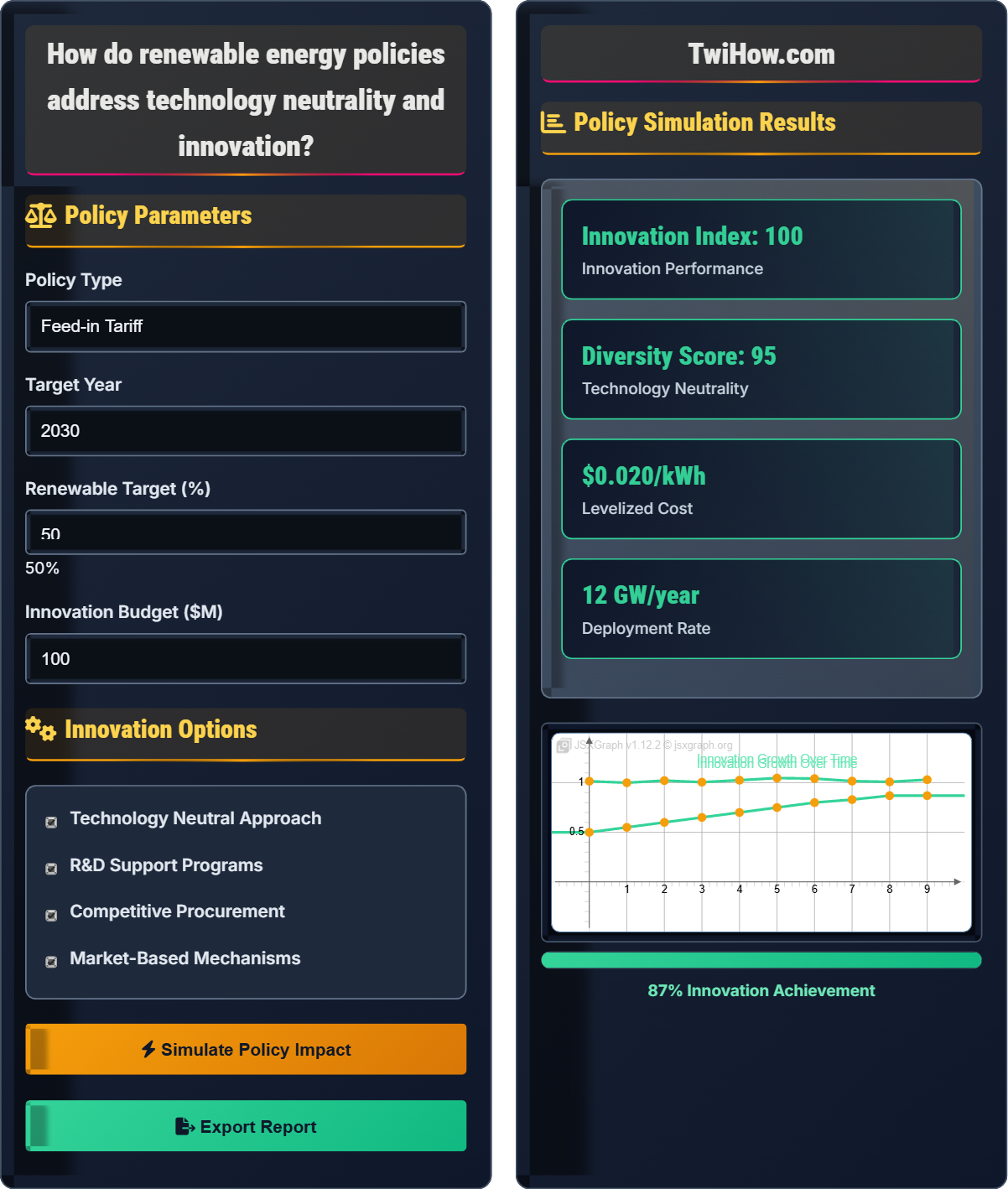
Policy Parameters
Innovation Options
Policy Simulation Results
| Framework | Approach | Score | Impact |
|---|---|---|---|
| Technology Neutrality | Market Based | 85 | High |
| Innovation Support | R&D Grants | 92 | High |
| Competition | Auctions | 78 | Medium |
| Regulatory | Performance Based | 88 | High |
| Procurement | Outcome Focused | 82 | Medium |
Policy Innovation & Technology Neutrality Explained
Technology neutrality in renewable energy policy means that government regulations, incentives, and procurement processes do not favor specific technologies or suppliers. Instead, they focus on desired outcomes (like carbon reduction or renewable energy targets) while allowing the market to determine the most effective solutions.
Effective technology-neutral policies include several key components:
Components include:
- Outcome-Based Targets: Specify results rather than methods
- Competitive Mechanisms: Allow fair competition among technologies
- Performance Standards: Set measurable requirements
- Innovation Support: Provide R&D funding for emerging tech
- Regulatory Flexibility: Adapt to new technologies
Key instruments for promoting innovation while maintaining neutrality:
- Technology-Neutral RPS: Renewable portfolio standards based on outcomes
- Competitive Auctions: Price-based selection of technologies
- R&D Grants: Targeted funding for emerging technologies
- Tax Credits: Performance-based incentives
- Public Procurement: Outcome-focused purchasing
- Regulatory Sandboxes: Testing environments for new technologies
- Market Efficiency: Allows most competitive technologies to emerge
- Cost Reduction: Promotes price competition and innovation
- Technological Diversity: Reduces dependence on single solutions
- Future-Proofing: Adapts to new technologies without policy changes
- Global Competitiveness: Strengthens domestic innovation ecosystem
Innovation Factors & Technology Assessment
- Focus on outcomes rather than specific technologies
- Maintain competitive processes for technology selection
- Provide targeted support for emerging technologies
- Ensure transparent and fair market access
Technology Neutrality Frameworks
Renewable Energy Policy Quiz
Which of the following best exemplifies a technology-neutral renewable energy policy?
Technology neutrality means specifying desired outcomes (percentage of renewable electricity) without dictating which technologies should achieve those outcomes. Option B sets a renewable energy target without specifying which technologies must be used, allowing market forces to determine the optimal mix.
The answer is B) Requiring 50% renewable electricity without specifying technology.
Technology neutrality is a fundamental principle in effective renewable energy policy. It prevents government officials from picking technological winners and losers, which historically has led to suboptimal outcomes. By setting outcome-based targets, policies allow the most efficient and cost-effective technologies to emerge through market competition.
Technology Neutrality: Policy approach that specifies outcomes without mandating specific technologies
Outcome-Based Targets: Goals defined by results rather than methods
Market Competition: Process where technologies compete on cost and performance
• Specify outcomes, not methods
• Allow fair competition among technologies
• Focus on performance metrics
• Look for policies that set targets without specifying technologies
• Competitive auctions promote neutrality
• Performance standards enable innovation
• Confusing technology support with technology neutrality
• Assuming all subsidies are neutral
• Overlooking market distortion effects
Explain how competitive procurement mechanisms promote both technology neutrality and innovation in renewable energy policy.
Technology Neutrality: Competitive procurement mechanisms like reverse auctions allow all qualified technologies to compete for contracts based on cost and performance criteria. No single technology is favored, ensuring fair market access.
Innovation Promotion: The competitive pressure drives developers to innovate and reduce costs to win contracts. Technologies must continuously improve to remain competitive, fostering innovation across all participating technologies.
Implementation: Procurement criteria focus on measurable outcomes (energy output, capacity factors, delivery timelines) rather than specific technologies, maintaining neutrality while encouraging innovation.
Competitive procurement creates a virtuous cycle where technology neutrality and innovation reinforce each other. The neutrality aspect ensures fair competition, while the competitive pressure incentivizes continuous innovation. This approach has proven highly effective in driving down renewable energy costs while maintaining technological diversity.
Reverse Auction: Procurement method where lowest qualified bidders win
Competitive Pressure: Market forces that drive innovation and cost reductionFair Market Access: Equal opportunity for all qualified technologies
• Evaluate based on performance, not technology type
• Maintain transparent selection criteria
• Ensure fair access for all qualified bidders
• Use performance-based rather than technology-specific criteria
• Include innovation metrics in evaluation
• Maintain transparency in selection process
• Including technology-specific requirements
• Setting criteria that favor established technologies
• Lacking transparency in selection process
A country implements a technology-neutral renewable energy policy with a 40% target by 2030. The policy includes competitive auctions, R&D grants totaling $500M, and performance-based incentives. If the policy increases innovation spending by 25%, reduces renewable energy costs by 15%, and attracts 5 new technology companies to the market, calculate the innovation multiplier and describe the expected market impact.
Innovation Multiplier:
Multiplication Factor = (Increased Spending × Cost Reduction × New Entrants) / Baseline
Multiplier = (1.25 × 0.85 × 5) / 1 = 5.31
Expected Market Impact:
• Technology diversity increases by 25% due to new entrants
• Cost competitiveness improves by 15% through market pressure
• Innovation activity multiplies by 5.3 times baseline
• Market achieves 40% renewable target with diverse technology portfolio
The innovation multiplier demonstrates how technology-neutral policies create compounding effects. The combination of increased R&D spending, competitive pressure, and market access for new entrants creates a synergistic effect that amplifies innovation outcomes beyond the sum of individual policy components.
Innovation Multiplier: Measure of policy effectiveness amplification
Compounding Effects: Synergistic impact of multiple policy tools
Market Synergy: Combined effect greater than individual parts
• Combine multiple policy tools for maximum impact
• Ensure policy coherence across instruments
• Monitor synergistic effects
• Use complementary policy instruments
• Monitor innovation metrics regularly
• Adjust policies based on market feedback
• Using conflicting policy instruments
• Not monitoring policy interaction effects
• Over-relying on single policy tools
You're designing a renewable energy policy for a region with abundant solar, wind, and geothermal resources. How would you structure the policy to maintain technology neutrality while supporting innovation in emerging technologies that may not yet be cost-competitive?
Technology-Neutral Framework:
1. Outcome-Based RPS: Set 50% renewable target without specifying technology mix, allowing market competition among all resources.
2. Competitive Auctions: Hold regular reverse auctions open to all qualified technologies based on performance and cost criteria.
Emerging Technology Support:
3. Innovation Tiers: Create separate auction pools for emerging technologies with slightly higher price floors to allow market development.
4. R&D Grants: Provide targeted funding for research and demonstration projects across all technology categories.
5. Regulatory Sandbox: Allow pilot projects to operate under relaxed regulations to test innovative approaches.
This approach maintains neutrality while providing pathways for emerging technologies to mature and compete.
Balancing technology neutrality with support for emerging technologies requires sophisticated policy design. The key is creating mechanisms that allow new technologies to develop without compromising the competitive advantage of established solutions. This often involves temporary measures that phase out as technologies become cost-competitive.
Technology Neutrality: Equal treatment of all qualified technologies
Emerging Technologies: Innovations not yet cost-competitive
Regulatory Sandbox: Controlled testing environment
• Maintain long-term neutrality while supporting short-term development
• Phase out special support as technologies mature
• Ensure fair access for all technologies
• Use time-limited support mechanisms
• Set clear criteria for phasing out support
• Monitor technology maturation regularly
• Creating permanent advantages for specific technologies
• Not establishing exit criteria for support programs
• Failing to adapt policies as technologies mature
Which factor is most critical for ensuring that technology-neutral policies successfully promote innovation?
Strong competitive pressure is the most critical factor for promoting innovation in technology-neutral policies. Competition drives developers to continuously improve their technologies and reduce costs to win contracts. Without competitive pressure, there is little incentive for innovation regardless of other policy elements.
The answer is B) Strong competitive pressure.
While subsidies, contracts, and other support mechanisms can help, the fundamental driver of innovation in technology-neutral policies is market competition. When technologies must compete on cost and performance to secure contracts, developers are motivated to invest in research and development to gain competitive advantages.
Competitive Pressure: Market forces driving innovation and cost reduction
Market Competition: Process where technologies compete for market share
Innovation Driver: Factor that motivates technological advancement
• Competition drives innovation more than subsidies
• Market mechanisms outperform government selection
• Pressure creates motivation for improvement
• Design policies that create genuine competition
• Monitor competitive intensity regularly
• Avoid measures that reduce competitive pressure
• Over-emphasizing subsidies over competition
• Creating market conditions that reduce competition
• Assuming government can pick winning technologies
FAQ
Q: How do technology-neutral policies balance supporting emerging technologies with maintaining fair competition?
A: Technology-neutral policies balance emerging technology support with fair competition through several mechanisms:
Phased Approach: Create separate tracks or tiers for emerging technologies with slightly more favorable terms, but with clear timelines for convergence to mainstream criteria.
Performance-Based Criteria: Set technology-neutral performance standards that emerging technologies can meet through innovation rather than subsidies.
R&D Integration: Combine market mechanisms with dedicated R&D support to accelerate technology maturation.
Regular Reviews: Periodically assess technology readiness and adjust support mechanisms accordingly.
This approach maintains neutrality while providing pathways for innovation.
Q: What are the challenges for new companies entering markets with technology-neutral policies?
A: New companies face several challenges in technology-neutral markets:
Initial Disadvantage: Competing against established technologies with lower costs and proven track records.
Market Access: Gaining credibility and demonstrating reliability to secure contracts.
Capital Requirements: Need for significant investment to prove technology viability and scale.
However, opportunities exist:
• Innovation can create competitive advantages
• Emerging technology programs may offer support
• First-mover advantages in new technology segments
• Partnerships with established players can provide market access