How do renewable energy policies address the transition from fossil fuels?
Complete transition policy guide • Fossil fuel transition strategies
Energy Transition Policies:
Show Transition SimulatorRenewable energy policies play a crucial role in facilitating the transition from fossil fuels through a combination of economic incentives, regulatory frameworks, and strategic planning. These policies create market conditions that favor clean energy while gradually reducing dependence on fossil fuels.
Key policy mechanisms include carbon pricing, renewable energy standards, feed-in tariffs, and fossil fuel phase-out programs. Successful transitions require coordinated approaches that address economic, social, and technical challenges while ensuring energy security and affordability.
Transition mechanisms:
- Carbon Pricing: Making fossil fuels more expensive through taxes or cap-and-trade
- Renewable Standards: Mandating renewable energy deployment
- Subsidy Reform: Redirecting fossil fuel subsidies to clean energy
- Just Transition: Supporting workers and communities
Effective policies balance economic competitiveness with environmental goals while ensuring a socially equitable transition.
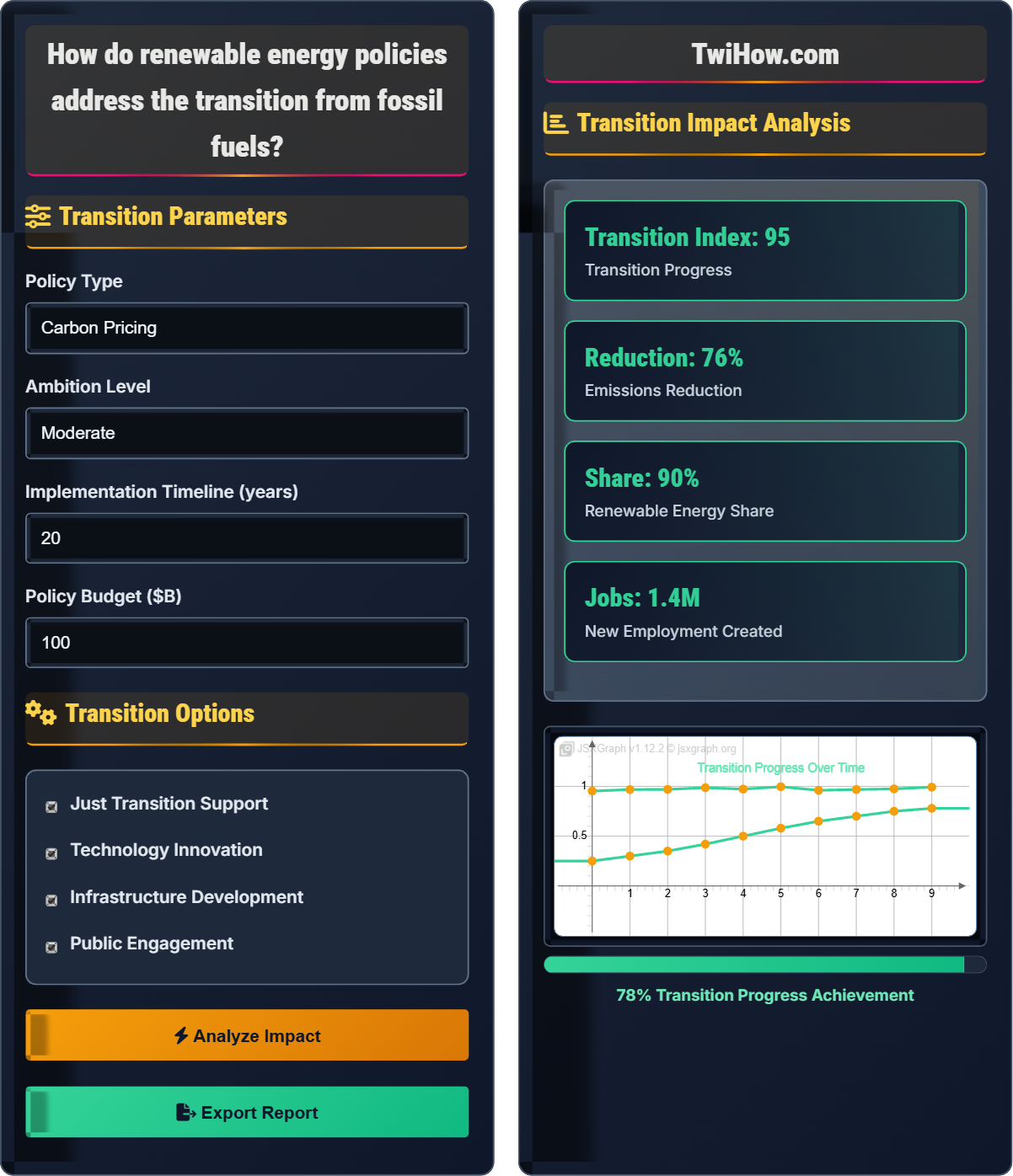
Transition Parameters
Transition Options
Transition Impact Analysis
| Mechanism | Effectiveness | Cost | Speed |
|---|---|---|---|
| Carbon Pricing | High | Medium | Fast |
| Renewable Standards | High | Low | Medium |
| Subsidy Reform | Medium | Low | Slow |
| Phase-Out Programs | High | High | Medium |
| Investment Incentives | High | High | Fast |
Transition Progress Visualization
Policy Flow
Energy Transition Policies Explained
Energy transition policies are government measures designed to accelerate the shift from fossil fuel-based energy systems to renewable energy sources. These policies address market failures, create incentives for clean energy adoption, and manage the economic and social impacts of the transition.
Effective transition policies follow a structured approach:
Framework components include:
- Market Creation: Establishing conditions for renewable energy growth
- Displacement: Gradually replacing fossil fuel infrastructure
- Investment: Directing capital toward clean energy
- Just Transition: Supporting affected workers and communities
- Regulation: Implementing standards and phase-out timelines
Primary mechanisms for fossil fuel transition:
- Carbon Pricing: Cap-and-trade systems and carbon taxes
- Renewable Energy Standards: Mandatory renewable energy targets
- Feed-in Tariffs: Guaranteed prices for renewable energy producers
- Subsidy Reform: Eliminating fossil fuel subsidies
- Phase-out Programs: Scheduled retirement of fossil fuel infrastructure
- Climate Mitigation: Significant reduction in greenhouse gas emissions
- Energy Security: Reduced dependence on fossil fuel imports
- Economic Growth: Job creation in clean energy sectors
- Health Benefits: Improved air quality and public health
- Technological Innovation: Advancement of clean energy technologies
Transition Metrics & Policy Assessment
- Set clear, achievable targets with timelines
- Provide adequate support for affected communities
- Ensure policy coherence across sectors
- Maintain energy security during transition
Policy Mechanism Profiles
Energy Transition Policy Quiz
Which carbon pricing mechanism is most effective for reducing fossil fuel demand?
A carbon tax with full revenue recycling is most effective because it creates a direct price signal that makes fossil fuels more expensive while returning revenue to citizens or investing in clean energy. This approach provides both demand reduction and reinvestment in transition efforts.
The answer is B) Carbon tax with full revenue recycling.
Carbon pricing works by internalizing the external costs of carbon emissions, making fossil fuels more expensive relative to clean alternatives. A carbon tax provides price certainty and can be designed to return revenue to citizens or invest in transition efforts, enhancing both effectiveness and political acceptability.
Carbon Pricing: Economic mechanism to price carbon emissions
Revenue Recycling: Returning carbon tax revenue to citizens
Price Signal: Market incentive created by pricing
• Direct price signals are most effective
• Revenue recycling improves acceptance
• Certainty encourages investment
• Use border adjustments to prevent carbon leakage
• Return revenue to citizens for equity
• Start with modest rates and increase over time
• Setting prices too low to be effective
• Not addressing competitiveness concerns
• Failing to recycle revenue appropriately
Explain how Renewable Energy Standards (RES) work and describe their advantages and limitations for fossil fuel displacement.
How RES Works: Renewable Energy Standards mandate that utilities source a specific percentage of electricity from renewable sources by certain deadlines. Utilities can meet requirements through direct investment or renewable energy certificates.
Advantages:
• Provides market certainty for renewable energy developers
• Creates steady demand for clean energy technologies
• Can be designed with technology-specific targets
• Gradual implementation allows for system adaptation
Limitations:
• May not provide sufficient price signals for rapid transition
• Can be politically challenging to strengthen
• May not address all fossil fuel uses beyond electricity
• Requires enforcement mechanisms to be effective
RES policies work by creating artificial demand for renewable energy, helping to overcome market barriers and scale up clean energy deployment. They complement other policies by providing long-term market signals while allowing market forces to determine the most cost-effective solutions.
Renewable Energy Standard: Mandated renewable energy targets for utilities
Renewable Energy Certificate: Tradable certificate proving renewable energy generation
Market Certainty: Predictable conditions for investment
• Targets must be ambitious but achievable
• Enforcement mechanisms are essential
• Complementary policies enhance effectiveness
• Design with technology-specific carve-outs
• Include provisions for credit banking
• Align with grid integration capabilities
• Setting targets too low for meaningful impact
• Not accounting for grid integration challenges
• Failing to include enforcement mechanisms
A country plans to transition from fossil fuels to renewables over 25 years. Currently, fossil fuels provide 80% of energy, and renewables provide 20%. The country aims for 90% renewable energy by 2049. Calculate the required annual growth rate for renewable energy and the corresponding decline rate for fossil fuels, assuming total energy demand grows at 2% annually.
Initial Conditions:
Fossil fuels: 80% → Final: 10%
Renewables: 20% → Final: 90%
Renewable Growth Calculation:
Annual growth rate = (Final/Initial)^(1/n) - 1
Renewable growth = (90/20)^(1/25) - 1 = 0.0606 or 6.06% annually
Fossil Fuel Decline:
Decline rate = (10/80)^(1/25) - 1 = -0.0824 or 8.24% annually
With 2% demand growth: Renewable deployment must exceed 8% annually to achieve the target.
This calculation demonstrates the exponential nature of energy transitions. Achieving dramatic shifts in energy mix requires sustained, rapid growth rates that may exceed historical precedents. The compounding effect means that early action is crucial for meeting long-term targets.
Compound Growth: Exponential increase over time
Energy Mix: Proportion of different energy sources
Transition Rate: Speed of energy system change
• Transition rates compound over time
• Early action has greatest impact
• Growth rates must exceed demand growth
• Use logarithmic scales for growth calculations
• Account for demand growth in targets
• Consider historical precedent rates
• Not accounting for demand growth
• Underestimating compound growth effects
• Setting unrealistic growth targets
You're designing a fossil fuel transition policy for a country heavily dependent on coal mining. The economy relies on coal for 40% of jobs in certain regions. Design a comprehensive policy package that addresses both the energy transition and the economic transition for affected communities.
Energy Transition Policies:
• Renewable Energy Standards with gradual phase-in
• Carbon pricing with revenue recycling to affected regions
• Investment incentives for clean energy deployment
Economic Transition Policies:
• Just Transition Fund for worker retraining and relocation
• Economic diversification programs for coal-dependent regions
• Early retirement packages for older miners
• Infrastructure investments in affected communities
• Support for small business development in new sectors
Successful energy transitions require addressing both the technical and social dimensions of change. The "just transition" concept recognizes that workers and communities affected by the shift away from fossil fuels need support to adapt economically. This requires coordinated policies across multiple sectors.
Just Transition: Fair and inclusive energy transition process
Economic Diversification: Developing alternative industries
Regional Impact: Localized economic effects
• Address economic impacts alongside energy transition
• Engage affected communities in planning
• Provide comprehensive support packages
• Involve workers in transition planning
• Leverage existing skills in new sectors
• Invest in education and retraining
• Focusing only on energy transition
• Not engaging affected communities
• Insufficient economic support programs
What is the most significant challenge in reforming fossil fuel subsidies?
Political resistance from beneficiaries is the most significant challenge. Fossil fuel subsidies create powerful constituencies that benefit from the status quo and actively resist reforms. These groups often have significant political influence and can mobilize public opinion against subsidy removal.
The answer is B) Political resistance from beneficiaries.
Subsidy reform faces a classic collective action problem where concentrated benefits (to subsidy recipients) face diffused costs (to taxpayers). Those benefiting from subsidies are highly motivated to preserve them, while those bearing the costs are less motivated to organize against them. This creates political barriers that must be overcome through strategic policy design.
Fossil Fuel Subsidies: Government support for fossil fuel production/consumption
Political Economy: Politics of economic policy
Concentrated Benefits: Focused gains for specific groups
• Subsidies create powerful political constituencies
• Beneficiaries organize to protect interests
• Reform requires addressing political barriers
• Use revenue from subsidy removal for transition
• Communicate benefits of reform clearly
• Phase out subsidies gradually to reduce resistance
• Underestimating political economy factors
• Not addressing beneficiary concerns
• Attempting rapid reform without preparation
FAQ
Q: How can policymakers ensure that fossil fuel transition policies don't harm energy security?
A: Energy security during transition requires:
Diversification: Multiple renewable energy sources and technologies
Grid Flexibility: Storage, demand response, and flexible generation
Transition Planning: Phased approach that maintains supply during transition
Strategic Reserves: Maintaining some fossil capacity during transition
International Cooperation: Regional energy cooperation and trade
Well-designed policies can enhance energy security by reducing dependence on fuel imports.
Q: What support is available for workers transitioning from fossil fuel industries?
A: Worker support typically includes:
Retraining Programs: Skills development for clean energy jobs
Early Retirement: Buyout packages for older workers
Relocation Assistance: Help moving to new employment areas
Income Support: Unemployment benefits during transition
Community Investment: Economic development in affected regions
Many countries have established just transition funds specifically for worker support.