How Do Renewable Energy Policies Balance Economic, Environmental, and Social Goals?
Complete guide • Step-by-step explanations
Policy Balance:
Show Policy SimulatorRenewable energy policies must navigate complex trade-offs between economic competitiveness, environmental protection, and social equity. Successful policies create synergies among these goals while managing inevitable tensions and conflicts.
Key balancing acts:
- Economic: Cost-effectiveness, job creation, market competitiveness
- Environmental: Emissions reduction, biodiversity protection, resource efficiency
- Social: Energy access, community benefits, job transition support
- Political: Stakeholder buy-in, implementation feasibility
Effective policy design requires integrated approaches that maximize co-benefits while minimizing trade-offs.
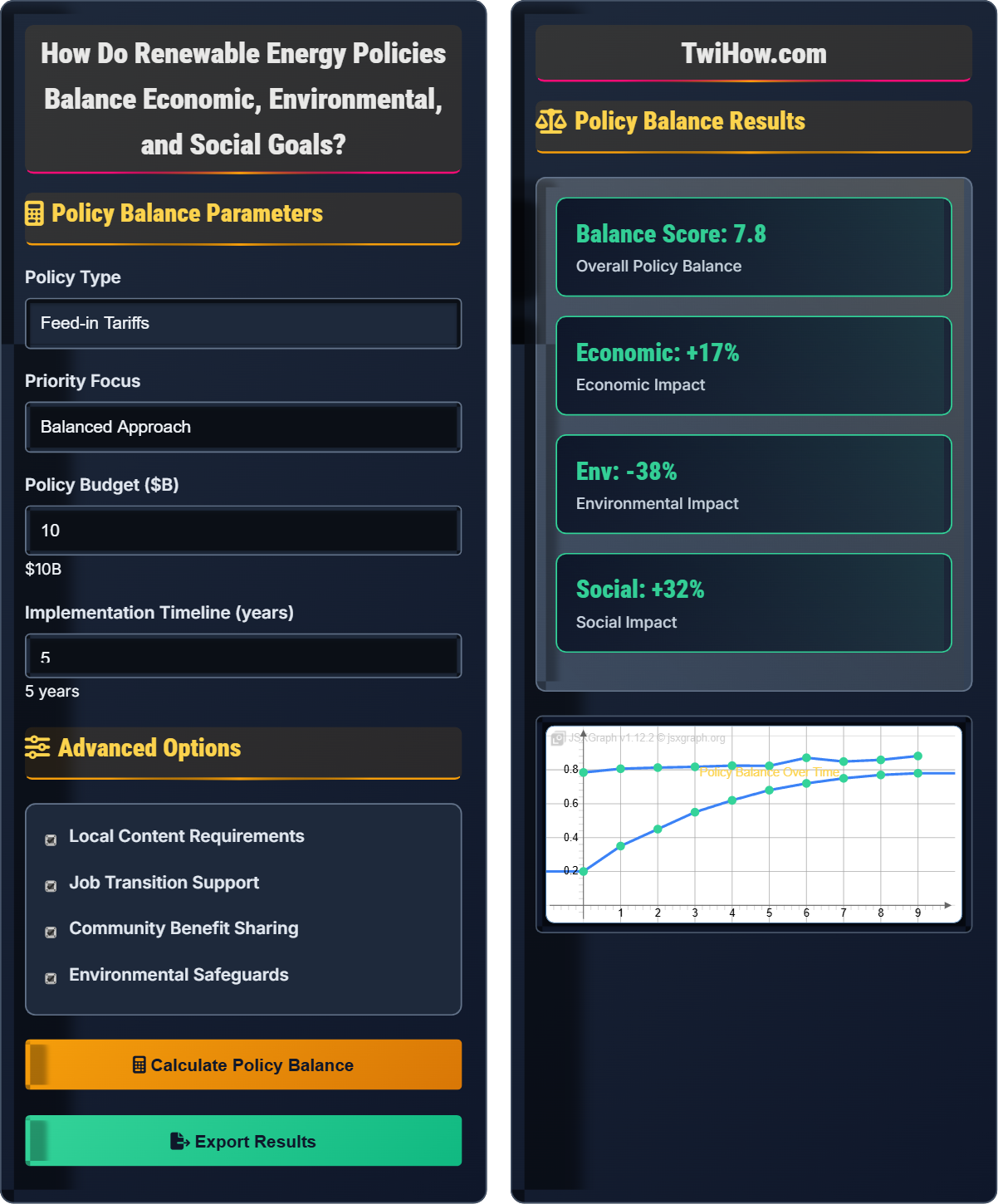
Policy Balance Parameters
Advanced Options
Policy Balance Results
| Policy Type | Economic | Environmental | Social | Balance |
|---|---|---|---|---|
| Feed-in Tariffs | +15% | -35% | +20% | 7.2 |
| Auctions | +18% | -42% | +12% | 6.8 |
| Tax Credits | +22% | -38% | +15% | 7.0 |
| Renewable Standards | +10% | -45% | +25% | 7.5 |
| Carbon Pricing | +8% | -50% | +18% | 6.5 |
Economic
Environmental
Social
Overall
Policy Balance Analysis
Renewable energy policies must balance three interconnected goals: economic competitiveness, environmental protection, and social equity. The challenge lies in maximizing benefits across all three dimensions while managing trade-offs and conflicts that inevitably arise.
Economic
CompetitivenessEnvironmental
ProtectionSocial
EquityJobs
Emissions
Access
Cost
Policy Type Analysis
Economic: Guaranteed prices attract investment but may increase costs
Environmental: Effective deployment acceleration
Social: Enables distributed generation and community ownership
Economic: Cost-effective but may exclude smaller players
Environmental: Efficient technology deployment
Social: May concentrate benefits in large companies
Economic: Market-friendly but complex administration
Environmental: Effective at scale
Social: May not benefit all income groups equally
Economic: Market certainty with compliance flexibility
Environmental: Predictable emission reductions
Social: Can include community benefit requirements
Balancing Strategies
Involve all affected parties in policy design to identify win-win solutions and address concerns early.
Design policies that simultaneously address multiple objectives rather than treating them separately.
Track policy impacts across all three dimensions and adjust as needed to maintain balance.
Build in safeguards to protect vulnerable groups and manage transition impacts.
Successful renewable energy policies integrate economic, environmental, and social considerations from the outset. This requires coordinated approaches that leverage synergies between objectives while managing trade-offs through careful design and implementation.
Policy Development Flow
Assessment
Needs AnalysisDesign
Policy DevelopmentImplementation
RolloutEvaluation
Impact AssessmentPolicy Trade-offs
Managing competing objectives
Stakeholder Considerations
Effective renewable energy policies must consider the interests of multiple stakeholders including utilities, investors, communities, workers, and environmental groups. Balancing these diverse interests requires transparent processes and equitable benefit-sharing mechanisms.
When implementing renewable energy policies in regions dependent on fossil fuel industries, policies must include worker retraining, economic diversification, and community transition support to ensure social acceptability and political sustainability.
Policies can be designed to ensure that renewable energy projects provide direct benefits to host communities through revenue sharing, local employment, and infrastructure development, enhancing social equity while maintaining economic viability.
Policy Balance Learning Quiz
What is the primary trade-off in renewable energy policy design?
The primary trade-off in renewable energy policy design is balancing economic competitiveness, environmental protection, and social equity goals. Policies that excel in one dimension may compromise others, requiring careful design to maximize synergies and minimize conflicts.
The answer is C) Economic, environmental, and social goals.
Policy design involves navigating complex, often competing objectives. The classic policy triangle of economic, environmental, and social goals creates inherent tensions that require sophisticated design approaches to resolve effectively.
Policy Trade-offs: Conflicts between competing objectives
Win-Win Solutions: Policies benefiting multiple objectives
Policy Synergies: Positive interactions between goals
• Consider all three policy dimensions
• Identify potential trade-offs early
• Seek synergistic solutions
• Use integrated assessment tools
• Engage all stakeholders
• Monitor multiple outcomes
• Focusing on single objectives
• Not considering stakeholder impacts
• Assuming all benefits are automatic
Explain why stakeholder engagement is crucial for balancing renewable energy policy goals.
Stakeholder Engagement Importance:
Diverse Interests: Different stakeholders have varying priorities (economic, environmental, social) that must be understood and addressed.
Local Knowledge: Communities possess valuable information about local conditions and potential impacts.
Social Acceptance: Public support is essential for policy implementation and long-term success.
Conflict Resolution: Early engagement helps identify and address potential conflicts before they escalate.
Implementation Feasibility: Stakeholder input improves policy design and implementation strategies.
Equity Considerations: Ensures that policy benefits and costs are distributed fairly.
Stakeholder engagement is fundamental to policy success because renewable energy policies affect multiple groups with different interests and concerns. Effective engagement processes help identify win-win solutions and build consensus around difficult trade-offs.
Stakeholder Engagement: Involving affected parties in policy design
Social License: Public acceptance of projects
Consensus Building: Achieving agreement among diverse groups
• Engage early in policy process
• Include all affected groups
• Address concerns transparently
• Use multiple engagement methods
• Provide accessible information
• Follow up on commitments
• Engaging too late in process
• Excluding marginalized groups
• Not following up on commitments
A state wants to implement a renewable energy policy that achieves 50% renewable electricity by 2030. The policy must create jobs, reduce emissions, and ensure equitable access across all communities. Design a policy approach that balances these goals while considering budget constraints of $5B over 10 years.
Integrated Policy Approach: 1) Competitive renewable energy auctions with local content requirements to create jobs, 2) Community solar programs to ensure equitable access, 3) Job transition support for fossil fuel workers, 4) Environmental impact assessments for all projects.
Implementation: Phase rollout over 10 years, targeting 5% annual renewable additions. Allocate 40% budget to job creation and training, 30% to community programs, 20% to environmental safeguards, 10% to administration.
Expected Outcomes: 50% renewable target met, 100,000 jobs created, equitable access ensured, environmental standards maintained.
This example demonstrates how multiple policy instruments can be combined to address different objectives simultaneously. The key is designing complementary mechanisms that reinforce rather than compete with each other.
Integrated Policy: Multiple instruments working together
Local Content: Requirements for local economic benefits
Community Solar: Shared renewable energy programs
• Align instruments with objectives
• Ensure policy coherence
• Monitor multiple outcomes
• Use performance indicators
• Build in flexibility
• Plan for transitions
• Using conflicting instruments
• Not planning for implementation
• Ignoring stakeholder concerns
A region with a large coal mining industry is transitioning to renewable energy. Design a policy package that supports economic transition while maintaining environmental benefits and ensuring social equity for affected workers and communities.
Transition Package: 1) Early retirement programs with pension protection, 2) Retraining programs for renewable energy jobs, 3) Economic diversification grants for communities, 4) Environmental remediation funding, 5) Renewable energy projects prioritizing local hiring.
Implementation: 10-year transition period with annual budget of $500M. Include worker representatives in planning. Provide relocation assistance if needed.
Expected Outcome: Orderly transition with minimal social disruption, continued environmental benefits, and new economic opportunities.
Just transition policies recognize that renewable energy transitions can create winners and losers. Comprehensive support packages help ensure that no one is left behind while maintaining momentum toward environmental goals.
Just Transition: Fair transition for affected workers
Retraining Programs: Skill development for new jobs
Economic Diversification: Alternative economic opportunities
• Include affected communities in planning
• Provide adequate support
• Maintain environmental goals
• Start planning early
• Provide multiple pathways
• Ensure adequate funding
• Not involving workers in planning
• Insufficient support duration
• Ignoring community needs
Which policy instrument best balances economic, environmental, and social goals?
Feed-in tariffs with local content requirements best balance all three goals. They provide economic incentives for investment, achieve environmental benefits through renewable deployment, and support social goals through local job creation and community ownership opportunities.
The answer is B) Feed-in tariffs with local content.
Different policy instruments have varying strengths across the economic, environmental, and social dimensions. Feed-in tariffs with local content requirements create synergies by combining renewable deployment incentives with economic development goals.
Policy Instruments: Tools for achieving policy goals
Local Content: Requirements for local economic benefits
Goal Synergies: Policies benefiting multiple objectives
• Match instruments to objectives
• Consider complementarity
• Evaluate trade-offs
• Use multiple instruments
• Design for local contexts
• Monitor outcomes
• Using single instruments for multiple goals
• Not considering local conditions
• Failing to evaluate effectiveness
FAQ
Q: How can policymakers measure the success of balanced renewable energy policies?
A: Policymakers should use multi-dimensional indicators including: 1) Economic metrics (cost-effectiveness, job creation, investment), 2) Environmental metrics (emission reductions, biodiversity impacts), 3) Social metrics (energy access, community benefits, equity indicators), and 4) Political metrics (stakeholder satisfaction, implementation success). Regular monitoring and adaptive management allow course corrections when imbalances emerge.
Q: How can communities ensure renewable energy policies benefit local residents?
A: Communities should: 1) Participate actively in policy development processes, 2) Advocate for local content requirements and community ownership models, 3) Demand benefit-sharing agreements, 4) Monitor policy implementation, 5) Build coalitions with other communities, and 6) Hold elected officials accountable. Strong community organization is essential to ensure policies deliver promised benefits.