How Do Renewable Energy Systems Address Cybersecurity and Grid Resilience?
Complete guide • Step-by-step explanations
Cybersecurity & Grid Resilience:
Show Security SimulatorRenewable energy systems introduce both cybersecurity vulnerabilities and resilience opportunities to the electrical grid. As distributed energy resources become more prevalent, understanding their security implications and resilience benefits is crucial for maintaining reliable power systems.
Key security considerations:
- Distributed Nature: Multiple entry points for cyber attacks
- Smart Controls: Connected devices vulnerable to hacking
- Grid Stability: Intermittent sources require advanced management
- Communication Networks: Critical for coordination and control
Strategic deployment of renewable systems can enhance grid resilience through distributed generation, redundancy, and self-healing capabilities.
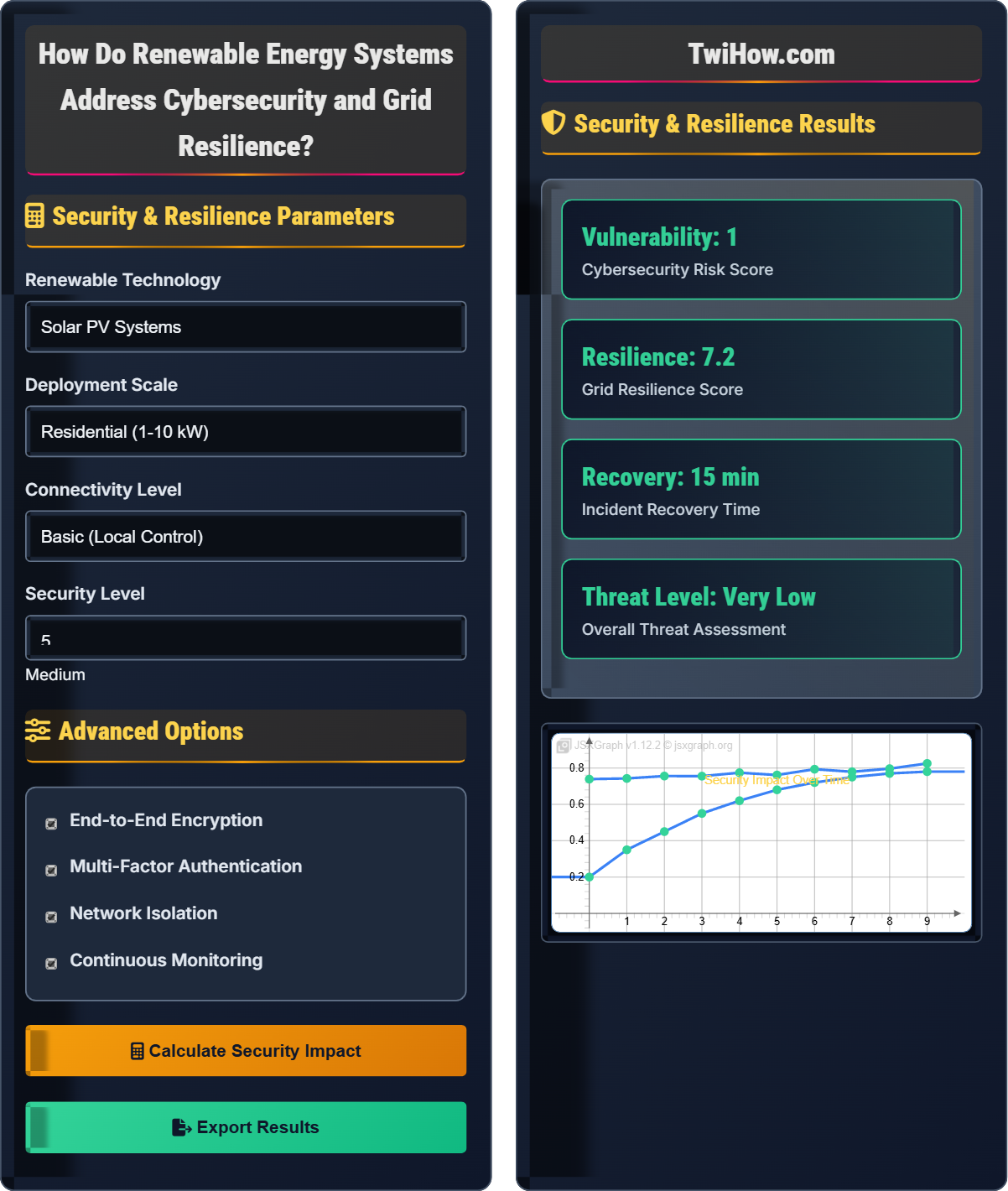
Security & Resilience Parameters
Advanced Options
Security & Resilience Results
| Technology | Vulnerability | Resilience | Security Score |
|---|---|---|---|
| Solar PV | Medium | High | 7.2 |
| Wind | Low | Medium | 6.8 |
| Battery Storage | High | High | 6.5 |
| Microgrids | Medium | Very High | 8.2 |
| Smart Grid | High | Medium | 5.8 |
Solar PV
Wind
Storage
Microgrid
Cybersecurity & Grid Resilience Analysis
Renewable energy systems introduce new cybersecurity risks due to their connectivity and distributed nature. Smart inverters, communication networks, and automated control systems create potential attack vectors. However, they also offer opportunities for enhanced grid resilience through distributed generation and self-healing capabilities.
Traditional Grid
Centralized ControlSmart Grid
Connected DevicesSecure Grid
Enhanced SecurityDistribution
Redundancy
Isolation
Recovery
Technology Security Analysis
Vulnerability: Medium (connected inverters)
Resilience Benefit: High (distributed generation)
Security Measures: Secure inverter firmware, encrypted communications
Vulnerability: High (critical control systems)
Resilience Benefit: High (grid stabilization)
Security Measures: Encrypted BMS, secure communication protocols
Vulnerability: Medium (multiple systems)
Resilience Benefit: Very High (island capability)
Security Measures: Segmented networks, redundant controls
Vulnerability: High (extensive connectivity)
Resilience Benefit: Medium (advanced controls)
Security Measures: Comprehensive cybersecurity protocols
Defense Strategies
Isolate critical energy systems from general IT networks to prevent lateral movement of threats.
Implement end-to-end encryption for all communications between renewable energy systems and control centers.
Require multiple verification factors for access to critical energy management systems.
Deploy real-time security monitoring to detect and respond to threats immediately.
Effective incident response for renewable energy systems requires coordinated efforts between cybersecurity teams, grid operators, and equipment manufacturers. Response protocols should include immediate isolation of compromised systems, backup power activation, and rapid restoration procedures to maintain grid stability during cyber incidents.
Cyber Threat Model
Reconnaissance
System DiscoveryExploitation
Access GainExecution
Attack LaunchResponse
CountermeasuresOverall Vulnerability
Multiple entry points and distributed nature
Grid Architecture Considerations
Distributed renewable energy systems create multiple potential entry points for cyber attacks, but also provide resilience benefits. Unlike centralized systems where a single compromise can affect the entire grid, distributed systems can continue operating even when some components are compromised. This architectural advantage must be balanced with the increased complexity of securing numerous endpoints.
A coordinated attack on solar inverters could cause grid instability by suddenly disconnecting large amounts of distributed generation. Defense requires real-time monitoring, automatic islanding capabilities, and rapid response protocols to maintain grid stability.
Compromised battery storage controllers could drain systems during peak demand or inject harmful power fluctuations. Security requires encrypted communications, authentication protocols, and independent safety systems.
Cybersecurity & Grid Resilience Learning Quiz
How does the distributed nature of renewable energy systems affect cybersecurity?
The distributed nature of renewable energy systems creates both challenges and benefits. On one hand, it increases the number of potential entry points for cyber attacks. On the other hand, it provides resilience benefits because the failure or compromise of individual systems doesn't necessarily affect the entire grid, unlike centralized systems.
The answer is C) Creates both security challenges and resilience benefits.
This illustrates the complex relationship between system architecture and security. Distributed systems inherently have more potential vulnerabilities due to their multiple connection points, but they also offer fault tolerance and resilience that centralized systems cannot match.
Distributed Systems: Energy generation spread across multiple locations
Attack Surface: Total number of potential entry points for attackers
Resilience: Ability to maintain function during disruptions
• More endpoints = more potential vulnerabilities
• Distributed systems offer fault tolerance
• Security must balance accessibility and protection
• Implement standardized security protocols
• Use network segmentation to isolate systems
• Maintain consistent security updates
• Assuming distributed equals secure
• Not standardizing security across systems
• Overlooking endpoint security
Explain the security implications of smart grid technologies in renewable energy systems and how they can be addressed.
Smart Grid Security Implications:
Increased Connectivity: Smart inverters, meters, and controllers create numerous communication paths that can be exploited.
Data Privacy: Granular energy usage data can reveal sensitive information about user behavior.
Remote Control: Automated systems can be manipulated to disrupt grid operations.
Protocol Vulnerabilities: Communication protocols may have inherent security weaknesses.
Security Solutions: End-to-end encryption, multi-factor authentication, network segmentation, and continuous monitoring can address these vulnerabilities while maintaining system functionality.
Smart grid technologies exemplify the tension between functionality and security. While these systems provide valuable grid management capabilities, they also expand the attack surface and create new vulnerability categories that must be carefully managed.
Smart Grid: Modern electrical grid with digital communication
IoT Devices: Internet-connected energy management systems
SCADA: Supervisory control and data acquisition systems
• Security must be built into design
• Regular security updates are essential
• Defense in depth approach required
• Implement zero-trust security model
• Use encrypted communication protocols
• Deploy intrusion detection systems
• Prioritizing functionality over security
• Not updating security regularly
• Assuming default settings are secure
A utility operates 50,000 smart solar inverters across its service territory. A coordinated cyber attack causes 20% of the inverters to simultaneously disconnect from the grid. Calculate the potential grid stability impact and propose security measures to prevent such an attack.
Impact Analysis: If 20% of 50,000 inverters (10,000 units) disconnect simultaneously, and each averages 5kW capacity, this represents 50MW of sudden generation loss. Such rapid disconnection could cause frequency instability and voltage fluctuations.
Prevention Measures: 1) Implement rate-of-change limits on inverter disconnections, 2) Deploy distributed intelligence to coordinate responses, 3) Use encrypted, authenticated communications, 4) Implement network segmentation, 5) Deploy real-time anomaly detection systems.
Recovery Protocol: Automated restart sequences with grid stability checks to prevent cascading failures.
This scenario demonstrates how cyber attacks on distributed energy resources can have grid-scale impacts. The coordinated nature of such attacks amplifies their potential damage, requiring both preventive and responsive security measures.
Frequency Stability: Grid's ability to maintain target frequency
Rate-of-Change Limits: Restrictions on how quickly systems can change
Cascading Failure: Sequential system failures
• Prevent coordinated simultaneous actions
• Implement response rate limiting
• Maintain grid stability during disruptions
• Randomize response timing
• Implement geographic diversity
• Deploy redundant control systems
• Not considering aggregate impacts
• Lacking coordinated response plans
• Insufficient anomaly detection
A microgrid serves a critical facility (hospital) with 2MW solar, 1MW battery storage, and diesel backup. Design a cybersecurity framework that maintains grid resilience while protecting against cyber attacks.
Security Framework: 1) Air-gapped critical control systems, 2) Encrypted communication between components, 3) Independent security monitoring, 4) Manual override capabilities.
Resilience Features: 1) Multiple isolation points, 2) Redundant control paths, 3) Automated failover procedures, 4) Physical security measures.
Response Protocol: Upon detection of cyber threat: isolate compromised systems, switch to manual control, activate backup power, and restore from secure configurations.
Expected outcome: Maintains critical power while preventing attack propagation.
This example shows how critical infrastructure requires enhanced security measures that don't compromise the resilience benefits of renewable systems. The design must balance connectivity needs with security requirements.
Air-Gapped: Isolated from external networks
Failover: Automatic system switching
Manual Override: Human control capability
• Critical systems need enhanced security
• Maintain manual control capabilities
• Implement layered security approach
• Use hardware security modules
• Implement security by design
• Regular penetration testing
• Not planning for manual operation
• Insufficient physical security
• Lacking incident response plans
Which communication protocol is most secure for renewable energy system control?
Encrypted HTTPS with certificates provides authentication, integrity, and confidentiality for communications. This protocol verifies the identity of communicating parties and encrypts data in transit, making it the most secure option for renewable energy system control.
The answer is B) Encrypted HTTPS with certificates.
Secure communication protocols are fundamental to renewable energy cybersecurity. They protect against eavesdropping, tampering, and impersonation attacks that could compromise system control and grid stability.
HTTPS: HTTP with SSL/TLS encryption
Certificates: Digital credentials for authentication
Encryption: Data protection through coding
• Always encrypt critical communications
• Authenticate communicating parties
• Verify data integrity
• Use mutual authentication
• Implement certificate rotation
• Monitor for certificate expiration
• Using unencrypted communications
• Not verifying certificates
• Weak authentication methods
FAQ
Q: How can renewable energy systems maintain security while enabling smart grid functionality?
A: Security and smart functionality can coexist through: 1) Zero-trust network architectures that verify every connection, 2) End-to-end encryption for all communications, 3) Segmented networks that isolate critical functions, 4) Regular security updates and patches, 5) Intrusion detection systems, and 6) Secure-by-design protocols that prioritize security during development. The key is implementing security as a foundational element rather than an afterthought.
Q: What are the most effective strategies for defending against coordinated cyber attacks on distributed renewable systems?
A: Effective defense strategies include: 1) Network segmentation to limit attack spread, 2) Decentralized control systems that don't rely on single points of failure, 3) Rate limiting on commands to prevent coordinated simultaneous actions, 4) Real-time anomaly detection using AI/ML, 5) Geographic diversity in system deployments, 6) Independent backup control systems, and 7) Rapid isolation capabilities. Coordination with cybersecurity agencies and sharing threat intelligence also strengthens collective defense.