How Renewable Energy Systems Address Grid Modernization & Smart Grid Needs
Complete energy guide • Step-by-step explanations
Grid Modernization with Renewables:
Show Grid Integration SimulatorRenewable energy systems play a crucial role in modernizing electrical grids and enabling smart grid capabilities. Traditional grids were designed for centralized, predictable power generation, but renewable sources like solar and wind require sophisticated control systems, energy storage, and bidirectional power flows.
Smart grid technologies enhance grid reliability, efficiency, and sustainability by integrating renewable energy sources with advanced monitoring, control, and communication systems. This integration addresses challenges such as intermittency, voltage regulation, and frequency stability.
Key integration approaches:
- Energy Storage: Batteries and other storage systems smooth out renewable variability
- Smart Controls: Advanced inverters and grid management systems
- Demand Response: Adjusting consumption to match renewable availability
- Grid Flexibility: Enabling bidirectional power flows and distributed generation
Successful renewable integration requires comprehensive grid modernization that combines digital technologies with physical infrastructure upgrades to create resilient, efficient, and sustainable power systems.
Grid Integration Parameters
Advanced Options
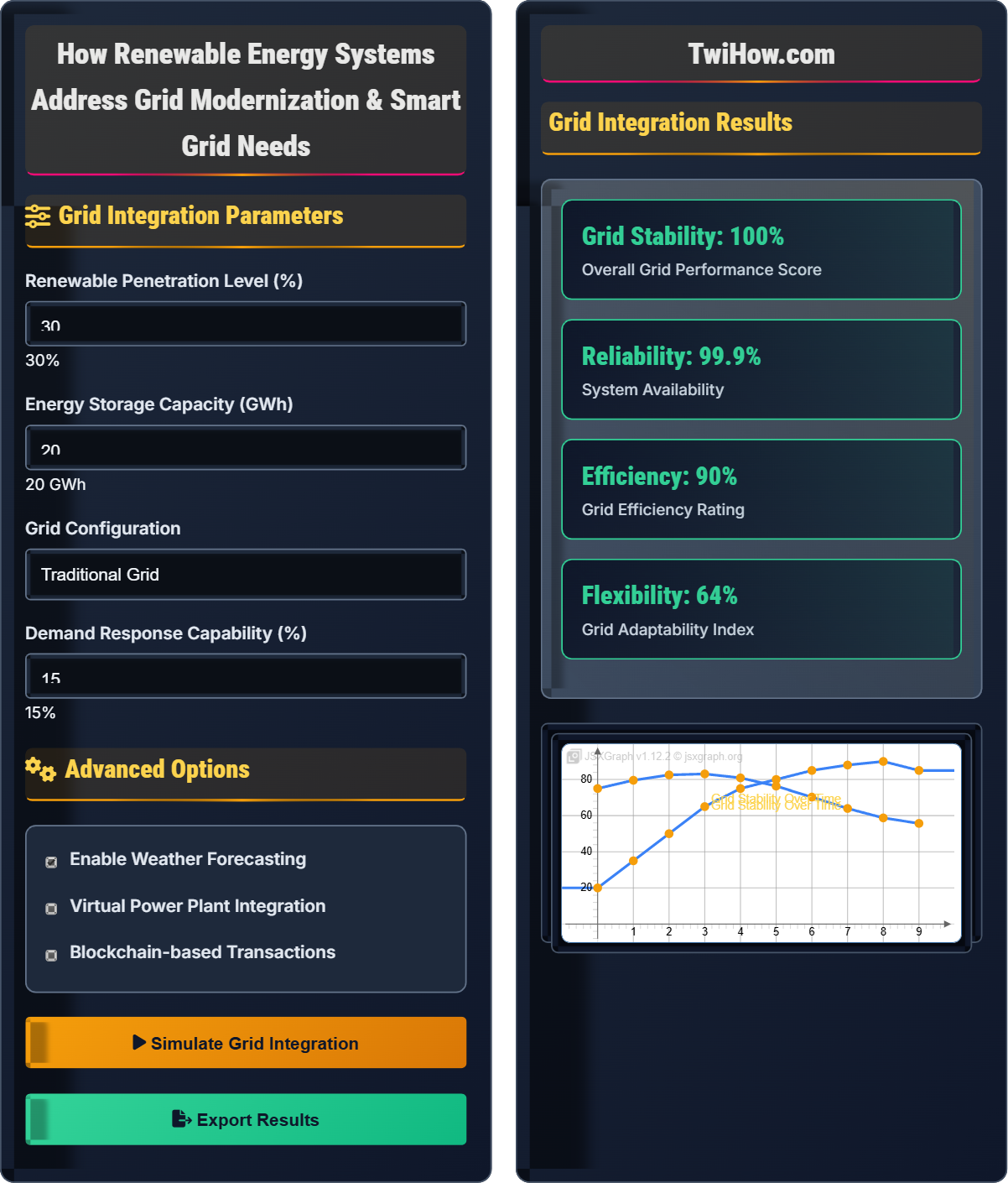
Grid Integration Results
| Component | Status | Capacity | Utilization |
|---|---|---|---|
| Solar PV | Active | 500 MW | 75% |
| Wind Turbines | Active | 300 MW | 65% |
| Battery Storage | Active | 200 MW | 45% |
| Smart Meters | Active | 100k | 90% |
Renewable Energy Grid Integration Explained
Traditional electrical grids were designed for one-way power flow from centralized generators to consumers. Renewable energy systems introduce bidirectional flows, variable generation, and distributed resources that require modernized grid infrastructure. Smart grid technologies enable real-time monitoring, control, and optimization of power systems with high renewable penetration.
Grid stability with renewable integration depends on balancing supply and demand:
Where:
- Supply Flexibility: Ability to adjust generation rapidly
- Demand Response: Consumer participation in grid balancing
- Renewable Variability: Fluctuations in renewable output
- Grid Resilience: Robustness against disturbances
Key technologies enabling renewable integration:
- Advanced Metering Infrastructure: Smart meters for real-time monitoring
- Distribution Management Systems: Centralized grid control platforms
- Energy Storage Systems: Batteries for grid stabilization
- Demand Response Programs: Consumer participation in grid balancing
- Microgrids: Localized grid sections with autonomy
- Virtual Power Plants: Aggregated distributed resources
- Enhanced Reliability: Faster fault detection and recovery
- Improved Efficiency: Reduced transmission losses
- Increased Flexibility: Better accommodation of variable resources
- Consumer Empowerment: Greater control over energy usage
- Cost Reduction: Optimized resource utilization
- Environmental Benefits: Higher renewable penetration
Grid Integration Fundamentals
Grid stability, renewable variability, smart controls, energy storage, demand response, grid flexibility.
Grid Stability = (Generation Flexibility + Storage Capacity + Demand Response) / (Renewable Variability × Grid Constraints)
Where Stability = system balance, Flexibility = adaptation capability, Variability = renewable fluctuations.
- Supply and demand must be balanced in real-time
- Grid stability requires adequate reserves
- Smart controls enable renewable integration
Applications
Utility-scale solar farms, wind installations, residential solar, battery storage, smart cities, microgrids.
- Grid infrastructure upgrades
- Advanced control systems
- Energy storage deployment
- Demand response programs
- Grid resilience requirements
- Regulatory frameworks
- Consumer participation
- Technology interoperability
Grid Modernization Quiz
What is the primary challenge associated with integrating high levels of renewable energy into the electrical grid?
The primary challenge with renewable energy integration is the intermittent and variable nature of sources like solar and wind. Unlike conventional power plants that can provide consistent output, renewable generation fluctuates based on weather conditions, making grid balancing more complex.
The answer is B) Intermittency and variability of renewable sources.
Traditional power grids were designed around predictable, controllable generation sources. Renewable energy introduces uncertainty into the grid equation, as solar output depends on cloud cover and wind generation depends on wind speeds. This variability requires new approaches to grid management, including advanced forecasting, energy storage, and flexible backup generation.
Intermittency: Unpredictable variations in power generation
Grid Balancing: Matching electricity supply with demand in real-time
Flexible Generation: Power sources that can quickly adjust output
• Supply must equal demand at all times
• Frequency and voltage must remain stable
• Adequate reserves are essential for reliability
• Think of the grid as a constantly balanced scale
• Renewable variability requires compensation strategies
• Geographic diversity helps smooth out fluctuations
• Assuming renewables provide constant power
• Ignoring the need for backup generation
• Underestimating forecasting importance
Explain how smart grid technologies address the challenges of renewable energy integration and describe three key components that enable this integration.
Smart Grid Solutions: Smart grid technologies use advanced sensing, communication, and control systems to manage the variability and bidirectional flows associated with renewable energy integration.
Three Key Components:
1. Advanced Metering Infrastructure (AMI): Smart meters provide real-time consumption data, enabling demand response and accurate load forecasting.
2. Energy Storage Systems: Batteries and other storage technologies store excess renewable energy and release it when needed, smoothing out variability.
3. Automated Distribution Management Systems: These systems optimize power flows, detect faults, and manage distributed generation in real-time.
Together, these technologies create a responsive, flexible grid that can accommodate high levels of renewable energy while maintaining reliability.
Smart grid technologies transform the passive, one-way traditional grid into an active, two-way communication network. This transformation is essential for renewable integration because it allows the grid to respond dynamically to changes in generation and demand, rather than relying on fixed generation patterns.
Smart Grid: Digitally enabled electrical grid with real-time monitoring
Advanced Metering: Intelligent metering with communication capabilities
Distribution Management: Software systems for grid operations
• Real-time data enables proactive management
• Communication systems are critical for coordination
• Automation reduces response time
• Smart grids act like a nervous system for the power grid
• Think of it as upgrading from analog to digital
• Integration requires both hardware and software
• Confusing smart grid with just smart meters
• Ignoring cybersecurity requirements
• Underestimating integration complexity
A utility plans to increase renewable penetration from 20% to 50% of total generation. Currently, the grid has 10 GW of conventional generation with 2 GW of flexible backup capacity. To maintain grid stability with 50% renewable penetration, calculate how much additional flexible capacity is needed, assuming renewable variability requires 30% of renewable capacity as backup. Also, determine how much energy storage would be beneficial if 10% of peak renewable output should be stored for 4 hours.
Current Situation: 10 GW total generation, 2 GW flexible backup
Future Renewable Capacity: 50% of 10 GW = 5 GW renewable
Required Backup for Renewables: 30% of 5 GW = 1.5 GW
Current Flexible Capacity: 2 GW
Additional Flexible Needed: 1.5 GW (required) - 2 GW (available) = 0 GW (adequate with current capacity)
Energy Storage Calculation: 10% of 5 GW = 0.5 GW for 4 hours
Storage Requirement: 0.5 GW × 4 hours = 2 GWh of storage
The utility has adequate flexible capacity but should add 2 GWh of energy storage to optimize renewable integration.
This problem demonstrates the planning required for renewable integration. As renewable penetration increases, utilities must carefully balance generation flexibility with storage capabilities. The calculation shows that while backup capacity is important, energy storage provides additional benefits by shifting energy in time rather than just providing instantaneous power.
Grid Flexibility: Ability to respond to supply/demand changes
Peak Shaving: Reducing peak demand through storage
Spinning Reserve: Available generation ready to serve load
• Backup requirements depend on renewable variability
• Storage provides time-shifting capability
• Planning must consider multiple scenarios
• Use percentage factors for quick calculations
• Consider both power and energy requirements
• Account for seasonal variations
• Ignoring geographic diversity effects
• Not accounting for forecast accuracy
A university campus operates as a microgrid with 5 MW of rooftop solar, 2 MW of battery storage, and 10 MW of peak load. The campus connects to the main grid but wants to achieve 80% energy independence. Calculate the minimum battery capacity needed to store excess solar generation and provide backup during low solar periods. Assume average daily solar generation is 30 MWh and peak load occurs for 4 hours daily.
Target Energy Independence: 80% of campus needs
Daily Campus Consumption: 10 MW × 24 hours = 240 MWh
Target Self-Supply: 80% of 240 MWh = 192 MWh
Required Daily Solar Output: At least 192 MWh
Current Solar Generation: 30 MWh/day
Deficit: 192 - 30 = 162 MWh/day from storage
Minimum Storage Needed: To handle peak load for 4 hours: 10 MW × 4 hours = 40 MWh
For 80% independence, the campus would need significantly more solar capacity (at least 6.4 MW) and expanded storage (at least 40 MWh) to store excess generation and provide backup during low production periods.
Microgrids demonstrate how renewable energy systems can operate independently while still connecting to the main grid. The calculation shows that achieving high levels of energy independence requires careful balance between generation capacity, storage capability, and load profiles. Energy storage is crucial for microgrid operations, providing backup during outages and enabling self-sufficiency.
Microgrid: Local grid that can operate independently
Energy Independence: Self-sufficiency in energy needs
Peak Load: Maximum power demand at any time
• Microgrids require balance between generation and storage
• Peak demand drives storage requirements
• Grid connection provides backup capability
• Consider load profiles when sizing storage
• Factor in seasonal variations
• Plan for worst-case scenarios
• Ignoring peak demand constraints
• Not accounting for cloudy days
Which of the following best describes the role of demand response in renewable energy integration?
Demand response involves adjusting electricity consumption patterns to better align with renewable energy availability. Instead of only managing supply to match demand, demand response allows consumers to shift their usage to times when renewable generation is high, improving grid balance and renewable utilization.
The answer is B) Adjusting electricity consumption to match renewable availability.
Demand response represents a paradigm shift from traditional grid management. Rather than having completely inflexible demand that must be met by generation, demand response programs allow certain loads to be shifted in time. This flexibility is particularly valuable with renewable energy, which cannot be turned on and off at will like conventional generators.
Demand Response: Adjusting consumption based on grid conditions
Load Shifting: Moving electricity usage to different times
Peak Shaving: Reducing demand during high-load periods
• Demand response provides grid flexibility
• Consumers receive incentives for participation
• Timing is crucial for effectiveness
• Think of demand response as making demand flexible
• It complements renewable generation
• Many loads can be shifted without inconvenience
• Thinking it reduces total energy use
• Ignoring consumer participation requirements
FAQ
Q: How do advanced inverters contribute to grid stability with renewable energy?
A: Advanced inverters play a crucial role in grid stability by providing grid support functions that were traditionally provided by synchronous generators:
1. Voltage Regulation: Advanced inverters can inject or absorb reactive power to maintain voltage levels
2. Frequency Control: They can adjust power output to help stabilize grid frequency
3. Ride-Through Capabilities: They continue operating during minor grid disturbances
4. Synthetic Inertia: They can provide virtual inertia to help stabilize the grid
5. Fast Response: They can respond to grid events within milliseconds
These capabilities make renewable energy sources behave more like traditional generators, enhancing grid stability while maintaining the environmental benefits of renewable energy.
Q: What regulatory changes are needed to support renewable grid integration?
A: Effective renewable grid integration requires several regulatory adaptations:
Market Design: Capacity markets that value flexibility and ancillary services, time-of-use pricing to reflect renewable availability
Interconnection Standards: Streamlined processes for connecting distributed renewable resources
Grid Codes: Technical requirements for renewable generators to provide grid support services
Ownership Models: Allowing third parties to own grid assets like storage and demand response
Planning Processes: Integrated resource planning that considers renewable variability
Cybersecurity: Standards for protecting smart grid communications
These regulatory changes enable the technical innovations needed for high renewable penetration while maintaining reliability and economic efficiency.